

How to conduct an HR compliance health check
TL;DR:
- An HR compliance health check is a proactive audit that verifies adherence to Australian employment laws, including the Fair Work Act. Conducting this review allows organizations to demonstrate good-faith compliance and reduces penalty risks. Regular audits and clear remediation plans are essential for ongoing legal adherence and workplace efficiency.
An HR compliance health check is a proactive, employer-initiated audit of your HR practices to verify adherence to Australian employment laws, including the Fair Work Act and workplace safety regulations. Conducting this review gives you control over scope and timing, which demonstrates good-faith compliance to regulators and can reduce penalty severity if issues are later discovered. The standard industry term for this process is an HR compliance audit. Both terms describe the same structured review, and using either signals to regulators that your business takes its obligations seriously.
What do you need before starting an HR compliance health check?
Preparation determines whether your audit produces real findings or just paperwork. Before you begin, gather the documents and assign the people who will carry the work.
Key documents to collect:
- Payroll records and pay slip samples covering at least the past 12 months
- Employee contracts, signed acknowledgements, and job descriptions
- Safety training logs and induction records
- Policy documents and your employee handbook
- Termination records and any overtime dispute files
- Leave records, including annual leave, personal leave, and long service leave
Stakeholders to involve:
- HR lead (audit owner and primary reviewer)
- Payroll manager (for wage and classification checks)
- Legal counsel or an external HR adviser (for interpretation of grey areas)
- A senior leader or business owner (for sign-off authority and resource allocation)
Once your documents are assembled, define your sample size. Audit samples commonly cover 10%–20% of your active workforce, with all high-risk groups included regardless of random selection. High-risk groups include recently terminated employees and anyone involved in overtime disputes. That inclusion rule matters because disputes cluster around exactly the records most likely to contain errors.
| Preparation element | What to do |
|---|---|
| Document collection | Gather payroll, contracts, training logs, and policy files |
| Scope definition | Set boundaries: which departments, roles, and time periods |
| Sample selection | 10%–20% random sample plus all high-risk employees |
| Audit ownership | Assign one named person accountable for completion |
| System access | Export data from your HRIS or compliance management platform |

Pro Tip: Create a single shared folder before day one. Centralising documents in one place cuts retrieval time significantly and prevents version confusion during the review.
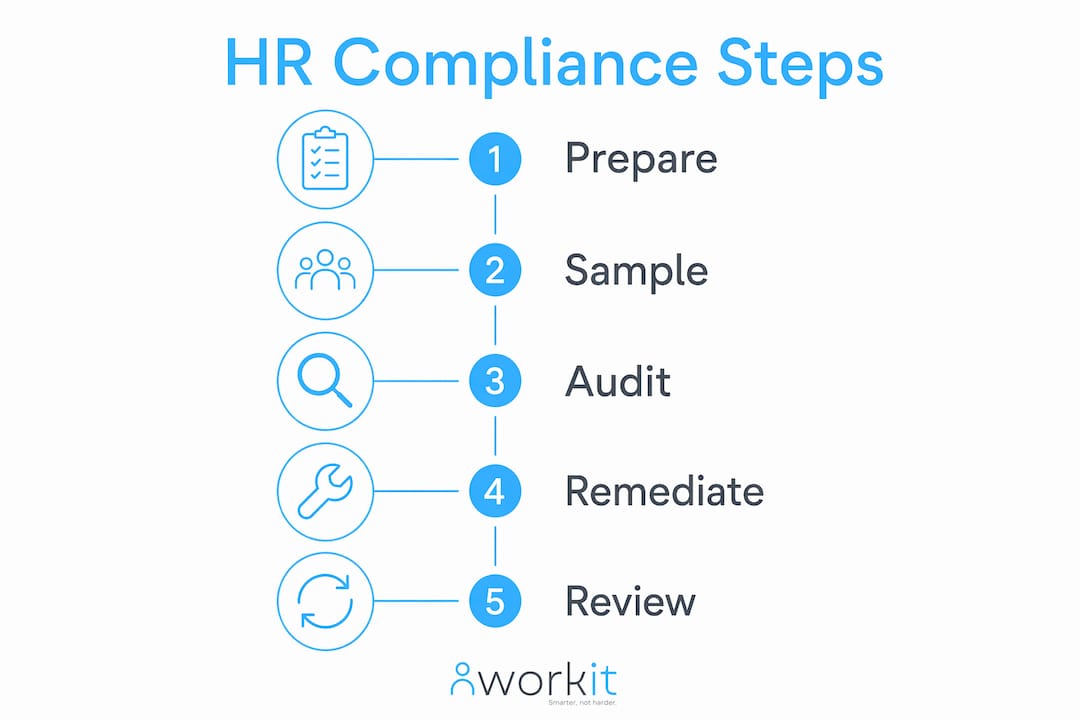
How do you conduct an effective HR compliance audit step by step?
A structured process produces findings you can act on. Follow these six steps to run a workplace compliance assessment that holds up under scrutiny.
-
Define your audit scope. Align the scope with Australian statutory requirements under the Fair Work Act, the National Employment Standards, and any applicable modern award. Decide which HR functions you are reviewing: hiring, onboarding, payroll, safety, or all of the above. A narrow, well-defined scope produces better results than a broad, shallow one.
-
Collect and organise your documentation. Pull records according to your predefined scope and sample. Use your HRIS export as the primary data source. Cross-reference digital records against physical files where both exist. An HRIS built for Fair Work compliance makes this step significantly faster by centralising records in one place.
-
Review files against a standardised checklist. Work through each employee file and process using a consistent checklist. Flag every gap between your written policies and your actual documented practices. Do not rely on paperwork alone. Effective audits assess actual workplace practices, not just whether a policy document exists on a server.
-
Classify findings into three risk tiers. Sort every finding into one of three categories: immediate legal exposure, operational risk, or best practice gap. This three-tier classification is the standard framework for prioritising remediation. Immediate legal exposures include missing mandatory documents, classification errors, and underpayment evidence. Operational risks are inconsistent processes that create future exposure. Best practice gaps are improvements that go beyond minimum legal requirements.
-
Build a 30/60/90-day remediation plan. Assign each finding an owner, a deadline, and a resolution action. A full HR audit for a mid-size company typically takes 4–12 weeks, with quick wins achievable within seven days. Use the 30-day window for legal exposures, the 60-day window for operational risks, and the 90-day window for best practice improvements.
-
Establish ongoing monitoring. A one-time audit is a starting point, not a finish line. Transition to quarterly compliance dashboards and assign regional or departmental audit owners. Ongoing compliance monitoring with regular reviews is best practice for sustained legal adherence.
Pro Tip: Schedule your next audit date on the day you finish the current one. Organisations that treat compliance as a calendar event rather than a crisis response catch issues before they become penalties.
What mistakes should you avoid during an HR compliance health check?
The most common audit failures come from scope creep, surface-level reviews, and poor timing. Knowing these pitfalls in advance lets you avoid them.
-
Auditing everything at once. Attempting to audit all HR processes simultaneously leads to burnout and shallow findings. Start with documentation and classification, which carry the highest legal risk and are technically the easiest areas to remediate. Expand scope progressively across subsequent audits.
-
Reviewing policies without observing practices. A signed policy document does not prove the policy is followed. Wherever possible, include brief observations of onboarding sessions, safety briefings, or payroll approval workflows. The gap between written policy and daily practice is where most compliance failures live.
-
Delaying audits during busy periods. Delaying audits beyond 12 months increases the risk of undetected compliance issues and forces more intensive remediation later. Hiring sprints and operational surges are the most common reasons businesses postpone reviews. They are also the periods when new compliance errors are most likely to occur.
-
Skipping evidence mapping. Linking documentation to compliance requirements through evidence mapping is a non-negotiable step. Missing links between a policy and its supporting evidence, such as a signed acknowledgement or a dated training log, often result in failed audit scores and penalties during enforcement reviews.
-
Underestimating time requirements. First-time audits for businesses with 15–30 employees typically require 8–16 hours over one to two weeks. That figure covers documentation review only. Factor in stakeholder interviews, remediation planning, and report writing when setting your timeline.
Pro Tip: Block audit time in your calendar the same way you block payroll runs. Treating it as a fixed operational task rather than an optional project prevents indefinite postponement.
How do you prioritise and remediate audit findings?
Not every finding carries the same weight. A risk ranking framework helps you direct resources to the issues that matter most.
Rank findings by three factors: the size of the potential penalty, the likelihood of enforcement action, and the operational disruption caused by the gap. Immediate legal exposures sit at the top of every remediation list. These include missing mandatory employee documents, worker classification errors, and any evidence of underpayment against a modern award. Prioritising classification errors and missing documents prevents costly penalties and back-pay obligations that can accumulate quickly.
Operational risks come next. These are inconsistent processes, such as managers applying leave approval rules differently across teams, that create future legal exposure even if no breach has occurred yet. Fix these within your 60-day window by updating workflows and retraining the relevant staff.
Best practice gaps sit at the base of the priority stack. Examples include updating job description templates to reflect current role requirements or adding a formal exit interview process. These improvements lift HR quality beyond the compliance floor and reduce turnover risk, but they do not require urgent action.
Document every remediation step thoroughly. Evidence mapping that links your corrective actions to the original compliance requirement creates a clear record of good-faith effort. Regulators consider documented remediation when assessing penalty severity. Retain all audit records, including checklists, finding reports, and remediation logs, for a minimum of seven years to cover standard limitation periods under Australian law.
After remediation, schedule a follow-up review of the highest-risk areas within 90 days. Use that review to confirm fixes are embedded in daily practice, not just recorded on paper.
Key takeaways
A structured HR compliance audit, run at least annually and followed by a documented 30/60/90-day remediation plan, is the most reliable way to reduce legal exposure and demonstrate good-faith compliance to Australian regulators.
| Point | Details |
|---|---|
| Prepare before you start | Collect payroll records, contracts, training logs, and policy documents before beginning any review. |
| Use a 10%–20% sample | Include all high-risk employees regardless of random selection to avoid missing the records most likely to contain errors. |
| Classify findings into three tiers | Sort every finding into immediate legal exposure, operational risk, or best practice gap to guide remediation order. |
| Map evidence to requirements | Link every policy to signed acknowledgements and dated training logs so your compliance record holds up under enforcement scrutiny. |
| Audit on a fixed schedule | Annual reviews at minimum, with quarterly dashboard monitoring, prevent issues from compounding between formal audits. |
Why I think most businesses audit too late and too broadly
After working with Australian SMEs on compliance for years, the pattern I see most often is the same: a business waits until something goes wrong, then tries to fix everything at once. Both decisions make the problem worse.
Waiting until a Fair Work complaint or a WorkSafe visit lands on your desk removes the one advantage a self-audit gives you: control. Self-audits allow you to demonstrate proactive compliance management, which regulators weigh favourably when deciding on penalties. That advantage disappears the moment an external investigation begins.
The “audit everything” instinct is equally counterproductive. I have watched HR teams spend three weeks reviewing low-risk processes while classification errors and missing mandatory documents sat untouched. The three-tier risk framework exists precisely to prevent this. Start with what can cost you money or trigger enforcement. Everything else follows.
The businesses I have seen handle compliance best share one habit: they treat the audit as a recurring operational task, not a one-off project. They assign a named owner, set a fixed date, and review findings against the previous year’s remediation log. That continuity is what separates a compliance culture from a compliance exercise.
If you are building your first HR health review, keep the scope tight. Fifteen to thirty employees, documentation and classification only, eight to sixteen hours. Get one clean audit done, then expand. A narrow audit completed is worth more than a broad audit abandoned.
— Stephen
Workit makes compliance tracking easier for Australian teams
Running a thorough HR compliance audit requires accurate, centralised records. Workit is built specifically for Australian businesses and puts payroll data, employee documents, onboarding records, and compliance checklists in one place, so you are not hunting across spreadsheets when audit time arrives.
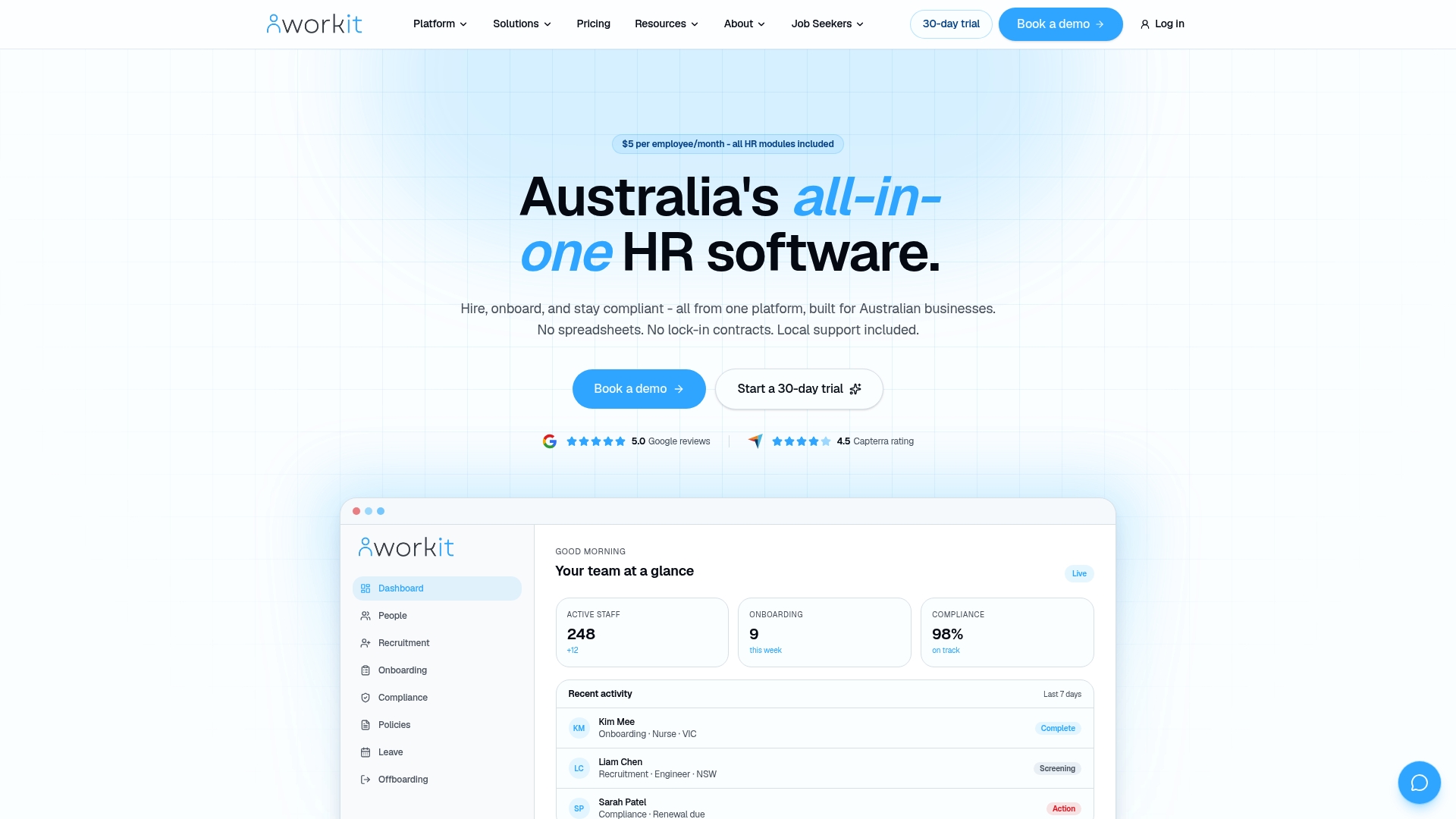
Workit’s HR compliance software includes automated reminders, real-time compliance dashboards, and document tracking that supports both point-in-time audits and ongoing monitoring. At $5 per employee per month with all modules included, it gives small and medium-sized businesses the same compliance visibility that larger organisations rely on. Book a demo or explore the full HRIS platform to see how Workit supports audit-readiness across your entire workforce.
FAQ
What is an HR compliance health check?
An HR compliance health check is an employer-initiated audit that reviews HR practices against Australian legal requirements, including the Fair Work Act and National Employment Standards. It identifies gaps in documentation, classification, and policy adherence before they become penalties.
How often should you conduct an HR compliance audit?
Annual audits are the minimum standard, with quarterly dashboard reviews recommended for ongoing monitoring. Delaying beyond 12 months increases the risk of undetected issues and more intensive remediation.
How long does an HR compliance audit take?
First-time audits for businesses with 15–30 employees typically take 8–16 hours over one to two weeks. Mid-size companies running full audits should plan for 4–12 weeks, with quick wins achievable in the first seven days.
What are the three risk tiers in an HR audit?
The three tiers are immediate legal exposure, operational risk, and best practice gap. Immediate legal exposures, such as missing mandatory documents or classification errors, require resolution within 30 days.
What documents do you need for a workplace compliance assessment?
Collect payroll records, signed employee contracts, job descriptions, safety training logs, leave records, and your employee handbook. Include termination records and any overtime dispute files as part of your high-risk group review.