


Police checks in Australia: your 2026 guide
What is a National Police Check and how do you apply?
A National Police Check (NPC) is an official summary of your disclosable criminal history across all Australian states and territories. You’ll need one for job applications, volunteer roles, licensing, immigration, or working with children or vulnerable people. The document is sometimes called a National Police Certificate; both terms refer to the same thing.
The Australian Federal Police (AFP) issues NPCs for Commonwealth and ACT purposes. For other purposes, you apply through an ACIC-accredited body or your state or territory police agency. The Australian Criminal Intelligence Commission (ACIC) manages the national checking system centrally but does not accept applications directly from individuals.
Here is what a National Police Check can be used for:
- Recruitment and job applications
- Volunteer and not-for-profit positions
- Working with children or vulnerable groups
- Licensing or registration scheme applications
- Australian citizenship and permanent residence applications
- Visa applications for some countries
- Working overseas
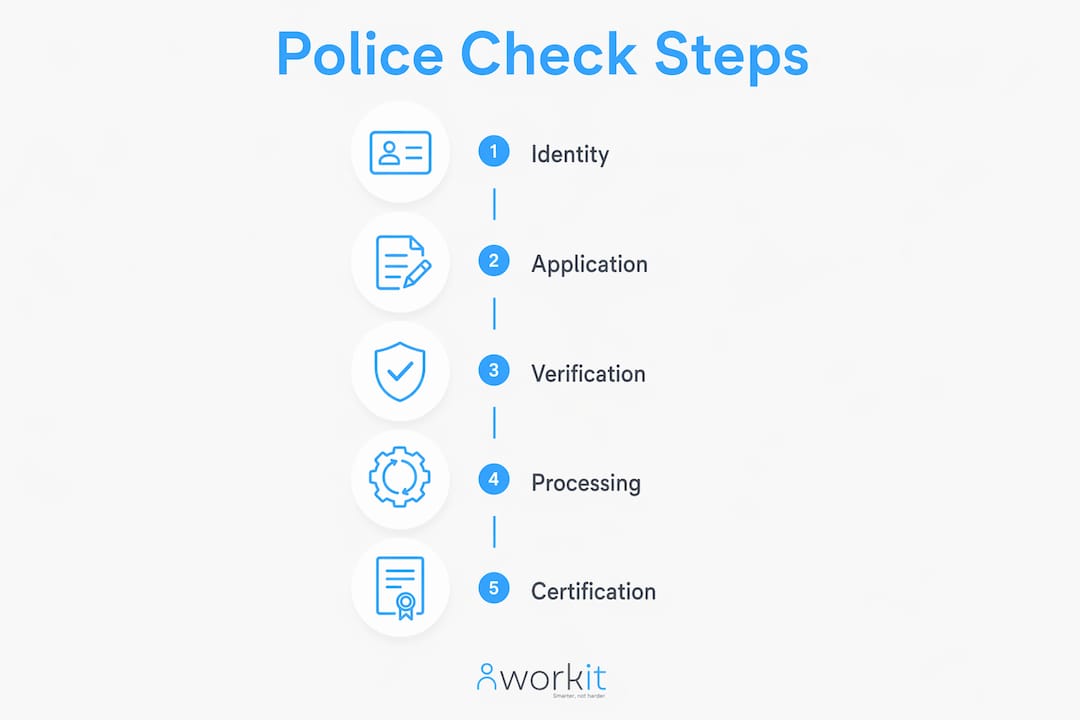
Identity verification is required for every application using a 100-point system, meaning you must provide documents that collectively reach 100 points, including at least one photo ID. Approximately 70% of National Police Checks are processed within minutes, while 30% require manual processing with no guaranteed timeframe, depending on your history and the check type.
What types of police checks are available in Australia?
Not all criminal record checks are the same. The type you need depends on your purpose, and choosing the wrong one can cause delays or an outright rejection.

Standard employment check This is the most common type. It lists disclosable court outcomes relevant to the employment purpose, filtered through state, territory, and Commonwealth spent convictions laws. Spent convictions generally do not appear unless the requesting organisation holds a specific legislative exemption.
Volunteer check A reduced-cost option for genuine unpaid roles. The ACIC’s volunteer check criteria are strict: the applicant must not receive a salary or any entitlements beyond out-of-pocket expenses. This check type cannot be used for au pairs, students on compulsory placements, family day care providers operating commercially, or participants in government schemes like Work for the Dole.
Fingerprint check Required for visa applications to certain countries, adoption, and some security-sensitive roles. It cross-references your identity against national fingerprint databases, which takes significantly longer than a name-based check.
Company check The AFP can conduct an NPC on an Australian company rather than an individual. This is a separate process from personal checks.
What appears on your certificate depends on the purpose you declare:
- Local and interstate criminal and traffic court outcomes
- Outstanding warrants
- Pending charges where you have been charged but not yet appeared in court
- Information is filtered through spent convictions legislation, which varies by state and territory
One certificate cannot be used for multiple purposes. If you need a check for both an employment role and a volunteer position, you must apply and pay separately for each.
Pro Tip: A Working With Children Check (WWCC) and a National Police Check are different documents. In Victoria they are separate processes entirely; in New South Wales, a WWCC includes a National Police Check. Always confirm what your employer or organisation actually requires before you apply.
How do you apply for a police check online or by post?
The AFP and most state police agencies offer both online and postal applications. Online is faster for standard name-based checks; post is required if you need fingerprints included.
Applying online
- Visit the AFP website or your state police agency’s online portal (for example, the Queensland Police Service accepts online applications with ID verification through Australia Post).
- Complete the application form with your full legal name, all previous names or aliases, date of birth, current and previous residential addresses for the last five years, and contact details.
- Select the correct purpose of check. This is legally significant and governs what information is disclosed.
- Upload scanned identity documents meeting the 100-point threshold, including at least one photo ID.
- Pay $56 by credit card for a standard AFP check.
- Submit. You will receive a payment receipt by email, and your digital certificate arrives as a secure PDF once the check is complete.
Applying by post
- Download and print the relevant application form from the AFP or your state police agency.
- Complete all sections in block letters. Do not alter or delete any wording on the form.
- Have an authorised certifier (a police officer, pharmacist, Justice of the Peace, or other authorised person) sight your original documents, certify photocopies, and witness your signature.
- Include certified copies of identity documents meeting 100 points.
- Pay by bank cheque or money order in Australian dollars, made out to the Australian Federal Police (for AFP applications).
- Post the completed form, certified documents, and payment together. The AFP requires the form to be submitted no more than three months after you sign it.
- For fingerprint checks, you cannot apply online. You must attend a police station in person, often by appointment, to have fingerprints taken via Livescan.
Pro Tip: Double-check every personal detail before submitting. Incorrect names, missing aliases, or mismatched dates of birth are among the most common reasons applications are returned or delayed.
For employers wanting to understand how police checks fit into a broader employment screening process, the legal obligations around consent and purpose selection are just as important as the application mechanics.
What do police checks cost and how long do they take?
Fees are set by the issuing agency and vary slightly by state, but the AFP’s published rates give a reliable benchmark.
- Standard NPC (AFP): $56
- NPC with fingerprints (AFP): $113
- Volunteer checks: reduced fees apply through accredited bodies or state police; some volunteers qualify for a free check through schemes like South Australia’s VOAN programme, where the cost is funded by the state government
- Concession rates: available from some agencies with proof of a current concession card
Around 70% of National Police Checks are processed within minutes. The remaining 30% are referred to one or more police agencies for manual processing, with no guaranteed timeframe.
That 30% is where timing becomes unpredictable. Manual processing typically takes 5–10 working days, though it can run longer during peak periods or when multiple jurisdictions are involved. Victoria Police advises a minimum of 10 business days for standard processing, while the Queensland Police Service estimates 5–10 working days for applications requiring further investigation. Fingerprint checks take 15–30 business days.
Factors that extend processing times include:
- A criminal history that requires manual review by one or more police agencies
- Incomplete or incorrectly certified identity documents
- Fingerprint requirements
- Peak application periods, when resourcing constraints across agencies slow turnaround
- Submitting multiple applications does not speed things up. All accredited bodies have equal access to the national system.
Allow as much lead time as possible before any deadline. If you are applying for a role with a start date, submit your check at least three to four weeks in advance to account for potential manual processing.
Legal and practical things you need to know before applying
Getting the application right matters beyond just filling in a form. There are legal obligations on both sides of the process.
Spent convictions Spent convictions are generally not disclosed on a police check. In Victoria, for example, an adult conviction becomes spent after a ten-year offence-free period; for juveniles it is five years. Most employers do not hold a legislative exemption and will only see convictions that are not spent. If an organisation without an exemption receives your spent conviction information, the person who disclosed it may be liable for a penalty.
Purpose selection is legally binding The purpose you declare on your application directly determines what information is released. Selecting the wrong purpose, whether accidentally or to obtain a different level of disclosure, can result in rejection or improper disclosure. You cannot use a certificate issued for one purpose to satisfy a different requirement.
Police checks versus other screenings A National Police Check is not the same as a Working With Children Check or a Working With Vulnerable People Check. The Australian Institute of Family Studies notes that these checks differ in legal scope and operational process. A police check alone does not authorise someone to work with children in Australia. Depending on your jurisdiction and role, you may need both.
Additional points to keep in mind:
- There is no official expiry date on a National Police Certificate. It is a point-in-time document. The organisation requesting it sets its own validity window based on risk policy.
- Volunteer check eligibility is narrow. Using the volunteer category for a role that does not genuinely qualify is not permitted and may result in the check being rejected.
- If you believe information on your certificate is incorrect, a formal disputed record process exists. For AFP-issued certificates, complete a Disputed Record form. For state-issued certificates, contact the issuing agency directly.
- You can only apply on behalf of another person if you hold Enduring Power of Attorney, and original documentation must be sighted by an authorised person.
For a deeper look at how police checks fit alongside other screening methods in a compliant hiring process, the requirements vary considerably by industry and role type.
Expert insights on identity verification and processing times
The ACIC does not accept applications directly from individuals. This surprises many applicants who search for a central government portal and cannot find one. You must go through either an ACIC-accredited body or a state or territory police agency. Accredited bodies are commercial organisations approved to submit checks on behalf of individuals and organisations; they all have equal access to the national system, so no single provider can deliver faster results than another.
Identity verification is where most applications run into trouble. You need four identity documents in total, structured as follows:
- One commencement of identity document: a full Australian birth certificate (not an extract), current Australian passport, Australian citizenship certificate, or valid Australian visa
- One primary use in the community document: current Australian driver’s licence, proof of age card, or current foreign passport with accompanying visa
- Two secondary use in the community documents: Medicare card, electoral enrolment evidence, bank card, or government-issued photo ID
For postal applications, all documents must be certified by an authorised person who has sighted the originals in your presence. Certifiers include police officers, pharmacists, and Justices of the Peace. The certifier must sign and date each photocopy and confirm the photo ID is a true likeness of you.
Fingerprint checks require physical attendance at a police station with Livescan capabilities. The AFP states these checks take 15–30 business days due to cross-referencing against national fingerprint databases. You cannot include a fingerprint check in an online application; it must go by post or in person.

Once your certificate arrives, check every personal detail immediately. If anything is wrong, contact the issuing agency without delay. The AFP provides a Disputed Record form for this purpose. Errors left uncorrected can cause problems when you present the certificate to an employer or licensing body.
Digital certificates from the AFP are issued as secure PDFs with a unique QR code for validation. Victoria Police digital certificates are issued through Service Victoria. Both formats are accepted by most organisations, though some may ask to see the original or verify the certificate directly with the issuing agency.
Workit makes compliance tracking easier for Australian employers
Managing police checks across a team is one of those tasks that looks simple until you are tracking expiry preferences, chasing documents, and trying to remember who submitted what and when. Workit’s onboarding and compliance software gives Australian HR teams a single place to track screening requirements, document submissions, and onboarding status for every new starter.

At $5 per employee per month with all modules included, Workit is built for Australian businesses that want real compliance visibility without the spreadsheet chaos. Book a demo and see how it fits your team.
Key takeaways
A National Police Check is a point-in-time document with no official expiry, and the purpose you declare on your application legally determines what criminal history information is disclosed.
| Point | Details |
|---|---|
| Standard AFP fee | A name-based National Police Check costs $56; adding fingerprints brings the total to $113. |
| Processing speed | Around 70% of checks complete within minutes; the remaining 30% go to manual processing with no guaranteed timeframe. |
| Identity documents | You need four documents meeting 100 points, including one commencement of identity document and one photo ID. |
| Fingerprint checks | These take 15–30 business days and must be submitted by post or in person, not online. |
| No official expiry | Certificates are point-in-time only; the requesting organisation sets its own validity window. |
FAQ
What is the difference between a police check and a background check?
A National Police Check is an official government document listing your disclosable court outcomes across Australia. A background check is a broader term that can include employment history, reference checks, and other screening methods alongside a criminal record check.
How long does a police check take in Australia?
Around 70% of checks are processed within minutes. Manual processing takes 5–10 working days or longer, and fingerprint checks take 15–30 business days. For more detail on check validity and renewal, timelines vary by organisation.
Can I use one police check for multiple jobs?
No. Each National Police Certificate is issued for a single stated purpose. A certificate obtained for a volunteer role cannot be used for an employment application, and vice versa.
Do volunteer checks cost the same as employment checks?
No. Volunteer checks attract a reduced fee. Some volunteers working with approved organisations may qualify for a free check through state-funded schemes such as South Australia’s VOAN programme.
What happens if my certificate contains incorrect information?
Contact the issuing agency immediately. The AFP provides a formal Disputed Record form, and state police agencies have their own review processes. Leaving an error uncorrected can cause problems when you present the certificate to an employer or licensing body.