

Talent acquisition: a practical guide for Australian businesses
TL;DR:
- Talent acquisition is a proactive, long-term strategy that focuses on building candidate pipelines and aligning hiring with future workforce needs. It differs from reactive recruitment, which responds to immediate vacancies and prioritizes speed over quality. Implementing structured onboarding and continuous pipeline management enhances retention and overall hiring success.
Talent acquisition is defined as the proactive, long-term discipline of identifying, attracting, and hiring people who align with your business goals. Unlike filling a vacancy, it connects workforce planning, employer branding, and structured onboarding into one continuous process. For HR professionals and small business owners, getting this right is the difference between a team that performs and one that constantly turns over. This guide covers the core components, the onboarding connection, and the hiring best practices shaping 2026.
How does talent acquisition differ from recruitment?
Talent acquisition is a proactive, long-term strategy that differs fundamentally from recruitment, which is reactive and tactical. Recruitment fills a seat. Talent acquisition builds a pipeline.
When a resignation lands on your desk and you post a job ad that afternoon, you are recruiting. When you have already spoken to three strong candidates in the past month because you mapped your workforce needs six months ago, you are doing talent acquisition. The distinction matters because reactive hiring is expensive, slow, and prone to poor fit.
Here is how the two approaches compare in practice:
- Recruitment responds to an immediate vacancy. It is transactional, short in timeframe, and focused on speed.
- Talent acquisition anticipates future needs. It builds relationships with passive candidates before roles open.
- Recruitment measures success by time-to-fill. Talent acquisition measures it by quality of hire and retention.
- Talent acquisition integrates with onboarding, performance management, and workforce planning as one connected system.
Pro Tip: Map your headcount needs by quarter, not just when someone resigns. Even a simple spreadsheet tracking planned growth by department gives you a three-month head start on sourcing.
The business case is straightforward. Talent mapping enables proactive pipeline building and hiring efficiency, reducing the scramble that leads to poor decisions under pressure.
What are the core components of an effective talent acquisition strategy?
A strong talent acquisition strategy rests on five connected components. Miss one and the others underperform.
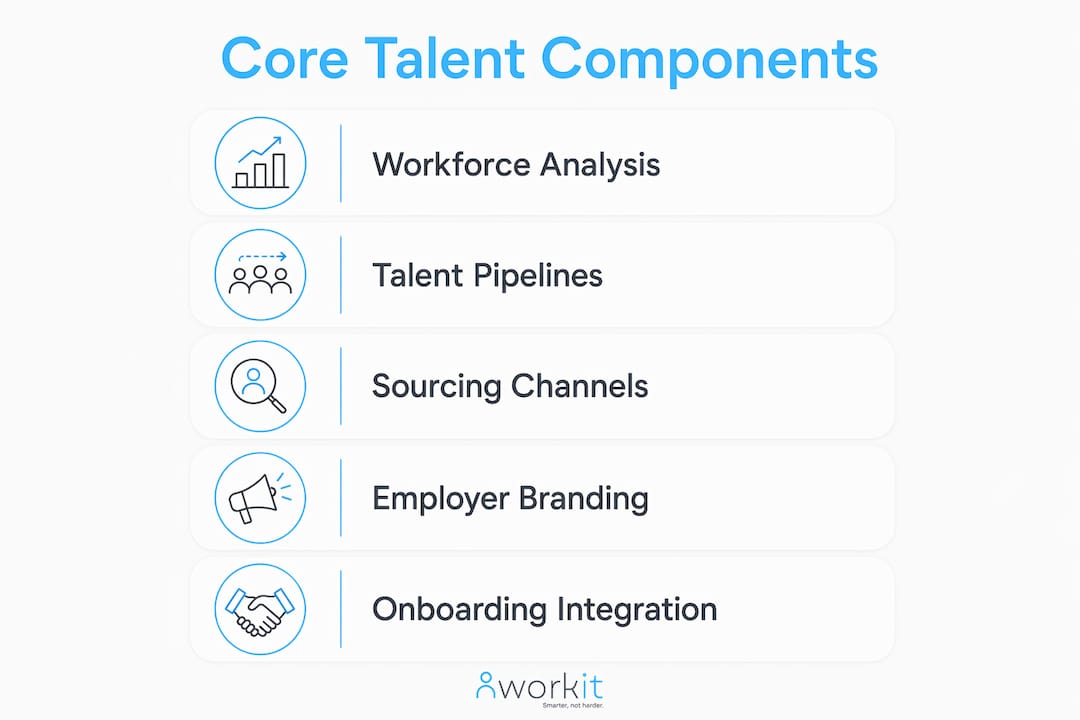
1. Workforce analysis and forecasting
Before you source a single candidate, you need to know what roles you will need and when. Talent acquisition specialists forecast workforce needs 6–24 months ahead using talent mapping tools. That window gives you time to build relationships, not just post ads.
2. Proactive talent pipelines
A talent pipeline is a pool of pre-qualified candidates you stay in contact with before a role opens. This means attending industry events, maintaining a talent community via LinkedIn, and keeping warm conversations going with people who impressed you in past processes.

3. Diverse sourcing channels
Relying on one job board limits your reach. Effective sourcing combines employee referrals, social media, university partnerships, industry associations, and direct outreach. Each channel attracts a different candidate profile, which builds a more varied and capable shortlist.
4. Employer branding
Candidates research your business before they apply. Your careers page, Glassdoor presence, and LinkedIn activity all shape their first impression. A clear, honest employer brand reduces the volume of poor-fit applications and attracts people who genuinely want to work with you.
5. Integration with onboarding
Hiring does not end at the offer letter. Connecting your acquisition process to a structured employee onboarding process protects the investment you made in finding the right person. Candidates who experience a disjointed handover between recruitment and onboarding disengage quickly.
Pro Tip: Build a simple candidate relationship management habit. After every interview, send a brief follow-up to strong candidates you did not hire. A short, genuine message keeps the door open and costs you nothing.
| Component | Reactive approach | Proactive approach |
|---|---|---|
| Sourcing | Post and pray | Pipeline and outreach |
| Forecasting | When a role opens | 6–24 months ahead |
| Employer brand | Incidental | Actively managed |
| Onboarding | Separate from hiring | Integrated from offer |
| Success metric | Time-to-fill | Quality of hire |
How can structured onboarding enhance talent acquisition outcomes?
Structured onboarding is the most underused tool in talent management. Structured onboarding improves employee retention by 82% and productivity by 70% in the first year. Those numbers reflect what happens when new hires feel prepared, connected, and clear on expectations from day one.
Onboarding programmes follow a 90-day cycle that spans pre-boarding, orientation, role-specific training, and a formal 90-day review. Each phase has a distinct purpose.
| Onboarding phase | Timing | Primary focus |
|---|---|---|
| Pre-boarding | Offer accepted to start date | Paperwork, access, culture introduction |
| Orientation | Day 1–5 | Team introductions, systems, expectations |
| Training | Week 2–8 | Role-specific skills and workflows |
| 90-day review | End of month 3 | Performance check-in and feedback |
The pre-boarding phase deserves special attention. Pre-boarding is the highest ROI phase of onboarding, eliminating administrative friction before a new hire’s first day. When contracts, tax forms, and system access are sorted before someone walks in the door, day one becomes about culture and connection rather than paperwork.
For small business owners, the practical barrier is usually time. The good news is that effective onboarding processes can be implemented in as little as one afternoon without complex planning. A simple checklist covering pre-boarding tasks, a first-week schedule, and a 30-day check-in is enough to outperform most businesses your size.
Key responsibilities during onboarding break down clearly:
- HR owns pre-boarding paperwork, compliance documentation, and system setup.
- The hiring manager owns role clarity, 30-day goals, and the 90-day review conversation.
- The team owns the cultural welcome, buddy systems, and day-to-day integration.
When each group knows their role, new hires do not fall through the cracks between handovers.
What are the latest hiring best practices for 2026?
The biggest shift in talent acquisition right now is the move away from credentials toward capability. Skills-based hiring enables organisations to assess specific job-related capabilities over traditional degree-based methods. This opens your candidate pool significantly, particularly in technical and trade roles where experience outweighs formal qualifications.
The second major shift is in how you measure success. Hiring success measurement is shifting from time-to-fill toward quality of hire and sourcing effectiveness. Time-to-fill tells you how fast you hired. Quality of hire tells you whether you hired well. Tracking quality-of-hire metrics alongside retention rates gives you a far clearer picture of whether your strategy is working.
Current best practices worth adopting:
- Skills assessments replace or supplement degree requirements in job ads and shortlisting.
- Structured interviews use consistent, role-specific questions across all candidates to reduce bias.
- Diversity sourcing actively targets underrepresented groups through targeted job boards and partnerships.
- Candidate experience audits review every touchpoint from application to offer to identify friction points.
- Continuous pipeline review keeps talent pools warm rather than starting from scratch each time a role opens.
Pro Tip: After every hire, ask your new employee what the application process felt like from their side. Their answer will tell you more about your candidate experience than any internal review.
Proactive talent acquisition strategies transform hiring from tactical vacancy filling to a strategic business advantage. The businesses that treat hiring as an ongoing discipline rather than an occasional task consistently build stronger teams.
Key takeaways
Effective talent acquisition requires connecting workforce planning, proactive pipelines, employer branding, and structured onboarding into one continuous system rather than treating each as a separate task.
| Point | Details |
|---|---|
| Acquisition beats recruitment | Proactive talent pipelines reduce hiring pressure and improve candidate quality over time. |
| Forecast 6–24 months ahead | Talent mapping tools let you engage candidates before vacancies open, not after. |
| Onboarding drives retention | Structured onboarding improves first-year retention by 82% and productivity by 70%. |
| Pre-boarding has the highest ROI | Completing paperwork and access setup before day one frees the first week for culture and connection. |
| Measure quality, not speed | Tracking quality of hire and retention reveals whether your strategy is actually working. |
What I have learned from watching small businesses hire
The most common mistake I see small business owners make is treating every hire as an emergency. A resignation triggers a panic, a rushed job ad goes up, and the first available candidate gets the role. Six months later, the cycle repeats.
The businesses that break this pattern do one thing differently. They invest a few hours each quarter in workforce planning, even informally. They know which roles are likely to grow, which are at retention risk, and which skills they will need in the next year. That small habit changes everything about how they hire.
The second thing I have noticed is that small businesses underestimate how much their onboarding process affects their reputation as an employer. Word travels fast in tight industries. A chaotic first week sends a signal that the business is disorganised, and that signal reaches candidates you have not even met yet.
You do not need a complex system to do this well. A clear pre-boarding checklist, a structured first week, and a genuine 30-day conversation are enough to stand out. The technology to support all of this exists and is affordable. The only real barrier is deciding to start.
— Stephen
Workit makes talent acquisition simpler for Australian teams
Building a strong hiring process does not require a large HR team or a complicated setup. Workit is an all-in-one HR platform built specifically for Australian businesses, covering recruitment workflows, onboarding, and compliance in one place at $5 per employee per month.
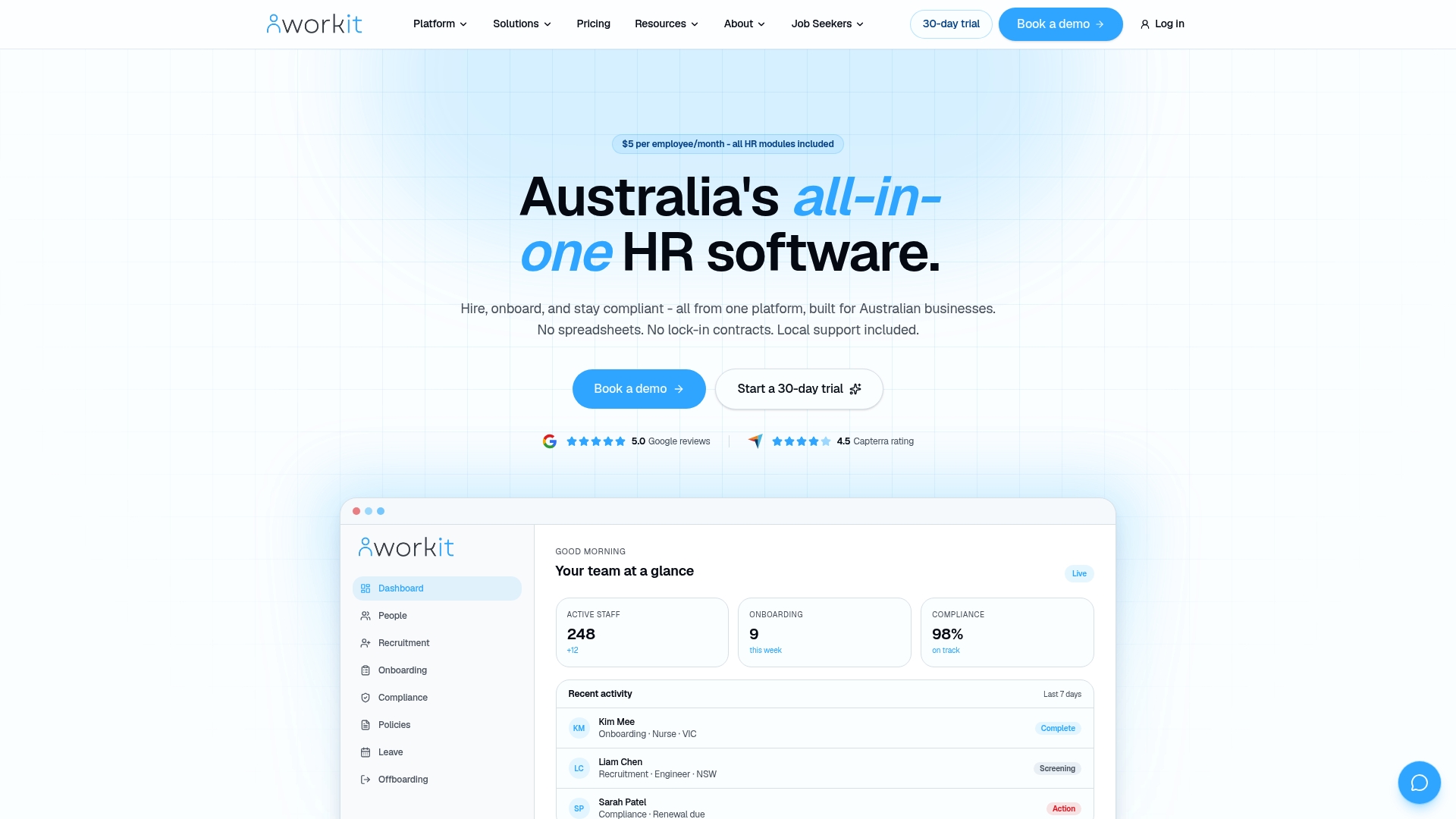
Workit’s onboarding software handles pre-boarding paperwork, automated task assignments, and compliance tracking so your new hires arrive ready to contribute. Every module is included in the one price, with no hidden fees and local support from a team that knows the Australian market. If you want to see how it works for your business, book a demo and get a walkthrough tailored to your team size and industry.
FAQ
What is talent acquisition?
Talent acquisition is the proactive, long-term process of identifying, attracting, and hiring people who align with your business goals. It differs from recruitment by incorporating workforce planning, employer branding, and onboarding as connected disciplines.
How does talent acquisition differ from recruitment?
Recruitment is a reactive, short-term response to an open vacancy. Talent acquisition is a forward-looking strategy that builds candidate pipelines 6–24 months before roles open, focusing on quality of hire rather than speed.
What does a structured onboarding process include?
A structured onboarding process covers four phases: pre-boarding, orientation, role-specific training, and a 90-day review. Research links this approach to an 82% improvement in retention and a 70% increase in first-year productivity.
How can small businesses start talent acquisition without a dedicated HR team?
Small businesses can begin with a quarterly workforce planning review, a simple candidate pipeline tracked in a spreadsheet, and a pre-boarding checklist for new hires. These three steps alone outperform most reactive hiring approaches.
What metrics should I track to measure hiring success?
Track quality of hire, 90-day retention rate, and sourcing channel effectiveness rather than time-to-fill alone. These metrics show whether your hiring process is delivering people who stay and perform, not just people who accepted an offer.