

Stop Misclassifying Contractors in Australia: Whole of Relationship Test
Under Australian law, whether someone is an employee or an independent contractor depends on the whole of the working relationship, not the label on the contract, the ABN they quote, or the invoices they send. An employee works within and as part of your business; a contractor runs their own business and provides services to yours. If you’re unsure which applies, run a practical audit against the checklist below before you make any payroll or super decisions.
TL;DR:
- The whole of relationship test now applies to all work arrangements started after August 26, 2024, emphasizing actual day-to-day control and independence over written contracts.
- Classifying someone as a contractor requires weighing multiple factors such as control, tools supplied, financial risk, and delegation, rather than relying solely on their ABN or invoice habits.
- Misclassifying employees as contractors exposes businesses to back payments for entitlements, super shortfalls, penalties, and potential legal disputes if the relationship is found to be an employee.
- Proper documentation of working arrangements, contracts, and actual practice is essential, as regulators scrutinize the substance over the paperwork in classification disputes.
- Using centralized record-keeping platforms like Workit can streamline compliance, reduce audit risks, and ensure evidence readiness for classification and regulatory reviews.
Table of Contents
- Contractor vs employee Australia: the two legal tests explained
- What factors decide if someone is a contractor or employee?
- Tax and super: what changes between a contractor and an employee
- Myths and red flags that signal misclassification
- How to audit worker status: a step‑by‑step checklist
- The cost of getting it wrong: sham contracting and penalties
- Who to contact: ATO, Fair Work Ombudsman, or a lawyer?
- Workers’ compensation and insurance: who actually covers the risk
- Leave entitlements: what contractors miss out on
- Court decisions that shaped today’s classification rules
- Two scenarios that show how classification actually plays out
- Unfair dismissal, discrimination, and other rights that differ
- How consistent processes cut classification risk
- How Workit keeps contractor records audit ready
- Sources
- FAQ
Contractor vs employee Australia: the two legal tests explained
Australian regulators use two different tests depending on when the working relationship started, and mixing them up is one of the most common compliance mistakes business owners make.
For any business covered by the Fair Work system, the whole of relationship test has applied since 26 August 2024. This test looks at how the arrangement actually operates day to day, not just what the paperwork says. If a contract calls someone a “contractor” but you set their hours, supply their tools, and direct how they do every task, the practical reality can override the label.
Arrangements that started before that date generally sit under the start of relationship test, which focuses more heavily on the terms agreed at the outset. There’s a notable carve out here too: contractors earning above the high income threshold can choose to opt out of the whole of relationship test and rely on the original contract terms instead, giving genuinely high earning contractors more certainty.
Working out which test applies matters because it changes what evidence carries weight:
- Whole of relationship test — considers the contract terms and how the work is actually performed in practice.
- Start of relationship test — focuses primarily on the terms agreed when the engagement began.
- High income opt out — available to eligible contractors above the threshold who prefer certainty over a practice based review.
The Fair Work Commission frames the central question simply: is this person serving in your business, or running their own? That question traces back to the High Court’s decisions in Personnel Contracting and Jamsek, which shifted the modern analysis toward the legal rights and obligations actually created by the contract, while leaving room for practical performance evidence to matter under the newer Fair Work provisions.
What factors decide if someone is a contractor or employee?
No single factor decides classification. Authorities weigh several indicia together, and a worker can look like a contractor on one measure and an employee on another.
The main indicia are:
- Control — can you direct how, when, and where the work happens, or does the worker decide their own methods? A bookkeeper who sets her own hours and chooses her own software leans contractor; a receptionist rostered to your opening hours leans employee.
- Delegation — can the worker send someone else to do the job? Genuine contractors can usually subcontract or delegate; employees generally can’t send a substitute.
- Tools and equipment — who supplies the significant gear? An electrician who owns and maintains their own van and tools looks like a contractor; a warehouse picker using your forklifts and scanners looks like an employee.
- Basis of payment — is pay for a result (a quoted job, a fixed fee, an invoice per project) or for time worked (an hourly or salaried rate)?
- Hours and location — does the worker set their own schedule, or do you dictate start times, breaks, and where the work happens?
- Expectation of continuity — is this a one off or project based engagement, or an ongoing expectation of regular work, similar to permanent staff?
- Financial risk — does the worker bear the cost of fixing mistakes, carry their own insurance, and risk profit or loss, or are they simply paid regardless of outcome?
Pro Tip: Weigh the indicia together rather than ticking boxes individually. A worker with an ABN, their own tools, and full control over their hours can still be found an employee if, in substance, they’re integrated into your business with no real independence.
The ATO notes that employees typically operate under direction, while contractors typically have discretion over method, can delegate, and carry commercial risk. That combination, not any one indicator, drives the outcome.
Tax and super: what changes between a contractor and an employee
Classification changes your obligations immediately, and getting it wrong can leave you owing back super, withheld tax, and penalties years after the fact.
For employees, you must:
- Withhold PAYG tax from wages and remit it to the ATO.
- Pay the super guarantee into their nominated fund.
- Report earnings through Single Touch Payroll.
For contractors, the arrangement is usually simpler: they invoice you, manage their own tax, and typically aren’t entitled to super from you. There’s an important exception though. If a contract is principally for the individual’s labour, super guarantee obligations can still apply even when the worker has an ABN and invoices you like any other supplier. This catches out a lot of businesses who assume an ABN automatically removes super liability.
Don’t confuse this with the Personal Services Income 80% rule. That’s a tax test looking at whether 80% or more of a contractor’s income comes from one client, which affects how their income is taxed if they operate through a company or trust. It has nothing to do with whether Fair Work or the ATO considers them an employee, and treating it as an employment test is a common and costly mistake.
Myths and red flags that signal misclassification
Several common assumptions get business owners into trouble, and none of them hold up under scrutiny.
- “They have an ABN, so they’re a contractor.” An ABN, invoices, or even a registered business name don’t automatically establish contractor status, according to ATO guidance.
- “They’ve worked for us for years, so they must be an employee.” Length of engagement alone isn’t decisive either way.
- “They invoice monthly like a business.” Payment structure matters, but it’s one indicium among several, not a standalone test.
Watch for these red flags instead: the worker is integral to your core operations, works set hours at your premises, uses equipment you supply, and can’t send anyone else to do the job. Any one of these should trigger a proper review, not a shrug.
How to audit worker status: a step‑by‑step checklist
Running a proper audit takes an afternoon and can save years of back payments. Work through it methodically for every contractor on your books.
- Pull the paperwork. Collect the signed contract, recent invoices, timesheets or job logs, email correspondence about scheduling, and any internal policies the worker is expected to follow.
- Compare contract terms against actual practice. Does the contract say “no set hours” while your roster shows fixed shifts? Does it say “can delegate” while nobody has ever actually sent a substitute?
- Check control and location. Who decides when and where the work happens, on paper and in reality?
- Check tools and financial risk. Who supplies major equipment, and who absorbs the cost if something goes wrong?
- Assess whether the contract is principally for labour. This determines if super guarantee obligations might still apply, regardless of ABN status.
- File and date everything. Keep a dated record of your assessment and reasoning. This becomes your evidence of reasonable belief if a regulator ever asks.
Pro Tip: Document your reasoning at the time you make the classification decision, not months later when a dispute has already started. A contemporaneous record showing why you believed an arrangement was genuine contracting is one of the strongest defences available if the classification is later challenged.
If the audit throws up inconsistencies you can’t resolve internally, that’s the point to bring in an employment lawyer rather than guessing.
The cost of getting it wrong: sham contracting and penalties
Deliberately or carelessly labelling an employee as a contractor to dodge entitlements is called sham contracting, and it’s illegal under the Fair Work Act.
If a worker is reclassified, you’re typically looking at:
- Back payment of unpaid entitlements, including minimum wages, penalty rates, and leave.
- Superannuation guarantee shortfalls, plus the associated charge and interest.
- Civil penalties for the business, and potentially for individuals involved in the decision.
Fair Work Ombudsman investigators focus on evidence of actual practice: rosters, supervision records, correspondence about how work was directed, and whether the business can show a reasonable belief the arrangement was genuine contracting. A business that documented its reasoning at the time has a real defence; one that just copied a template contract and hoped for the best usually doesn’t.
Who to contact: ATO, Fair Work Ombudsman, or a lawyer?
Different questions belong with different bodies, and knowing which one saves you time.
- Tax and super questions go to the ATO, including PAYG withholding and super guarantee obligations.
- Workplace classification and entitlement questions go to the Fair Work Ombudsman, which handles the whole of relationship test guidance.
- Complex disputes or contested classifications are best referred to the Fair Work Commission or an employment lawyer.
Once you’ve identified a mismatch, correct payroll and super settings, document what changed and why, and get advice before backdating anything.
Workers’ compensation and insurance: who actually covers the risk
This is where misclassification gets expensive fast, because insurance gaps often surface only after someone is already injured.
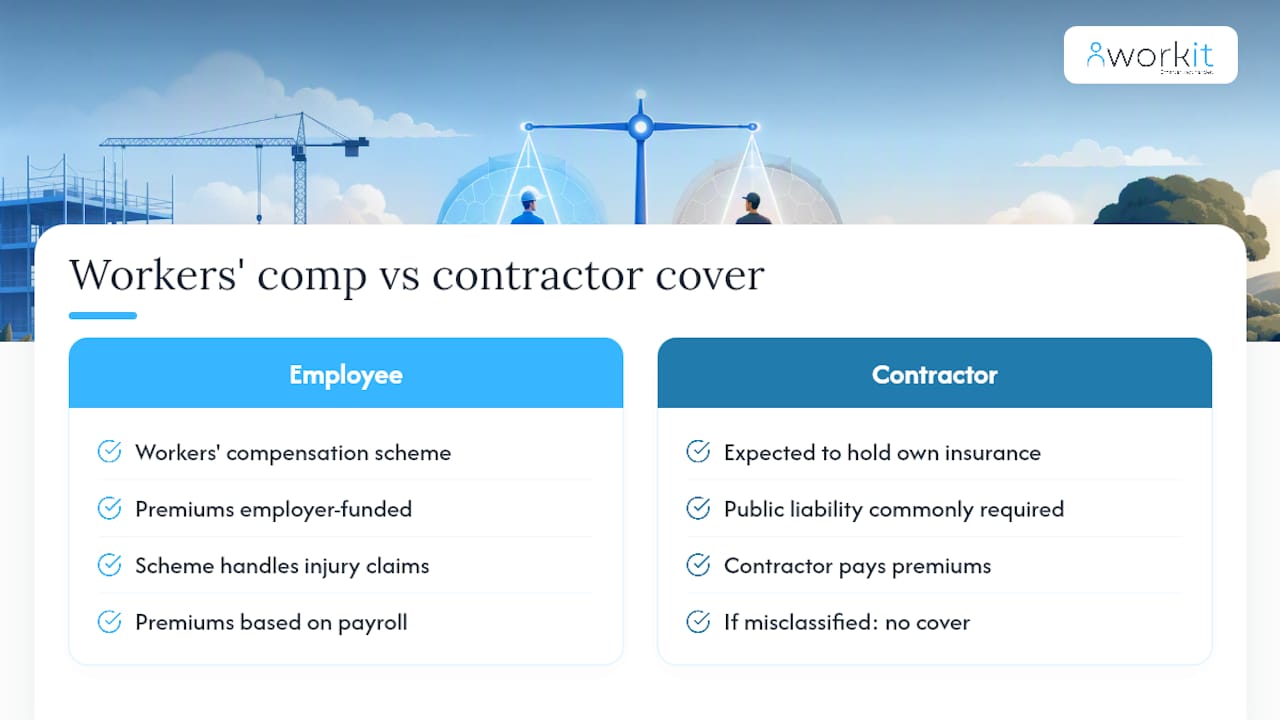
Employees are automatically covered by your state or territory workers’ compensation scheme, funded through premiums you pay based on your payroll. If an employee is hurt on the job, the claim goes through that scheme regardless of fault.
Contractors are generally expected to hold their own insurance, including public liability and, often, their own income protection or personal accident cover. If you’ve misclassified an employee as a contractor and they’re injured, you may find your workers’ compensation policy doesn’t cover them at all, because the insurer never collected a premium for that worker. You’re then personally exposed to the claim, on top of any back pay and super liabilities from the reclassification itself.
Some industries, particularly construction and logistics, require principal contractors to check that subcontractors carry adequate insurance before work starts. That check protects you as much as it protects the contractor. If a genuine contractor turns up without public liability cover, that’s a business risk worth pausing on before you engage them, not after an incident.
Leave entitlements: what contractors miss out on
Employees accrue paid leave under the National Employment Standards; contractors generally don’t, and this is one of the starkest practical differences between the two categories.
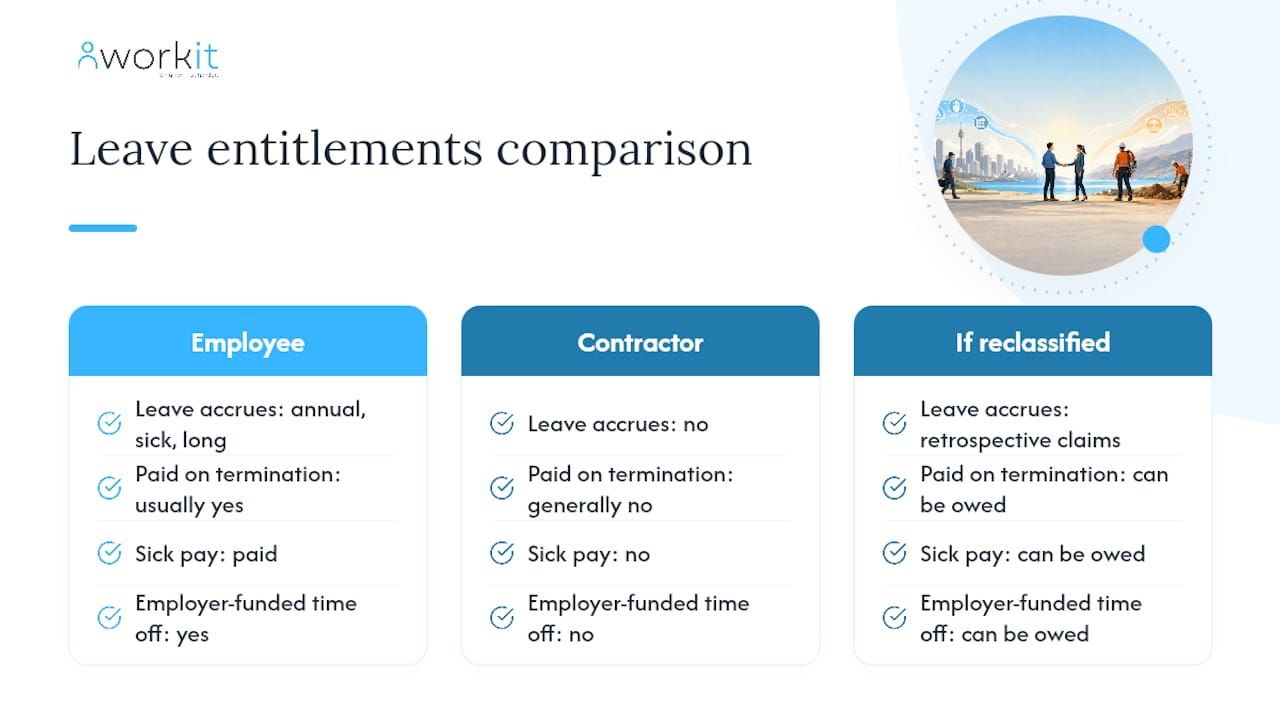
Full time and part time employees build up annual leave, personal or sick leave, and often other entitlements like compassionate leave and long service leave over time. These accrue automatically and are paid out on termination in most cases. Contractors, by contrast, are running their own business, so there’s no leave accrual, no sick pay, and no employer funded time off. A genuine contractor prices that risk into their rate; that’s part of why contractor day rates are often higher than an equivalent employee’s daily wage.
The catch is that if a “contractor” is later found to actually be an employee, they can claim years of unpaid leave entitlements retrospectively. This is one of the biggest back payment exposures in a reclassification case, because leave accrual compounds over the length of the engagement. A worker who’s been on your books for four years under a contractor label, then reclassified, can trigger a leave liability running into tens of thousands of dollars per person. Businesses that check entitlement exposure early, through NES entitlement guidance, tend to catch this risk before it compounds.
Court decisions that shaped today’s classification rules
Two High Court cases now anchor almost every classification conversation in Australia, and both moved the analysis in the same direction.
Personnel Contracting and Jamsek both concerned workers labelled as contractors under written agreements, and both cases turned on the legal rights and obligations the contract actually created, rather than a checklist of behaviours. The High Court’s reasoning pushed classification analysis back toward the terms of the contract itself, while regulators like Fair Work have since layered the whole of relationship test on top for arrangements from 26 August 2024 onward, bringing practical performance back into scope. Legal commentary referenced in ATO guidance treats these decisions as the foundation for how contractual analysis and practical evidence now interact.
The practical upshot: a well drafted contract still matters enormously, but it’s no longer a guaranteed shield. Regulators can and do look past the paperwork when the day to day reality tells a different story, and Fair Work Ombudsman commentary on the loophole closing reforms makes clear that a written “contractor” clause is no longer a reliable safeguard on its own.
Two scenarios that show how classification actually plays out
Real classification questions rarely look like a textbook example. Two common Australian scenarios illustrate how the indicia interact.
Scenario one: the “permanent” IT contractor. A software developer signs a contractor agreement, invoices monthly through a company structure, and has done so for three years. But she works exclusively for one client, uses their laptop and internal systems, attends daily standups at set times, and has never sent a substitute. On the indicia, this leans strongly toward employee: no delegation, no financial risk, fixed hours, and total integration into the business, despite the ABN and invoices.
Scenario two: the tradie subcontractor. An electrician quotes fixed prices per job, supplies his own van, tools, and public liability insurance, sets his own schedule around multiple clients, and occasionally sends an apprentice in his place. This points clearly to genuine contracting: control over method, real financial risk, delegation capacity, and no integration into any single business’s operations.
The difference isn’t the industry. It’s the substance of how each relationship actually runs.
Unfair dismissal, discrimination, and other rights that differ
Employment status determines which legal protections a worker can access, and the gap is wider than most business owners expect.
Employees who meet minimum service requirements can bring unfair dismissal claims through the Fair Work Commission if terminated unfairly. Contractors generally can’t, because unfair dismissal protections attach to employment relationships, not commercial ones. Discrimination protections under state and federal law extend to both employees and, increasingly, to contractors and other workers in many circumstances, but the specific remedies and processes can differ depending on category.
Employees also get access to the general protections provisions covering adverse action, right to request flexible work, and unpaid parental leave, none of which apply to a genuine independent contractor. This is exactly why misclassification disputes so often surface after a termination: a worker let go abruptly discovers they may have had unfair dismissal rights all along, and the classification question becomes central to whether their claim can proceed at all.
How consistent processes cut classification risk
Misclassification rarely happens on purpose. It creeps in when contracts sit in someone’s inbox, timesheets live in three different spreadsheets, and nobody revisits an arrangement once it’s set up. Centralised, dated records of contracts, invoices, and actual working patterns give you the evidence trail regulators ask for. Where an audit turns up genuine uncertainty, fix the arrangement or get advice promptly rather than leaving it to compound.
— Stephen
How Workit keeps contractor records audit ready
Chasing down a contractor’s original agreement, three years of invoices, and a paper trail of scheduling emails during a Fair Work inquiry is not where any Australian business wants to be. Workit is built to stop that scramble before it starts: every contract, onboarding record, and policy acknowledgement lives in one platform, timestamped and searchable, so your evidence of reasonable belief is already sitting there when you need it.
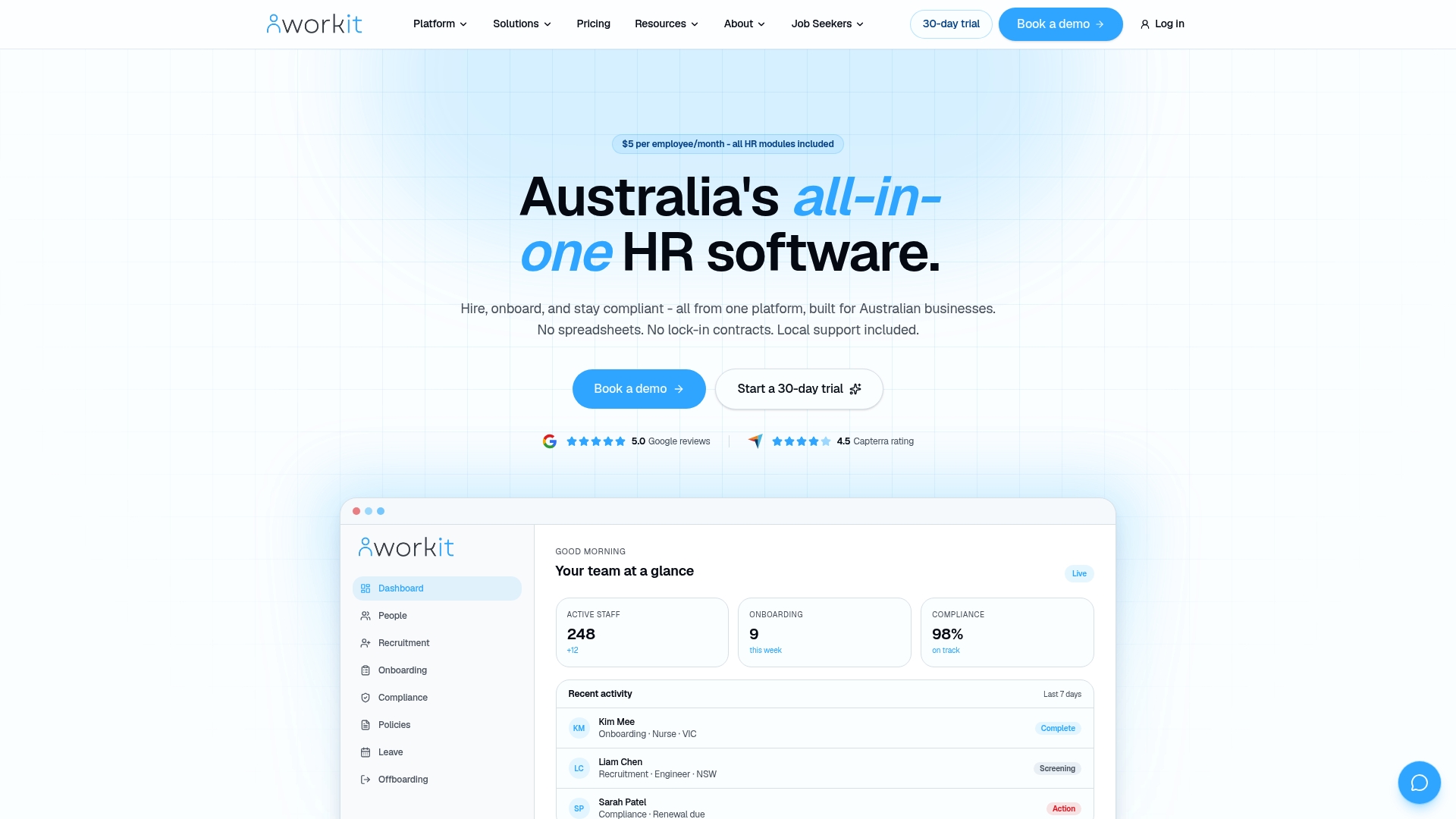
Workit’s compliance management module tracks real time obligations across your whole workforce, contractors and employees alike, and generates the reporting you’d hand to an auditor without rebuilding it from scratch. Standard onboarding templates in the employee onboarding software mean every new engagement, employee or contractor, gets consistent documentation from day one, closing the gap between what the contract says and what you can actually prove happened. With every module included and local Australian support on the other end of the phone, it’s a practical fix for the record keeping problem this whole article has been circling.
If you’re carrying any uncertainty about a worker’s status right now, book a demo and see how the platform organises your contracts, timesheets, and audit trail in one place.
Sources
- Difference between employees and independent contractors (ATO)
- Independent contractors (Fair Work Ombudsman)
- The 80% rule (Small Business tax and super guidance)
FAQ
What is the 80% rule for contractors?
The 80% rule is a Personal Services Income tax test checking whether 80% or more of a contractor’s income comes from one client. It affects how income is taxed through a company or trust and has no bearing on whether Fair Work considers someone an employee.
Is having an ABN proof someone is a contractor?
No. The ATO confirms an ABN, invoices, or a business name don’t automatically establish contractor status. Classification depends on the whole working relationship, including control, delegation, and financial risk.
How much tax does a contractor pay in Australia?
Contractors manage their own income tax and typically don’t have PAYG withheld, unlike employees. The exact rate depends on their structure (sole trader, company, or trust) and total taxable income, so it varies by individual circumstances rather than a single fixed rate.
How long can a contractor work for the same company?
There’s no fixed time limit that automatically converts a contractor into an employee. Length of engagement is one factor regulators may consider, but a long running arrangement can still be genuine contracting if control, delegation, and financial risk indicators point that way.
What’s the main difference between an employee and a contractor?
Employees work within and as part of your business under your direction; contractors run their own business and provide services to yours, carrying their own commercial risk, according to ATO guidance.