

Contractor management in Australia: your complete PCBU guide
Effective contractor management in Australia is a non-delegable PCBU duty under the Work Health and Safety Act 2011 (Cth), not a box-ticking exercise. It combines legal obligations with a repeatable operational process: prequalification, contract, induction, and monitoring. If you engage contractors, start here.
Act on these five things now:
- Identify every PCBU in your contractual chain and confirm who controls what
- Confirm the scope of each contractor’s work and the risks it creates
- Run a prequalification check before any contractor sets foot on site
- Schedule a site induction and confirm SWMS are in place before work begins
- Set monitoring and audit dates in your calendar before mobilisation
The WHS Act 2011 (Cth), Safe Work Australia’s Model Codes of Practice, and your state or territory WHS regulator (SafeWork NSW, WorkSafe Victoria, SafeWork SA, and others) are the governing sources. When state law differs from the model law, the state law applies to you.
Key takeaways
Effective contractor management in Australia requires PCBUs to combine non-delegable WHS duties with a documented, auditable operational process covering prequalification, contracting, induction, and ongoing monitoring.
| Point | Details |
|---|---|
| PCBU duty is non-delegable | You cannot contract out WHS responsibilities; verify contractor systems and performance actively. |
| Prequalification is your first control | Check insurance, licences, SWMS, and incident history before any contractor accesses your site. |
| Induction must be site-specific | Generic inductions are not defensible; tie induction content to the contractor’s actual tasks and hazards. |
| Active monitoring is required | Inspection logs, toolbox talk records, and SWMS audits are the evidence regulators look for. |
| Workit centralises the process | Workit’s platform handles digital inductions, compliance tracking, and audit-ready reporting for Australian PCBUs at $5 per employee per month. |
Table of Contents
- What does contractor management legally mean for Australian PCBUs?
- How to run a contractor management process from procurement to offboarding
- What should you check when pre-qualifying contractors?
- How should contracts allocate WHS responsibilities?
- How do you make contractors site-ready through induction and onboarding?
- How do you monitor contractors and handle incidents?
- What are the sector-specific requirements you need to know?
- What are the most common contractor management mistakes?
- How does software make contractor management auditable and repeatable?
- How long does setup take and what drives the cost?
- What safety officers should prioritise first
- Workit gives Australian PCBUs one place to manage contractor compliance
- Sources
- FAQ
What does contractor management legally mean for Australian PCBUs?
The short answer: you cannot contract out your WHS responsibilities. A PCBU (Person Conducting a Business or Undertaking) retains its primary duty of care to workers it engages, directs, or influences, regardless of what a commercial contract says. That duty extends to contractors, subcontractors, and labour hire workers.
What “reasonably practicable” actually requires
“Reasonably practicable” is not a vague standard. Safe Work Australia defines it as what a PCBU could reasonably do given the likelihood of harm, its severity, knowledge of the hazard, and the cost and availability of controls. The greater your control over a contractor’s work, the more you are expected to do. A principal who dictates work methods, supplies equipment, and manages the site carries a heavier verification burden than one who engages a specialist at arm’s length; even in the latter case, Comcare’s guidance for Commonwealth PCBUs is clear: reliance on a specialist does not remove the duty to verify their WHS systems and performance.
Shared duties and consultation
When more than one PCBU owes a duty over the same matter, each must discharge their duty to the extent they can influence or control it. Safe Work Australia’s fact sheet on WHS duties in a contractual chain makes this explicit: duties are concurrent, not transferable. You must consult, cooperate, and coordinate with other PCBUs. That means sharing hazard information, aligning induction requirements, and agreeing on incident notification protocols before work starts.
The definition of “worker” under WHS law is broad. Safe Work Australia confirms it includes contractors and subcontractors, meaning your consultation and risk management obligations apply to every person in your contractor chain, not just direct employees.
What auditors and inspectors actually look for
Pro Tip: Regulators do not accept a folder of certificates as evidence of compliance. They look for active verification: signed induction records, dated inspection logs, SWMS reviewed and acknowledged by the contractor, and evidence that you acted on any deficiencies found. If you cannot show a paper trail of ongoing oversight, you are exposed.
How to run a contractor management process from procurement to offboarding
A defensible contractor management process moves through six phases. Each phase has a time anchor so you can build it into your project schedule.
-
Procurement and standards setting (before tender close). Define WHS requirements in the scope of works. Specify minimum insurance levels, licence requirements, and safety management system expectations. This is where you set the bar, not after you have already selected a supplier.
-
Prequalification (2–4 weeks before engagement). Assess capability, WHS history, insurance currency, and licence validity. Use a scored prequalification questionnaire. Do not skip this step for short-duration or “low-risk” work; many incidents involve contractors engaged for routine tasks.
-
Contracting (before mobilisation). Execute a written agreement that allocates WHS responsibilities, grants audit rights, and requires incident notification. See Section 5 for specific clause types.
-
Supervision and monitoring (ongoing, with scheduled audit points). Conduct regular site inspections, toolbox talk attendance checks, and SWMS adherence observations. Audit frequency should match risk level: high-risk work warrants weekly checks; lower-risk ongoing contracts may suit monthly reviews.
-
Performance review and offboarding (at contract end or renewal). Score contractor performance against WHS and delivery criteria. Retain all records. Revoke site access, collect permits, and document any outstanding safety issues before final payment.
Downloadable checklist templates for each phase are available from Safe Work Australia and your state WHS regulator. Workit’s onboarding software includes configurable contractor onboarding workflows that map directly to these phases.
What should you check when pre-qualifying contractors?
Prequalification is your first and strongest control. The minimum documents and capability checks you need before engaging any contractor:
Insurance and financial standing
- Public liability insurance (confirm currency, not just a certificate date)
- Workers compensation insurance covering all workers they will deploy
- Professional indemnity where the work involves design, advice, or specialist services
Licences and registrations
- Relevant trade licences (electrical, plumbing, scaffolding, high-risk work licences)
- Business registration and ABN
- Labour hire licence where applicable under state law
WHS systems and history
- Safety management system or documented safe work procedures
- Safe Work Method Statements (SWMS) for high-risk construction work
- Training and competency records for workers they will deploy
- Incident and injury history for the past three years
- Evidence of any regulator notices, improvement notices, or prohibition orders
Capability checks by contractor type
For labour hire suppliers, verify that workers hold the specific licences and competencies required for your site, not just the supplier’s general capability. For subcontractors, check that their SWMS covers the actual tasks they will perform at your site, not a generic template. For sole traders, confirm personal licences are current and that they hold their own workers compensation coverage (or that your policy covers them, depending on jurisdiction).
Red flags that should stop engagement or trigger a deeper audit:
- Expired insurance or a refusal to provide current certificates
- Generic SWMS that do not reference your site, your hazards, or your controls
- A poor incident history with no evidence of corrective action
- Inability to name the supervisor who will be on site
- Subcontracting arrangements that were not disclosed upfront
Do not stop at the primary contractor. Auditors increasingly scrutinise the full subcontracting chain, and a failure by a sub-subcontractor can expose you as the principal PCBU. Ask your primary contractor to provide prequalification evidence for any subcontractors they intend to engage.
For identity and background verification processes, Workit’s background screening guide covers the employer’s obligations in detail.
How should contracts allocate WHS responsibilities?
Contracts clarify control, allocate risk, and establish how compliance will be verified. They cannot transfer your legal duties as a PCBU to a contractor. What they can do is create enforceable obligations on the contractor’s side and give you the rights you need to monitor and act.
Key clause types to include
- Scope of works: Describe the work precisely. Ambiguity about what the contractor controls creates gaps in both accountability and WHS coverage.
- Safety management obligations: Require the contractor to maintain a safety management plan, provide SWMS before work starts, and update them when conditions change.
- Incident notification: Specify that the contractor must notify you of any notifiable incident immediately, and that both parties will cooperate with any regulator investigation.
- Audit and inspection rights: Give yourself the right to inspect work, attend toolbox talks, and audit records at any time with reasonable notice.
- Subcontracting rules: Require written approval before the contractor engages subcontractors, and require the same WHS standards to flow down.
- Insurance evidence: Require certificates of currency at contract execution and at each annual renewal.
Who controls what: a practical guide
| Activity | PCBU / client | Contractor | Subcontractor |
|---|---|---|---|
| Site risk assessment | Leads and approves | Contributes and reviews | Contributes for own scope |
| SWMS preparation | Reviews and approves | Prepares and owns | Prepares for own tasks |
| Worker supervision | Sets standards | Directly supervises | Directly supervises own workers |
| PPE provision | Specifies minimum standard | Provides for own workers | Provides for own workers |
| Induction delivery | Delivers site induction | Delivers task induction | Attends both |
| Incident notification | Must notify regulator | Must notify PCBU | Must notify contractor |
Pro Tip: Word your audit rights clause to be practical: “The client may conduct unannounced inspections of the work site and request copies of training records, SWMS, and incident logs within 24 hours of request.” Vague audit rights are rarely exercised; specific ones are.
How do you make contractors site-ready through induction and onboarding?
A contractor is not site-ready until you have verified their identity, confirmed their SWMS is current and site-specific, delivered the site induction, issued any required permits, and confirmed they know the emergency procedures. That sequence is non-negotiable.
A practical induction flow
Before arrival: Send the contractor a pre-induction pack covering site rules, emergency contacts, PPE requirements, and any site-specific hazards. Ask them to review and acknowledge receipt. Confirm their SWMS has been reviewed and approved by your safety officer.
On arrival (day one): Verify photo ID and licence currency. Deliver the site induction covering hazard identification, emergency evacuation, first aid locations, incident reporting procedures, and site-specific controls. Issue access permits for any restricted areas or high-risk work. Confirm PPE allocation and fit.
Ongoing: Retrigger the induction when site conditions change materially, when new hazards are introduced, or when a contractor returns after an extended absence. A digital induction platform makes this automatic.
Digital induction best practices
Digital inductions work well for Australian workplaces because they capture timestamped completion evidence, can be completed before arrival, and can be configured to expire and retrigger automatically. The key requirements for an auditable digital induction:
- Timestamped completion record tied to the individual worker’s identity
- Acknowledgement of specific SWMS and site rules (not just a generic “I have read the above”)
- Automatic expiry and retrigger when controls change or the induction period lapses
- Records stored in a searchable, exportable format for regulator requests
Store induction records for the duration of the contract plus a minimum of five years, or longer if your state regulator requires it. Workit’s compliance management platform keeps these records centralised and audit-ready.
How do you monitor contractors and handle incidents?
Active monitoring is a legal requirement, not a best-practice add-on. The OHS Body of Knowledge’s contractor safety management chapter is direct: documentation alone is insufficient evidence of compliance. Effective systems verify capability through observation and ongoing oversight.
What an audit checklist should capture:
- Observed work practices versus SWMS requirements (are workers actually following the method?)
- PPE compliance at the point of work
- Toolbox talk attendance records (dated, signed)
- Training and competency records for workers currently on site
- SWMS currency (has it been updated since the last audit?)
- Subcontractor supervision arrangements
- Any near-miss or hazard reports since the last audit
Audit cadence by risk level:
- High-risk work (confined space, working at heights, energised systems): weekly or per-shift checks
- Medium-risk ongoing contracts: monthly formal audit, weekly informal observation
- Lower-risk short-duration work: pre-start check and end-of-work review
Incident notification: who does what
When a notifiable incident occurs, both the PCBU and the contractor may have notification obligations. Under the WHS Act, the PCBU with management or control of the workplace must notify the relevant regulator (Comcare for Commonwealth workplaces; the state regulator for all others) immediately. The site must be preserved until an inspector attends or the regulator gives clearance.
Practically, your contract should require the contractor to notify you immediately, and you then notify the regulator. Both parties must cooperate during any investigation. Keep a contemporaneous record of what happened, who was notified, and when.
Records to retain and for how long:
- Inspection logs: retain for the life of the contract plus five years
- Training and competency records: retain for the life of the contract plus five years
- Induction evidence: retain for the life of the contract plus five years
- SWMS (including all revisions): retain for the life of the contract plus two years minimum
- Incident reports and investigation records: retain for the duration of any legal proceedings, or a minimum of seven years
A compliance health check run annually will confirm your records are complete and your monitoring cadence matches your risk profile.
What are the sector-specific requirements you need to know?
Contractor risks and regulatory requirements vary significantly by industry. Here is what matters most in the highest-risk sectors.
Construction
- Principal contractors on notifiable construction projects carry additional duties under the WHS Regulations, including preparing a WHS management plan before work starts and displaying it on site.
- All high-risk construction work requires a written SWMS. Safe Work Australia’s construction duties tool outlines the specific obligations for PCBUs and workers on construction sites.
- Subcontracting chains in construction are deep. Regulators increasingly audit the full vertical chain, so your monitoring must extend beyond your direct contractors.
- For businesses managing multi-site construction crews, Workit’s multi-state construction HR resource covers the practical HR and compliance considerations.
Mining and resources
- Site inductions in mining are typically longer and more detailed than in other sectors, covering emergency response, isolation procedures, and site-specific hazards.
- High-risk permits (confined space entry, hot work, electrical isolation) must be issued and tracked for every relevant task.
- Contractor tier matters in mining. Tier 1 contractors are large, well-resourced firms with mature safety systems; Tier 2 and Tier 3 contractors require proportionally more oversight and verification.
Healthcare
- Credential verification is critical: confirm registration with AHPRA (for regulated health practitioners), working with children checks, and infection control training before any contractor accesses a clinical area.
- Contractors working in clinical environments need site-specific inductions covering infection control protocols, patient privacy obligations, and emergency codes.
- Safe Work Australia’s healthcare WHS guidance clarifies how PCBU duties apply in health and social assistance settings.
Pro Tip: Tailor your prequalification questionnaire to your sector’s specific risks. A construction prequalification should probe SWMS quality and high-risk work licences. A healthcare prequalification should probe credential currency and infection control training. A generic questionnaire misses the hazards that actually hurt people in your industry.
For jurisdiction-specific guidance and downloadable templates, SafeWork SA’s contractor pages are a practical starting point, with equivalent pages available from SafeWork NSW, WorkSafe Victoria, and other state regulators.
What are the most common contractor management mistakes?
Most regulatory action against PCBUs for contractor failures comes down to a small set of recurring mistakes.
- Over-reliance on certificates. Holding a certificate of currency does not mean the contractor is working safely today. Certificates confirm a point-in-time status; active monitoring confirms current practice.
- Weak or generic inductions. An induction that covers generic site rules but not the specific hazards of the contractor’s task is not a defensible induction. It is a form-filling exercise.
- Poor supervision of subcontractors. Many PCBUs monitor their direct contractors but have no visibility of the subcontractors those contractors engage. That gap is where incidents happen.
- Unclear contract clauses. Contracts that describe WHS obligations in vague terms (“the contractor will comply with all applicable laws”) give you no practical enforcement mechanism and no audit rights.
- Failing to act on deficiencies. Finding a problem during an audit and not documenting the corrective action is worse than not auditing at all. It shows you knew and did nothing.
Consider a scenario where a principal PCBU engages a contractor for electrical maintenance, conducts an initial induction, and then has no further contact for six months. When an incident occurs, the regulator finds no inspection logs, no SWMS review, and no evidence of any supervision after day one. The result: an improvement notice, a directed safety review, and significant operational disruption while work is suspended. The cost of six months of inaction far exceeds the cost of a monthly site check.
Remediation steps:
- Replace certificate collection with a scheduled verification calendar
- Rewrite inductions to reference specific tasks, hazards, and controls
- Require primary contractors to provide subcontractor lists and prequalification evidence
- Add specific audit rights and notification clauses to all contracts
- Document every finding and every corrective action, with dates and responsible parties
How does software make contractor management auditable and repeatable?
Digital systems make contractor management verifiable. Manual spreadsheets and paper files fail at scale: records go missing, inductions lapse unnoticed, and audit evidence is scattered across email threads. A purpose-built platform centralises everything and creates the timestamped, searchable record that regulators expect.
What useful software functions look like in practice
A well-configured contractor management or HR platform should handle:
- Prequalification modules: Scored questionnaires, document upload, expiry tracking for insurance and licences, and automatic alerts when documents lapse
- Digital induction: Configurable induction flows, timestamped completion records, automatic retrigger on expiry or controls change
- SWMS repository: Version-controlled storage with acknowledgement tracking
- Audit logs: Dated inspection records, corrective action tracking, and exportable reports for regulator requests
- Incident reporting: Structured incident capture tied to the relevant contractor and work order
- Payroll integration: Connection to Xero and other payroll systems so contractor records and compliance status are visible alongside engagement and payment data
A practical example of the time saving
A mid-sized facilities management business managing 40 contractors across three sites previously tracked induction currency in a spreadsheet. Inductions lapsed regularly because no one owned the expiry calendar. The audit log produced for a regulator visit took minutes to export rather than hours to compile.
Pro Tip: When evaluating contractor management software, check whether the audit log is tamper-evident and exportable in a format your regulator accepts. A log you cannot export is not a defensible record.
Transparent pricing matters too. Workit’s model at $5 per employee per month includes all modules, so you are not paying separately for compliance tracking, reporting, and onboarding. For a detailed feature checklist, the HR compliance software buyer guide covers what to look for when assessing platforms for Australian regulatory requirements.
How long does setup take and what drives the cost?
Most businesses can have a basic contractor management process documented and running within two to four weeks. A full software implementation with integrations typically takes four to eight weeks depending on the number of contractors, the complexity of your workflows, and whether you need payroll integration.
Cost drivers to plan for:
- Number of active contractors: more contractors means more prequalification records, more induction completions, and more audit events to manage
- Complexity of work and risk profile: high-risk industries require more detailed SWMS, more frequent audits, and more granular competency tracking
- Integration requirements: connecting contractor management to Xero or another payroll system adds configuration time but saves significant ongoing effort
- Training and implementation services: most platforms offer paid implementation support; factor this into your first-year budget
- Internal resource time: someone needs to own the process, configure the platform, and train the team
Phasing your rollout reduces both cost and risk. Start with your highest-risk contractor cohort, get the process right, then extend to lower-risk groups. A pilot with 10–15 contractors will surface configuration issues before you scale to your full contractor base.
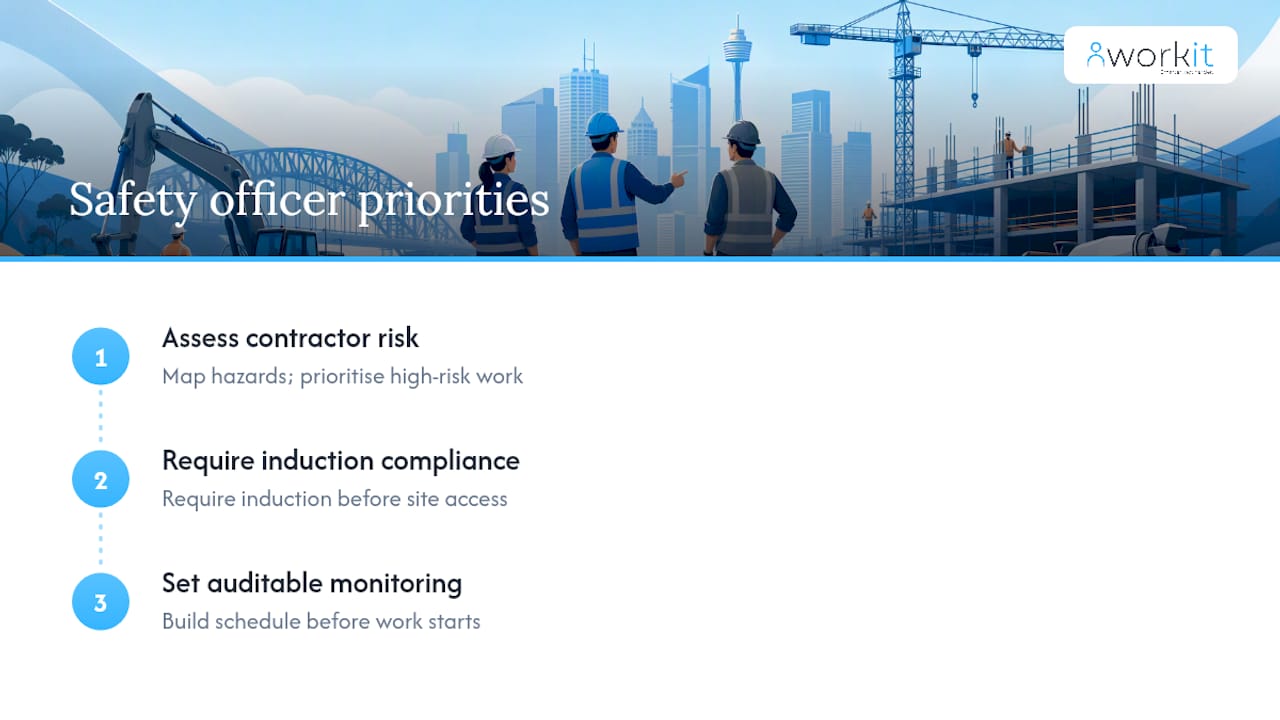
What safety officers should prioritise first
The three actions that deliver the biggest risk reduction fastest are: identify your highest-risk contractor activities, lock in induction compliance before site access is granted, and implement an auditable monitoring schedule.
Most safety officers I speak with know their legal obligations in theory. The gap is almost always in execution: inductions that happen informally, audits that get deferred, and subcontractor chains that nobody is watching. The WHS Act does not distinguish between a deliberate breach and a negligent one when it comes to penalties. Both expose the PCBU.
Start with risk. Map every contractor engagement against the hazards it creates. High-risk work at heights, in confined spaces, or with energised systems needs the most rigorous controls. Routine maintenance by a licensed tradesperson needs a solid process too, but the audit cadence can be lighter. Proportionality is built into “reasonably practicable,” but proportionality still requires you to have done the risk assessment.
Induction compliance is the second priority because it is the most visible failure point in regulator investigations. A contractor who was never properly inducted, or whose induction lapsed, is a liability you could have prevented. Digital induction platforms remove the human error from this entirely.
Auditable monitoring is third because it is the difference between a PCBU who can demonstrate active oversight and one who cannot. The OHS Body of Knowledge is clear that procurement strategy and active engagement, not just safety artefacts, are what separate effective contractor safety management from paper compliance. Build your monitoring schedule before the contractor starts, not after the first incident.
Workit gives Australian PCBUs one place to manage contractor compliance
Managing contractors in Australia means handling prequalification records, digital inductions, SWMS storage, audit logs, and incident reports, often across multiple sites and contractor cohorts. Workit brings all of that into one platform built specifically for Australian businesses, at $5 per employee per month with every module included.
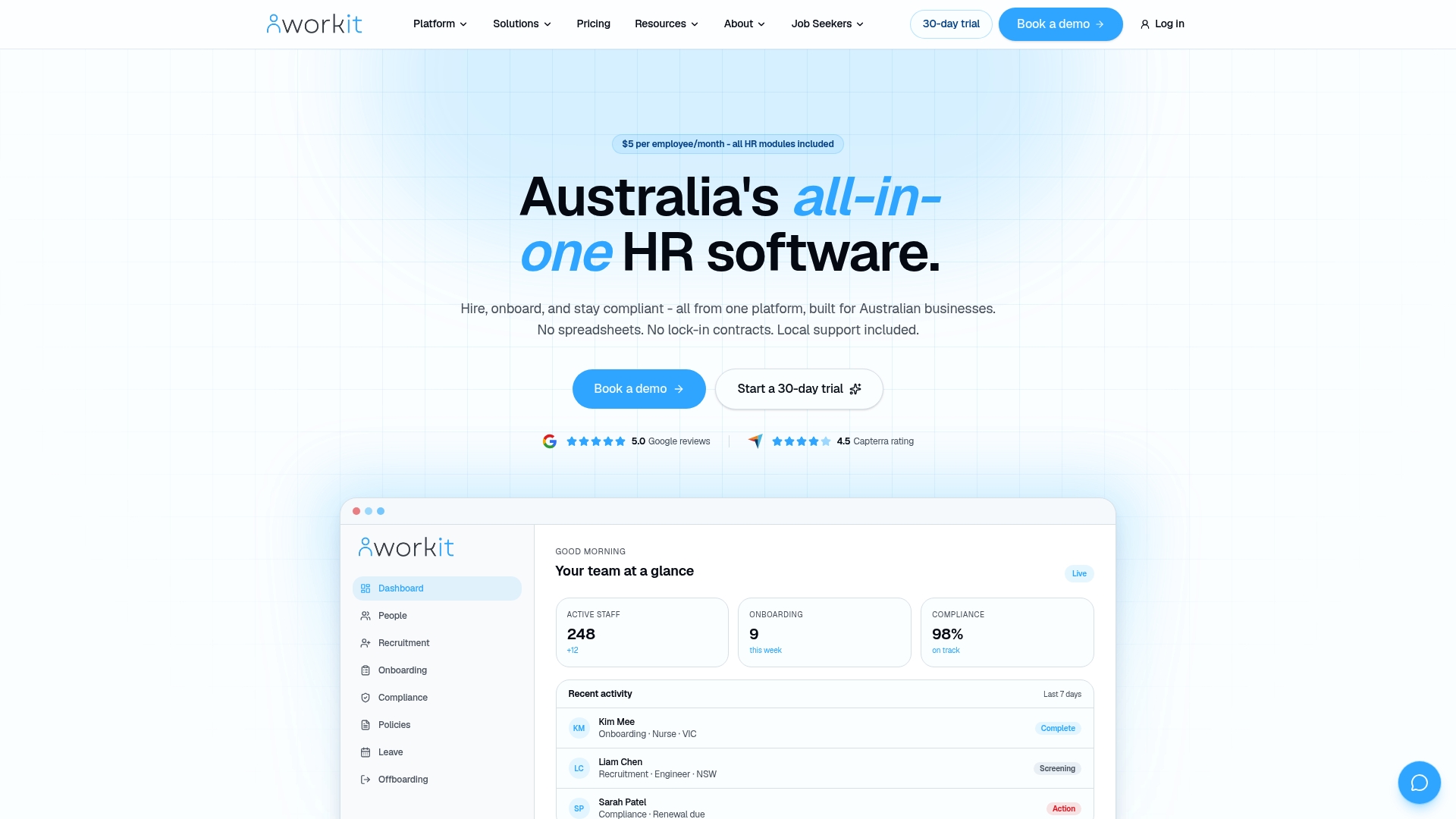
Workit’s onboarding software handles digital inductions with timestamped completion records and automatic expiry alerts. The compliance management module tracks licence and insurance currency, flags gaps before they become audit findings, and produces exportable reports in the format regulators expect. Integration with Xero means contractor engagement data and compliance status sit alongside payroll, with no duplicate data entry. Local support from an Australian team means you get practical help fast, not a ticket queue.
Book a demo to see how Workit maps to your contractor management process from prequalification through to offboarding.
Sources
Use these authoritative sources to support your implementation and audit defence.
- Contractor management: guidance for Commonwealth PCBUs (Comcare)
- Chapter 12.4: Contractor safety management – OHS Body of Knowledge
- Duties of a PCBU | Safe Work Australia
A practical note on jurisdiction: the WHS Act 2011 (Cth) is the model law, but each state and territory has its own WHS legislation. For jurisdiction-specific questions, always check your state regulator’s page first. Store copies of every document you relied on during contractor selection and monitoring. If a regulator asks how you made a decision, your file should answer the question without you having to reconstruct it from memory.
This article is general information, not a substitute for advice from a qualified lawyer. Consult a qualified legal professional about your own circumstances before acting on anything here.
FAQ
What does contractor management mean under Australian WHS law?
Contractor management is the process by which a PCBU meets its duty of care to contractors it engages, directs, or influences. It covers prequalification, contracting, induction, supervision, and incident management, and it cannot be delegated to the contractor.
What are the main responsibilities of a PCBU managing contractors?
A PCBU must verify contractor WHS systems before engagement, deliver a site-specific induction, actively monitor work practices, consult and coordinate with other PCBUs in the chain, and notify the relevant regulator of any notifiable incident.
Who are Tier 1 contractors in Australia?
In the construction and resources sectors, Tier 1 contractors are large, well-resourced firms typically engaged on major projects with mature safety management systems. Tier 2 and Tier 3 contractors are progressively smaller, with less internal WHS capacity, and generally require more oversight from the principal PCBU.
What is the 80% rule for contractors?
It does not affect WHS duties, which apply regardless of the income split.
How can software help with contractor compliance in Australia?
Platforms like Workit centralise prequalification records, digital inductions, SWMS storage, audit logs, and incident reports in one place, producing the timestamped, exportable evidence that Australian regulators expect when they audit a PCBU’s contractor management system.