

What is a HR benchmark report? A guide for Australian HR teams
TL;DR:
- An HR benchmark report compares your organization’s HR metrics with industry standards and peers, revealing performance gaps. It provides external context to internal data, enabling better strategic decisions and workforce improvements. Regular benchmarking ensures accurate insights and guides ongoing HR initiatives effectively.
An HR benchmark report is a structured comparison of your organisation’s HR metrics against external industry standards and peer organisations, revealing where your workforce performance stands relative to others. The report typically covers metrics such as turnover rates, cost-per-hire, and revenue per employee, drawing on authoritative data sources like SHRM and Mercer to set meaningful reference points. Without this external context, internal HR data tells you what is happening but not whether it is good, average, or a cause for concern. For Australian HR professionals and business leaders, understanding what an HR benchmark report covers is the first step toward using it to drive real workforce improvements.
What is a HR benchmark report and why does it matter?
An HR benchmark report compares internal HR metrics against external industry norms to evaluate HR effectiveness and identify improvement opportunities. The distinction from standard internal HR reporting is significant. An internal report tells you your voluntary turnover rate is 18%. A benchmark report tells you the industry median is 12%, which means your organisation has a retention problem worth addressing.

This external context is what gives benchmarking its value. HR benchmarking turns data into strategic insights by revealing whether your metrics are strong, average, or concerning relative to similar organisations. Without that comparison, HR leaders risk making decisions based on incomplete information. The report also supports board-level conversations, because executives respond to data that shows performance relative to peers, not just year-on-year internal trends.
The term “HR benchmark report” is the common shorthand. The recognised industry term is a human capital benchmarking report, and you will see both used interchangeably across SHRM publications and Mercer’s annual workforce surveys.
What metrics and components does an HR benchmark report include?
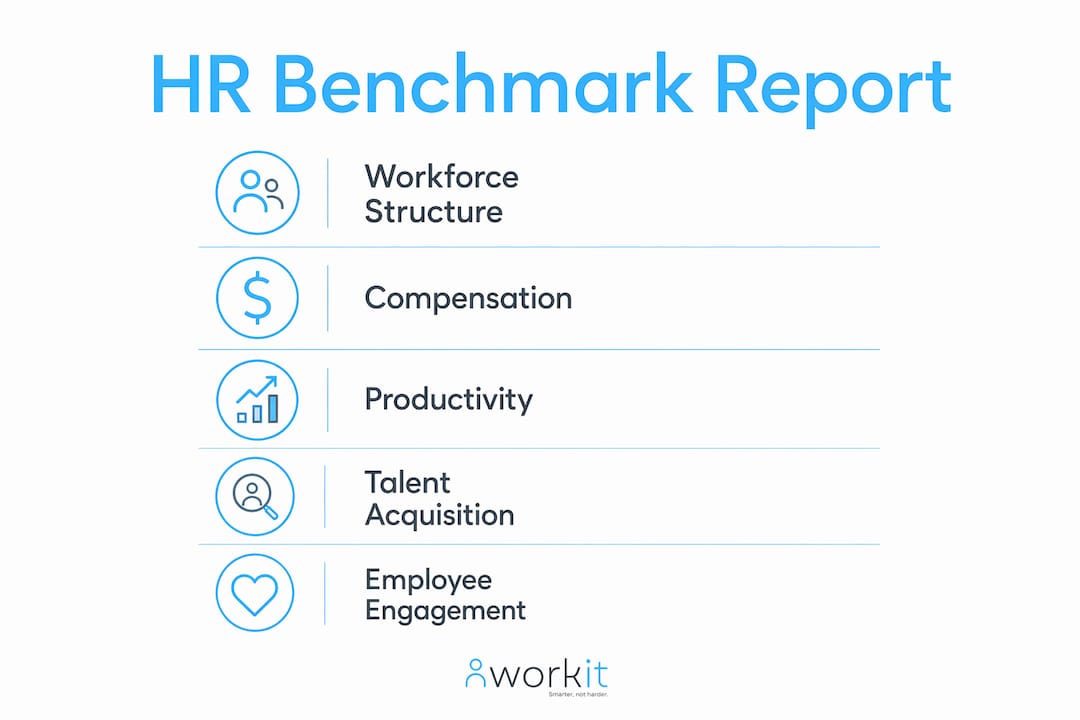
Typical components of a human capital benchmarking report span workforce structure, compensation, productivity, talent acquisition, learning and development, engagement, diversity, and HR technology utilisation. Reports also incorporate both lagging metrics, which reflect historical performance, and leading metrics, which are predictive indicators of future workforce health.
The table below summarises the core components and what each one covers.
| Component | What it measures |
|---|---|
| Talent acquisition | Time-to-hire, cost-per-hire, offer acceptance rate |
| Compensation and benefits | Salary ranges, total rewards, pay equity ratios |
| Productivity | Revenue per employee, output per FTE |
| Employee engagement | Voluntary turnover, absenteeism, engagement scores |
| Learning and development | Training hours per employee, internal promotion rate |
| Diversity and inclusion | Representation by level, gender pay gap |
| HR technology | System adoption rates, self-service usage |
The difference between internal HR reporting and benchmarking metrics is worth clarifying. Internal reports track what your organisation does. Benchmarking metrics are defined consistently across organisations so that comparisons are valid. A “cost-per-hire” figure only means something when every organisation in the peer group calculates it the same way, which is why metric frameworks like ISO 30414 and SHRM standards exist. Using these frameworks is not optional if you want results you can trust.
Pro Tip: Before pulling data for a benchmark report, confirm that your organisation’s metric definitions match the framework used by your data source. A small definitional difference in “time-to-hire” can produce a gap of several days that looks like a performance problem but is actually a measurement inconsistency.
How does the HR benchmarking process work?
HR benchmarking involves four phases: defining relevant metrics, selecting appropriate peer groups, collecting standardised data, and interpreting findings in organisational context. Each phase builds on the last, and skipping steps produces misleading results.
- Define your metrics and objectives. Decide which HR performance metrics align with your current business priorities. A growth-stage business might focus on time-to-hire and onboarding completion rates. A mature organisation might prioritise retention and leadership pipeline metrics.
- Select your peer group. Match peers by industry, organisation size, and workforce complexity. A 200-person professional services firm should not benchmark against a 5,000-person manufacturer. Mismatched peer groups distort insights and lead to poor decisions.
- Collect standardised data. Use consistent definitions for every metric. Reference ISO 30414 or SHRM standards to align your calculations with those of your peer group. Collect data from a consistent time period, typically the previous financial year.
- Interpret findings in context. A metric that sits below the peer median is not automatically a problem. Consider your organisation’s stage, strategy, and operating environment before drawing conclusions. A higher-than-median cost-per-hire may reflect a deliberate investment in quality talent, not inefficiency.
- Document and share findings. Translate the analysis into a report that connects each metric to a business implication. Pair it with your executive HR reporting workflows so findings reach the right decision-makers.
Pro Tip: The most common peer group mistake is selecting organisations that look similar on the surface but operate in different labour markets. A Sydney-based tech firm and a regional Queensland services business may share an industry code but face entirely different hiring conditions. Always validate peer group relevance before collecting data.
What are the common pitfalls in interpreting HR benchmark reports?
The most damaging mistake in HR benchmarking is treating benchmark figures as rigid targets rather than reference points. A 15% turnover rate only gains meaning when compared against an industry median such as 12%. The gap signals a potential issue. It does not automatically mean your organisation must hit 12% by the next quarter, because context determines whether that gap is a priority or an acceptable trade-off.
Common pitfalls include:
- Cherry-picking benchmarks. Selecting benchmarks that present performance favourably distorts the analysis and wastes the effort. Use the full data set, including metrics where your organisation underperforms.
- Using irrelevant peer groups. Comparing against organisations of a different size, industry, or complexity produces misleading results. Valid benchmarking requires peers matched by size, industry, and workforce complexity.
- Confusing efficiency, effectiveness, and outcomes. A low cost-per-hire is an efficiency metric. It says nothing about whether the people hired are performing well. Outcomes metrics like 90-day retention and performance ratings tell a different story.
- Treating benchmarking as a one-off activity. External norms shift. A benchmark that was accurate two years ago may no longer reflect current market conditions, particularly in a tight labour market.
- Ignoring data quality. Benchmarking data availability does not guarantee quality. Organisations must standardise and interpret data carefully to derive meaningful insights.
Pro Tip: Run a data quality check before every benchmarking cycle. Confirm that your HRIS is capturing the right fields, that definitions have not drifted, and that any manual data entry has been audited. Clean data produces credible findings. Messy data produces confident-sounding conclusions that are wrong.
How can you use HR benchmark reports to improve workforce management?
Effective HR benchmarking is a continuous improvement practice that identifies performance gaps, aligns HR strategy with business goals, and prioritises actions for improved competitiveness. The goal is not to copy what high-performing peers do. The goal is to transform data into decisions that fit your organisation’s specific context.
Practical ways to apply benchmarking findings include:
- Set realistic improvement targets. Use peer medians as a baseline and top-quartile performance as an aspirational target. Moving from the bottom quartile to the median on time-to-hire is a meaningful, achievable goal. Jumping straight to top-quartile performance in one cycle rarely works.
- Align findings with business objectives. If your organisation is scaling rapidly, prioritise talent acquisition and onboarding metrics. If retention is the board’s concern, focus on engagement and voluntary turnover data. Benchmarking findings should feed directly into your HR strategy, not sit in a report that nobody reads.
- Act on specific gaps. A below-median engagement score points toward retention initiatives, manager capability programmes, or compensation reviews. A high cost-per-hire points toward sourcing channel analysis or employer brand investment.
- Revisit benchmarks annually. Benchmarking enables organisations to shift from reactive HR management to predictive human capital strategies. Annual cycles let you track progress, adapt to changing external norms, and anticipate talent needs before they become urgent.
- Connect benchmarking to your HRIS. Accurate benchmarking depends on clean, consistent data. An HRIS that supports standardised reporting reduces the manual effort of data collection and improves the reliability of your findings.
Australian HR teams that have embedded benchmarking into their annual planning cycle consistently report clearer conversations with executive teams and faster alignment on workforce priorities.
Key takeaways
An HR benchmark report only delivers value when your peer group is relevant, your metric definitions are consistent, and your findings are interpreted in organisational context rather than treated as fixed targets.
| Point | Details |
|---|---|
| Definition of benchmarking | An HR benchmark report compares your internal metrics against external peer and industry data to assess HR effectiveness. |
| Metric consistency matters | Use ISO 30414 or SHRM standards to align definitions with your peer group before collecting data. |
| Peer group relevance is critical | Match peers by size, industry, and complexity to avoid misleading comparisons that waste effort. |
| Benchmarks are guides, not targets | Treat benchmark figures as reference points and interpret gaps in the context of your organisation’s strategy. |
| Benchmarking is ongoing | Revisit your benchmarks annually to track progress and respond to shifting labour market conditions. |
Why most organisations get benchmarking wrong the first time
I have seen HR teams invest weeks pulling together benchmarking data, only to present findings that the executive team immediately questions. The problem is almost never the data itself. The problem is peer group selection and the way findings are framed.
The instinct is to benchmark against aspirational peers, the organisations you want to be rather than the organisations you currently resemble. That produces a gap analysis that looks alarming but is not credible, because the comparison is not fair. A 300-person Australian professional services firm should not be measuring its cost-per-hire against a global technology company with a dedicated talent acquisition team of 50 people.
The second mistake I see consistently is treating the benchmark report as a destination rather than a starting point. Teams spend months on the analysis, present it once, and then move on. Benchmarking only creates value when it feeds into a decision, a target, a budget conversation, or a programme review. The report is the input. The improvement is the output.
The organisations that do this well treat benchmarking as a discipline, not a project. They run it on a consistent annual cycle, they use the same peer group and metric definitions each time, and they connect findings directly to their HR planning process. That consistency is what turns benchmarking from an interesting exercise into a genuine management tool.
— Stephen
Workit makes HR reporting straightforward for Australian teams
Accurate benchmarking starts with clean, consistent HR data, and that requires a system that captures the right information without relying on spreadsheets or manual entry.
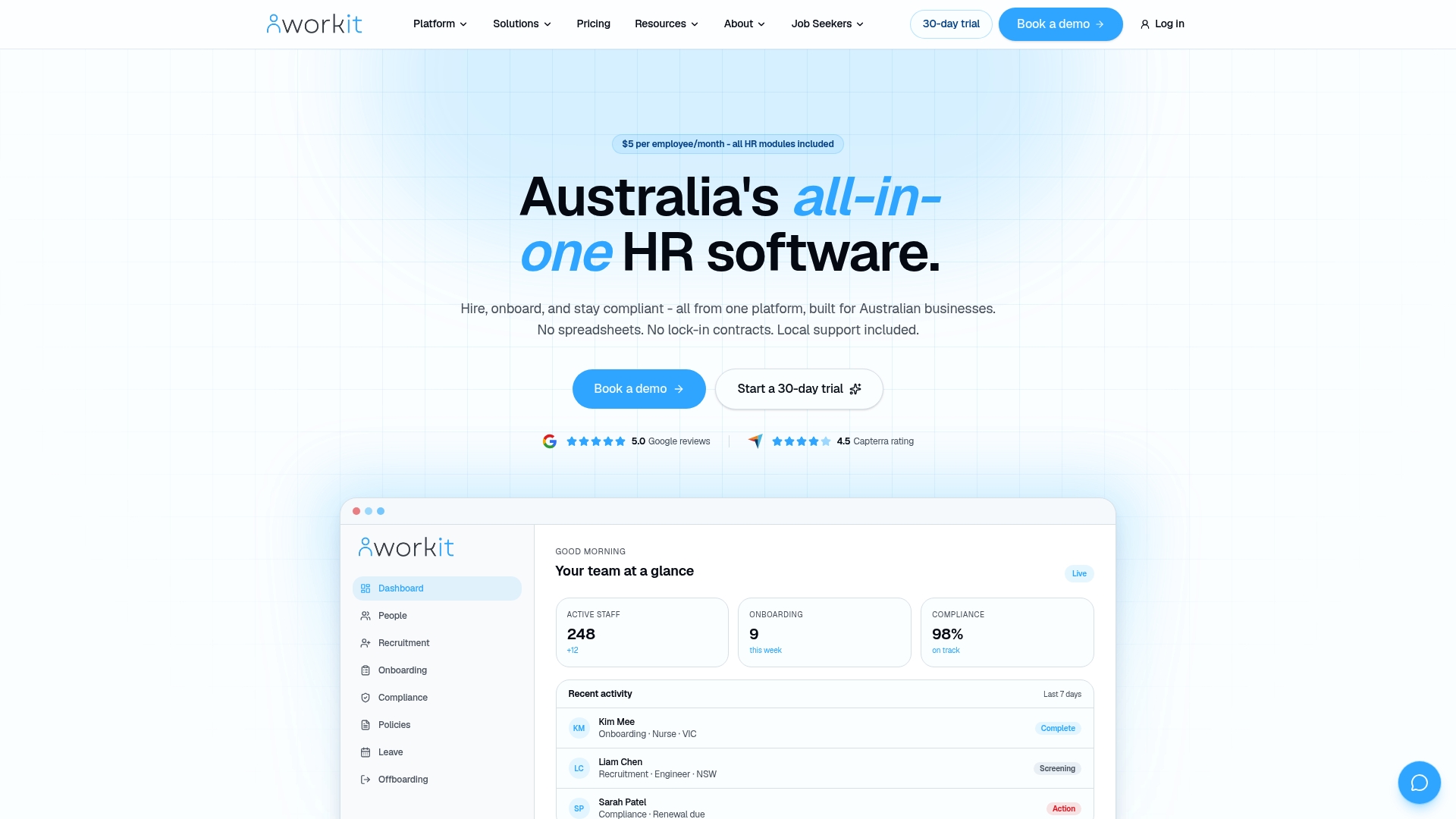
Workit is built specifically for Australian businesses, with HR reporting tools that give you real-time visibility across the metrics that matter most for benchmarking: turnover, headcount, time-to-hire, and engagement data, all in one place. At $5 per employee per month with all modules included, Workit removes the cost barrier that keeps smaller Australian teams from accessing the same quality of workforce data as larger enterprises. Book a demo to see how Workit can support your next benchmarking cycle.
FAQ
What is a HR benchmark report?
An HR benchmark report compares your organisation’s internal HR metrics, such as turnover, cost-per-hire, and revenue per employee, against external industry standards and peer organisations to assess HR effectiveness and identify improvement opportunities.
How is HR benchmarking different from standard HR reporting?
Standard HR reporting describes what is happening inside your organisation. HR benchmarking adds external context by comparing your metrics against peer medians, which reveals whether your performance is strong, average, or below par relative to comparable organisations.
What data sources are used in HR benchmark reports?
Authoritative sources include SHRM’s annual benchmarking surveys, Mercer’s workforce data, and frameworks such as ISO 30414, which standardises HR metric definitions to ensure valid comparisons across organisations.
How often should an organisation update its HR benchmark report?
Organisations should revisit benchmarks annually. Labour market conditions, industry norms, and peer performance shift over time, so an annual cycle keeps your reference points current and your improvement targets realistic.
What is the biggest mistake in HR benchmarking?
The most common mistake is selecting an irrelevant peer group. Comparing your organisation against peers that differ significantly in size, industry, or complexity produces misleading results and leads to poor workforce decisions.