

HR data accuracy: what it is and how to keep it clean
HR data accuracy means every field in your HR system, from job title to pay rate, matches reality closely enough that leaders can act on it without double checking. The fastest way to start improving it is running a field-level audit of your tier-one fields today: employee status, job code, base pay, manager and location.
Two numbers explain why this matters. Only 3% of company data meets basic quality standards, according to Harvard Business Review, and poor data quality costs organisations an average of US$12.9 million a year, per Gartner figures cited by AIHR. Workit builds validation into data entry so these errors get caught before they spread.
- Run a tier-one field audit this week
- Assign an owner for each field type
- Set a completeness target before you set anything else
Key Takeaways
HR data accuracy improves fastest when teams validate tier-one fields at entry, assign named stewards, and measure completeness monthly rather than annually.
| Point | Details |
|---|---|
| Start with tier-one fields | Audit employee status, job code, base pay, manager and location before anything else. |
| Validate at entry, not downstream | Dropdowns and range checks stop errors before they enter reports or payroll. |
| Measure four KPIs monthly | Track completeness, accuracy, consistency and timeliness on a one-page scorecard. |
| Assign named stewards | Each data domain needs one accountable owner with a written refresh cadence. |
| Consolidate your system of record | Workit’s single HRIS applies validation rules and real-time reporting across onboarding, payroll and compliance for $5 per employee per month. |
Table of Contents
- Why HR data accuracy shapes every decision you make
- What actually causes inaccurate HR data
- Your quarter-one checklist: audit, fix, prevent
- How do you measure HR data accuracy?
- Who owns HR data accuracy in your organisation?
- What a single system of record does for accuracy
- Impact of inaccurate HR data on compliance and legal risks
- Training programs for HR staff on data accuracy best practices
- Technological tools and software solutions to automate accuracy checks
- Author perspective: what to prioritise in the first 90 days
- Keep HR data accurate without adding more manual work
- Sources
- FAQ
Why HR data accuracy shapes every decision you make
Bad HR data does not just sit quietly in a spreadsheet. It shows up in board reports that get questioned, payroll runs that need correcting, and workforce plans built on headcount numbers nobody trusts. Once leaders catch a dashboard being wrong twice, they stop using the dashboard.
Decision makers routinely stop relying on HR reporting the moment they spot an error they cannot explain, reverting to gut instinct instead of the numbers in front of them, according to analysis of poor data quality’s downstream effects.
That trust, once lost, is hard to rebuild. It also blocks the next wave of HR technology. SHRM’s research on data-first AI adoption points out that duplicates, missing values and inconsistent formats are the main reasons HR AI projects stall before they start. You cannot forecast attrition or model pay equity on records that are wrong a third of the time. Clean data is not a nice-to-have layer under analytics. It is the analytics.
What actually causes inaccurate HR data
Most HR data problems trace back to a handful of repeat offenders, and they rarely announce themselves until a report or a pay run exposes them.
- Manual file handoffs. Spreadsheets moving between recruitment, payroll and finance introduce transcription errors every time a human retypes a number.
- Siloed systems with no shared source of truth. When onboarding, payroll and performance tools do not talk to each other, the same employee ends up with three slightly different records.
- Missing validation at entry. A date field that accepts any text, or a salary field with no range check, lets typos through unchecked.
- Duplicate records. Rehires, contractor conversions and merged entities routinely create two profiles for one person.
- Inconsistent free-text fields. “Sydney,” “SYD” and “NSW Office” all describe the same location but read as three different values to a reporting tool.
- Stale org structures. Managers change teams, but the reporting line in the system does not, so approval workflows route to someone who left the role months ago.
These surface fastest in payroll reconciliation and headcount reports, where a single wrong pay rate or duplicate employee ID can throw out an entire pay run.
Your quarter-one checklist: audit, fix, prevent
Treat this as a rolling sequence, not a one-off project. Each phase feeds the next.
- Audit tier-one fields first. Pull a sample of records and calculate completeness for employee status, job code, base pay, manager and location, the fields industry guidance flags as highest impact for payroll and reporting.
- Build a data dictionary. Define what each field means, its accepted format, and who is allowed to edit it. Tier your fields so everyone knows what gets fixed first.
- Validate at the point of entry. Gartner’s guidance on data quality is blunt on this: shift controls to where data enters the system, not where it gets reported. A dropdown beats a free-text box every time.
- Deduplicate on a schedule. Run a matching process against name, date of birth and tax file number quarterly, not just when someone notices a problem.
- Automate syncs between systems. Replace manual exports between your payroll platform and HRIS with a live integration wherever you can.
- Monitor continuously. Track error rates and exception reports weekly, and review them at a standing governance meeting.
Pro Tip: Fixing an error at the point of entry costs a fraction of fixing it after it has flowed into three downstream reports, a pattern consultants describe as the 1-10-100 rule applied to HR data. Catch it at the source and you never pay the 100.
How do you measure HR data accuracy?
You measure it against four KPIs, and each one has a simple calculation you can run in a spreadsheet before you ever build a dashboard.
- Completeness: populated mandatory fields divided by total records. A tier-one field sitting below 95% completeness needs immediate attention.
- Accuracy: records matching a verified source (payroll, government ID, contract) divided by total records sampled.
- Consistency: records using the standard format (one location naming convention, one date format) divided by total records.
- Timeliness: records updated within your defined SLA window (for example, five business days after a change) divided by total changes logged.
A one-page scorecard reporting these four numbers for your tier-one fields, refreshed monthly, is enough to earn the trust the earlier dashboard problem cost you. AIHR notes that a simple scorecard like this is often what unlocks budget from finance, because it makes an invisible problem visible in one glance.
Who owns HR data accuracy in your organisation?
Accuracy does not sustain itself after a clean-up project ends. It sustains itself because someone specific is accountable for each field, every quarter, indefinitely.
- Assign a steward per domain. Recruitment owns candidate and offer data, HRIS owns core employee records, payroll owns pay and banking details.
- Write a simple domain contract. State the refresh cadence, the quality threshold and who has edit access for each data domain, an approach federated governance models favour over chasing one impossible single source of truth.
- Trigger a data checkpoint on every org change. A restructure, a new manager, or a location move should automatically flag affected records for review.
- Schedule recurring audits. A quick spot check monthly, a fuller review quarterly, and a full field-level audit annually.
Without a named owner, quality drifts within months of any system going live, a pattern documented in HCM data quality research tracking systems after implementation.
What a single system of record does for accuracy
Every manual handoff between systems is a chance for a number to change on the way through. A single HRIS with validation rules built in removes that chance almost entirely, because the data only gets entered once.
- Recruitment, onboarding, payroll and compliance data live in one record instead of four spreadsheets
- Validation rules catch a malformed pay rate or a missing tax file number before it saves
- Real-time reporting means a scorecard reflects this week’s data, not last month’s export
A field validated once at entry never needs reconciling three times downstream. That single change is the difference between a data quality project that ends and one that never starts.
Process fixes matter first when your team is small and your systems are simple. Once you are juggling more than two or three disconnected tools, a consolidated HRIS platform usually pays for itself faster than another round of manual clean-up.
Impact of inaccurate HR data on compliance and legal risks
Compliance runs on records, and a wrong record is a compliance gap wearing a disguise. Underpayment claims, one of the costliest risks for Australian employers, frequently trace back to an incorrect pay rate, award classification, or hours record that nobody caught before the pay run went out. Fix the number after the fact and you still owe back pay, interest, and potentially penalties.
Award and classification data is a particular exposure point. If an employee’s job code or classification is wrong in the system, every subsequent pay calculation inherits that error, and it can run for months before anyone notices. Terminations carry similar risk: a stale start date, incorrect leave balance, or missing employment history can turn a routine offboarding into a dispute over entitlements owed.
Reporting obligations compound the problem. Gender pay gap reporting, workers’ compensation claims and superannuation guarantee calculations all draw from the same employee records. An error in one flows straight into a statutory report, and correcting a filed report after the fact is far more painful than catching the error before submission.
The practical fix is the same governance discipline covered earlier: validate pay and classification fields at entry, assign a steward accountable for compliance-critical data, and run a scheduled audit before every statutory reporting deadline. Treat compliance fields as tier-one, not as an afterthought, because the legal exposure sits exactly where the data errors do.
Training programs for HR staff on data accuracy best practices
Most data errors are not caused by careless staff. They are caused by staff who were never shown what “correct” looks like for a given field, or why a shortcut that seems harmless creates downstream problems.

A useful training program covers three things. First, the data dictionary itself: every HR team member entering or editing records should know the accepted format for each tier-one field, not just the general concept of “keep data clean.” Second, the reason behind validation rules: staff who understand that a missing manager field breaks an approval workflow are far less likely to skip it under time pressure. Third, a short walk-through of what happens to a record after it leaves their screen, so a recruiter entering a new starter understands that their entry feeds payroll, compliance reporting and performance tracking downstream.
Run this training at onboarding for new HR staff, then refresh it annually alongside your governance review. Keep sessions short and specific to the systems your team actually uses rather than generic data hygiene advice. Pair the training with the scorecard from your KPI reporting, so staff can see the direct link between their data entry habits and the completeness numbers leadership reviews each month. A team that understands the “why” behind a validation rule enforces it far more consistently than one that was simply told to follow it.
Technological tools and software solutions to automate accuracy checks
Manual audits catch problems after they happen. Automated checks catch them before they save, which is where most of the real cost saving lives.
Validation rules built into your HRIS at the field level are the first layer: dropdowns instead of free text, range checks on salary fields, and required-field logic that blocks an incomplete record from saving. The second layer is deduplication matching, which runs automatically against identifiers like tax file number and date of birth to flag likely duplicate records for review rather than waiting for someone to notice two profiles for the same person. The third layer is integration between systems. A live sync between your HRIS and payroll platform removes the manual export-and-import step that introduces so many of the errors covered earlier in this guide.
Reporting tools that pull directly from your system of record, rather than from a manually maintained export, close the loop. If your reporting dashboard reflects live data instead of last month’s spreadsheet, the completeness and accuracy KPIs you calculate are trustworthy the moment you look at them. A CRM data hygiene framework built for a different function shows the same principle applies broadly: automated checks at entry, scheduled deduplication, and reporting from a single source beat any manual clean-up cycle on cost and consistency.
Author perspective: what to prioritise in the first 90 days
Most HR leaders try to fix everything at once and burn out three months in. Prioritise your five tier-one fields, fund a part-time steward role even if it is just two hours a week, and accept that automation will not catch every edge case. A rehire with a gap in service, or a contractor converting to permanent, still needs a human eye. Aim for fewer, better-checked fields over a sprawling clean-up that never finishes.
Keep HR data accurate without adding more manual work
Workit gives you one system of record instead of the spreadsheets and disconnected tools that cause most of the errors covered in this guide. Validation rules catch a missing manager field or a malformed pay rate before it saves, and real-time reporting means your completeness scorecard reflects today’s data, not last month’s export.
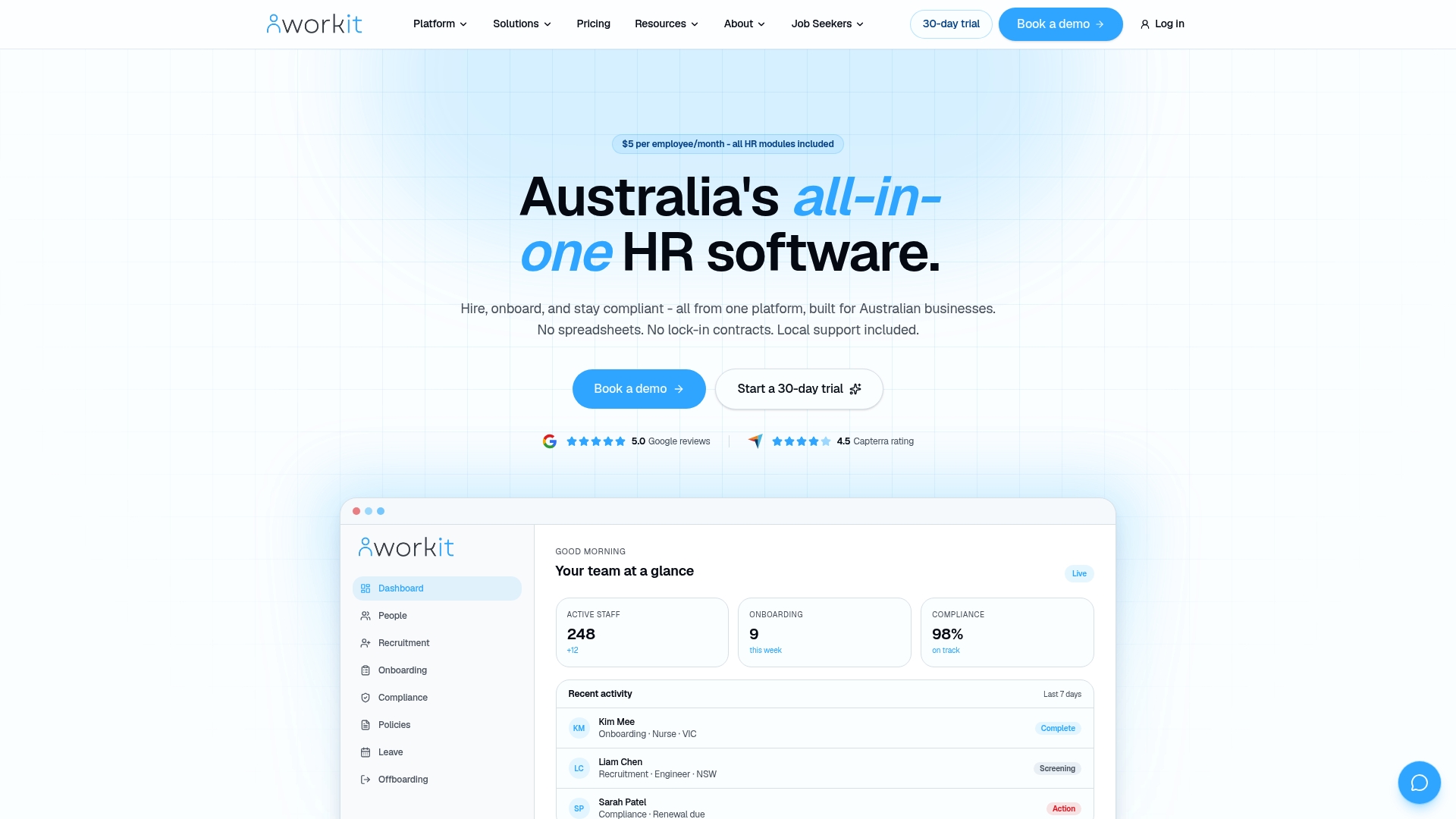
Every module, from onboarding through to compliance and payroll integration, sits under one transparent price of $5 per employee per month, with no hidden fees for the modules covered in this checklist. Local support means a real person answers when your integration throws an error, not a ticket queue. If you are ready to see how a single HRIS handles the audit, validation and reporting steps outlined above, book a demo and walk through your own tier-one fields with the team.
Sources
- Why a data‑first mindset is key to making AI work in HR (SHRM)
- How to improve your data quality (Gartner)
- Only 3% of a company’s data meets basic quality standards (HBR)
- HR data management: a practical guide for 2026 (AIHR)
FAQ
What are the five key HR metrics for data quality?
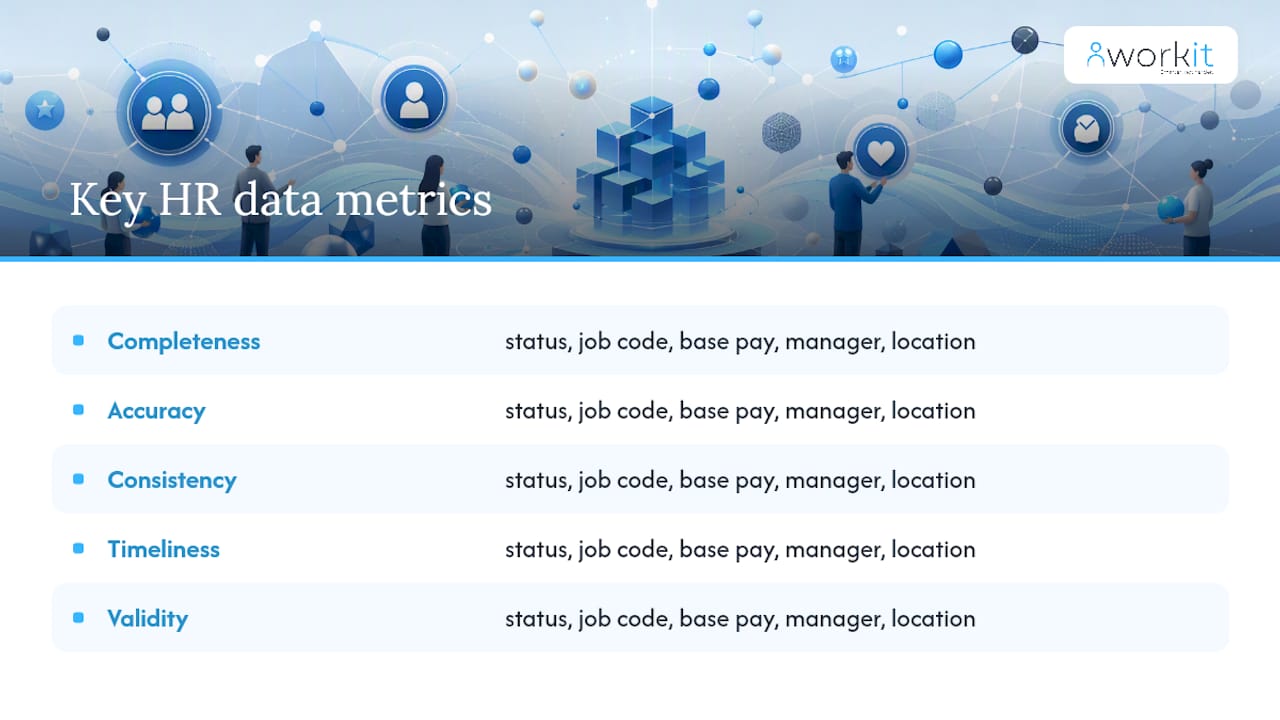
The five most cited are completeness, accuracy, consistency, timeliness and validity, measured against your tier-one fields like employee status, job code, base pay, manager and location.
How do you measure HR data accuracy?
Calculate accuracy by dividing records that match a verified source, such as payroll or a government ID, by the total records sampled, then repeat quarterly to track trends.
How can I check HR data for accuracy?
Run a field-level audit against your data dictionary, sample a set of records, and compare mandatory fields against a trusted source like payroll or contract documents.
What are some examples of HR metrics beyond data quality?
Common examples include headcount, turnover rate, time to hire and absenteeism, all of which depend on accurate underlying employee records to be trustworthy.
Does a single HRIS actually reduce data errors?
Yes. Consolidating onboarding, payroll and compliance into one system of record removes the manual file handoffs that cause most duplicate and inconsistent records.