

What is an HR data audit? A practical guide
TL;DR:
- An HR data audit examines the accuracy, security, and governance of human resources data within an organization. It helps prevent costly errors, compliance penalties, and supports strategic workforce decisions. Regular, structured audits embedded into the HR calendar improve data quality and organizational compliance.
An HR data audit is the systematic process of examining the accuracy, integrity, security, and accessibility of HR data stored across your organisation’s systems. Unlike a broader HR compliance audit, which reviews policies and practices, an HR data audit focuses specifically on the quality and governance of the data itself. For Australian HR professionals and business owners, this distinction matters. Poor data quality creates real financial exposure, from wage overpayments to misclassification penalties, and undermines every workforce decision you make. Getting this process right is one of the most practical things you can do for your organisation.
What is an HR data audit and how does it differ from other audits?

An HR data audit differs from a general compliance audit by focusing on the integrity, accuracy, security, and accessibility of stored HR data rather than on policies or legal practices. A compliance audit asks, “Are we following the rules?” An HR data audit asks, “Is our data correct, complete, and protected?” Both matter, but they require different methods and produce different outcomes.
The scope of an HR data audit covers several distinct data categories. Each category carries its own regulatory obligations and business risks.
| Data category | Examples | Regulatory or business impact |
|---|---|---|
| Payroll data | Base pay, allowances, tax file numbers | Wage compliance, ATO obligations, overpayment risk |
| Personnel files | Employment contracts, certifications, visa status | Fair Work Act obligations, right-to-work verification |
| Benefits data | Superannuation records, leave balances | SG compliance, leave liability accuracy |
| Performance data | Review records, disciplinary notes | Unfair dismissal risk, promotion equity |
| Access and security | System permissions, vendor agreements | Privacy Act obligations, data breach exposure |
The systems involved typically include your HRIS, payroll platform, benefits vendors, and any standalone spreadsheets still in use. A written audit charter, defined before you begin, specifies data owners, retention rules, and the compliance standards you are measuring against. Without that charter, the audit loses focus and accountability.
How to conduct an effective HR data audit
A full HR compliance audit typically takes 4–12 weeks, though meaningful quick wins are achievable within the first seven days. The key is following a structured, repeatable process rather than a one-off review.
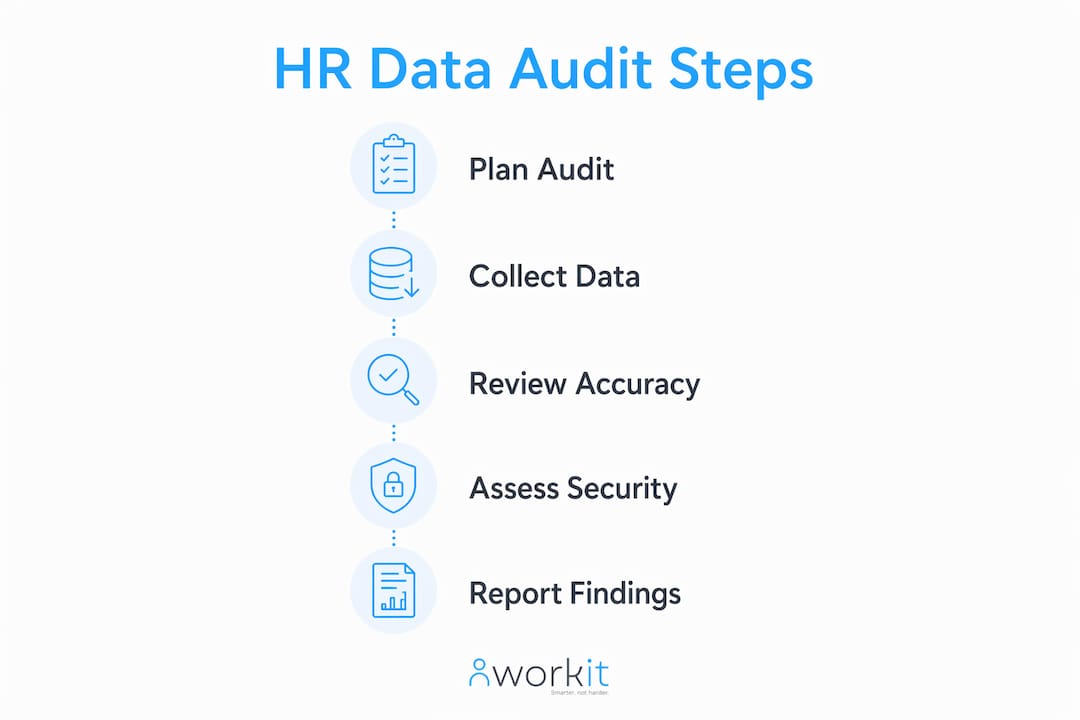
- Define scope and goals in writing. Specify which data categories, systems, and time periods the audit covers. Name the data owners responsible for each area and the compliance standards you are measuring against.
- Centralise data exports from all relevant systems. Starting with centralised HRIS exports is critical for identifying missing, duplicated, or inconsistent records at the outset. Pull payroll, benefits, and personnel data into one place before analysis begins.
- Cross-reference data sets to find errors. Compare payroll records against HRIS records, then against benefits vendor data. Look for mismatches in job grades, pay rates, leave balances, and employment status.
- Assess data security and access controls. Review who has access to sensitive HR data, check vendor data agreements, and confirm your Privacy Act obligations are met.
- Document every finding with a remediation owner and deadline. A finding without an assigned owner rarely gets fixed. Attach a name and a due date to every issue you identify.
- Prioritise and action quick wins first. Obvious errors, such as duplicate records or missing tax file numbers, can often be corrected within days. Clearing these early builds momentum and reduces immediate risk.
- Schedule the next audit before you close this one. Recurring, documented audits are what separate proactive organisations from those reacting to complaints and regulatory inquiries.
Pro Tip: Schedule HR data audits on a fixed annual calendar, not as a response to problems. Organisations that audit reactively always find more issues and face higher remediation costs than those that audit on a planned cycle.
Why is an HR data audit critical for compliance and strategic HR?
The risks from inaccurate HR data are concrete and costly. A single data entry error can cause a $27,000 overpayment when incorrect base pay or job grade mappings go undetected across a payroll cycle. That figure represents one example. Multiply it across a workforce and the financial exposure becomes significant.
Regulatory scrutiny is also increasing. US immigration authorities conducted over 6,400 I-9 audits in a single fiscal year, nearly double prior volumes. While that figure reflects the US context, the trend toward more frequent regulatory inspection is consistent across developed economies, including Australia, where Fair Work compliance audits have grown in scope and frequency.
External professional HR audits typically cost between $5,000 and $25,000, with annual audits recommended by the Society for Human Resource Management. That cost is a useful benchmark for understanding the value of building internal audit capability. Organisations that develop repeatable internal processes reduce their dependence on expensive external reviews.
Beyond compliance, HR data audits support strategic workforce decisions. Compensation data audits use regression analysis to identify pay equity gaps, which is increasingly important as pay transparency expectations grow across Australian workplaces. Workforce planning accuracy depends entirely on the quality of the underlying data. If your headcount, classification, and pay data contain errors, your planning assumptions are wrong from the start.
HR audits are best understood as strategic performance evaluations, not compliance tasks. That framing shifts the outcome from “we passed the audit” to “we now have a clearer picture of our workforce and where we need to act.”
Pro Tip: After each audit, produce a one-page summary of findings for your leadership team. Translating data errors into dollar figures and compliance risks gets faster attention and budget than a technical audit report.
Common challenges when performing HR data audits
Most HR data audits run into the same set of problems. Knowing them in advance lets you plan around them.
- Underestimating the time required. Reconciling data across multiple systems takes longer than expected, particularly when spreadsheets are still in use alongside your HRIS. Build buffer time into your audit plan from the start.
- Failing to define scope formally. An audit without a written charter drifts. Teams end up reviewing what is easy to access rather than what carries the most risk. Write the scope document before you touch any data.
- Finding errors but skipping remediation. Identifying problems is only half the job. Without assigned owners and deadlines, findings sit in a report and nothing changes. Remediation accountability is non-negotiable.
- Focusing only on compliance and missing strategic insights. An audit that only checks boxes misses the opportunity to identify pay equity issues, workforce planning gaps, and data governance weaknesses. Build a strategic review step into your process.
- Relying on one-off audits. Consistent, repeatable audit processes with clear documentation are what distinguish proactive organisations from those reacting to audits and complaints. A single audit gives you a snapshot. A programme of audits gives you a trend.
Pro Tip: If your organisation still manages HR data across spreadsheets and disconnected systems, your first audit will take significantly longer than subsequent ones. Use the first audit as a baseline, then invest in centralising your data before the next cycle. For guidance on managing audit costs effectively, small business accounting resources can offer useful benchmarks.
How technology supports the HR data auditing process
All-in-one HR platforms reduce the manual effort of data auditing by centralising records in a single system. When payroll, personnel files, benefits, and compliance data all live in one place, cross-referencing becomes a reporting task rather than a reconciliation project.
The features that matter most for audit readiness fall into a few clear categories.
| Feature category | What it does | Audit benefit |
|---|---|---|
| Centralised data storage | Single source of truth for all HR records | Eliminates reconciliation across disconnected systems |
| Automated data validation | Flags missing fields, duplicates, and format errors | Reduces manual checking time |
| Compliance tracking | Monitors certification expiry, visa status, and obligations | Prevents compliance gaps between audits |
| Audit trail and reporting | Records who changed what and when | Supports regulatory inquiries and internal accountability |
| Access controls | Role-based permissions for sensitive data | Meets Privacy Act obligations |
Workit’s HRIS platform for Australian businesses includes compliance tracking, real-time reporting, and centralised data management across all HR modules. For organisations looking to build Fair Work compliance and audit readiness, having these features in one platform removes the biggest source of audit complexity: fragmented data.
The 15 must-have features for HR software include audit trail functionality, automated compliance alerts, and role-based access controls. These are not premium add-ons. They are baseline requirements for any organisation that takes data governance seriously.
Key takeaways
An HR data audit is the most direct way to protect your organisation from financial loss, regulatory penalties, and poor workforce decisions caused by inaccurate data.
| Point | Details |
|---|---|
| Definition is specific | An HR data audit examines data integrity and security, not policies or practices. |
| Scope must be written | A formal audit charter with named data owners prevents scope drift and accountability gaps. |
| Cross-referencing is critical | Comparing payroll, HRIS, and benefits data catches costly errors that single-system reviews miss. |
| Audits have strategic value | Pay equity analysis and workforce planning accuracy both depend on clean, verified HR data. |
| Repeatability is the goal | Annual, documented audit cycles produce better outcomes than one-off compliance reviews. |
Why HR data audits deserve a permanent place in your people strategy
I have worked with HR teams that treat the annual audit as a fire drill. They scramble, find problems, fix the obvious ones, and move on. Twelve months later, the same issues reappear. The audit becomes a ritual rather than a tool.
The organisations that get genuine value from HR data audits treat them differently. They embed the process into the annual HR calendar, assign clear ownership before the audit begins, and use findings to drive decisions, not just corrections. When a pay equity gap surfaces in the data, it becomes a conversation with the leadership team, not a note in a report that nobody reads.
The other thing I have seen consistently is that the first audit is always the hardest. Fragmented systems, legacy spreadsheets, and years of unverified data entries create a backlog that takes real effort to clear. But the second audit is dramatically faster. And by the third, the process is genuinely routine.
If you are a business owner or HR manager who has never formally audited your HR data, the HR compliance health check is a practical starting point. Do not wait for a Fair Work inquiry or a payroll discrepancy to make the case for you. The data problems are already there. The audit just makes them visible.
— Stephen
Workit makes HR data auditing simpler for Australian businesses
Running a thorough HR data audit requires clean, centralised data and the right tools to surface problems quickly. Workit is built for exactly that. As an all-in-one HR platform designed for Australian businesses, Workit brings payroll data, personnel records, compliance tracking, and reporting into a single system at $5 per employee per month, with no hidden fees and all modules included.
Whether you are preparing for your first formal audit or building a repeatable annual process, Workit gives your team the visibility to find issues before they become costly. Explore the HR compliance software built for Australian teams, or book a demo to see how Workit supports audit readiness from day one.
FAQ
What is an HR data audit?
An HR data audit is a structured review of the accuracy, integrity, security, and accessibility of HR data stored across your organisation’s systems. It differs from a compliance audit by focusing on data quality and governance rather than policies or legal practices.
How often should an HR data audit be conducted?
The Society for Human Resource Management recommends annual audits. Recurring, documented audit cycles produce better compliance outcomes than one-off reviews and are far less costly than responding to regulatory inquiries.
How long does an HR data audit take?
A full HR data audit typically takes 4–12 weeks, depending on the size and complexity of your organisation. Mid-size businesses can achieve meaningful quick wins within the first seven days by focusing on centralising data and fixing obvious errors.
What are the biggest risks of skipping an HR data audit?
Undetected data errors can cause substantial financial losses, including wage overpayments and misclassification penalties. Inaccurate HR data also undermines pay equity analysis, workforce planning, and Fair Work compliance.
What HR data should be included in an audit?
A thorough audit covers payroll records, personnel files, benefits data, performance records, and system access controls. Each category carries distinct regulatory obligations under Australian law, including the Fair Work Act and the Privacy Act.