

How to plan a career path that actually works
TL;DR:
- A career path is a deliberate sequence of roles and decisions toward professional goals. Regularly updating a flexible plan helps navigate industry shifts and personal growth effectively.
A career path is the deliberate sequence of roles and decisions that moves you toward your professional goals. Most people treat it as a vague aspiration rather than a working plan, and that gap is where careers stall. The good news is that career development planning is a living process you update as you grow, not a document you write once and file away. Career experts recommend reviewing your plan every 6–24 months to stay aligned with industry shifts and personal change. That cadence keeps your professional growth intentional rather than accidental.
What are the main stages of a career path?
Every career moves through three broad phases: exploration, building career capital, and deployment. Understanding which phase you are in right now changes what you should prioritise.
-
Exploration. This is where you test potential directions before committing to one. Early-career professionals and career changers typically spend one to two years in this phase, though young adults entering the workforce often take longer. The goal is not to find the perfect answer. It is to gather enough real-world data to make a better decision. Take on stretch projects, informational interviews, short courses, or contract roles in fields that interest you.
-
Building career capital. Once you have a direction, the focus shifts to acquiring skills, credentials, and relationships that make you more valuable. This phase is about deliberate accumulation. You choose roles not just for salary but for what they teach you and who they connect you with. A junior analyst who volunteers for cross-functional projects builds a broader skill base than one who stays in their lane.
-
Deployment. This is the phase where you apply your accumulated skills to work that meets your personal criteria: income, impact, autonomy, or whatever matters most to you. Deployment does not mean you stop learning. It means your choices are now driven by contribution and fulfilment rather than skill acquisition alone.
Each phase has a different success metric. Exploration measures learning. Building capital measures skill growth. Deployment measures impact and satisfaction.
Pro Tip: Do not linger in exploration indefinitely. Spending more than two years testing without committing to a direction is a sign you need to make a provisional choice and learn from doing, not from researching.
How do you set a long-term career vision without getting stuck?
A career vision is a broad picture of the roles, impact areas, and values you want your work to reflect over the next ten to fifteen years. It is not a job title. It is a direction.
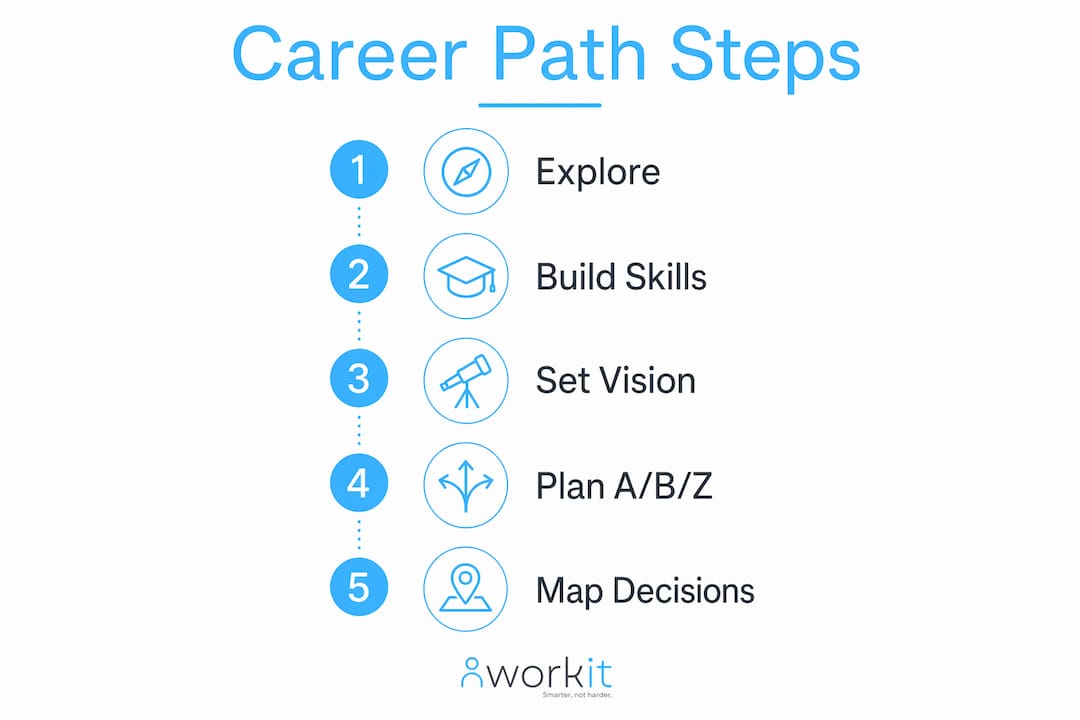
The danger with vision is fixation. Locking onto one specific outcome, such as “I must be a CFO by 40,” creates rigidity that makes you brittle when circumstances change. Balancing a flexible long-term vision with a focus on your best immediate next step produces better outcomes than chasing a fixed destination.
Two planning approaches help here:
- Working backwards. Start from your vision and identify the roles, skills, and relationships you would need to get there. This reveals gaps you can address now. If your vision involves leading a technology team, and you have no technical credentials, that gap is your next priority.
- Working forwards. Scan growing fields and emerging roles to spot where momentum is building. If a sector is expanding rapidly, entering it early gives you an advantage that is hard to replicate later. This approach is especially useful when your vision is still forming.
Combining both approaches gives you a plan that is grounded in where you want to go and responsive to where the world is heading. Revisit your vision every time you complete a major role or qualification. Your values and priorities shift with experience, and your vision should reflect that.
Pro Tip: Write your career vision in terms of the impact you want to have and the values you want to live, not just the title you want to hold. Titles change. Impact and values are more durable guides.
What is the A/B/Z career planning method?
The A/B/Z planning method is one of the most practical frameworks for managing career uncertainty. It works by preparing three distinct plans simultaneously rather than betting everything on one outcome.
- Plan A is your ideal scenario. It is the career direction you most want to pursue right now, based on your skills, interests, and opportunities. You invest the most energy here.
- Plan B is a close alternative. If Plan A becomes unavailable or less attractive, Plan B is a pivot you could make without starting from scratch. A marketing manager whose Plan A is a creative director role might have a Plan B in brand strategy, which uses similar skills in a different context.
- Plan Z is your fallback. It is the option that keeps you financially stable and professionally active if everything else falls through. Plan Z is not failure. It is the safety net that gives you the confidence to take risks in Plans A and B.
The power of this method is psychological as much as practical. Knowing you have a fallback reduces the anxiety that leads to paralysis. You make bolder moves when you know the floor is not too far below you.
Pro Tip: Set a specific trigger for reviewing your plans, such as a performance review, a redundancy announcement, or a six-month calendar reminder. Do not wait for a crisis to ask whether your plan still fits.
Regularly updating all three plans is as important as creating them. Career development plans that evolve with your experience stay relevant. Plans that sit untouched become obstacles.
How do you map your career path for better decisions?
Careers are not linear. Each job choice opens certain future doors and closes others. Treating your professional life as a branching system rather than a straight ladder gives you a far more accurate picture of your options.
A career path map is a visual tool that plots your current position, your target destinations, and the decision points in between. Think of it as a 20-year branching roadmap with flags at each major fork. At each flag, you ask: what skills do I need to take this branch, and what do I give up if I go the other way?

| Planning tool | What it shows | Best used for |
|---|---|---|
| Career path map | Decision points and branching options over time | Long-term direction setting |
| Skill gap analysis | Distance between current skills and target role requirements | Prioritising learning investments |
| Scenario planning | Multiple possible futures based on different choices | Risk assessment and contingency thinking |
Skill gap analysis is the most immediately useful tool for most people. You identify the competencies required for your target role, compare them against what you currently have, and rank the gaps by importance. That ranking becomes your learning agenda.
Career progression frameworks with competency mapping and performance metrics make this process measurable. When organisations define role levels with clear skill benchmarks, you can see exactly what is required to move from one level to the next. If your employer does not provide this, build your own version using job descriptions from roles you aspire to hold.
Values alignment also belongs in any career map. Choosing roles that conflict with your core values produces short-term gain and long-term dissatisfaction. Map your values alongside your skills so that both inform your decisions.
Key takeaways
A career path works best when it combines a flexible long-term vision, a structured risk plan, and a visual map of the decisions that shape your options over time.
| Point | Details |
|---|---|
| Review your plan regularly | Update your career plan every 6–24 months to stay aligned with industry and personal change. |
| Know your current phase | Exploration, building capital, and deployment each require different priorities and success metrics. |
| Use the A/B/Z method | Prepare an ideal plan, a close alternative, and a fallback to reduce anxiety and support bold moves. |
| Map decisions visually | A branching career map reveals which choices open or close future opportunities over time. |
| Align roles with values | Choosing work that conflicts with your values produces dissatisfaction regardless of salary or title. |
Why I think most career advice misses the point
Most career advice focuses on the destination. Get the right degree. Land the prestigious firm. Reach the senior title. That framing puts all the pressure on a future outcome you cannot fully control, and it leaves people frozen when the path does not go as planned.
What I have observed, both in my own recalibrations and in watching others navigate rapid industry change, is that the people who fare best are not the ones with the clearest ten-year plan. They are the ones who are genuinely curious about their next step and honest about what is not working right now.
The A/B/Z method resonates with me precisely because it normalises having a fallback. Admitting that Plan A might not work is not pessimism. It is the kind of clear-eyed thinking that lets you take real risks rather than safe ones.
Career planning is not a one-off task you complete in a weekend workshop. It is a practice you return to every few months with fresh eyes. The goal is not a perfect plan. The goal is a plan you will actually use and update.
— Stephen
How Workit supports career progression in your organisation
Tracking career development across a team is genuinely difficult without the right tools. Workit’s all-in-one HRIS platform gives Australian businesses a single place to manage role definitions, skill benchmarks, and performance data, so career progression becomes transparent rather than guesswork.
With Workit, managers can build clear progression frameworks, run skill gap reviews, and track employee growth over time, all within one platform at $5 per employee per month with no hidden fees. If you want to see how structured career development tools work in practice, book a demo and a local Australian team member will walk you through it.
FAQ
What is a career path?
A career path is the intentional sequence of roles and decisions that moves you toward your professional goals. It combines a long-term vision with specific near-term steps and a plan for managing uncertainty.
How often should I review my career plan?
Career experts recommend reviewing your plan every 6–24 months. Major life events, industry shifts, or a change in personal values are also good triggers for an earlier review.
What is the A/B/Z career planning method?
The A/B/Z method prepares three plans simultaneously: Plan A is your ideal direction, Plan B is a close alternative, and Plan Z is a stable fallback. This structure reduces anxiety and supports bolder career moves.
How long does the exploration phase last?
Early-career professionals and career changers typically spend one to two years in the exploration phase. Spending significantly longer without committing to a direction is a signal to make a provisional choice and learn from experience.
How do I identify skill gaps in my career development?
Compare the competencies listed in job descriptions for your target roles against your current skills. Rank the gaps by importance and treat that ranking as your learning agenda for the next six to twelve months.