

Equal opportunity employer: a practical guide for 2026
TL;DR:
- Employers must meet legal requirements to be considered equal opportunity employers under Australian law.
- Data-driven diversity hiring improves performance by identifying bias points and fostering inclusive workplaces.
An equal opportunity employer is defined as an organisation that makes all hiring and employment decisions based on merit, free from discrimination on the basis of race, gender, age, disability, religion, or any other protected attribute. In Australia, this commitment is governed by legislation including the Fair Work Act 2009, the Age Discrimination Act 2004, and the Racial Discrimination Act 1975, enforced by the Australian Human Rights Commission. The business case is clear: diverse teams outperform peers by 39%, according to 2026 industry research. That figure means organisations that treat equal employment opportunity as a compliance checkbox are leaving measurable performance gains on the table. Getting this right requires more than a statement on a job ad. It demands systemic changes across recruitment, interviewing, and retention.
What does an equal opportunity employer mean legally in 2026?
Equal opportunity employer status is not self-declared. It is defined by the legal obligations your organisation must meet under Australian and, where relevant, international law.
Australian employers must comply with the following core frameworks:
- Fair Work Act 2009: prohibits adverse action against employees or candidates based on protected attributes including race, sex, age, disability, and union membership.
- Age Discrimination Act 2004: bars discrimination in employment decisions on the basis of age, covering both older and younger workers.
- Racial Discrimination Act 1975 and Sex Discrimination Act 1984: prohibit direct and indirect discrimination in recruitment, promotion, and termination.
- Disability Discrimination Act 1992: requires reasonable adjustments for candidates and employees with disability.
- Australian Human Rights Commission Act 1986: establishes the Australian Human Rights Commission as the primary body receiving and investigating discrimination complaints.
For Australian businesses with global operations or US-based clients, additional standards apply. US federal law requires employers to direct applicants to the EEOC Know Your Rights poster as a legal standard for non-discrimination notification. Large federal contractors, such as Northrop Grumman, must maintain formal Affirmative Action Programs audited annually. Smaller businesses operate under different compliance expectations, but the core obligation to eliminate hiring funnel bias applies universally.
Your practical compliance responsibilities include publishing a clear equal opportunity employer statement, training hiring managers on anti-discrimination obligations, documenting recruitment decisions, and conducting regular HR compliance health checks to identify gaps before they become liabilities.
How does data-driven diversity hiring improve business performance?
The performance case for diversity hiring is no longer theoretical. Diverse teams outperform their peers by 39%, based on 2026 industry research. That gap reflects the direct contribution of varied perspectives to problem-solving, decision-making, and customer understanding.
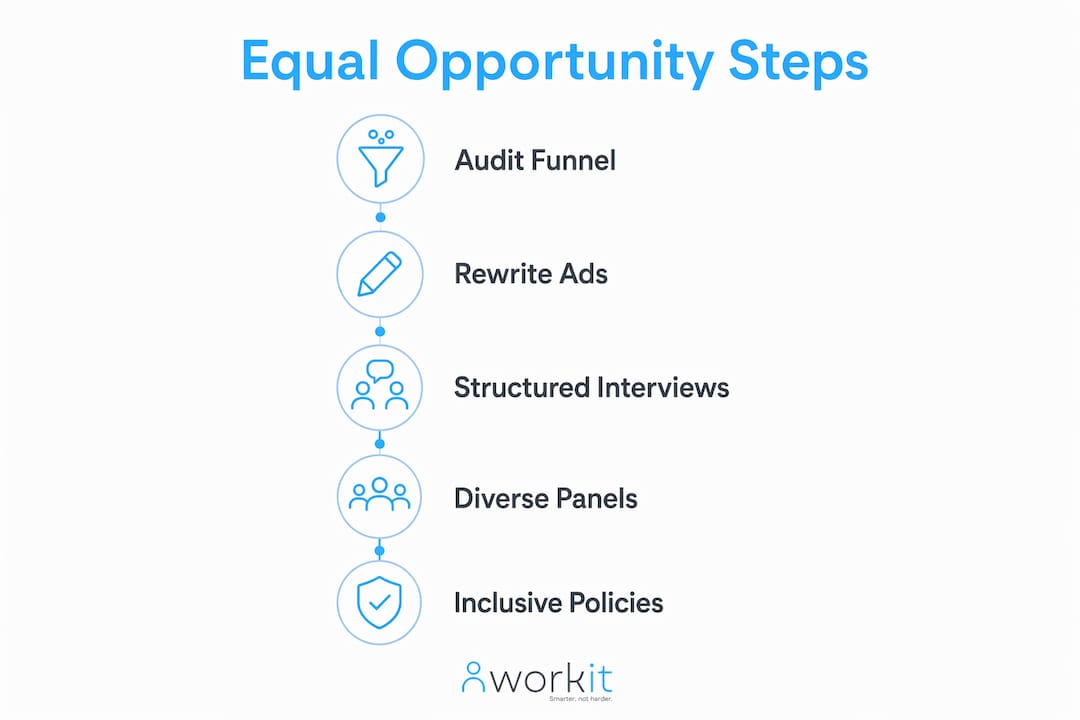
Data-driven hiring means tracking candidate progression at every stage of your recruitment funnel by demographic group. Without this data, you cannot know whether bias is entering at the job ad, the screening stage, or the interview panel. Auditing candidate stage progression by demographic is the most reliable method for identifying exactly where drop-offs occur and targeting interventions precisely.
The metrics worth tracking include:
- Applicant diversity: the demographic breakdown of everyone who applies.
- Screening pass rates by group: which groups advance from application to interview at lower rates.
- Interview-to-offer conversion: whether certain groups are interviewed but rarely offered roles.
- Retention by demographic: whether diverse hires stay at the same rate as the broader workforce.
Beyond compliance, diversity and inclusion drive innovation and competitiveness in the 2026 market. Organisations with genuinely inclusive cultures report stronger employee engagement, broader customer reach, and faster product innovation cycles. These are business outcomes, not HR metrics.
Pro Tip: Set a quarterly review cadence for your hiring funnel data. A single annual audit misses seasonal bias patterns and gives you less time to course-correct before the next intake.
Which strategies build and maintain equal opportunity employer status?
Genuine equal opportunity requires structural changes to how you recruit, assess, and retain people. Good intentions without process change produce inconsistent results.
1. Audit your recruitment funnel
Map every stage from job ad to offer and pull demographic data at each point. Hiring bias often sits inside the funnel, not just in the sourcing pipeline. If women apply at equal rates but advance to interview at lower rates, the screening criteria need examining, not the sourcing channels.

2. Rewrite job advertisements
Remove non-exclusionary language from job ads. Phrases like “cultural fit,” “digital native,” or “recent graduate” can screen out protected groups without any deliberate intent. Use plain language and list only the skills genuinely required for the role.
3. Implement structured interviews and blind reviews
Standardising screening with blind reviews and structured rubrics evaluates candidates on skills and reduces unconscious bias more effectively than diversity training alone. Structured rubrics mean every candidate answers the same questions and is scored against the same criteria. Blind reviews remove names, addresses, and graduation years from applications before shortlisting.
4. Build diverse candidate slates and interview panels
Require at least two candidates from underrepresented groups on every shortlist. Pair this with diverse interview panels. A panel that reflects only one demographic group introduces its own bias, regardless of how structured the questions are.
5. Develop inclusive workplace policies
Equal employment opportunities extend beyond recruitment. Pay transparency, flexible work arrangements, and equitable parental leave policies all affect whether diverse employees stay. Systemic culture change, including pay transparency and equitable grading, is what separates organisations that retain diverse talent from those that simply hire it.
The table below summarises the key strategies and their primary purpose:
| Strategy | Primary purpose |
|---|---|
| Funnel audit by demographic | Identify where bias enters the process |
| Structured interview rubrics | Standardise assessment and reduce subjectivity |
| Blind application reviews | Remove identifying information before shortlisting |
| Diverse candidate slates | Prevent default selection from familiar networks |
| Pay transparency and flexible benefits | Retain diverse talent beyond the hiring stage |
Pro Tip: Use your recruitment software to tag and report candidate demographics at each funnel stage. Manual tracking in spreadsheets introduces its own errors and makes auditing unreliable.
How do you write a credible equal opportunity employer statement?
An equal opportunity employer statement is a formal declaration that your organisation does not discriminate in any employment decision. A weak statement is a liability. A strong one signals genuine commitment and attracts a broader candidate pool.
A credible statement includes:
- A clear list of the protected attributes your organisation does not discriminate on (race, sex, age, disability, religion, sexual orientation, and others relevant to your jurisdiction).
- A reference to the specific legislation your organisation complies with, such as the Fair Work Act 2009 or the Australian Human Rights Commission Act 1986.
- A contact point for candidates who need reasonable adjustments during the recruitment process.
- A brief mention of active inclusion initiatives, such as Employee Resource Groups or transparent pay bands.
Avoid two common pitfalls. The first is implying preferential treatment or quotas. Statements that promise to “prioritise” certain groups can expose you to reverse discrimination claims and misrepresent what equal opportunity means. The second is listing aspirational values without any operational substance. Candidates and regulators both read these statements carefully.
Pro Tip: Review your equal opportunity employer statement every 12 months against current legislation. Australian anti-discrimination law is updated periodically, and an outdated statement can create compliance gaps.
Pair your statement with visible inclusion initiatives. Employee Resource Groups, published diversity goals, and transparent reporting on workforce composition all demonstrate that the statement reflects practice, not just policy. HR reporting tools make it straightforward to publish workforce composition data without manual compilation.
Key takeaways
Equal opportunity employer status is built through systemic process changes, not statements alone. Organisations that audit their hiring funnels, use structured rubrics, and track demographic data consistently outperform those that rely on goodwill and training.
| Point | Details |
|---|---|
| Legal compliance is the baseline | Australian employers must meet obligations under the Fair Work Act, Age Discrimination Act, and related legislation. |
| Data reveals where bias lives | Auditing funnel drop-offs by demographic identifies the exact stage where intervention is needed. |
| Structured processes beat training | Blind reviews and interview rubrics reduce unconscious bias more reliably than awareness programmes alone. |
| Retention requires systemic change | Pay transparency and equitable policies keep diverse talent; hiring alone does not. |
| Statements need operational backing | An EOE statement is only credible when paired with published goals and visible inclusion initiatives. |
Why equal opportunity is a systems problem, not a pipeline problem
I have worked with HR teams across Australian businesses for long enough to recognise a pattern. Most organisations that struggle with diversity are not short of good intentions. They are short of process discipline.
The most common mistake I see is treating equal opportunity as a sourcing challenge. Teams invest in diverse job boards, attend community events, and rewrite their employer brand. Then they wonder why the demographic mix at offer stage looks identical to what it did three years ago. The problem is almost never the top of the funnel. The real bias sits inside the funnel, at the screening and interview stages, where subjective judgements compound quietly.
The second mistake is confusing quota targets with systemic change. Businesses often fail on equal opportunity by chasing numbers rather than standardising the process that produces those numbers. A structured rubric applied consistently will produce fairer outcomes than any target set without process reform behind it.
What actually works is treating your hiring process like an audit trail. Every decision should be documented, every stage should produce demographic data, and that data should go to leadership on a regular cadence. When leaders see the funnel data, the conversation shifts from “we need more diverse candidates” to “why are we losing candidates at the phone screen?” That is the right question.
The organisations I have seen make genuine progress share one trait: they treat equal employment opportunity as an ongoing operational discipline, not a project with a completion date.
— Stephen
How Workit supports equal opportunity employer compliance
Managing equal opportunity compliance across recruitment, onboarding, and reporting is a significant operational task. Workit is built specifically for Australian businesses and brings all of those processes into one platform, at $5 per employee per month with no hidden fees.
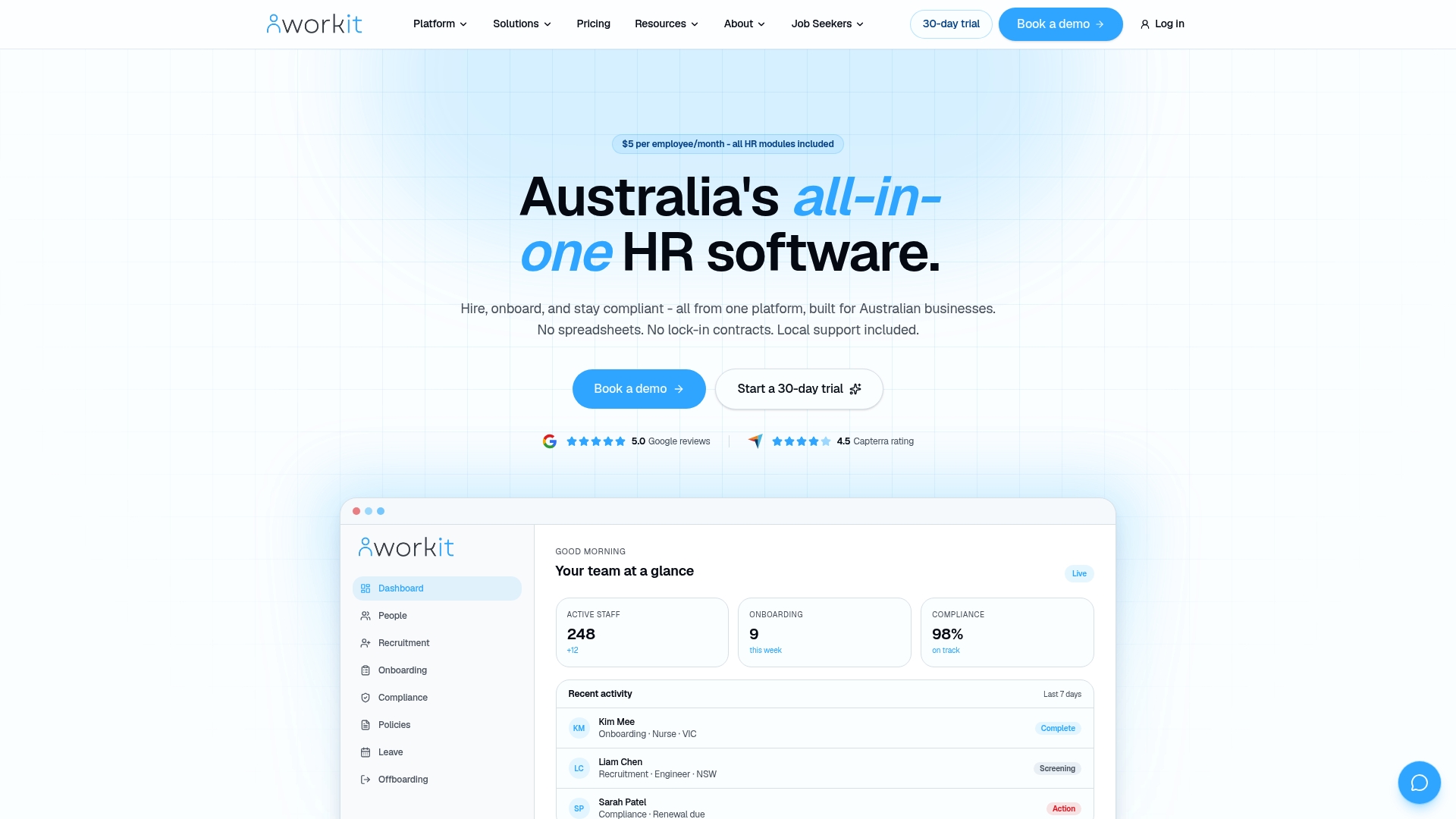
Workit’s compliance management tools give you real-time visibility over your obligations under Australian anti-discrimination law. The recruitment module tracks candidate demographics through every funnel stage, so you can identify drop-offs and act on them quickly. Reporting is built in, which means your equal opportunity employer data is always ready for leadership review or an external audit. If you want to see how Workit handles compliance and diversity hiring in practice, book a demo and speak with the local support team.
FAQ
What is an equal opportunity employer?
An equal opportunity employer makes all hiring and employment decisions based on merit, without discrimination on the basis of race, gender, age, disability, religion, or other protected attributes. In Australia, this obligation is governed by the Fair Work Act 2009 and enforced by the Australian Human Rights Commission.
What should an equal opportunity employer statement include?
A strong statement lists all protected attributes, references the relevant legislation, provides a contact point for reasonable adjustment requests, and mentions active inclusion initiatives. It should be reviewed annually to stay current with Australian anti-discrimination law.
How do you identify bias in a hiring process?
Audit candidate progression at every funnel stage by demographic group. Drop-offs at the screening or interview stage, rather than at sourcing, indicate where bias is entering the process and where structured interventions are needed.
Does being an equal opportunity employer mean using quotas?
No. Equal opportunity means standardising the process so that all candidates are assessed on the same criteria. Quota-based hiring without process reform does not eliminate bias and can create legal exposure under Australian anti-discrimination law.
What is the business case for diversity hiring?
Diverse teams outperform their peers by 39%, based on 2026 industry research. Beyond performance, organisations with inclusive cultures report stronger employee engagement, broader customer reach, and greater capacity for innovation.