

Corporate values: a practical guide for leaders
TL;DR:
- Corporate values are guiding beliefs that shape how organizations behave, decide, and treat people.
- They must be actively defined, embedded, and regularly reviewed to truly influence culture and behavior.
Corporate values are defined as the fundamental beliefs that guide how an organisation behaves, makes decisions, and treats its people. They are not aspirational slogans. They are the operating principles that shape culture, drive hiring decisions, and determine how employees act when no policy exists to tell them what to do. Research shows that a structured listening programme tied to values recognition increased employee agreement that company values reflect culture by 23 points. That result tells you everything about the gap between values on a wall and values in practice. For business leaders and HR professionals, closing that gap is the real work.
What are corporate values and why do they matter?
Corporate values are the non-negotiable principles that define how your organisation operates, not just what it produces. They answer the question every employee eventually asks: “How do we do things here?” Without a clear answer, culture forms anyway. It just forms without your input.

The importance of corporate values becomes most visible during pressure. When a difficult client pushes back, when a team member cuts a corner, when a hire looks perfect on paper but feels wrong in the room. Values give people a shared framework for those moments. They replace the need for a manager to be present for every decision.
Strong values also directly affect employee engagement. Organisations that embed values into recognition, onboarding, and performance conversations build cultures where people understand what is expected and why it matters. That clarity reduces friction and increases retention.
What are the different types of corporate values?
HR frameworks distinguish four value types: core, aspirational, permission-to-play, and accidental. Each plays a different role, and confusing them is one of the most common mistakes leaders make.
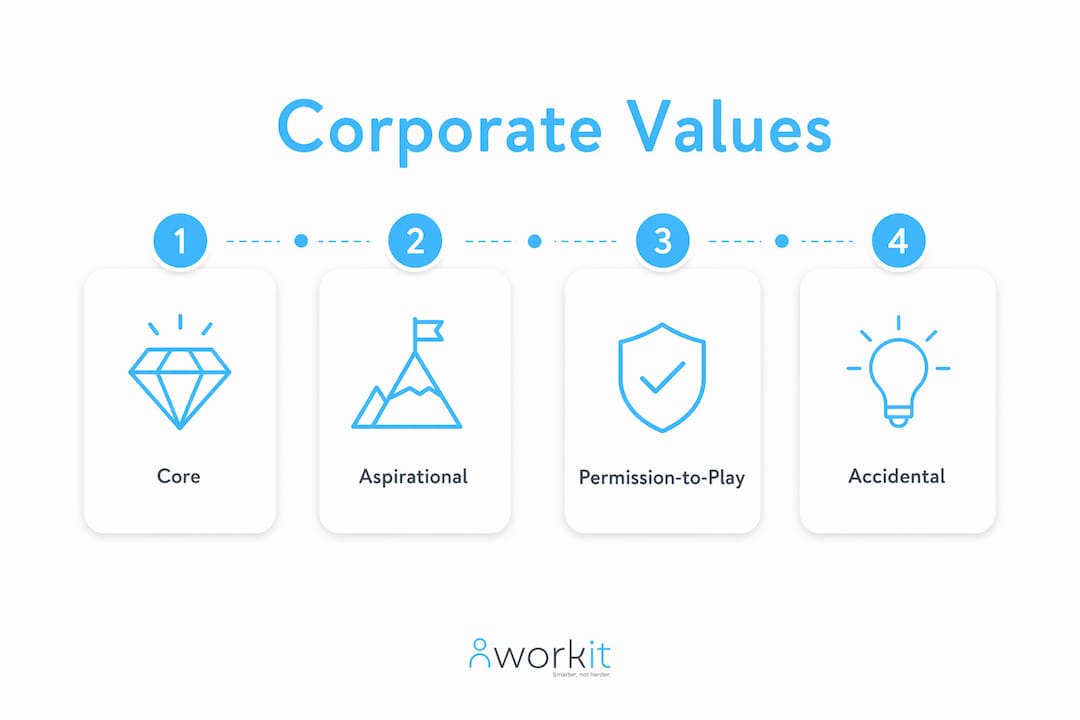
| Value type | Definition | Strategic consideration |
|---|---|---|
| Core | Non-negotiable beliefs that define the organisation | Limit to 3–5; these drive hiring, firing, and decisions |
| Aspirational | Values the organisation wants but does not yet live | Use carefully; can mislead employees if treated as current |
| Permission-to-play | Baseline expectations any professional should meet | Do not list these as differentiators; they are table stakes |
| Accidental | Values that emerged organically without intention | Audit regularly; some are worth keeping, others are not |
The practical recommendation is to limit core values to 3–5 principles for daily operational use. More than five and employees stop remembering them. Values inflation is a real risk. When every value sounds like a LinkedIn post, none of them guide behaviour.
- Drop generic terms like “integrity” or “excellence” unless you can define exactly what they look like in your business
- Test each value against a real decision: “Would this value have helped us make a better call last quarter?”
- Remove any value that applies equally to every business in your industry
Pro Tip: Run a subtractive exercise with your leadership team. List every value candidate, then cut anything that a competitor could claim without blinking. What remains is closer to your real identity.
How do you define authentic company values?
The biggest mistake in defining company values is confusing what you wish were true with what is already true. Aspirational values feel good in a workshop. They fail in practice because employees can see the gap between the poster and the behaviour.
Authentic values come from lived experience. They are observable in how people act when leadership is not watching. The most reliable method to surface them is a three-phase approach.
-
Desk research. Gather existing documents: your company mission statement, past performance reviews, exit interview notes, and any customer feedback that mentions your team’s behaviour. Look for patterns in the language people use to describe your organisation.
-
Behavioural interviews. Ask employees to share specific stories. “Tell me about a time you made a decision without a clear rule to follow. What guided you?” These stories reveal the values already operating in your culture. Behavioural interviews uncover real values that no survey can capture.
-
Data analysis. Triangulate the stories with quantitative signals: which behaviours get praised in peer recognition, which traits appear in your best performers’ profiles, which issues surface repeatedly in team feedback.
This three-phase method consistently produces 3–5 values that employees recognise as real, not invented. That recognition is what makes them stick.
Pro Tip: Involve frontline employees in the interview phase, not just managers. The values that guide a warehouse team’s daily decisions are often more revealing than the ones a leadership team articulates in a boardroom.
Avoid the trap of letting the CEO define values alone. When values come only from the top, they reflect the founder’s aspirations rather than the organisation’s actual culture. The result is a set of principles that leadership believes in and employees ignore.
Why do values matter more for small and medium businesses?
For smaller organisations, core values function as primary judgement mechanisms where no rule exists. A founder cannot be present for every decision. Values distribute that judgement across the team.
At small scale, every hire has an outsized cultural impact. One person who operates outside the organisation’s values can shift the culture of a ten-person team faster than any policy can correct. Values give you a hiring filter that goes beyond skills and experience.
The recommended format for a small business values exercise is a focused four-hour workshop with your founding team or senior leaders. The goal is to identify 4–6 company-specific values with clear behavioural definitions for each.
- Write one sentence defining what each value means in your business specifically
- Write one example of what the value looks like in action
- Write one example of what violating the value looks like
- Test each value against your three best performers: do they all demonstrate it?
The difference between values and culture is worth naming here. Culture is the sum of all behaviours in your organisation. Values are the principles you use to shape that culture deliberately. You cannot control culture directly. You can influence it through the values you hire for, recognise, and enforce.
Pro Tip: Values should create a sense of belonging at work for the right people and healthy discomfort for those who do not fit. If your values make everyone equally comfortable, they are not doing their job.
How do you embed values into daily organisational practices?
Defining values is the easy part. Embedding values requires moving beyond posters to daily rituals that connect principles to behaviour. The organisations that do this well treat values as operational tools, not communication assets.
| Embedding method | How it works | Evidence of impact |
|---|---|---|
| Values-based hiring | Use values as explicit criteria in interview scorecards | Reduces cultural misalignment in new hires |
| Onboarding conversations | Discuss values with examples in the first week | Sets behavioural expectations before habits form |
| Peer recognition tied to values | Link praise to a named value in recognition systems | Reinforces which behaviours the organisation rewards |
| Performance reviews | Include values-based criteria alongside output metrics | Makes values a career development factor, not just a slogan |
| Leadership language | Leaders name values when explaining decisions | Models values-based decision-making for the whole team |
An always-on recognition system that links praise to company values is one of the most cost-effective embedding tactics available. It requires no budget, only consistency. When a team member calls out a colleague for demonstrating a specific value by name, that value becomes real in a way that a poster never can.
Culture should be treated as a living organism. Values need to be reviewed regularly through ongoing listening to employee stories about real decision-making moments. A values set that was accurate three years ago may not reflect who your organisation has become.
Pro Tip: Add a standing agenda item to your quarterly leadership meeting: “Which value did we live well this quarter? Which did we fall short on?” That conversation keeps values from becoming decorative.
The role of leadership in sustaining values cannot be overstated. When a leader makes an exception to a stated value for a high performer, the message to the rest of the team is clear. Values apply to everyone or they apply to no one.
Key takeaways
Strong corporate values require deliberate definition, consistent embedding, and ongoing review to genuinely shape organisational culture and employee behaviour.
| Point | Details |
|---|---|
| Limit core values to 3–5 | More than five values reduces memorability and operational impact across the team. |
| Use behavioural interviews | Ask employees for real decision-making stories to surface values that already exist in your culture. |
| Embed values in daily rituals | Tie recognition, hiring, and performance reviews to named values, not just output metrics. |
| Treat culture as ongoing | Review values regularly through employee feedback, not just in annual planning cycles. |
| Leadership sets the standard | When leaders make exceptions to values, the entire framework loses credibility with the team. |
Values on paper versus values in practice
The hardest part of this work is not defining values. It is enforcing them when it costs something.
I have seen organisations with genuinely well-crafted values frameworks collapse under the weight of one leadership decision that contradicted everything on the wall. A top performer kept despite repeated values violations. A promotion given to someone who achieved results through behaviour the organisation claimed to reject. Those moments do more damage than having no values at all, because they reveal the gap between stated and lived values in the most public way possible.
The organisations that get this right accept something uncomfortable early: real values will exclude some people. They will constrain behaviour. They will require you to have difficult conversations with people who deliver results but undermine culture. That is not a flaw in the framework. That is the framework working.
What I find genuinely rewarding about this work is watching a team make a good decision without being asked. When a frontline employee declines a shortcut because it does not reflect how the organisation operates, and they can name the value that guided them, that is the outcome worth working towards. It takes time, consistency, and a leadership team willing to be held to the same standard as everyone else.
— Stephen
How Workit supports value-driven HR practices
Building a values-driven culture requires more than good intentions. It requires systems that make values visible at every stage of the employee lifecycle.
Workit is built for Australian businesses that want to embed their values into the moments that matter: hiring, onboarding, and performance management. The employee onboarding software gives you a structured way to introduce values in the first week, before habits form. The performance management module lets you build values-based criteria directly into review conversations. All modules are included at $5 per employee per month, with no hidden fees and local support from a team that understands the Australian market. Book a demo to see how Workit fits your organisation.
FAQ
What are corporate values?
Corporate values are the fundamental beliefs that guide how an organisation makes decisions and treats its people. They define expected behaviour across hiring, daily operations, and performance.
How many core values should a company have?
Industry best practice recommends limiting core values to 3–5 principles. More than five reduces memorability and makes values harder to enforce consistently.
What is the difference between core and aspirational values?
Core values reflect how the organisation already operates. Aspirational values describe what the organisation wants to become. Treating aspirational values as current ones misleads employees and erodes trust.
How do you embed values into organisational culture?
Embed values by tying them to peer recognition, onboarding conversations, hiring criteria, and performance reviews. Values that appear only on walls or websites do not influence daily behaviour.
How often should company values be reviewed?
Values should be reviewed at least annually through structured employee feedback. Culture evolves continuously, and values that no longer reflect real behaviour lose their operational usefulness.