

How to measure HR software vendor performance
TL;DR:
- A reliable vendor performance assessment combines technical, operational, adoption, and outcome KPIs mapped to SLAs and compliance evidence. Tracking metrics like uptime, support response, active user rate, and onboarding time helps evaluate long-term vendor stability and service quality. Regular reviews, enforceable SLA clauses, and employee feedback ensure continuous alignment with organizational goals and compliance requirements.
The most reliable way to measure HR software vendor performance is a weighted vendor scorecard that combines technical, adoption, operational, and outcome KPIs mapped directly to contract SLAs and compliance evidence. Use this quick checklist to sanity-check any vendor right now:
- Uptime and support SLA: Is the vendor meeting agreed availability targets, and are support tickets resolved within contracted timeframes?
- Adoption rate: What percentage of your workforce actively uses the platform each month?
- Integration health: Are payroll and third-party integrations running without manual workarounds?
- Outcome metrics: Are time-to-hire, quality of hire, and onboarding time improving since go-live?
- Security and compliance proof: Has the vendor demonstrated Notifiable Data Breaches scheme readiness and alignment with Australian Privacy Principle 8 (APP 8) for cross-border data handling?
- Commercial stability: Is the vendor financially sound, with a credible product roadmap?
Workit, built specifically for Australian businesses, maps to each of these categories out of the box, making it a practical in-market reference point throughout this guide.
Table of Contents
- Why should you measure HR software vendor performance?
- What KPIs and metrics should you track?
- How do you build a repeatable vendor scorecard?
- How do you translate scorecard results into contract terms?
- What compliance and integration checks matter in Australia?
- Who owns measurement, and how often should you review?
- What measurement mistakes do HR teams commonly make?
- What does the scorecard look like in practice?
- Does your vendor’s product roadmap actually align with your needs?
- How do you assess whether a vendor will still be here in five years?
- How do you benchmark your vendor against the Australian market?
- How does employee feedback fit into vendor performance measurement?
- Key takeaways
- What most HR teams get wrong about vendor measurement
- Workit gives you a ready-made measurement framework for Australian HR
- Useful sources and references
- FAQ
Why should you measure HR software vendor performance?
Measuring vendor performance protects your organisation from three compounding risks: compliance failure, adoption collapse, and hidden cost blowout. Australian organisations that skip structured measurement often discover problems only after a payroll error, a data breach notification, or a frustrated workforce that has quietly stopped using the system.
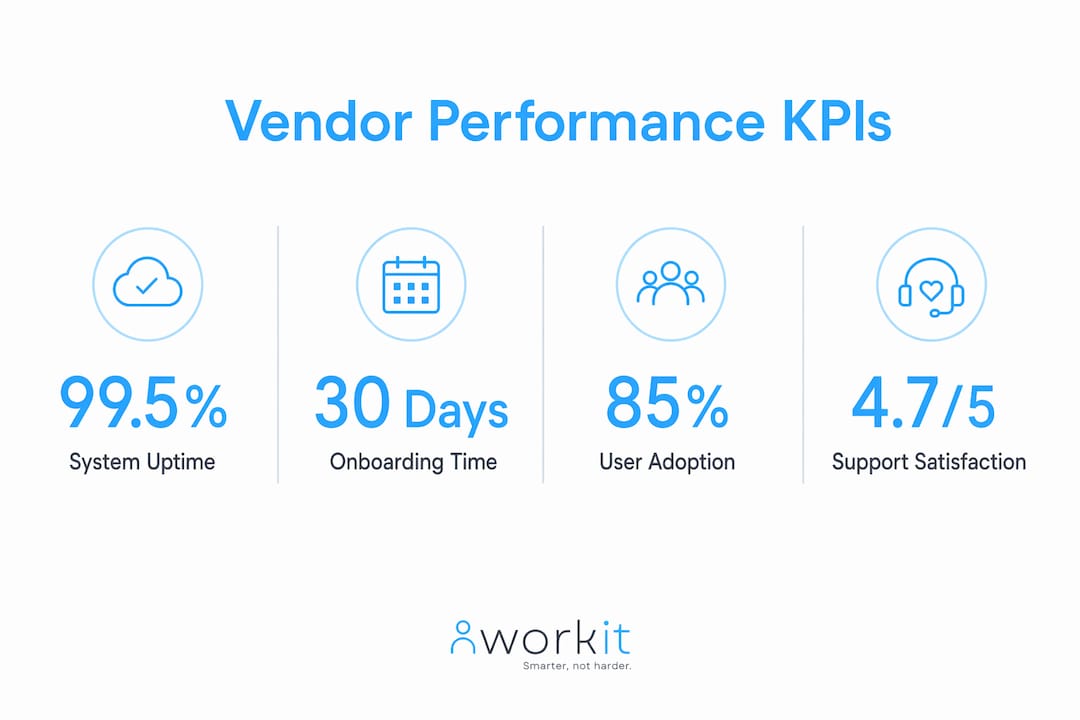
The business case for measurement is straightforward. Outcome-based ROI from HR technology, such as reduced compliance risk, automated reporting hours, and faster onboarding, is far more defensible to executives than efficiency vanity metrics. When you can show that onboarding time dropped by two weeks or that payroll errors fell after go-live, the measurement programme pays for itself.
The scope of measurement should cover six dimensions:
- Functional fit: Does the platform do what you bought it to do, consistently?
- Integrations: Are connections to payroll, accounting, and identity systems reliable?
- Support quality: Are issues resolved quickly by people who understand Australian employment conditions?
- Security and compliance: Is the vendor meeting OAIC obligations and APP 8 cross-border requirements?
- Adoption: Are employees and managers actually using the system?
- Commercial health and roadmap: Is the vendor investing in the product and financially stable enough to be a long-term partner?
Vendor shortlisting for Australian organisations should weigh functional fit, local support, data residency, integration capability, and total cost of ownership over a three-to-five year horizon. That same lens applies once you are post-contract.
Pro Tip: Scope your measurement around business outcomes first. “Reduced payroll errors” and “faster onboarding” are outcomes your CFO understands. Feature checklists are not.
What KPIs and metrics should you track?
A practical KPI set groups metrics into four categories: technical, operational, adoption, and outcome. The table below gives definitions, calculation examples, and indicative targets for Australian organisations. Targets marked “org-specific” should be set against your own baseline before go-live.

| Category | KPI | Definition / Calculation | Indicative Target |
|---|---|---|---|
| Technical | System uptime | (Total available minutes − downtime minutes) ÷ total available minutes × 100 | ≥ 99.5% monthly |
| Technical | Integration availability | Successful API calls ÷ total API calls × 100 | ≥ 99% |
| Operational | Support first-response time | Average minutes from ticket lodgement to first vendor reply | ≤ 4 business hours |
| Operational | Mean time to resolve (MTTR) | Average hours from ticket open to resolution | ≤ 24 hours (P1), — |
| Adoption | Active user rate | Monthly active users ÷ total licensed users × 100 | org-specific within 90 days of go-live |
| Adoption | Process completion rate | Completed workflows (e.g. onboarding tasks) ÷ initiated workflows × 100 | ≥ 90% |
| Outcome | Time-to-hire | Average calendar days from job requisition to accepted offer | Org-specific baseline |
| Outcome | Quality of hire | Composite of 6–12 month performance rating, retention, and cultural fit score | Org-specific baseline |
| Outcome | Onboarding time | Calendar days from offer acceptance to full productivity | Org-specific baseline |
| Outcome | Admin hours saved | Pre-go-live manual hours per process − post-go-live hours | Positive delta vs. baseline |
Time-to-hire, quality of hire, onboarding time, and admin hours saved are the four outcome metrics most directly tied to HR tech impact on business results. Track them from day one so you have a clean pre/post comparison.
Quality of hire deserves special attention. Assess it at the 6–12 month mark using early performance data, retention figures, and cultural fit indicators. A recruitment module that looks great at 90 days can underperform badly once you see who stayed and who thrived.
How do you build a repeatable vendor scorecard?
A vendor scorecard turns subjective impressions into a defensible, repeatable score. The structure below works for both initial evaluation and ongoing quarterly reviews.

Scorecard structure
| Category | Weight | Evidence source |
|---|---|---|
| Technical (uptime, integrations) | — | System dashboards, API logs |
| Operational (support SLAs, MTTR) | — | Ticketing system exports |
| Adoption (active users, completion rates) | — | Platform analytics, LMS data |
| Outcome (time-to-hire, onboarding, admin hours) | 30% | HRIS reports, payroll data |
Weights are a starting point. A highly regulated organisation, such as a financial services firm, may shift more weight to the compliance and technical categories. A fast-growth business may weight adoption and outcome metrics more heavily.
Step-by-step scorecard build
- Define objectives. Write two or three sentences on what success looks like at 6 months and 12 months.
- Choose KPIs. Select from the table above; limit to eight to twelve metrics to keep the scorecard manageable.
- Set weights. Assign percentage weights that reflect your organisation’s priorities. Weights must total 100%.
- Gather baseline data. Capture pre-go-live figures for every outcome KPI. Without a baseline, you cannot calculate improvement.
- Score the vendor. Rate each KPI on a 1–5 scale (1 = significantly below target, 5 = exceeds target). Multiply by weight to get a weighted score. Sum all weighted scores for the overall vendor score.
- Run monthly operational checks. Review technical and support KPIs monthly using system logs and ticket data.
- Run quarterly business reviews (QBRs). Review adoption and outcome KPIs with the vendor. Agree on remediation actions for any KPI below target.
A use-case-led evaluation that tests your actual scenarios, rather than vendor-scripted demos, produces far more reliable baseline data. Insist on it before signing.
Pro Tip: Combine quantitative scorecard data with a short employee satisfaction pulse survey (five questions, monthly) to catch adoption problems before they show up in the numbers. Users who are frustrated but compliant will score your adoption rate well while quietly working around the system.
How do you translate scorecard results into contract terms?
A scorecard without contract teeth is just a spreadsheet. Map your KPIs to enforceable SLA clauses so that poor performance triggers a defined response, not a negotiation.
SLA clauses to request in every HR software contract:
- Uptime guarantee: Minimum 99.5% monthly availability, with credits for each hour below threshold.
- Data access windows: Guaranteed access to your data within 48 hours of a written request, including on contract termination.
- Australian-hours support: Named support contact available during AEST/AEDT business hours; escalation path to a senior engineer within four hours for P1 issues.
- Named account manager: A specific person, not a shared inbox, accountable for your account.
- Escalation timelines: Defined steps from ticket to escalation to executive contact, with maximum timeframes at each stage.
- Penalty and credit structures: Automatic service credits (typically one day’s fee per hour of unplanned downtime beyond the SLA threshold) without requiring you to claim them.
Practical negotiation levers:
- Pilot acceptance criteria: Define measurable go/no-go criteria before the pilot starts. If the vendor cannot meet them, you exit without penalty.
- Exit and data portability clauses: Require data export in a standard format (CSV, JSON) within 30 days of contract end, at no additional cost.
- Performance-based payment terms: Tie a portion of annual licence fees to achieving agreed outcome KPIs at the 12-month mark.
The vendor selection and contracting process for Australian organisations typically spans several months. Build SLA negotiation time into your project plan, not as an afterthought after the commercial terms are agreed.
What compliance and integration checks matter in Australia?
Australian HR software buyers face compliance obligations that many offshore vendors underestimate. Get written evidence on each of the following before you sign.
Compliance evidence to require:
- Notifiable Data Breaches (NDB) scheme readiness: The vendor must have a documented breach response process aligned with the Privacy Act and OAIC guidance.
- APP 8 cross-border data handling: If employee data is processed or stored offshore, the vendor must demonstrate compliance with Australian Privacy Principle 8.
- Security audit summaries: ISO 27001 or SOC 2 certification is the minimum bar. Request the most recent audit summary, not just a certificate.
- Data residency documentation: Written confirmation of where data is stored and which third parties can access it.
Integration sanity checks:
- Request a live demonstration of the payroll integration with Xero or MYOB using your actual pay codes and award rules.
- Confirm STP Phase 2 compatibility with a sample payroll run before go-live.
- Ask for a documented list of all third parties with access to employee data (the APP 8 cross-border access list).
- Test backup and restore procedures: request a restore from backup in a sandbox environment.
- Verify that local payroll integrations with Australian accounting systems work without manual workarounds post go-live.
For a detailed compliance feature checklist, Workit’s compliance software buyer guide covers the specific capabilities Australian HR teams should require.
Who owns measurement, and how often should you review?
Measurement without clear ownership drifts. Assign roles before go-live and lock in a review cadence in the contract.
Roles and responsibilities
| Role | Responsibility | Review involvement |
|---|---|---|
| Vendor owner (HR lead) | Day-to-day relationship, ticket escalation, scorecard updates | Monthly ops check, QBR |
| Technical owner (IT/integration lead) | API health, uptime monitoring, security evidence | Monthly ops check |
| Procurement lead | Contract compliance, SLA credits, renewal negotiations | QBR, annual strategic review |
| Executive sponsor | Strategic alignment, escalation authority, budget decisions | Annual strategic review |
Recommended cadence:
- Monthly operational check: Review technical and support KPIs using system logs and ticket exports. Flag any metric below target for vendor response within five business days.
- Quarterly business review (QBR): Review adoption and outcome KPIs with the vendor present. Agree on remediation actions, timelines, and owners. Document outcomes in writing.
- 6–12 month strategic review: Validate quality of hire using performance data and retention figures. Assess roadmap alignment and commercial health. Decide on contract renewal or renegotiation.
A simple dashboard for the monthly check needs four panels: uptime trend, support ticket volume and MTTR, active user rate, and one outcome KPI (e.g. onboarding time). Keep it to one page so it actually gets read.
What measurement mistakes do HR teams commonly make?
The most expensive mistakes happen before go-live, not after. Here are the traps to avoid and the practices that prevent them.
Common pitfalls:
- Over-reliance on vendor demos. A polished demo tests the vendor’s presentation skills, not your use cases. Scenario-based demos that run your actual processes are the only reliable test.
- Measuring vanity metrics. Total logins and “features activated” tell you nothing about business outcomes. Tie every metric to a process or result.
- Ignoring integration effort. API maintenance, data cleansing, and custom reporting post go-live consume internal resource hours that rarely appear in vendor quotes. Include them in your total cost of ownership calculations.
- Not validating support SLAs in real incidents. Ask for a log of the last ten P1 incidents and the actual resolution times before you sign. Contracted SLAs and real-world performance often diverge.
- Skipping local references. Australian customer references in your industry and of similar size are the most reliable signal of how the vendor will perform for you.
Best-practice checklist:
- Triangulate data: use system logs, support ticket exports, and employee surveys together.
- Test real use cases in pilots, not vendor-scripted scenarios.
- Track total cost of ownership including internal resource hours post go-live.
- Require at least two local Australian references before shortlisting.
- Validate objective scorecards against real organisational use cases, not feature lists.
Pro Tip: Ask the vendor to name the Australian city where your primary support contact is based. If they cannot answer immediately, your tickets will be handled offshore with timezone delays. Named Australian account management in the SLA is non-negotiable for fast resolution.
What does the scorecard look like in practice?
Here is a worked example applying the scorecard to Workit as the in-market vendor, using anonymised baseline data from a mid-sized Australian organisation (250 employees, professional services).
Sample scorecard: 90-day post-go-live review
| KPI category | KPI | Target | Actual | Score (1–5) | Weighted score (weight) |
|---|---|---|---|---|---|
| Technical | System uptime | ≥ 99.5% | — | 5 | 1.25 (—) |
| Operational | Support first-response | ≤ 4 hrs | — | 5 | 1.00 (—) |
| Adoption | Active user rate | org-specific | — | 4 | 1.00 (—) |
| Outcome | Onboarding time | Baseline — | −26% vs. baseline | 5 | — |
| Overall | 4.75 / 5 |
Evidence used:
- Uptime: Workit platform dashboard export (30-day rolling average)
- Support response: Ticketing system export, filtered to P1 and P2 tickets
- Adoption: Active user report from Workit analytics module
- Onboarding time: Pre/post comparison from onboarding software workflow logs
Practical outcomes observed:
- Onboarding time reduced by 26% against the pre-go-live baseline, with new starters completing all compliance tasks before their first day.
- Payroll errors dropped in the first full payroll cycle after integration with the organisation’s existing payroll engine.
- Employee survey (five questions, sent at 30 days post go-live) returned a satisfaction score of 4.2 out of 5 for ease of use.
A score of 4.75 out of 5 at 90 days triggers a pilot extension confirmation and sets the agenda for the first QBR: locking in the active user rate improvement plan and scheduling the 6-month quality of hire review.
Does your vendor’s product roadmap actually align with your needs?
A vendor’s current feature set is only half the picture. What they are building next determines whether the platform grows with your organisation or becomes a constraint in two years.
Ask vendors for a 12-month roadmap in writing during evaluation, and revisit it at every QBR. The key question is not “what are you building?” but “which of our stated future-state requirements appear on your roadmap, and when?” If your organisation is moving toward skills-based workforce planning or automated compliance reporting, and those capabilities are not on the roadmap within 18 months, that is a material risk.
Watch for roadmap commitments that never ship. At each QBR, compare the roadmap you were shown at contract signing against what has actually been released. A vendor who consistently delays or deprioritises committed features is signalling a resource or strategic problem. Three consecutive missed roadmap items should trigger a formal review clause in your contract.
Innovation signals worth tracking include frequency of product releases, quality of release notes, and whether the vendor participates in Australian HR industry forums or contributes to local compliance updates (such as STP Phase 2 or Fair Work changes). A vendor who is genuinely invested in the Australian market will respond to local regulatory changes quickly.
How do you assess whether a vendor will still be here in five years?
Vendor financial stability is a procurement risk that HR teams routinely underweight. A vendor who wins your business and then runs out of funding, gets acquired, or pivots their product strategy can leave you with a stranded system and a costly migration.
Request a copy of the vendor’s most recent audited financial statements or, for privately held companies, a summary of funding history and runway. For Australian vendors, check ASIC records for company registration status and any adverse filings. For offshore vendors, ask specifically about the legal entity that holds your data and the jurisdiction governing your contract.
Longevity signals to assess during evaluation include customer retention rate (ask for it directly), the size and tenure of the local support team, and whether the vendor has invested in local infrastructure such as Australian data centres. A vendor with a stable, growing Australian customer base and a tenured local team is materially lower risk than one relying on a small offshore support function.
Include a data portability clause in every contract. If the vendor ceases operations or is acquired, you need guaranteed access to your data in a portable format within 30 days. This clause costs nothing to negotiate when the vendor is healthy and is invaluable if they are not.
How do you benchmark your vendor against the Australian market?
Benchmarking gives your scorecard scores context. A 99.5% uptime figure means something different if the market average is 99.9%.
The most practical benchmarking approach for Australian HR software buyers combines three sources. First, industry analyst data from Gartner and SHRM provides global baselines for HR technology performance. Second, peer networks such as the Australian HR Institute (AHRI) and local HR technology communities share real-world experience with specific vendors. Third, your own vendor’s customer references in Australia give you the most relevant comparison point.
When benchmarking support SLAs, note that Australian-hours coverage is a differentiator, not a standard. Many global vendors offer 24/7 support in name but route Australian tickets to offshore teams during AEST business hours. Benchmark against vendors who can demonstrate local response times, not just global averages.
For outcome metrics like time-to-hire and onboarding time, industry benchmarks vary significantly by sector and organisation size. Use them as directional guides, not hard targets. Your own pre-go-live baseline is a more reliable benchmark than a global average.
How does employee feedback fit into vendor performance measurement?
Employee satisfaction is a leading indicator of adoption failure. By the time your active user rate drops, the underlying dissatisfaction has usually been present for weeks.
Build a short pulse survey into your measurement cadence: five questions, sent monthly to a rotating sample of users. Cover ease of use, task completion confidence, and whether the system saves time compared to the previous process. A consistent score below 3.5 out of 5 on ease of use is a reliable signal that adoption will plateau or decline.
Manager feedback is equally important and often overlooked. Managers who find the system difficult to use for approvals, leave management, or performance reviews will create workarounds that undermine data quality across the whole platform. Include a manager-specific question set in your quarterly survey.
Connect survey results to your scorecard by treating employee satisfaction as a weighted KPI in the adoption category. A vendor who scores well on technical uptime but poorly on user satisfaction is delivering a system that works but that people avoid. Both dimensions matter for a complete picture of vendor performance.
Key takeaways
Measuring HR software vendor performance requires a weighted scorecard combining technical, adoption, and outcome KPIs tied to contract SLAs, compliance evidence, and regular employee feedback.
| Point | Details |
|---|---|
| Build a weighted scorecard | Combine technical, operational, adoption, and outcome KPIs with weights that reflect your organisation’s priorities. |
| Tie KPIs to contract SLAs | Map every scorecard metric to an enforceable SLA clause with defined credits and remediation steps. |
| Validate quality of hire at the 6–12 month mark | Assess quality of hire using performance data, retention figures, and cultural fit indicators at the 6–12 month mark. |
| Include employee satisfaction as a KPI | Run monthly pulse surveys and treat user satisfaction as a weighted adoption metric, not an optional extra. |
| Workit as an in-market example | Workit maps to all four scorecard categories with Australian-built compliance tracking, onboarding automation, and local support. |
What most HR teams get wrong about vendor measurement
The gap between a vendor scorecard that looks good on paper and one that actually changes procurement behaviour usually comes down to three things: relying on demos, ignoring local specifics, and underestimating what implementation actually costs.
Vendor demos are designed to show you the best possible version of the product. They are not designed to reveal how the system behaves when your payroll engine sends a malformed file at 11 PM on a Thursday, or when a new Fair Work change requires a configuration update within 48 hours. The only way to test those scenarios is to force them during a pilot. Define your acceptance criteria in writing before the pilot starts, run your actual use cases, and score the vendor against those criteria, not against their demo script.
Local specifics matter more than most global vendor assessments acknowledge. APP 8 compliance, STP Phase 2 payroll compatibility, and Australian-hours support are not nice-to-haves for Australian organisations. They are table stakes. A vendor who cannot name their Australian support contact or produce a current APP 8 cross-border data list should not make your shortlist, regardless of how impressive their feature set looks.
The hidden cost trap is real. Internal resource hours for API maintenance, data cleansing, and custom reporting post go-live rarely appear in a vendor’s quote. Audit those hours explicitly, include an allowance in your TCO calculation, and add a clause requiring the vendor to document any configuration changes that increase your internal maintenance burden. That single clause has saved procurement teams significant renegotiation effort at renewal.
Workit gives you a ready-made measurement framework for Australian HR
If you want an HR platform that already maps to the scorecard categories in this guide, Workit is built specifically for Australian businesses with transparent pricing, including all modules and no hidden fees.
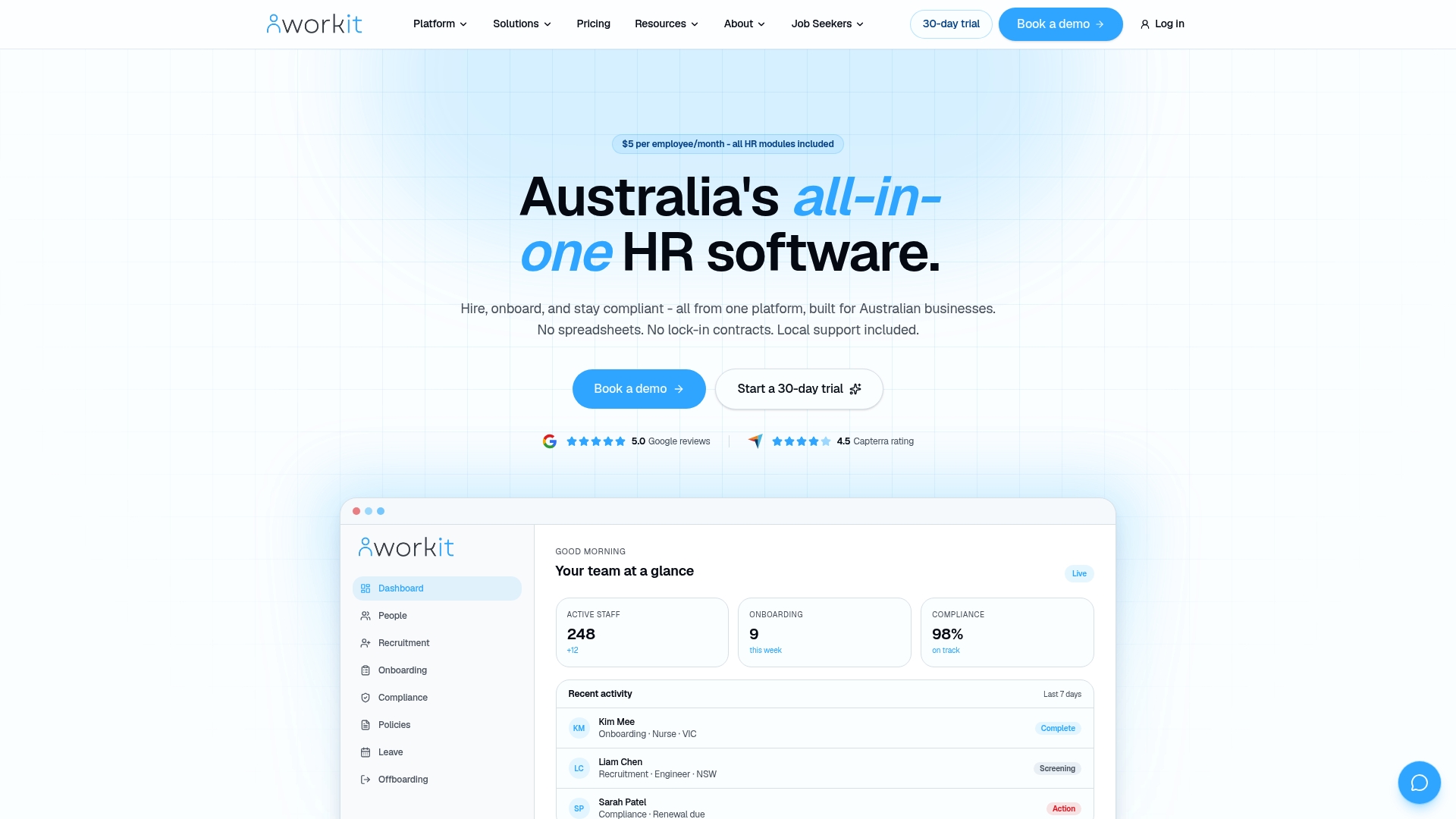
Here is how Workit’s features connect to the KPIs that matter most:
| Workit feature | KPI impacted |
|---|---|
| Onboarding automation | Onboarding time, process completion rate |
| Real-time compliance tracking | APP 8 / NDB readiness, audit log evidence |
| Built-in reporting and dashboards | Admin hours saved, active user rate |
| Australian local support team | Support first-response time, MTTR |
| Payroll integration (Xero, MYOB) | Integration availability, STP Phase 2 compliance |
Workit’s HR compliance software keeps your audit logs current and your cross-border data handling documented, so you can produce compliance evidence at any QBR without scrambling. The HRIS platform covers hiring, onboarding, and reporting in one place, which means your scorecard data lives in a single system rather than across disconnected tools.
Book a demo or start a 30-day trial at workit.com.au/demo-landing-page to see how the platform performs against your specific use cases before you commit.
Useful sources and references
Use these sources to verify compliance claims, KPI guidance, and vendor shortlisting best practice before your next procurement round.
- Office of the Australian Information Commissioner (OAIC): Primary reference for Notifiable Data Breaches scheme obligations and APP 8 cross-border data requirements. Use this to verify vendor compliance claims.
- Agile HR Analytics: Top 10 HR Metrics for Australian Organisations: Practical KPI definitions and benchmarks for Australian HR teams, including quality of hire and time-to-hire guidance.
- Pinpoint HRM: Effective Vendor Evaluation Approach: Covers use-case-led demos and shortlisting methodology. Use this to structure your pilot acceptance criteria.
- Zest HR: How to Choose the Right HRIS and Payroll System: Covers objective scoring, scenario-based testing, and realistic contracting timelines for Australian organisations.
- National Digital: Vendor Shortlisting Best Practices: Scoring framework recommendations and local market considerations including data residency and TCO over three to five years.
- HR Future: How to Choose HR Software for Australian Businesses: Covers security audit evidence (ISO 27001/SOC 2), local references, and STP Phase 2 checks.
- Workit: HR compliance buyer guide: Feature checklist for compliance capabilities specific to Australian HR teams.
| Source | Best used for |
|---|---|
| OAIC Privacy Act guidance | Verifying NDB and APP 8 vendor obligations |
| Agile HR Analytics metrics guide | KPI definitions and quality of hire assessment timing |
| Pinpoint HRM evaluation approach | Structuring use-case demos and pilot criteria |
| Zest HR HRIS guide | Objective scoring and contracting timelines |
| National Digital shortlisting guide | Scorecard weighting and TCO framework |
| HR Future 2026 guide | Security evidence and local reference checks |
Pick at least five of these sources to build your evidence pack before entering vendor negotiations. The OAIC reference and the Agile HR Analytics metrics guide are the two you should read first.
FAQ
How do you measure vendor performance?
Use a weighted scorecard that rates the vendor across technical, operational, adoption, and outcome KPIs, then map each metric to a contract SLA with defined credits and remediation steps. Review scores monthly for technical metrics and quarterly for outcome metrics.
What are the key HR metrics for measuring software impact?
The four most directly linked to HR tech outcomes are time-to-hire, quality of hire (assessed at the 6–12 month mark), onboarding time, and admin hours saved. Track each against a pre-go-live baseline to calculate improvement.
How do you evaluate HR software vendors in Australia?
Start with a use-case-led demo against your defined future state, then score vendors on functional fit, local support, data residency, integration capability, and total cost of ownership. Require APP 8 compliance evidence, STP Phase 2 payroll samples, and at least two Australian customer references before shortlisting.
How often should you review HR software vendor performance?
Run monthly operational checks on technical and support KPIs, quarterly business reviews covering adoption and outcome metrics, and a strategic review at the 6–12 month mark to validate quality of hire and roadmap alignment.
Does Workit support the measurement framework in this guide?
Yes. Workit provides built-in reporting dashboards, compliance tracking, onboarding automation, and Australian local support, covering all four scorecard categories. At $5 per employee per month with all modules included, it gives Australian organisations a single data source for most of the KPIs in this guide.