

6 Audit Ready Records Australian HR Teams Need for Policy Acknowledgment
The most defensible way to prove staff acknowledged a policy is a digital workflow that timestamps every sign off, ties it to a specific version, and records who did it and when. For high-risk policies, add a short comprehension check on top. A paper trail or an email thread might tick a box, but Fair Work and workplace tribunals increasingly ask for proof, not just a paper record, and some digital HR software platforms build that proof into the way policies get distributed in the first place.
TL;DR:
- Digital acknowledgment systems that timestamp, tie to specific policy versions, and log individual user details provide the strongest proof in audits and disputes.
- Paper and email methods are prone to loss, tampering, and lack version control, making them unsuitable for high-risk policies like workplace safety or anti-discrimination.
- An audit-ready record must include employee identity, exact timestamp, policy version ID, delivery method, and an active acknowledgment statement, with comprehension checks for high-risk policies.
- Automating acknowledgment workflows with reminders, separate policies, and escalation rules helps ensure compliance and reduces file gaps before an audit occurs.
- Records should be retained in immutable, role-based, encrypted logs for several years, with easy export options to prove acknowledgment compliance during regulator inquiries.
Table of Contents
- What is policy acknowledgment tracking?
- Paper, email, or digital: which acknowledgement method holds up?
- What makes an acknowledgement record audit ready?
- How do you implement a digital acknowledgement workflow?
- How long should you keep acknowledgement records?
- How Workit builds acknowledgement evidence into everyday HR work
- Treat acknowledgement tracking as a compliance control, not paperwork
- Get your policy acknowledgements audit ready with Workit
- Sources
- FAQ
What is policy acknowledgment tracking?
Policy acknowledgment tracking is the process of recording proof that an employee received, read, and agreed to a specific version of a workplace policy at a specific point in time. It is not the same as sending a policy. Notification means the document reached an inbox. Acknowledgement means someone can point to a record and say who saw it, when, and which version.
That distinction matters in disputes. When an employer is defending a disciplinary decision or responding to a Fair Work claim, the question is rarely “did we have a policy?” It is “can you prove this person knew about it?” Regulatory and audit guidance increasingly frames version-specific, timestamped records as the line between “we sent it” and “we can prove understanding.”
A defensible acknowledgement record needs three things at minimum: individual attribution (who), a timestamp (when), and a version reference (which document). Miss any one of those and the record is a lot weaker in front of an auditor or a commissioner. Legal advisers also warn that acknowledgements are evidence of awareness, not a substitute for contract terms, so keep them separate from employment contracts rather than bundling the two.

Paper, email, or digital: which acknowledgement method holds up?
Every business starts somewhere, and most start with paper or email. The problem is that both methods were built for convenience, not for evidence.
Paper sign off sheets are quick to set up but painful to retrieve. A signature on a form filed three years ago is easy to lose, easy to misplace between offices, and easy to tamper with if nobody’s watching the paper trail closely.
Email acknowledgements feel more modern but carry their own risk. A “reply to confirm you’ve read this” email sits in a shared inbox, gets buried under other traffic, and rarely links back to the exact policy version that was current on the day it was sent. If the policy changes six months later, the old email trail says nothing about the new version.
Digital acknowledgement platforms solve both problems by attaching the sign off to the document itself. Look for:
- Version control that locks each acknowledgement to the exact policy text in force at that time
- Authenticated sign off, so the record ties to a real logged-in user, not a shared login
- Automated reminders for staff who haven’t responded
- Reporting dashboards showing completion rates in real time
- Comprehension checks for policies where understanding matters as much as receipt
As a rule of thumb: paper or email can work for low-risk, informal updates in very small teams. Anything touching WHS, harassment, discrimination, or code-of-conduct policies needs a digital, version-locked trail, because that’s exactly where regulators expect the strongest proof.
What makes an acknowledgement record audit ready?
An auditor doesn’t want to hear that a policy went out. They want to see the record. Here’s what belongs in it.
- Employee identity — a named individual, not a department or team alias, tied to a unique login or ID.
- Timestamp — the exact date and time the acknowledgement was completed, not just the date it was sent.
- Policy version ID — a reference that ties the acknowledgement to one specific version of the document, not “the policy” in general.
- Delivery method and channel — how it was sent, so you can show the employee had genuine access.
- Acknowledgement wording — a clear statement the employee actively agreed to, such as “I confirm I have read, understood, and agree to comply with this policy,” rather than a vague “noted.”
- Comprehension result (where applicable) — the score or outcome of any quiz attached to the acknowledgement.
For high-risk policies, a simple sign off is losing favour with regulators. The Fair Work Commission has flagged that a “tick and flick” style acknowledgement doesn’t prove engagement on its own, and recommends short comprehension checks, typically three to five questions, that create a separate evidence trail showing the employee actually understood the material.
Reminders matter just as much as the record itself. Set escalation rules so unread policies get flagged to a manager after a defined period, and never bundle multiple policies into a single acknowledgement. If someone signs once for five documents, you can’t prove which one they actually read.
Pro Tip: If a staff member refuses to acknowledge a policy, don’t leave it blank. Document the refusal, note who witnessed the conversation, and record that the policy was explained verbally. That refusal record becomes evidence in its own right if the matter ever escalates.
How do you implement a digital acknowledgement workflow?
Moving from scattered folders and email chains to a proper system doesn’t need to be a massive project. It comes down to five practical steps.
- Centralise your policy register. Pull every current policy into one place and assign an owner to each so someone is accountable for keeping it current.
- Decide which policies need formal acknowledgement. Not every document needs a signature. WHS, code of conduct, anti discrimination, and data privacy policies usually do; a minor office-hours update usually doesn’t.
- Set deadlines for each acknowledgement cycle. Give staff a realistic window, then track who’s inside and outside it.
- Configure authenticated delivery with reminders. Every acknowledgement should tie to a logged-in identity, with automatic nudges for stragglers.
- Add comprehension checks to high-risk policies, then archive the completed records according to your retention rules.
Practical details worth locking in from day one:
- Assign escalation so unresolved acknowledgements reach a manager, not just HR.
- Keep policies separate from onboarding paperwork so version updates don’t get lost in a new-hire pile.
- Export a completion report every quarter so gaps show up before an audit does, not during one.
For small teams especially, the single biggest improvement is often just ditching the “read this bundle of five policies and reply” email and replacing it with per-policy prompts and clear deadlines. It’s a small change that closes a surprising number of file gaps.
How long should you keep acknowledgement records?
Retention rules vary by sector, so the safest approach is to apply whichever retention window is longest among the frameworks that apply to your business, and tie that window to the policy version date rather than the date of hire. Sector guidance on retention generally points toward several years at minimum for compliance-related documents, and regulators expect those records to stay accessible, not just archived.
Security matters as much as duration. Records should sit in immutable, tamper-evident logs, meaning nobody, including administrators, can quietly edit a timestamp after the fact. Access should be role-based, so only people with a genuine reason can view acknowledgement data, and the data itself should be encrypted at rest.
When an auditor comes asking, they typically want an export, not a story. Expect requests for a CSV or PDF report listing employee name, policy version ID, timestamp, and completion status for a given date range. If your HR file has gaps in exactly this kind of record, that’s usually where compliance risk concentrates, because the burden of proof tends to sit with the employer, not the regulator.

How Workit builds acknowledgement evidence into everyday HR work
Workit runs policy distribution and tracking as part of its everyday compliance management, not as a bolt-on form. Every policy sits in a central register with version history, so when a document changes, the platform knows exactly which version each employee acknowledged and when.
Real-time compliance reporting means you can pull a completion snapshot at any point, rather than reconstructing one manually before an audit. Because acknowledgements are tied to authenticated logins inside the same system that runs onboarding and HRIS records, there’s no separate spreadsheet to reconcile against payroll or employee files.
Treat acknowledgement tracking as a compliance control, not paperwork
If there’s one thing worth acting on this week, it’s this: audit your current acknowledgement process before a regulator does it for you. Pick your riskiest policy, run it through a proper digital workflow with a timestamp and a comprehension check, and see what the gaps look like. Clean evidence is almost always cheaper to build than a failed audit is to fix.
— Stephen
Get your policy acknowledgements audit ready with Workit
Some HR platforms provide one place to store policies, run acknowledgement cycles, and pull compliance reports without using spreadsheets. They replace chasing signatures through shared inboxes with version locked records, authenticated sign off, and automated reminders, often included in a subscription pricing model that covers onboarding and HRIS features.
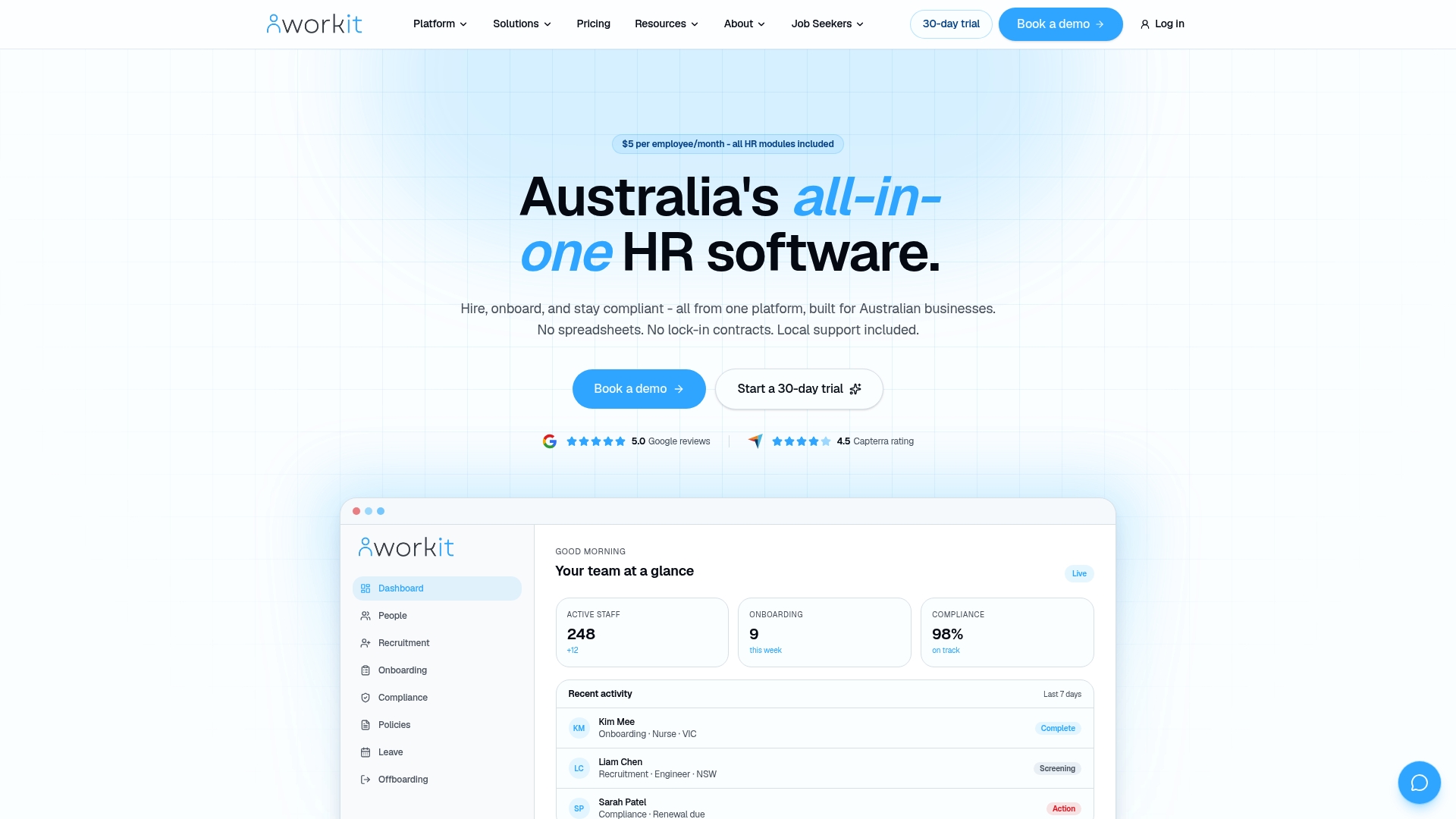
Start by running a quick internal audit of your current acknowledgement gaps, then pilot Workit on your highest-risk policy, whether that’s WHS, code of conduct, or anti discrimination. You’ll see completion rates and timestamps in real time, and you can export an audit-ready report the moment someone asks for one. If you’re ready to see it against your own policy list, book a demo and bring your riskiest document along.
Sources
For deeper detail on employer record-keeping obligations, see the Fair Work Ombudsman. For the shift toward comprehension based acknowledgement, see Mondaq’s coverage of the Fair Work Commission’s position, and for improving engagement around rollout communications, ALIGN’s employee advocacy playbook is a useful companion resource.
- Tick-and-flick gets the kick: FWC calls for proactive workplace policy engagement - Mondaq
- Employment forms explained: Australian legal guide for employers - Sprintlaw
FAQ
What Is a Policy Acknowledgement?
A policy acknowledgement is a record showing that a specific employee received, read, and agreed to a specific version of a workplace policy at a specific time. It differs from simply sending or notifying someone, because it captures proof of individual engagement rather than delivery.
What Are Good Acknowledgement Examples?
A strong example is a digital sign off tied to a login, timestamped automatically, and worded as “I confirm I have read, understood, and agree to comply with this policy.” A weak example is a group email reply of “noted” with no version reference or comprehension check attached.
Can You Give an Example of a Policy Acknowledgement Statement?
A defensible statement reads something close to: “I confirm I have read and understood [Policy Name, Version X], and I agree to comply with its terms as of [date].” Avoid vague language like “received” alone, since that only proves delivery, not understanding.
How Do You Write and Track a Policy Acknowledgement?
Write the acknowledgement as an active statement of understanding and agreement, not a passive confirmation of receipt, and pair it with a comprehension check for high-risk policies. Track it through a digital, version-locked workflow, such as the one built into Workit’s compliance management, rather than email or paper sign off sheets.
How Long Should Employers Keep Acknowledgement Records?
Retention periods vary by sector, so employers should apply the longest applicable retention window and tie it to the policy version date rather than the employee’s hire date. Records should remain accessible and tamper-evident for that entire period, not just archived in a drawer.