

Workplace policies in Australia: employer guide 2026
Start by checking which award or enterprise agreement covers your staff, confirm your policies meet the National Employment Standards, then put a signed policy pack in place this week. That single sequence covers the most common compliance gaps Australian employers face.
Here is what to do right now:
- Check your award or agreement. Use the Fair Work Ombudsman’s Pay and Conditions Tool to confirm which modern award applies, then cross-reference your leave, rostering and penalty clauses.
- Adopt your five core policies. Code of conduct, WHS, bullying and harassment, leave and attendance, and IT acceptable use cover the highest-risk areas for most businesses.
- Get written acknowledgement. Every employee should sign or digitally confirm they have read each policy. Store those records for at least seven years.
- Book a legal check for termination and discipline clauses. These areas generate most Fair Work disputes and deserve a tailored review, not a generic template.
Primary sources to bookmark: Fair Work Ombudsman, Business and Safe Work Australia.
Key takeaways
Australian workplace policies must start with legal obligations, match actual practice, use plain-English directions rather than contractual promises, and carry version control and review dates to be defensible.
| Point | Details |
|---|---|
| NES is the floor | No policy can reduce a National Employment Standard entitlement — check NES first, every time. |
| Five-step drafting process | Research, define scope, draft in plain English, get acknowledgement, and set a review date. |
| Seven-year record retention | Keep time, wages and acknowledgement records for seven years to meet Fair Work obligations. |
| Review triggers matter | Legislative change, WHS incidents and Fair Work claims each require an immediate policy review. |
| Workit automates the audit trail | Workit captures digital acknowledgements, version history and compliance reports in one platform at $5 per employee per month. |
Table of Contents
- What are workplace policies, procedures and processes in Australia?
- What workplace policies does every Australian employer need?
- What legal checkpoints must you clear before finalising policies?
- How do you draft a workplace policy that will actually hold up?
- How do you roll out policies so staff actually follow them?
- How often should you review your workplace policies?
- Where do you find practical templates and tools?
- How can an HR system support policy compliance?
- The mistake most employers make with workplace policies
- Workit makes policy compliance faster for Australian employers
- Sources
- FAQ
What are workplace policies, procedures and processes in Australia?
A policy is your organisation’s stated position on a topic: what behaviour is expected, what is prohibited, and what happens when the rule is broken. A procedure is the step-by-step method for carrying out that position. A process is the recurring operational routine that keeps the business running day to day.
The distinction matters legally. A policy worded as a direction (“employees must report incidents within 24 hours”) is a lawful employer instruction. A policy worded as a promise (“the company will always investigate within 48 hours”) can become a contractual term you are held to in a tribunal. Getting the language right from the start is not a drafting nicety — it is risk management.
A practical example: a harassment policy states that the business does not tolerate bullying and sets out reporting channels. The accompanying investigation procedure lists who receives a complaint, the steps for gathering evidence, the timeframe for a response, and how outcomes are communicated. The policy sets the rule; the procedure makes it workable.
Queensland Government guidance reinforces that well-written policies do more than satisfy regulators — they clarify expectations, reinforce business values and support consistent decision-making that reduces unfair dismissal and WHS prosecution risk.
What workplace policies does every Australian employer need?
Business.gov.au recommends keeping policies short, practical and accessible. The following list covers the minimum pack for most Australian employers, with the must-have clauses for each.
- Code of conduct. Sets behavioural expectations across the business. Must cover: scope (who it applies to, including contractors), examples of unacceptable conduct, and the consequence of breach.
- Bullying, harassment and discrimination. Addresses employee rights under the Fair Work Act and anti-discrimination legislation. Must include: a clear definition of prohibited conduct, reporting pathways, and a non-retaliation clause.
- Workplace health and safety (WHS). Required under the Work Health and Safety Act 2011 (Cth) and state equivalents. Must cover: duty of care obligations, hazard reporting, and since 2024–2025, psychosocial hazards including sexual harassment prevention.
- Leave and attendance. Aligns with NES entitlements (annual leave, personal/carer’s leave, parental leave). Must specify: how to request leave, notice requirements, and what happens when leave is taken without approval.
- Performance and disciplinary. Outlines the process from informal feedback through to termination. Must include: the steps taken before dismissal, the right to respond, and language that reads as a direction rather than a contractual promise.
- Privacy and confidentiality. Covers obligations under the Privacy Act 1988 and, where relevant, state health privacy laws. Must define: what constitutes confidential information, how it is stored, and what happens on exit.
- IT and acceptable use. Sets rules for company devices, email, internet and social media. Must cover: personal use limits, monitoring rights, and data security obligations.
- Workplace surveillance. Particularly important in New South Wales and Victoria, which have specific surveillance legislation. Must disclose: what is monitored, how, and that employees have been notified.
- Drug and alcohol. Addresses a drug and alcohol policy in Australia across safety-critical and office environments. Must specify: testing conditions, what constitutes impairment, and the consequence of a positive result.
- Flexible and remote work. Covers the right to request flexible arrangements under the Fair Work Act. Must include: how requests are made, the assessment criteria, and any equipment or data security requirements for home-based work.
For micro and small businesses, start with WHS, code of conduct and bullying/harassment. These three cover your highest legal exposure and are the policies most likely to be examined in a Fair Work or WHS investigation.
What legal checkpoints must you clear before finalising policies?
Getting the content right is only half the job. Before you publish any policy, clear these four checkpoints.
| Legal checkpoint | What to check | Key source |
|---|---|---|
| National Employment Standards | No policy can reduce an NES entitlement (annual leave, notice, parental leave, etc.) | Fair Work Ombudsman — NES |
| Award or enterprise agreement | Confirm rostering, penalty rates and allowances; a policy that conflicts with an award clause is unenforceable | Fair Work Ombudsman — Pay and Conditions Tool |
| WHS duties | Include psychosocial hazards; check state/territory WHS regulator for local codes of practice | Safe Work Australia |
| Privacy and surveillance | NSW and VIC have Workplace Surveillance Acts; all employers with turnover above $3 million are covered by the Privacy Act 1988 | OAIC and state regulators |
The National Employment Standards are the floor. Every policy you write sits above them — never below. A leave policy that caps annual leave accrual below the NES minimum is void, and the employer still owes the entitlement.
Preventing workplace problems starts with knowing which award or agreement governs your workforce. An employer in retail, hospitality or construction who writes a rostering policy without checking the applicable modern award is almost certain to create a conflict.
On record-keeping: Fair Work obligations require employers to keep time and wages records for seven years and to provide pay slips within one working day of payment. Signed policy acknowledgements should be stored with the same discipline — they are your evidence in a dispute.
How do you draft a workplace policy that will actually hold up?
The Fair Work Ombudsman’s best practice guide recommends a five-step process, and it is the right sequence for any business size.
- Research legal and award requirements. Before you write a word, confirm the NES entitlements, the applicable award or enterprise agreement, and any state-specific obligations (surveillance, WHS codes of practice, privacy). This step prevents the most common and costly drafting errors.
- Define purpose and scope. State in one sentence what the policy is for and who it covers. Include contractors, labour-hire workers and volunteers where relevant. A scope clause that is too narrow leaves gaps; one that is too broad creates obligations you cannot meet.
- Draft in plain English. One idea per sentence. Active voice. Avoid legal jargon. If a manager cannot explain the policy in a two-minute briefing, it needs a rewrite. Consistent HR processes depend on language everyone actually understands.
- Obtain written staff acknowledgement. Every employee should sign or digitally confirm receipt and understanding. Involving staff in the development stage — asking managers and workers what is unclear or unworkable — also improves consistent application.
- Set a review date. Annual review is the baseline. Trigger an immediate review on any legislative change, a WHS incident, a Fair Work claim, or a significant business change such as a merger or shift to remote work.
Pro Tip: Word disciplinary and termination clauses as directions, not promises. “The company may terminate employment for serious misconduct” is a lawful direction. “The company will always conduct a three-stage process before termination” is a promise that can be used against you if you deviate from it even once.
When policies touch termination, discipline or pay entitlements, get a tailored legal or industrial relations check. These are the clauses that generate most Fair Work disputes, and a workplace policy template that has not been adapted to your award and actual practice can become evidence against you.
How do you roll out policies so staff actually follow them?
Writing the policy is the easy part. Getting consistent compliance across a team takes a deliberate rollout.
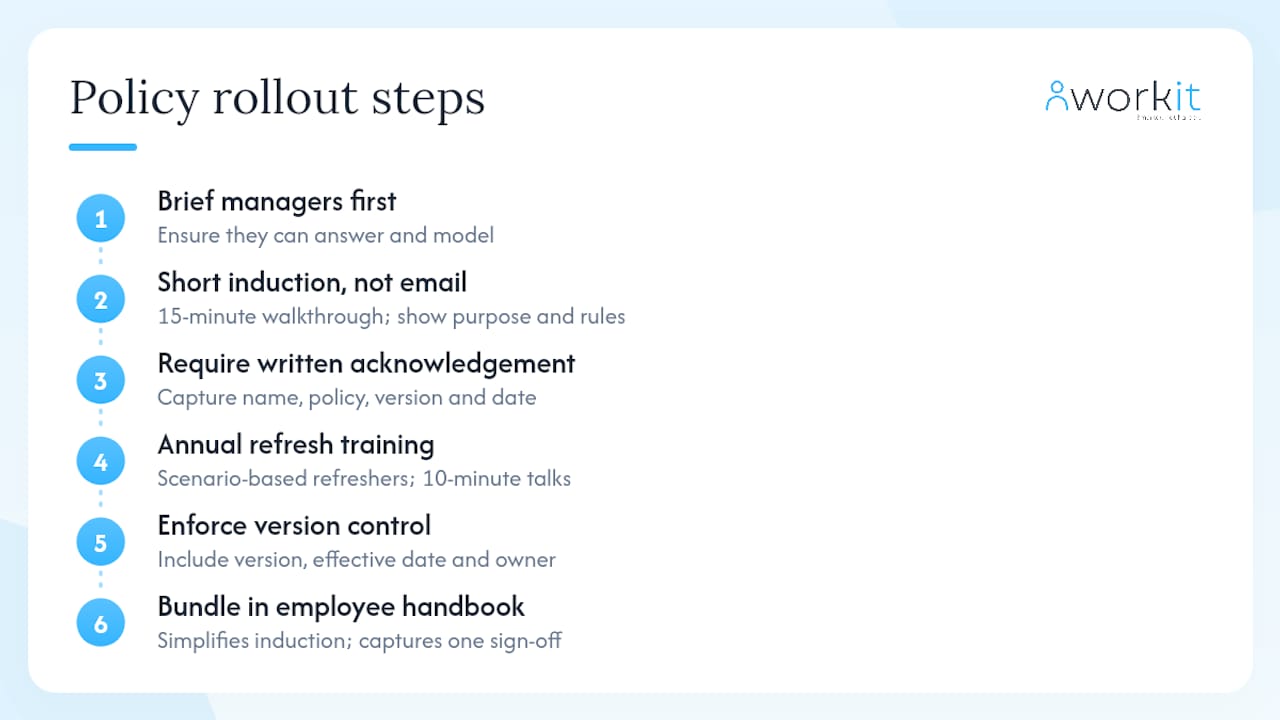
Manager briefings first. Before any policy goes to staff, brief your managers. They need to understand the policy well enough to answer questions and model the expected behaviour. A manager who is surprised by a new policy in front of their team undermines it immediately.
Short inductions, not email blasts. A 15-minute walkthrough — in person or via video call — is far more effective than sending a PDF and hoping people read it. Cover the purpose, the key rules and what to do if something goes wrong. Pair this with a digital single source of truth: one location where all current policies live and where staff can access them at any time.
Written acknowledgement every time. The acknowledgement should capture the employee’s name, the policy name and version, the date, and a statement that they have read and understood the document. This is your evidence if a policy breach later becomes a Fair Work matter. Store acknowledgements alongside the relevant policy version.
Refresh training annually. A once-off induction is not enough for high-risk policies like WHS, drug and alcohol, and harassment. Short scenario-based refreshers — even a 10-minute team discussion — keep the content current and demonstrate ongoing due diligence.
Pro Tip: Use a sample employee handbook to bundle your core policies into a single document for new starters. It simplifies induction and gives you one acknowledgement to capture rather than ten separate sign-offs.
Version control is non-negotiable. Every policy document should carry a version number, an effective date and the name of the policy owner. When you update a policy, archive the previous version — you may need it to show what was in force at the time of an incident.
How often should you review your workplace policies?
Annual review is the baseline, but several triggers should prompt an immediate update regardless of schedule.
| Trigger | Who acts | Timeframe |
|---|---|---|
| Legislative or award change | HR/legal owner | Within 30 days of change taking effect |
| WHS incident or near-miss | WHS officer + HR | Within days of incident |
| Fair Work claim or complaint | HR + legal adviser | Immediately on notification |
| Business change (merger, new site, remote work shift) | HR owner | Before the change takes effect |
| Annual scheduled review | Policy owner | Same month each year |
Assign a named owner to every policy. Without ownership, reviews slip. The owner is responsible for monitoring legislative updates in their area, initiating the review, and circulating the updated version for acknowledgement.
Where do you find practical templates and tools?
Templates save time, but they must be tailored to your industry, your award conditions and the way work is actually done in your business. A template that describes a process you do not follow is a liability, not a safeguard.
- Business — free policy guidance and checklists covering WHS, anti-discrimination, harassment and general HR topics. Best starting point for small businesses building their first policy pack.
- Fair Work Ombudsman — template employment contracts, pay slip guides, and best practice guides for small business. The My Account portal lets you check award coverage and minimum entitlements in real time.
- Safe Work Australia — model WHS codes of practice, hazard-specific guidance (including psychosocial hazards), and state-by-state WHS regulator links.
- Workit’s sample employee handbook guide — a practical structure for bundling policies into a new-starter handbook, with notes on which clauses need a legal check.
When adapting any template, map each clause to your real processes, check it against your applicable award, and get a legal review for any clause that touches termination, discipline or pay. A clause that sounds reasonable in a generic template may conflict with your enterprise agreement or create an obligation you cannot consistently meet.
For document storage, a central HR system beats a shared drive. Version control, access permissions and audit trails are built in, rather than something you have to manage manually.
How can an HR system support policy compliance?
Managing policies across a growing team with spreadsheets and email threads creates gaps. A purpose-built HR system handles the operational work so your team can focus on the substance.
Workit’s compliance management module supports the full policy lifecycle:
- Central policy repository. All current policies live in one place, accessible to every employee and manager. No more “which version is current?” conversations.
- Automatic acknowledgement capture. Employees confirm receipt digitally; Workit records the name, policy version and timestamp. That record is available instantly for audits or Fair Work inquiries.
- Version control. When you update a policy, the previous version is archived automatically. You always know what was in force at any point in time.
- Onboarding integration. Policies are bundled into new-starter checklists via Workit’s onboarding software, so every new employee reads and acknowledges core policies before their first day ends.
- Compliance reporting. Real-time dashboards show which employees have acknowledged which policies and which are outstanding — useful for manager accountability and regulator readiness.
For HR teams managing background screening alongside policy rollout, having both in one platform removes the coordination overhead that typically causes delays.
The mistake most employers make with workplace policies
The most common error is not having too few policies — it is having policies that describe a process the business does not actually follow. A disciplinary policy that promises a three-stage process, a WHS policy that lists a reporting chain that no longer exists, a drug and alcohol policy copied from a construction template applied to an office environment: each of these creates more legal exposure than having no policy at all.
The second mistake is treating acknowledgement as a one-time event. Policies change. Staff change. A signed acknowledgement from 2022 does not protect you in a 2026 dispute if the policy was updated in 2024 and the employee never saw the new version.
Get tailored legal advice whenever a policy touches termination, discipline, or obligations tied to pay and entitlements. The cost of a legal review is a fraction of the cost of a Fair Work unfair dismissal claim. Prioritise the policies that reduce your immediate legal risk — WHS, harassment, and disciplinary — and build from there.
Workit makes policy compliance faster for Australian employers
Keeping policy acknowledgements current, version-controlled and audit-ready is exactly the kind of administrative work that consumes HR hours without adding strategic value. Workit handles it automatically, at $5 per employee per month with every module included.
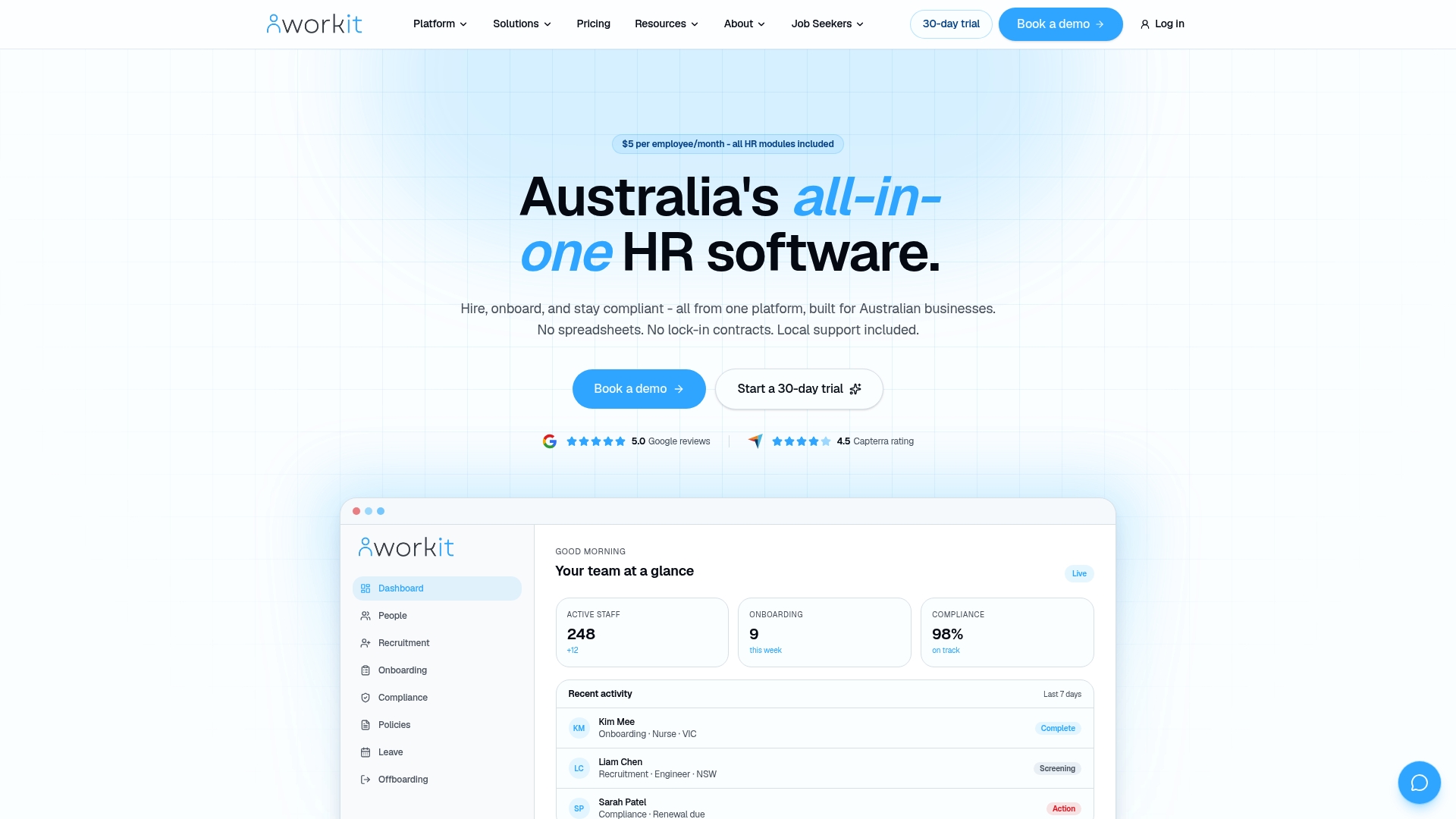
With Workit, you get a central policy repository, digital acknowledgement capture, version history and real-time compliance reporting — all built for Australian businesses, with local support from a team that knows the Fair Work framework. Policies are linked directly to onboarding checklists, so new starters acknowledge your core documents before day one is done. No spreadsheets, no chasing signatures, no gaps in your audit trail.
Ready to see it in practice? Book a demo and a local Workit team member will walk you through the policy and compliance modules in under 30 minutes.
Sources
For policies that affect termination, discipline, or obligations tied to enterprise agreements, obtain tailored legal or industrial relations advice before publishing.
FAQ
What are the most important workplace policies for Australian employers?
WHS, code of conduct, and bullying and harassment policies carry the highest legal risk and should be your first three. Add leave and attendance, IT acceptable use, and a disciplinary policy to complete a minimum-compliant pack.
Can a workplace policy override an award or the NES?
No. A policy cannot reduce any entitlement set by the National Employment Standards or a modern award. Where a conflict exists, the NES or award prevails and the policy clause is void.
How often should workplace policies be reviewed in Australia?
Annual review is the baseline. Trigger an immediate review on any legislative change, a WHS incident, a Fair Work claim, or a significant business change such as a restructure or shift to remote work.
Do employees need to sign workplace policies?
Written acknowledgement is not legally mandatory in every case, but it is strongly recommended. A signed or digitally confirmed acknowledgement is your primary evidence that an employee knew the rule existed — critical in unfair dismissal and WHS matters.
How does Workit help with policy compliance?
Workit provides a central policy repository, automatic digital acknowledgement capture, version control and real-time compliance reporting, all at $5 per employee per month. Policies link directly to onboarding checklists so new starters acknowledge documents from day one.