

WHS incident reporting: what to do and how to notify
TL;DR:
- If a workplace incident meets the notifiable-incident criteria, it must be reported immediately to the relevant WHS regulator.
- Protection of the scene and swift communication are essential steps, with documentation following as required.
If the event meets the notifiable-incident test, you must notify your state or territory WHS regulator immediately. Not after you’ve finished the paperwork. Not once you’ve spoken to your legal team. Right away.
The three immediate compliance steps are:
- Secure safety and get medical help. Call 000 if there is any risk to life. Provide first aid and remove people from ongoing danger.
- Phone your WHS regulator as soon as you become aware of the incident. Have your ABN, ACN, or WEN ready when you call.
- Preserve the scene where it is safe to do so. Do not disturb equipment, materials, or the area unless it is necessary to save a life or make the site safe.
That phone call is itself a compliance action under the Model WHS Act. Written information follows if the regulator requests it, commonly within 48 hours. The sequence matters: call first, document second.
Pro Tip: Record the time of your call, the name of the person you spoke to, and any reference number given. That log is your evidence of timely notification.
Table of Contents
- What counts as a notifiable incident under WHS law?
- What to do at the scene: a step-by-step guide
- How and when to notify your WHS regulator
- Penalties, inspector responses, and mistakes to avoid
- Practical tools: checklist, notification template, and evidence tips
- Key takeaways
- Why the phone call is the step most businesses get wrong
- Workit makes WHS incident reporting easier for Australian businesses
- Authoritative regulator contacts and resources
- FAQ
What counts as a notifiable incident under WHS law?
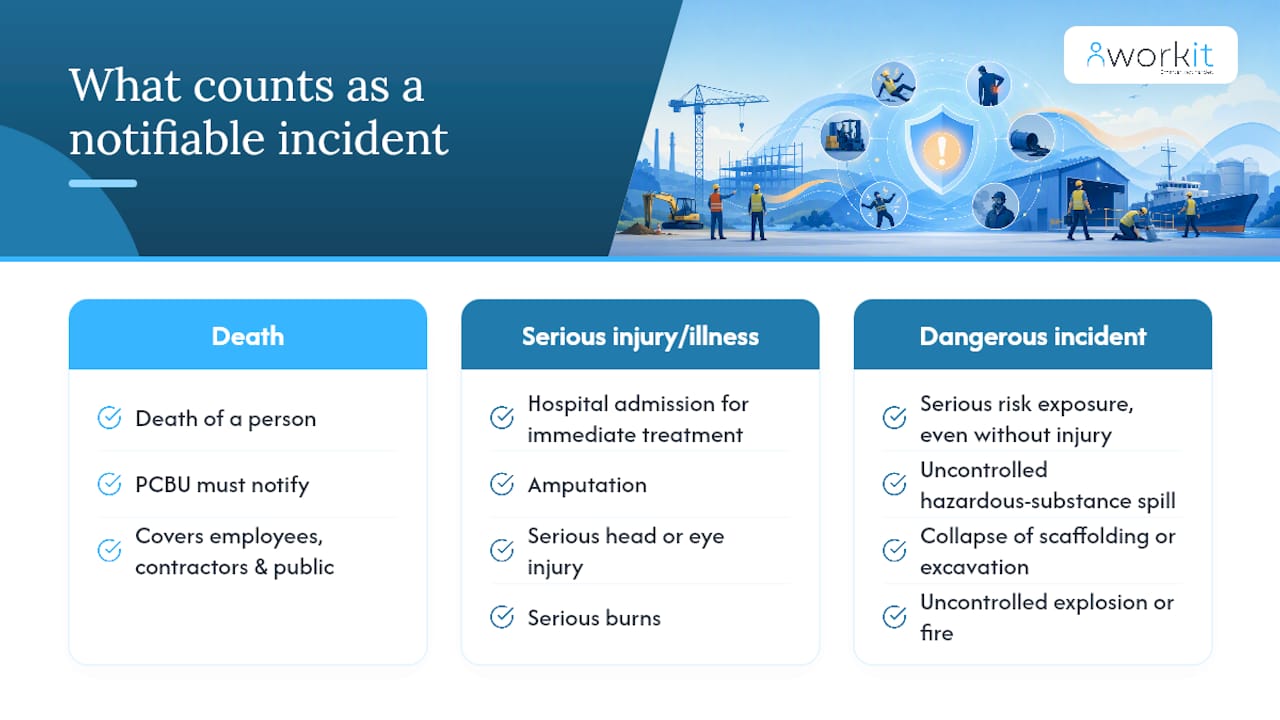
A notifiable incident is defined in the Model WHS Act as one of three things: the death of a person, a serious injury or illness, or a dangerous incident that exposes someone to a serious risk, even if no one is actually hurt. Safe Work Australia publishes clear guidance on each category.
Serious injury or illness covers hospital admission for immediate treatment, amputation, serious head or eye injuries, serious burns, spinal injuries, loss of bodily function, and serious lacerations. The key word is “serious” and the test is objective: does the nature of the injury inherently warrant medical treatment? Your personal judgement about severity is not the threshold.
Dangerous incidents are those that expose a person to a serious risk even when no injury results. Examples include uncontrolled spills of hazardous substances, collapses of scaffolding or excavations, uncontrolled explosions or fires, and failures of pressurised vessels. A near-miss involving mobile plant, an uncontrolled fall from height, or an electrical incident can all qualify.
“A notifiable incident includes a dangerous incident that exposes a worker or any other person to a serious risk to their health or safety emanating from an immediate or imminent exposure to an uncontrolled escape, spillage or leakage of a substance, an implosion, explosion or fire, an electric shock, the fall or release from a height of any plant, substance or thing, the collapse, overturning, failure or malfunction of, or damage to, any plant that is required to be authorised, the collapse or partial collapse of a structure, the collapse or failure of an excavation or of any shoring supporting an excavation, the inrush of water, mud or gas in workings in an underground excavation or tunnel, or the interruption of the main system of ventilation in an underground excavation or tunnel.” — Model WHS Act, Part 3
The duty to notify applies to the person conducting a business or undertaking (PCBU) and covers employees, contractors, visitors, and members of the public, provided the incident arises from the conduct of your business. A personal medical episode on site that has no connection to work activities may not be notifiable, but you should still record it internally.
The December 2025 model WHS Act amendments also introduced an extended-absence rule: a work-related absence of 15 or more consecutive calendar days may now be notifiable in jurisdictions that have adopted the change. Check with your local regulator before assuming this applies to you.
What to do at the scene: a step-by-step guide
Effective WHS incident reporting starts before you pick up the phone. WorkSafe Victoria sets out the core on-scene sequence clearly, and it applies as good practice across all jurisdictions.
- Ensure safety first. Remove people from immediate danger. Shut down plant or equipment if it is safe to do so. If anyone is at risk of death or serious injury, call 000 before anything else.
- Provide first aid. Administer first aid or arrange for a trained first-aider to do so. Do not delay medical care to preserve evidence.
- Secure the incident site. Cordon off the area to prevent unauthorised access. Use barriers, tape, or signage. The legal duty to preserve the scene does not mean a total lockdown: you may disturb it to save lives, provide medical aid, or make the area safe for others.
- Notify your internal contacts. Alert your WHS officer, site manager, or senior duty holder immediately. Your internal escalation chain should be documented in advance.
- Phone your WHS regulator. This is the legal notification step. Call as soon as you become aware, not after you have gathered all the facts.
- Record everything at the scene. Take time-stamped photographs, note witness names and contact details, identify the equipment or materials involved, and write down what you observed while it is fresh.
- Do not disturb the scene further once safety is secured, unless directed by an inspector or emergency services.
Pro Tip: Prepare a laminated on-scene checklist and keep it in your site first-aid kit. High-stress events cause people to skip steps. A physical prompt removes that risk.
Permitted exceptions to scene preservation are worth training your team on specifically. Moving a piece of plant to free a trapped worker is lawful. Cleaning up a spill because it looks bad is not. The distinction matters because inspectors will ask.
Evidence capture at the scene should include:
- Time-stamped photographs from multiple angles
- Names, roles, and contact details of all witnesses
- Equipment identification numbers and last-service dates
- Written notes on environmental conditions (lighting, weather, surface conditions)
- Any relevant Safe Work Method Statements (SWMS) or risk assessments in force at the time
How and when to notify your WHS regulator
The notification process follows a consistent two-step pattern across Australian jurisdictions: an immediate phone call, then written information if the regulator requests it. SafeWork NSW and WorkSafe ACT both confirm this approach, and it reflects the model WHS Act framework.
“Immediately” means as soon as circumstances permit after you become aware. If you are managing a medical emergency, the call comes after the person is safe. If the site is stable, the call comes right away.
What information to have ready
| Information | Details |
|---|---|
| Business identifier | ABN, ACN, or WEN |
| Incident date and time | Exact time if known, approximate if not |
| Location | Full address and specific area within the site |
| What happened | Brief factual summary of the event |
| Injuries or illness | Nature and extent of injuries sustained |
| Immediate actions taken | First aid, evacuation, site secured |
| Site preservation status | Whether the scene is preserved and any disturbances made |
| Contact person | Name, role, and direct phone number |
After the call, note the time, the name of the officer you spoke to, and any reference number. Treat this log as a compliance record.
Regulator contacts by jurisdiction
Safe Work Australia is the national policy body. It is not a regulator and does not receive incident notifications. Your notification goes to your state or territory regulator:
- NSW: — SafeWork NSW — 13 10 50
- Victoria: — WorkSafe Victoria — 13 23 60
- Western Australia: WorkSafe WA — 1300 307 877
Written follow-up timelines vary. Some jurisdictions require written notification within 48 hours of a request; others use online forms. Check your local regulator’s portal for the current process and form.
Model WHS Act changes: what to confirm locally
| Change | Model WHS Act position | What to confirm with your regulator |
|---|---|---|
| Objective test for serious injury | Clarified in December 2025 amendments | Whether your jurisdiction has adopted the amended definition |
| Extended absence (15+ days) | Included in model amendments | Whether this threshold applies in your state or territory |
| Expanded incident categories | Broadened under model law | Which categories are operative locally and from what date |
| Work-related suicides | Included in some contexts | Whether your jurisdiction has adopted this provision |
Practical steps to take now:
- Review your internal notification thresholds against the updated model definitions.
- Train WHS officers and site managers on the objective test.
- Map your regulator’s current online forms and phone contacts.
- Test your internal incident escalation workflow against a hypothetical scenario.
The Safe Work Australia incident notification page is the authoritative source for the model amendments. Your local regulator’s portal is the authoritative source for what is currently operative in your jurisdiction.
Penalties, inspector responses, and mistakes to avoid
Failing to notify your WHS regulator of a notifiable incident is a breach of the Model WHS Act and carries serious consequences. Regulators can issue infringement notices, commence prosecutions, and impose significant penalties on PCBUs and officers.
When a notifiable incident is reported, regulators may:
- Attend the site immediately or within hours
- Issue a non-disturbance notice requiring the scene to be preserved until an inspector has attended
- Issue improvement or prohibition notices
- Commence a formal investigation that may lead to prosecution
The most common compliance mistakes in WHS incident reporting are:
- Delaying the phone call while gathering evidence or waiting for management approval. The duty to notify is triggered when you become aware, not when you are ready.
- Disturbing the scene without justification. Moving equipment or cleaning up before an inspector attends, without a documented safety reason, is a serious breach.
- Inconsistent records. When the telephone notification, written follow-up, and internal investigation report contain different facts, inspectors treat the inconsistency as a red flag.
- Applying a subjective test. Deciding an injury is “not that serious” based on gut feel rather than the objective legal threshold leads to under-reporting.
- Broken escalation chains. Site managers who do not know who to call, or who assume someone else has already notified, are a systemic risk.
Delayed reporting consistently increases inspection intensity. Platforms that centralise incident data, including the phone log, photographic evidence, and written follow-up, produce an auditable trail that demonstrates timely action and benefit from legal and technology solutions for professional services like Lawg for SMSF Specialists - AI Superannuation Research. That audit trail is your best defence if a regulator questions your response.
Practical tools: checklist, notification template, and evidence tips
On-scene responder checklist
- Ensure safety: remove people from danger, shut down plant if safe.
- Call 000 if there is any risk to life.
- Provide or arrange first aid.
- Secure the incident area with barriers or tape.
- Notify your WHS officer or site manager immediately.
- Photograph the scene from multiple angles with timestamps.
- Record witness names, roles, and contact details.
- Note equipment identification numbers and last-service records.
- Phone your state or territory WHS regulator.
- Log the call: time, officer name, reference number.
- Do not disturb the scene further unless directed by an inspector.
Notification template fields
Copy these fields into an email or your regulator’s online form for the written follow-up:
- Business name and ABN/ACN/WEN
- Contact person: name, role, direct phone number
- Incident date, time, and precise location
- Description of what happened (factual, no speculation)
- Nature and extent of injuries or illness
- Immediate actions taken (first aid, evacuation, site secured)
- Whether the scene is preserved and any disturbances made
- Names of witnesses (if consent to disclose has been obtained)
Evidence storage tips
- Store photographs and video in a secure digital folder with restricted access immediately after capture.
- Use a platform that applies automatic timestamps and access logs to preserve chain of custody.
- Attach evidence files directly to your regulator follow-up submission where the form allows.
- Keep physical evidence (damaged equipment, PPE) in a labelled, locked location until the inspector has attended.
Incident reporting software that centralises all of this, from the initial phone log through to corrective-action sign-off, removes the risk of evidence being scattered across email threads, personal phones, and shared drives. An integrated platform also makes it straightforward to produce a complete audit trail if a regulator requests records.
Key takeaways
Effective WHS incident reporting requires an immediate phone call to your state or territory regulator, followed by consistent written records, preserved evidence, and a documented investigation with corrective actions.
| Point | Details |
|---|---|
| Notify immediately by phone | Call your state or territory WHS regulator as soon as you become aware of a notifiable incident. |
| Preserve the scene with exceptions | Do not disturb the site unless necessary to save lives or make the area safe for others. |
| Follow up in writing | Provide written information to the regulator if requested, typically within 48 hours, and keep a copy. |
| Check local adoption of model changes | The December 2025 model WHS Act amendments apply only once adopted by your jurisdiction — confirm with your local regulator. |
| Workit centralises compliance records | Workit’s incident reporting module keeps phone logs, evidence, and notifications in one auditable platform. |
Why the phone call is the step most businesses get wrong
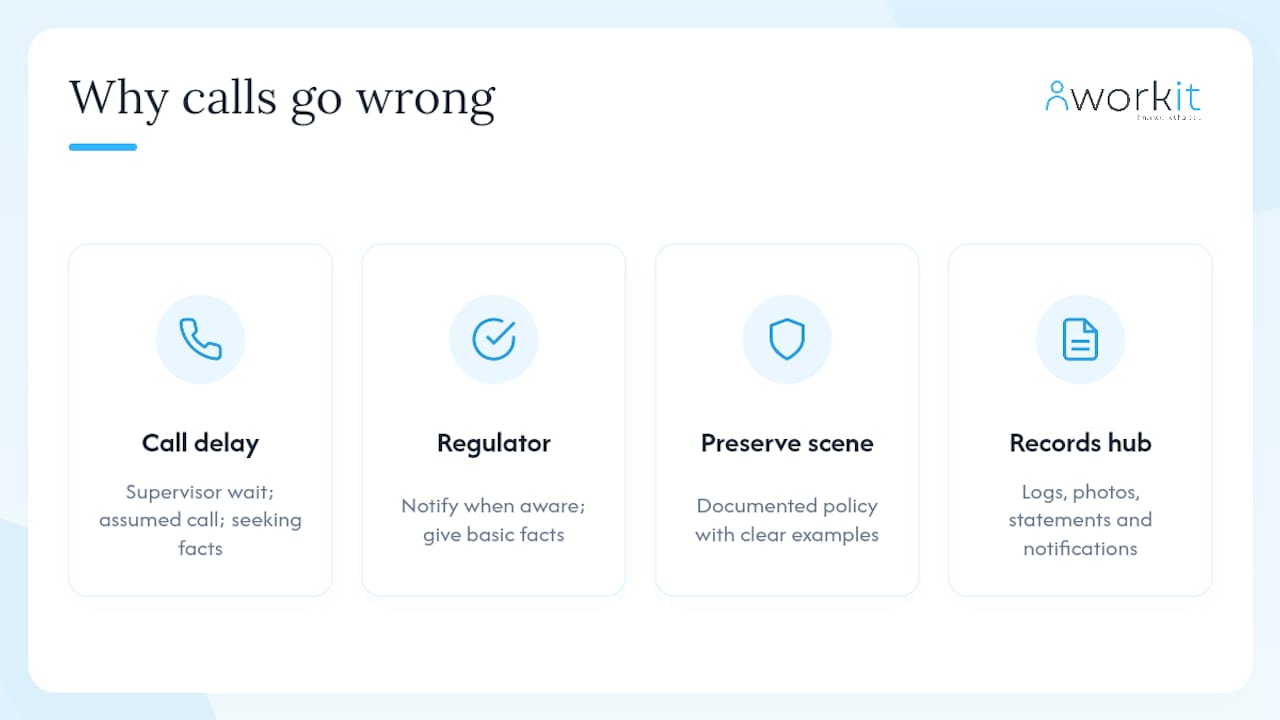
The gap between knowing you should notify and actually making the call is where most WHS compliance failures happen. In practice, the delay is almost never deliberate. It comes from a site manager waiting for a supervisor to confirm the incident is “serious enough,” or from someone assuming the WHS officer has already called, or from a genuine belief that gathering more information first will produce a better notification.
None of those reasons hold up under the Model WHS Act. The duty to notify is triggered the moment you become aware of a notifiable incident. The regulator does not expect a polished report on the first call. They expect a prompt call with the basic facts: what happened, where, when, and what you have done so far.
The other friction point I see consistently is scene preservation. Businesses either over-preserve (refusing to move anything even when workers are at risk) or under-preserve (cleaning up before an inspector arrives because the area looks hazardous). Both create problems. The answer is a documented scene preservation policy that your site managers have actually read, with clear examples of what is and is not a permitted disturbance.
Integrated incident-reporting software addresses the record-consistency problem directly. When the phone log, photographs, witness statements, and written notification all live in one place, there is no version of events to reconcile later. That consistency is what regulators are looking for when they review your response.
Workit makes WHS incident reporting easier for Australian businesses
Keeping up with WHS incident reporting obligations is demanding enough without managing evidence across email threads, shared drives, and paper forms. Workit’s incident reporting module gives Australian businesses a single platform to capture the phone log, attach time-stamped photographs, record witness statements, and track written notifications to regulators, all in one auditable trail.

Every record is retained automatically, so you are not scrambling to reconstruct a timeline if a regulator requests documentation. The platform supports your compliance management obligations across the full incident lifecycle, from the first on-scene action through to corrective-action sign-off, with local Australian support available when you need it.
At $5 per employee per month with all modules included, Workit is built for Australian businesses that want consistent processes without the complexity. Book a demo to see how the incident reporting module works in practice.
Authoritative regulator contacts and resources
Safe Work Australia publishes the model WHS Act framework, incident notification guidance, and a downloadable handbook with worked examples. It is the starting point for understanding the national framework, but it is not a regulator and does not receive notifications.
For operative rules and notification forms, go directly to your state or territory regulator:
| Jurisdiction | Regulator | Phone |
|---|---|---|
| NSW | SafeWork NSW | 13 10 50 |
| Victoria | WorkSafe Victoria | 13 23 60 |
| Queensland | WorkSafe Queensland | 1300 362 128 |
| Western Australia | WorkSafe WA | 1300 307 877 |
| South Australia | SafeWork SA | 1300 365 255 |
| ACT | WorkSafe ACT | 02 6207 3000 |
| Northern Territory | NT WorkSafe | 1800 019 115 |
| Commonwealth | Comcare | 1300 366 979 |
Key Safe Work Australia resources:
- Report an incident | WorkSafe Victoria
- Incident notification | Safe Work Australia
- Incident notification requirements under the model WHS Act | Safe Work Australia
- Incident reporting | Safe Work Australia
- Model WHS Act (consolidated) | legislation.gov.au
- Incident notification | SafeWork NSW
- Incident notification and investigation | WorkSafe ACT
- Reporting concerns and incidents — WorkSafe WA
Confirm with your local regulator whether the December 2025 model amendments have been adopted in your jurisdiction before updating internal thresholds or policies.
This article provides general information about WHS incident reporting obligations in Australia. It is not legal advice. Confirm current requirements with your state or territory WHS regulator or a qualified WHS professional.
FAQ
Which incidents must be reported to a WHS regulator?
Deaths, serious injuries or illnesses, and dangerous incidents that expose a person to a serious risk must be notified to your state or territory WHS regulator immediately. Safe Work Australia defines all three categories; not every workplace injury meets the threshold.
What are the four stages of a WHS incident investigation?
The four stages are: secure the scene and gather evidence, interview witnesses, conduct a root-cause analysis, and implement and document corrective actions. Timeframes for internal investigations vary, but the process should begin as soon as the scene is safe and the regulator has been notified.
How do you report a workplace incident in Australia?
Phone your state or territory WHS regulator as soon as you become aware of a notifiable incident, provide your ABN/ACN/WEN and the basic facts, then follow up in writing if the regulator requests it. Each jurisdiction has its own notification form and phone number; the contacts are listed in the regulator table above.
Do all workplace injuries need to be reported to the regulator?
No. Only notifiable incidents, deaths, serious injuries or illnesses, and dangerous incidents, must be reported to the regulator. Minor injuries that do not meet the legal threshold should still be recorded internally as part of your WHS management system.
Can Workit help manage WHS incident reporting records?
Yes. Workit’s incident reporting module centralises phone logs, photographs, witness statements, and written notifications in one auditable platform, supporting timely notification and consistent recordkeeping for Australian businesses.