


Why consistent HR processes reduce risk in Australia
TL;DR:
- Consistent HR processes involve repeatable, documented workflows that reduce legal and operational risk. They embed compliance into daily operations, minimizing variability and preventing costly breaches.
Consistent HR processes are defined as repeatable, documented workflows that apply the same standards to every employment decision, from hiring through to termination. They are the primary mechanism for reducing legal and operational risk in Australian workplaces. The Fair Work Ombudsman issued over 1,220 compliance notices in 2024–25, with civil penalties reaching $99,000 per breach for corporations. That figure tells you exactly how much variability in HR practice costs. When your processes are consistent, compliance becomes a built-in feature of daily operations, not a last-minute scramble before an audit.
Why inconsistent HR processes increase your legal and operational risk
Variability in HR decisions is the single greatest source of avoidable risk for Australian businesses. When managers handle performance issues, leave requests, or terminations differently from one another, the business cannot demonstrate fair and equal treatment. That gap between what your policy says and what actually happens is where legal exposure lives.
Inconsistent manager decisions create perceptions of unfairness and significantly increase workplace disputes and adverse claims. Uneven policy application fuels discrimination and unfair treatment claims that are difficult and expensive to defend. The problem compounds when there is no documentation to show what decision was made, who made it, and why.
Common sources of HR inconsistency include:
- Ad hoc manager decisions made without reference to policy, especially in performance management and disciplinary processes
- Undocumented conversations where verbal warnings or agreements are never recorded, leaving no audit trail
- Inconsistent onboarding where some employees receive full compliance inductions and others do not
- Variable leave approvals where the same request is granted for one employee and denied for another without documented reasoning
- Payroll errors caused by manual data entry or outdated award classifications applied differently across teams
Each of these gaps creates a potential claim. The risk is not theoretical. The Fair Work Ombudsman commenced 73 court proceedings in 2024–25 alone, and penalties apply per breach, not per incident.
Pro Tip: Document every significant HR decision at the time it is made. Contemporaneous records are far more credible in a dispute than notes reconstructed weeks later.
How standardisation in HR workflows creates compliance by design
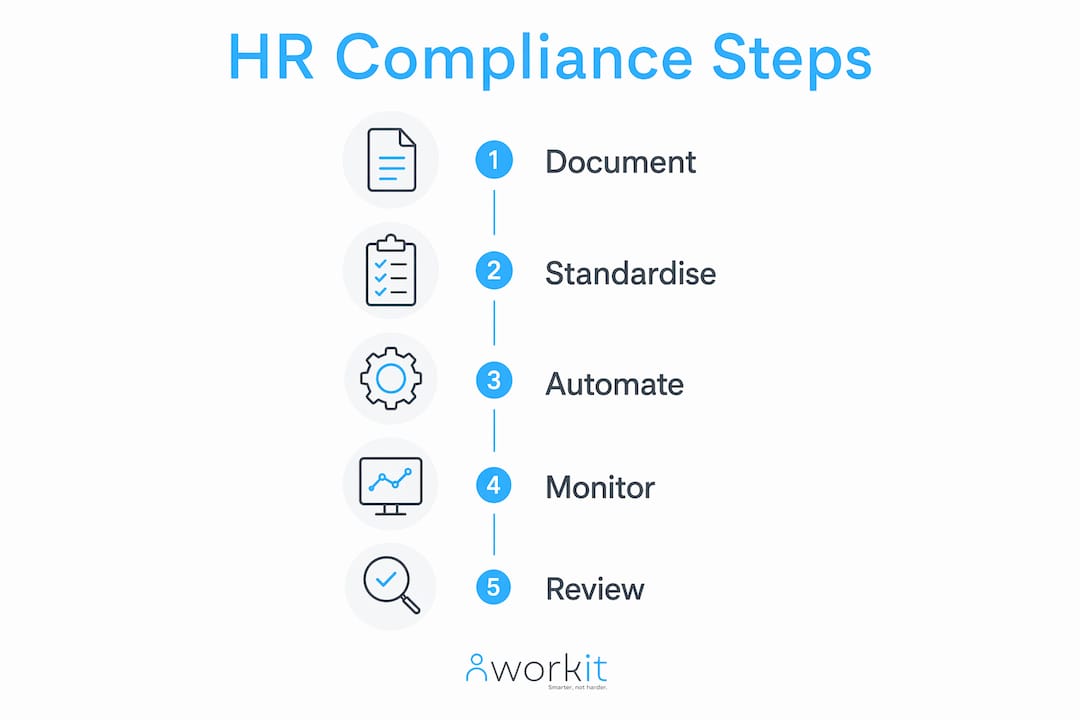
Standardised HR workflows embed compliance into repeatable steps, reducing errors and creating audit trails automatically. The concept is sometimes called “compliance by design.” Rather than relying on individual managers to remember every legal obligation, the workflow itself enforces the required steps.
A well-designed onboarding workflow, for example, does not let a manager skip the step where a new employee signs their contract, receives their Fair Work Information Statement, or completes their tax file number declaration. The checklist is the control. The same logic applies to termination workflows, where missing a step such as providing written notice or paying out accrued leave can trigger a claim.
The practical benefits of standardised workflows include:
- Automatic documentation — every completed step creates a record without requiring manual effort from the manager
- Reduced reliance on memory — critical compliance steps are prompted by the system, not recalled under pressure
- Consistent employee experience — every person goes through the same process, which is the strongest defence against claims of differential treatment
- Faster onboarding — structured workflows reduce the time to get a new employee fully operational and compliant
- Audit trail by default — completed checklists and timestamps provide evidence of compliance without additional reporting effort
Embedding automated compliance checkpoints such as triggers for required documents prevents process drift and reduces legal risk. This is the mechanism that makes consistency durable rather than dependent on individual effort. A meta-analysis of 115 studies confirms that businesses with well-integrated people practices experience better performance, growth, and lower turnover. Consistent HR processes are not just a legal safeguard. They are a performance driver.
How consistent HR processes support audit readiness
Audit readiness is not a project you run once a year. Continuous monitoring with quarterly reviews of payroll, superannuation, and award classifications is the standard that prevents compliance drift. Compliance drift occurs when actual workplace practices gradually diverge from documented policies, usually without anyone noticing until a complaint or audit forces a review.
Australian employers must keep employment records for at least seven years under the Fair Work Act. Incomplete records do not just create audit problems. They remove your ability to defend against claims, because you cannot prove what happened. A digital HR system that captures records automatically is far more reliable than a folder of spreadsheets.
The table below shows the difference between reactive and proactive audit approaches:
| Audit approach | Review frequency | Risk level | Typical outcome |
|---|---|---|---|
| Reactive (annual) | Once per year | High | Compliance gaps discovered late, penalties likely |
| Proactive (quarterly) | Every three months | Low | Drift caught early, corrective action taken quickly |
| Continuous (real-time) | Ongoing via HRIS | Minimal | Issues flagged before they become breaches |
Automated payroll systems must be regularly audited against current award classifications to avoid hidden compliance debt. Legacy spreadsheets often carry risk unnoticed until a major compliance event forces a full review. An HRIS that supports Fair Work compliance gives you real-time visibility into where your records stand, rather than discovering gaps under pressure.
Pro Tip: Schedule a quarterly payroll and award classification check as a fixed calendar event. Treat it the same way you treat a BAS lodgement. Missing it has similar consequences.
How consistent HR processes reduce workplace disputes and build fairness
Consistent HR processes are the most effective tool for preventing workplace disputes before they start. Training managers in consistent application of policies, documentation, and when to escalate issues significantly reduces HR risks. Defensible documentation is the key factor in legal disputes and demonstrates fairness to any tribunal or court.

Employees notice when the same rule is applied differently to different people. That perception of unfairness, even when unintentional, is what drives complaints to the Fair Work Commission. Consistent policies, applied uniformly and communicated clearly, remove the ambiguity that feeds those perceptions.
The practical steps that reduce dispute risk include:
- Written policies for every significant HR process, including performance management, disciplinary action, leave, and flexible work requests
- Manager training on how to apply policies consistently and how to document decisions at the time they are made
- Clear communication to employees about what the process is and what they can expect at each stage
- Escalation pathways so managers know when to involve HR rather than making unilateral decisions
- Regular policy reviews to check that documented processes still reflect actual practice and current legal requirements
Consistent, clear policies are the strongest legal defence against adverse claims. When you can show a tribunal that every employee in the same situation was treated the same way, and that the decision was documented at the time, the risk of an adverse finding drops significantly. Conducting a regular HR compliance health check is one of the most practical ways to confirm your processes are still aligned with your obligations under the Fair Work Act. You can also manage HR data privacy risks as part of the same review cycle, since employee records carry their own compliance obligations.
Automation and HRIS systems reduce manual errors, enforce compliance steps, and provide early warnings of risk patterns. Digital systems enhance record accuracy and simplify audits in ways that manual processes cannot replicate at scale.
Key takeaways
Consistent HR processes reduce risk by making compliance and fair treatment a repeatable, documented standard rather than a discretionary manager decision.
| Point | Details |
|---|---|
| Compliance by design | Standardised workflows enforce critical steps automatically, removing reliance on individual memory or discretion. |
| Quarterly audit reviews | Reviewing payroll, superannuation, and award classifications every quarter prevents costly compliance drift. |
| Seven-year record keeping | Australian employers must retain employment records for at least seven years under the Fair Work Act. |
| Manager training matters | Training managers to document decisions consistently is the most effective defence in unfair dismissal claims. |
| HRIS reduces manual risk | Digital HR systems improve record accuracy, flag risk patterns early, and simplify audit preparation. |
What I’ve learned from watching businesses get this wrong
The businesses that end up in Fair Work proceedings are rarely the ones with bad intentions. They are usually the ones that let their processes drift. A policy gets written, a manager gets trained, and then six months later the actual practice looks nothing like the document. Nobody noticed because nothing went wrong yet.
The most common mistake I see is treating HR consistency as a documentation exercise rather than a workflow design problem. Writing a policy and filing it away does not make your business consistent. Embedding the required steps into the actual process, so that skipping them requires deliberate effort, is what creates real protection.
Small and growing businesses are particularly exposed here. When you have five employees, the founder handles everything and nothing falls through the cracks. When you have fifty, the same informal approach creates serious legal exposure because different managers are making different calls. The time to build consistent processes is before you need them, not after a claim lands.
The long-term value of process consistency is not just legal protection. It is the trust that comes from employees knowing they will be treated the same way as their colleagues. That trust reduces turnover, improves engagement, and makes your business easier to manage. Consistent HR is not a compliance burden. It is a management advantage.
— Stephen
How Workit helps Australian businesses build consistent HR processes
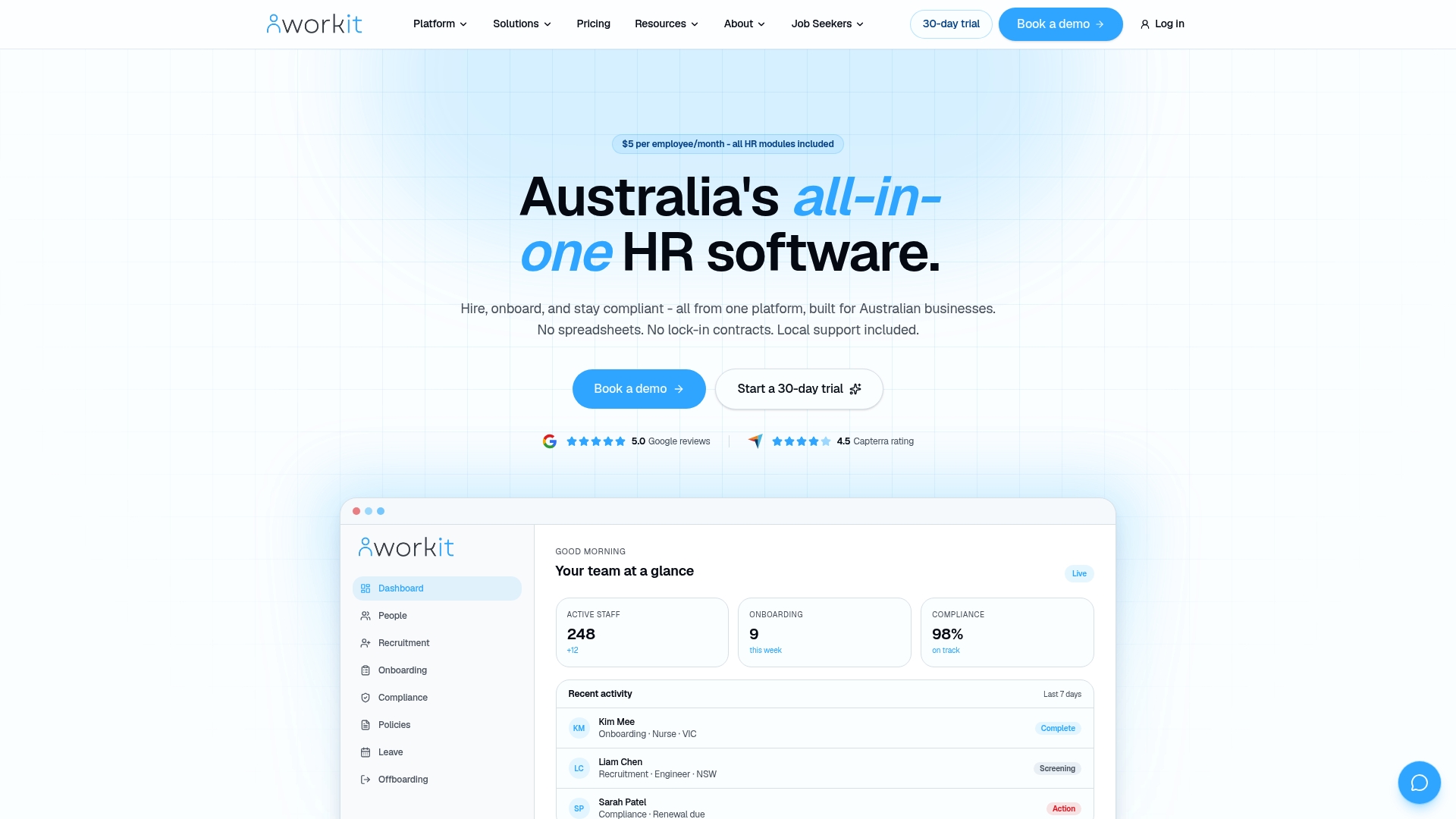
Workit is built specifically for Australian businesses that need to get HR compliance right without building a dedicated compliance team. The platform brings hiring, onboarding, and compliance into one place, with workflows that enforce the required steps automatically. Every completed action creates a record, so your audit trail builds itself as your team works.
Workit’s HR compliance software includes real-time compliance tracking, automated checklists, and reporting tools that give you visibility across your entire workforce. At $5 per employee per month with all modules included, it is built for businesses that want complete coverage without hidden costs. Book a demo at workit.com.au to see how it works for your team.
FAQ
What does HR process consistency mean in practice?
HR process consistency means applying the same documented steps to every equivalent employment decision, from onboarding to termination. It removes reliance on individual manager discretion and creates an automatic audit trail.
How does HR consistency reduce legal risk?
Consistent processes produce documented evidence that every employee was treated the same way. That documentation is the primary defence in unfair dismissal, discrimination, and adverse action claims before the Fair Work Commission.
What is compliance drift and why does it matter?
Compliance drift occurs when actual workplace practices gradually diverge from documented policies. Quarterly reviews of payroll and award classifications are the standard method for catching drift before it becomes a breach.
How long must Australian employers keep employment records?
Australian employers must retain employment records for at least seven years under the Fair Work Act. Incomplete records remove the ability to defend against claims during audits or disputes.
What is the role of an HRIS in managing HR risk?
An HRIS automates compliance steps, reduces manual data entry errors, and provides early warnings of risk patterns. It also simplifies audit preparation by maintaining accurate, timestamped records across all HR processes.