

Back pay explained: a guide for Australian employers
TL;DR:
- Back pay in Australia refers to wages owed to employees for periods when they were underpaid or not paid at all. Employers can be liable for back pay dating back six years, and active enforcement has recovered record-breaking fines. Proper calculation, reporting, and preventative measures are essential to reduce penalties and rebuild workplace trust.
Back pay is defined as wages or entitlements owed to an employee for prior pay periods where they were underpaid or not paid at all. Under the Fair Work Act section 544, employees can claim unpaid wages going back six years, which means a single payroll error left uncorrected can compound into a significant liability. The Fair Work Ombudsman recovered $509 million in underpayments in 2022–23, a record that signals active enforcement across small and medium businesses. For HR professionals and employers, understanding your obligations around back pay is not optional. It is a core compliance responsibility under Australian labour law.
What triggers back pay obligations?
Back pay obligations arise when an employee receives less than their legal entitlement under an Award, Enterprise Agreement, or the National Employment Standards. The causes are more common than most employers expect, and many originate from administrative oversights rather than deliberate underpayment.
The most frequent triggers include:
- Award misclassification: Placing an employee on the wrong classification level under a Modern Award results in a lower base rate than legally required.
- Payroll misconfiguration: Software set up incorrectly at the time of hire can silently underpay penalty rates, overtime, or allowances for months or years.
- Missed wage increases: Annual minimum wage increases set by the Fair Work Commission take effect on 1 July each year. Failing to apply them on time creates an immediate underpayment.
- Unpaid penalty rates: Weekend, public holiday, and shift penalty rates are frequently missed, particularly for casual and part-time employees with variable rosters.
- Superannuation shortfalls: Superannuation calculated on an incorrect base wage produces a compounding shortfall across every pay period.
The six-year statutory recovery limit under the Fair Work Act means an employee can claim back salary owed from as far back as 2020. That window is long enough to turn a modest weekly underpayment into a five-figure liability per employee. Employers who conduct regular payroll audits catch these issues early, before the exposure grows.
How do you calculate back pay accurately?
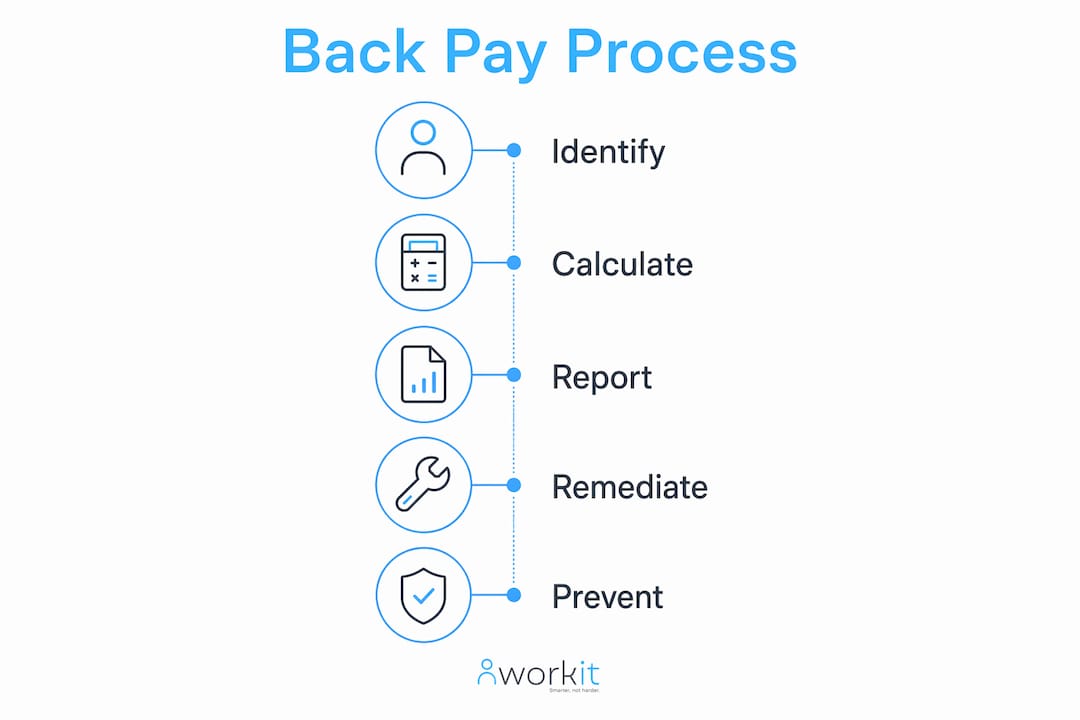
Accurate calculation of unpaid wages requires a structured audit process. Guessing at figures or applying a rough estimate exposes you to further liability if the amount is later found to be insufficient.
Follow these steps to calculate back pay correctly:
- Pull payroll records for the full period. Gather time and attendance data, rosters, and payslips for every affected employee across the entire underpayment period, up to six years if required.
- Identify the correct rate. Cross-reference the applicable Modern Award or Enterprise Agreement to confirm the correct base rate, classification level, and any applicable allowances for each employee.
- Calculate the base wage shortfall. Subtract what was actually paid from what should have been paid for each pay period. Do this for every employee individually.
- Add penalty rates and overtime. Comprehensive back pay must include all wage shortfalls plus penalty rates, overtime, and allowances owed under the Award or National Employment Standards.
- Adjust leave accruals. If an employee’s leave accrued on an incorrect base rate, the leave balance and any paid leave taken during the period may also need recalculating.
- Calculate superannuation on the corrected amount. Superannuation is owed on the underpaid wages as well. Apply the correct Superannuation Guarantee rate to the total wage shortfall for each period.
- Use the Fair Work pay calculator. The Fair Work Ombudsman’s pay calculator helps verify Award rates and penalty calculations for common industries and classifications.
For complex cases involving multiple Awards or long underpayment periods, consider engaging a specialist employment lawyer or payroll consultant to verify your methodology.
Pro Tip: Document every step of your calculation methodology in writing. If the Fair Work Ombudsman audits your remediation, a clear audit trail showing how you arrived at each figure is the single most effective way to demonstrate good faith and reduce penalty exposure.

How should you report back pay to the Fair Work Ombudsman?
When you identify an underpayment, the question is not whether to report it but how to do so effectively. Voluntary disclosure to the Fair Work Ombudsman is the legally and commercially sensible path. Employers who voluntarily disclose and remediate underpayments generally face penalties reduced by 50–80% compared to those discovered through complaints or audits. That reduction is material when penalties can reach hundreds of thousands of dollars per contravention.
A strong self-report to the Fair Work Ombudsman includes:
- A full audit covering all affected employees and pay periods. Partial disclosures that leave out some employees or periods are treated as incomplete and can trigger further investigation.
- A clear methodology statement. Explain how you identified the underpayment, which Award or Agreement applied, and how you calculated the amounts owed.
- Root cause analysis. Identify whether the cause was payroll misconfiguration, classification error, or a missed wage increase. The self-report audit must include evidence of the root cause to satisfy the Ombudsman’s requirements.
- A remediation plan with timelines. Commit to specific payment dates and confirm how you will prevent recurrence.
Internal communication with affected employees is equally important. Proactive communication about the underpayment amount and repayment plan reduces the risk of employees lodging separate complaints with the Fair Work Ombudsman, which would complicate your self-report. A clear, honest explanation of what happened and when they will be paid preserves trust far more effectively than silence.
Pro Tip: Before contacting the Fair Work Ombudsman, complete your internal HR compliance health check so you can present a complete picture from the outset. Incomplete disclosures can be treated as non-cooperative.
What are the penalties for underpayment under the Fair Work Act?
The financial consequences of failing to address underpayments are severe, and they scale quickly. Civil penalties for underpayment contraventions reach $93,900 per contravention for companies with fewer than 15 employees, and $469,500 per contravention for companies with 15 or more employees. Each pay period in which an employee was underpaid can be counted as a separate contravention. A business that underpaid three employees across 52 weekly pay periods faces up to 156 separate contraventions.
That arithmetic is not theoretical. The Fair Work Ombudsman applies it in enforcement proceedings, and the Fair Work Commission can issue binding decisions that carry legally enforceable undertakings. Bypassing formal processes or attempting to settle informally without a proper remediation plan risks enforcement action that removes your ability to negotiate terms.
From 2025, criminal penalties apply to intentional underpayments. Deliberate wage theft now carries the prospect of criminal prosecution, not just civil fines. The distinction between negligent and intentional underpayment has therefore become a critical legal question for employers managing wage recovery.
The full range of consequences includes civil fines, enforceable undertakings, court orders requiring repayment, and reputational damage that affects recruitment and client relationships. Prompt and complete remediation is the only reliable way to limit exposure across all of these dimensions.
Best practices for managing back pay and preventing future underpayments
Remediating a back pay issue is only half the job. The other half is building the processes that prevent it from happening again.
- Pay promptly or negotiate a schedule. Delaying payment of back pay increases the risk of disputes and additional penalties. If cash flow is constrained, negotiate a payment plan with affected employees and document the agreement in writing.
- Communicate clearly with employees. Tell affected staff what happened, how much they are owed, and when they will receive it. Vague or delayed communication increases the likelihood of Fair Work Ombudsman complaints.
- Audit your payroll configuration. Review your payroll integration settings against current Award rates at least annually, and immediately after any Award variation or wage increase takes effect.
- Classify employees correctly. Review classification levels for all employees against the applicable Modern Award. Misclassification is the leading cause of systemic underpayments in Australian workplaces.
- Conduct routine payroll audits. A structured HR data audit at least twice per year catches errors before they compound. Audit a sample of payslips against Award rates, rosters, and time records.
- Train your payroll and HR staff. Ensure the people processing pay understand the Awards that apply to your workforce, including penalty rate structures and allowance triggers.
- Use compliance software. HR and payroll platforms with real-time Award rate updates and compliance monitoring reduce the manual checking burden and flag anomalies before they become liabilities.
Key takeaways
Back pay obligations under the Fair Work Act require employers to calculate, report, and remediate all underpayments within a six-year window, with voluntary disclosure the most effective way to reduce penalty exposure.
| Point | Details |
|---|---|
| Six-year recovery window | Employees can claim unpaid wages going back six years under Fair Work Act section 544. |
| Calculate the full amount | Back pay must include base wages, penalty rates, allowances, leave adjustments, and superannuation. |
| Self-report proactively | Voluntary disclosure to the Fair Work Ombudsman can reduce civil penalties by 50–80%. |
| Penalties scale per contravention | Each underpaid pay period per employee can count as a separate contravention, with fines up to $469,500. |
| Prevent recurrence | Regular payroll audits, correct classification, and compliance software stop underpayments before they compound. |
Why transparency is the only credible strategy
The employers I have seen handle back pay issues well share one trait: they told their employees the truth quickly. Not after the lawyers had reviewed everything three times. Not after the Fair Work Ombudsman made contact. Early, direct, and honest.
The instinct to delay disclosure is understandable. No one wants to admit a payroll error to their workforce. But the commercial logic runs the other way. Employees who find out about an underpayment from their employer, with a clear explanation and a payment date, are far less likely to escalate to the Fair Work Ombudsman than employees who find out from a colleague or a payslip discrepancy they noticed themselves.
The penalty reduction for voluntary disclosure is real and significant. But the less-discussed benefit is what it does to your workplace culture. An employer who owns a mistake and fixes it promptly signals that their HR processes are trustworthy. That matters for retention, for morale, and for your ability to attract good people.
The practical advice I give to HR professionals is this: build your payroll audit into the calendar before something goes wrong. A twice-yearly review of Award rates, classification levels, and payroll configuration costs a few hours. Remediating a three-year underpayment across a team of 20 costs months of work, significant legal fees, and a conversation with your employees that no one wants to have.
Get the pay run process right from the start. The compliance infrastructure exists. Use it.
— Stephen
How Workit supports payroll compliance and back pay management
Managing back pay obligations requires accurate records, clear audit trails, and real-time visibility over your payroll compliance position.
Workit is built for Australian businesses and includes compliance monitoring, payroll integration, and reporting tools in a single platform at $5 per employee per month, with no hidden fees. The HRIS compliance module supports Fair Work audit readiness by maintaining structured employee records, tracking Award classifications, and flagging configuration gaps before they become underpayments. When you need to demonstrate a complete remediation to the Fair Work Ombudsman, Workit’s reporting tools give you the documentation to do it. Book a demo at workit.com.au to see how the platform supports your compliance obligations.
FAQ
What is back pay in Australian employment law?
Back pay is the amount an employer owes an employee for wages or entitlements that were not paid correctly in prior pay periods. It includes base wage shortfalls, penalty rates, allowances, leave adjustments, and superannuation on underpaid amounts.
How far back can an employee claim unpaid wages in Australia?
Under Fair Work Act section 544, employees can claim unpaid wages going back six years from the date of the claim. Employers must remediate all known underpayments within this window to achieve compliance.
What should a self-report to the Fair Work Ombudsman include?
A self-report must include a full audit of all affected employees and pay periods, a methodology statement, evidence of the root cause such as payroll misconfiguration, and a remediation plan with specific payment timelines.
What are the civil penalties for underpaying employees?
Civil penalties reach $93,900 per contravention for companies with fewer than 15 employees and $469,500 per contravention for larger companies. Each underpaid pay period per employee can be counted as a separate contravention.
Does voluntary disclosure reduce penalties for underpayment?
Employers who voluntarily disclose and remediate underpayments generally face penalties reduced by 50–80% compared to those identified through complaints or Fair Work Ombudsman audits.