

Best HR software Australia: 2026 guide for HR leaders
TL;DR:
- Workit is the leading HR software choice in 2026 for Australian businesses, offering compliance-focused features and local support. It supports complex payroll requirements like STP Phase 2 and Payday Super, with transparent pricing and integrated modules. Proper evaluation, including a parallel pay cycle, is essential to ensure compliance and smooth implementation.
For most Australian businesses, Workit is the recommended HR software choice in 2026. It combines compliance-first design for STP Phase 2 and Payday Super, transparent pricing at a low per-employee monthly rate, and Australian-based support — all in one platform with no hidden fees.
The compliance stakes are higher than ever. From 1 July 2026, Payday Super requires employers to pay superannuation guarantee contributions on payday, with funds reaching the fund within seven business days of each pay event. At the same time, STP Phase 2 mandates detailed earnings category splits and valid tax treatment codes for every pay event. Your HR software must handle both, or you are exposed.
This guide is published by Workit. The recommendation reflects Workit’s product capabilities and the evidence gathered from Australian regulatory sources and industry research. Where a different product class genuinely fits better, this guide says so plainly.
Table of Contents
- Why Workit works for Australian businesses
- How do you choose the right HR software in Australia?
- What features must Australian HR software have in 2026?
- What does implementation actually look like?
- When is a different type of solution a better fit?
- How does Workit meet Australian compliance requirements?
- What do STP Phase 2 and Payday Super actually require from your software?
- How does HR software handle multi-state compliance in Australia?
- What training and onboarding resources should vendors provide?
- What types of HR software exist, and which fits your organisation?
- How Australian businesses are using HR software successfully
- How does Workit scale and adapt across Australian industries?
- How do payroll and accounting integrations work in Australian HR software?
- Key takeaways
- The real problem with how most businesses choose HR software
- Ready to see Workit in action?
- Useful sources
- FAQ
Why Workit works for Australian businesses
Workit was built specifically for the Australian market, which means its compliance logic reflects how Australian payroll and HR actually operate — not a localised version of a US or UK product.

Compliance alignment. Workit’s payroll integration supports STP Phase 2 payload generation, including the earnings category splits and 6-character tax treatment codes the ATO requires. It also supports Payday Super timing workflows, so super contributions are triggered at each pay event rather than quarterly. The Superannuation Guarantee rate rose to 12% on 1 July 2025, which increases the financial exposure for any late or miscalculated payment — the right software removes that risk.
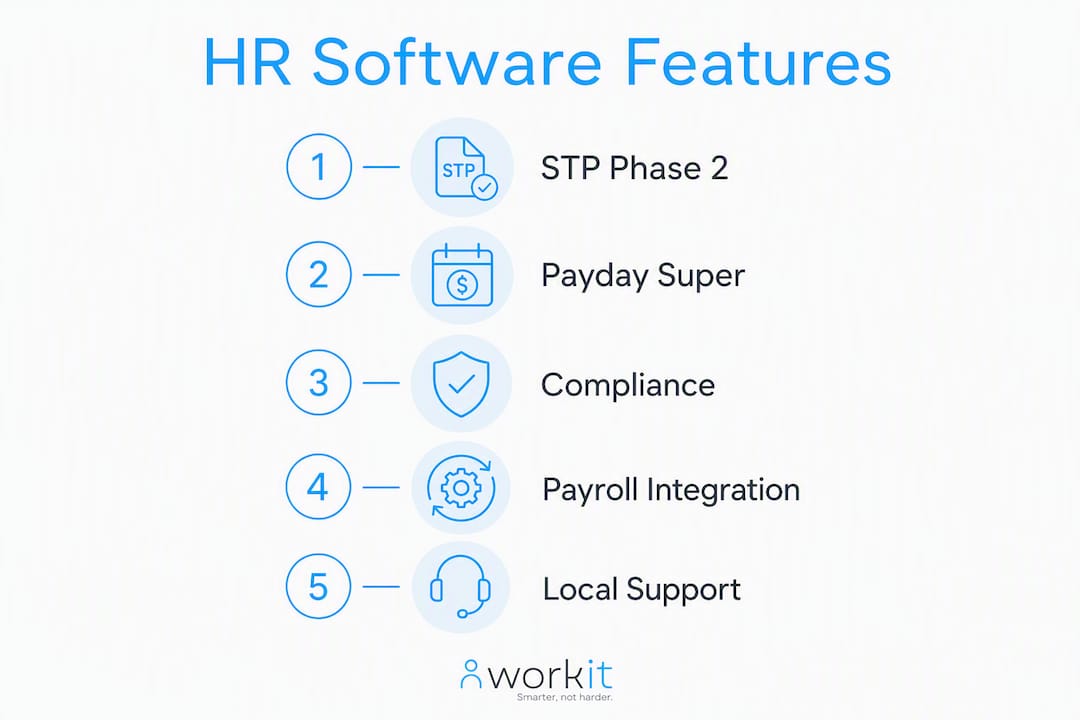
Pricing. At a consistent per-employee monthly rate, every module is included. Recruitment, onboarding, HRIS, leave tracking, performance reviews, compliance management, learning, incident reporting, policy distribution, custom forms, employee self-service, and real-time reporting. No per-module add-ons, no surprise fees at renewal.
Key signals that support the recommendation:
- Native integration with Xero and other Australian payroll providers
- Award-aware timesheets and NES-aligned leave tracking
- Role-based access controls and full audit logs for Fair Work readiness
- Secure document management with 7-year retention support
- Australian-based support team with local implementation services available
Local support. When something goes wrong at 8 AM on a Monday before payroll runs, you need someone who understands Australian awards, Fair Work obligations, and the ATO’s requirements. Workit’s support team is based in Australia and responds quickly. That is a practical advantage that offshore-only support models cannot match.
How do you choose the right HR software in Australia?
Prioritise compliance by design, payroll fit, integration depth, and vendor proof — then run a pilot before you sign.
Build your shortlist in order
- Confirm compliance credentials first. Ask every vendor for a live STP Phase 2 payload demonstration, not a slide deck. Request evidence of Payday Super handling, including how the system manages the seven-business-day window.
- Check payroll integration depth. A native integration with your payroll provider (Xero, KeyPay, or another local provider) is preferable to a middleware connector. Ask whether the integration is bidirectional and how often it syncs.
- Verify award interpretation. If your workforce is covered by modern awards, the system must interpret those awards correctly for overtime, penalty rates, and allowances. Ask for a demonstration using your specific award.
- Test integrations end-to-end. Request a sandbox environment and connect it to your actual payroll and accounting tools before committing.
- Run a pilot and parallel pay. Process one pay period in both your existing system and the new platform. Compare outputs line by line. This step surfaces mapping errors and classification gaps before go-live.
- Check references. Ask vendors for at least two Australian customer references in a similar industry and size. Call them.
Questions to ask vendors during demos
- Can you show a sample STP Phase 2 payload for a back-pay scenario?
- How does the system handle bounced super payments within the Payday Super window?
- How are earnings categories mapped for employees on multiple awards?
- Where is our data hosted, and what is your data residency policy?
- What are your support hours, and is support based in Australia?
Red flags to watch for
A vendor who cannot produce STP Phase 2 payload screenshots on request is a concern. “STP-enabled” does not automatically mean STP-compliant for your specific payroll setup or industry — the ATO’s own guidance makes this distinction clear. Offshore-only support, opaque per-module pricing, and vague answers about data export at contract end are all signals to walk away. If a vendor resists a parallel pay cycle, that resistance itself tells you something.
For a deeper framework, the Australian HR software buyer guide covers vendor evaluation criteria in full.
What features must Australian HR software have in 2026?
The non-negotiable foundation is native compliance and payroll integration. Everything else builds on that.
Australian employers need their HR platform to handle the full employee lifecycle while staying aligned to Fair Work, the National Employment Standards, and ATO reporting requirements. The specific capabilities that matter:
- Single employee record covering personal details, employment history, documents, and compliance status in one place
- Award-aware timesheets that apply the correct penalty rates, overtime rules, and allowances for each modern award
- NES-aligned leave tracking covering annual leave, personal/carer’s leave, parental leave, and long service leave accruals by state
- STP Phase 2-ready payroll payloads with correct earnings category splits and tax treatment codes
- Payday Super support with per-pay-event super triggers and error correction workflows within the seven-business-day window
- Secure document management with 7-year retention to meet Australian record-keeping obligations
- Audit logs and role-based access for Fair Work readiness and psychosocial safety governance
- Employee and manager self-service via mobile, which matters for dispersed workforces in retail, hospitality, construction, and healthcare
- Onboarding workflows that capture tax file numbers, super fund choices, and policy acknowledgements digitally
Regulators now expect visibility across the full employee lifecycle, from onboarding through to incident reporting. That means your HR platform needs to function as a governance tool, not just a record-keeper.
Pro Tip: Ask vendors to demonstrate STP Phase 2 and Payday Super handling for edge cases specifically: back-pay runs, leave without pay, terminations mid-period, and bounced super payments. A vendor who can walk through a documented error-correction workflow for a bounced super payment within the seven-business-day window has genuinely built for Australian compliance. One who cannot is relying on you not to ask.
For a full feature checklist, see HR compliance software must-have features for Australian businesses.
What does implementation actually look like?
For a small business (under 50 employees), expect four to eight weeks from contract to go-live. Mid-size organisations (50–250 employees) typically need eight to fourteen weeks. Larger or more complex environments can run sixteen weeks or more, particularly where award complexity or multi-entity payroll is involved.
| Stage | Small org (weeks) | Mid-size org (weeks) | Large/complex org (weeks) |
|---|---|---|---|
| Discovery and scoping | 1 | 1–2 | 2–3 |
| Data clean-up and migration | 1–2 | 2–3 | 3–5 |
| Configuration and pilot | 1–2 | 2–3 | 3–5 |
| Parallel pay run | 1 | 1–2 | 2–3 |
| Go-live and stabilisation | 1 | 2 | 2–4 |
The biggest cost driver is almost always data quality. Messy employee records, inconsistent award classifications, and undocumented pay structures add weeks to migration. Clean your data before you start, not during.
Other cost drivers to budget for:
- Award complexity (multiple awards, enterprise agreements, or irregular pay structures)
- Number and depth of integrations (payroll, accounting, timeclocking hardware)
- Custom reporting requirements
- Paid implementation services for complex migrations
Before signing any contract, confirm: SLA response times, data residency location, security audit certifications (ISO 27001 or SOC 2), termination and data export clauses, support hours, and whether you will have a named implementation lead. A vendor who cannot answer these questions before contract is unlikely to answer them faster after.
Running a parallel pay cycle is not optional for most organisations. It is the only reliable way to catch mapping errors, classification gaps, and integration timing issues before they affect real employees. Scope it to one full pay period across a representative sample of your workforce — different award types, different pay frequencies, different employment categories.
The HR system implementation guide for Australian businesses covers each stage in detail.
When is a different type of solution a better fit?
Choose a specialised product when payroll complexity, rostering scale, or enterprise integration requirements exceed what an all-in-one HRIS can handle.
Most Australian businesses — particularly those under 500 employees — are well served by an all-in-one HRIS with a strong payroll integration. But there are genuine cases where a best-of-breed approach makes more sense:
- Heavy award and roster environments (hospitality, aged care, construction) where real-time award interpretation across hundreds of employees and complex shift patterns requires a dedicated workforce management platform
- Multi-entity or multi-country payroll where a single payroll engine cannot handle the legal entity structure, currency, or reporting requirements across jurisdictions
- Organisations with integrated timeclock hardware that require direct API connections to physical devices and real-time attendance feeds
- Enterprise environments needing advanced workforce analytics, headcount modelling, or deep ERP integration (SAP, Oracle) that a mid-market HRIS is not designed to support
The practical approach: start with an HRIS as the central employee record and add specialist tools only where a genuine gap exists. A proven payroll integration between your HRIS and a dedicated payroll engine (such as Xero or KeyPay) covers most Australian businesses without the overhead of a full enterprise HCM suite.
How does Workit meet Australian compliance requirements?
Workit satisfies the core criteria: compliance-first design, native payroll links, and local support from a team that understands Australian employment law.
Product features mapped to mandatory requirements:
- STP Phase 2 support via payroll integration, generating earnings category splits and tax treatment codes per pay event
- Payday Super timing with per-pay-event super triggers and documented error-correction workflows
- Award-aware time and leave tracking aligned to NES entitlements and modern award conditions
- Document retention and audit logs supporting 7-year record-keeping and Fair Work audit readiness
- Psychosocial safety and incident reporting workflows with full audit trails
- Policy distribution and acknowledgement tracking for governance and compliance visibility
Pricing example. A 40-person business pays a fixed monthly fee. That covers every module — no separate fees for onboarding, compliance, performance, or reporting. Optional paid implementation services are available for organisations that need hands-on migration support.
Support model. Australian-based support during business hours, with a named implementation lead for complex deployments. Paid professional services are available for data migration, award configuration, and integration setup.
For a full product overview, see Workit’s HRIS software page.
What do STP Phase 2 and Payday Super actually require from your software?
STP Phase 2 and Payday Super are the two compliance requirements that most directly affect your choice of HR and payroll software in 2026.
STP Phase 2 requires employers to report detailed payroll information to the ATO at every pay event. Gross earnings must be split into specific categories — ordinary time earnings, allowances, bonuses, leave payments, and others — and each employee’s tax treatment must be expressed as a valid 6-character code. The ATO’s STP Phase 2 guidelines also mean that STP reports replace TFN declarations, so the data must be accurate from day one of employment.
Payday Super, effective from 1 July 2026, ends the quarterly super payment cycle. Contributions must be paid on payday, with funds reaching the employee’s fund within seven business days. Late payments attract penalties of 25–50% depending on compliance history. The New Payments Platform now supports near real-time super payments, and updated SuperStream standards include improved error messaging and member verification. Your software must be able to trigger super payments per pay event, track the seven-business-day window, and handle errors — bounced payments, incorrect fund details, and member verification failures — within that window.
The practical implication: “STP-enabled” on a vendor’s marketing page is not sufficient. You need to verify that the system handles your specific payroll setup, including back-pay, terminations, and leave without pay scenarios, correctly.
How does HR software handle multi-state compliance in Australia?
Australia’s employment framework is national through Fair Work, but state and territory variations still create real complexity for multi-state employers.

Long service leave is the most significant variable. Each state and territory has its own Long Service Leave Act, with different accrual rates, qualifying periods, and portability rules. An employee who moves from Queensland to Victoria mid-employment triggers a different calculation in each jurisdiction. Your HR software must track state of employment for each worker and apply the correct LSL rules automatically.
Workers’ compensation is entirely state-based. Premiums, claims processes, and return-to-work obligations differ across New South Wales, Victoria, Queensland, Western Australia, and the other jurisdictions. HR software should record the relevant state for each employee and support incident reporting workflows that align to the applicable scheme.
Public holidays vary by state and, in some cases, by region within a state. Award interpretation for penalty rates on public holidays must reflect the employee’s actual work location, not the employer’s head office. For businesses operating across multiple states, this is a common source of payroll errors.
A platform that handles multi-state compliance well will let you assign a state of employment to each employee record, apply the correct LSL and workers’ comp rules automatically, and flag when a transfer or change of location triggers a recalculation. Ask vendors to demonstrate this specifically if you operate in more than one state.
What training and onboarding resources should vendors provide?
The quality of vendor training resources is a reliable indicator of how well the implementation will go — and how quickly your team becomes self-sufficient.
Good vendors provide structured onboarding for HR administrators, not just a help centre. That means a defined implementation programme with milestones, a named contact who knows your configuration, and training sessions tailored to your award setup and payroll integration. Generic video libraries are useful for ongoing reference but are not a substitute for guided setup.
For Australian users specifically, look for training that covers STP Phase 2 reporting workflows, Payday Super payment triggers, and how to configure award rules within the platform. A vendor who offers Australian-specific training content has built it because their customers needed it — which tells you something about their customer base and compliance depth.
After go-live, ongoing resources matter. Regular product update communications (particularly around ATO changes), a responsive support channel, and access to a community or knowledge base for peer questions all reduce the long-term cost of running the platform. Workit provides Australian-based support and implementation services, with resources tailored to local compliance requirements.
What types of HR software exist, and which fits your organisation?
The four main categories are HRIS, HCM, payroll software, and workforce management (WFM). They overlap, but they are not interchangeable.
HRIS (Human Resource Information System) is the core employee record system. It manages personal data, employment history, documents, leave, onboarding, and compliance workflows. Most Australian businesses under 500 employees need a strong HRIS as their foundation. Workit sits in this category, with payroll integration rather than a built-in payroll engine.
HCM (Human Capital Management) extends HRIS with talent management, succession planning, advanced analytics, and often global payroll. It suits large enterprises with complex organisational structures and dedicated HR teams. The cost and configuration overhead is significant.
Payroll software handles pay calculations, tax, super, and ATO reporting. In Australia, this means STP Phase 2 compliance and, from July 2026, Payday Super. Xero Payroll and KeyPay are well-known local options. Most businesses run payroll software integrated with their HRIS rather than as a standalone tool.
Workforce Management (WFM) covers rostering, time and attendance, and shift planning. It is most relevant for industries with complex shift patterns — hospitality, retail, healthcare, and aged care. WFM tools often integrate with both HRIS and payroll but are rarely the right starting point for a business that does not have a rostering problem.
For small businesses (under 50 employees), an HRIS with a solid payroll integration covers most needs at a manageable cost. Mid-size organisations (50–500 employees) benefit from the same foundation with more attention to award complexity and integration depth. Larger organisations should evaluate whether an enterprise HCM or a best-of-breed stack is justified by their actual complexity.
How Australian businesses are using HR software successfully
The pattern that appears consistently across successful implementations is straightforward: organisations that invest in data clean-up before migration, run a parallel pay cycle, and engage their payroll team early in the process go live faster and with fewer errors. Those that treat HR software as an IT project rather than a payroll and compliance project tend to encounter problems at go-live.
For Australian businesses specifically, the compliance requirements around STP Phase 2 and Payday Super mean that the payroll integration must be validated before go-live, not assumed. Businesses that have done this well typically run a full parallel pay cycle covering at least one pay period across all award types and employment categories before switching over.
Workit’s HR resources and insights blog includes implementation examples and practical guidance from Australian businesses across industries.
How does Workit scale and adapt across Australian industries?
Workit’s module-based structure means you activate what you need and leave the rest. A 15-person professional services firm uses onboarding, HRIS, leave tracking, and performance reviews. A 200-person retail business adds award-aware timesheets, rostering integration, and incident reporting. The pricing stays the same: $5 per employee per month regardless of which modules you use.
Custom forms and approval workflows let you adapt the platform to industry-specific processes without custom development. A not-for-profit managing volunteer compliance, a finance firm with strict document retention requirements, or a construction business tracking site inductions can all configure Workit to their workflows. Industry-specific solution pages for not-for-profits and finance cover the specific compliance and reporting considerations for those sectors.
Scalability works in both directions. Growing from 20 to 200 employees does not require a platform change or a pricing renegotiation. The $5 per employee monthly rate applies at every scale, and the compliance features that matter at 200 employees are already present at 20.
How do payroll and accounting integrations work in Australian HR software?
The integration between your HRIS and payroll software is the most operationally critical connection in your HR tech stack.
In Australia, the most common HRIS-to-payroll integrations run between platforms like Workit and payroll tools such as Xero or KeyPay. A well-built integration pushes employee data (new starters, terminations, pay rate changes, leave approvals) from the HRIS to payroll automatically, eliminating double entry and reducing the risk of payroll errors. It also pulls payroll confirmation data back into the HRIS for reporting.
For STP Phase 2, the integration must support the transfer of earnings category data and tax treatment codes in the correct format. For Payday Super, it must trigger super payment instructions at each pay event and track the seven-business-day window. These are not generic integration requirements — they are specific to Australian payroll law, and they are worth verifying explicitly during vendor demos.
Beyond payroll, useful third-party integrations for Australian HR teams include accounting platforms (Xero, MYOB), learning management systems, background check providers, and identity verification tools for onboarding. Workit’s integration with Xero covers the payroll data flow and supports payroll software selection for teams evaluating their full stack.
Key takeaways
The best HR software for Australian businesses in 2026 must handle STP Phase 2, Payday Super, and Fair Work compliance natively — and Workit delivers all three with competitive per-employee pricing and Australian-based support.
| Point | Details |
|---|---|
| Payday Super is live from July 2026 | Super must reach the fund within seven business days of each pay event; late payments attract penalties of 25–50%. |
| STP Phase 2 requires detailed payloads | Every pay event must include earnings category splits and valid 6-character tax treatment codes. |
| Pilot before you go live | Run a parallel pay cycle across all award types to catch mapping errors before they affect real employees. |
| Pricing transparency matters | Workit’s $5 per employee per month covers all modules with no per-feature add-ons. |
| Workit for Australian compliance | Workit supports STP Phase 2, Payday Super, NES-aligned leave, and audit logs with Australian-based support. |
The real problem with how most businesses choose HR software
Most HR software decisions in Australia are driven by feature checklists and demo aesthetics. The vendor shows a clean interface, ticks every box on the requirements list, and the deal gets done. Then payroll goes live and the STP Phase 2 payload is wrong, or the super payment misses the seven-business-day window, and the team is scrambling.
The compliance requirements that matter most in 2026 — Payday Super timing, STP Phase 2 earnings splits, award interpretation for penalty rates — are exactly the ones that are hardest to verify from a demo. They require specific test cases, real payloads, and a vendor who is willing to show you edge cases rather than just the happy path.
The businesses that get this right treat the payroll integration as the primary evaluation criterion, not an afterthought. They run parallel pay cycles. They call references and ask specifically about compliance incidents. They read the contract’s data export and termination clauses before signing.
Workit’s design reflects this reality. The compliance features are not add-ons — they are built into the core product because Australian businesses cannot afford to treat compliance as optional. That is the honest reason for the recommendation.
Ready to see Workit in action?
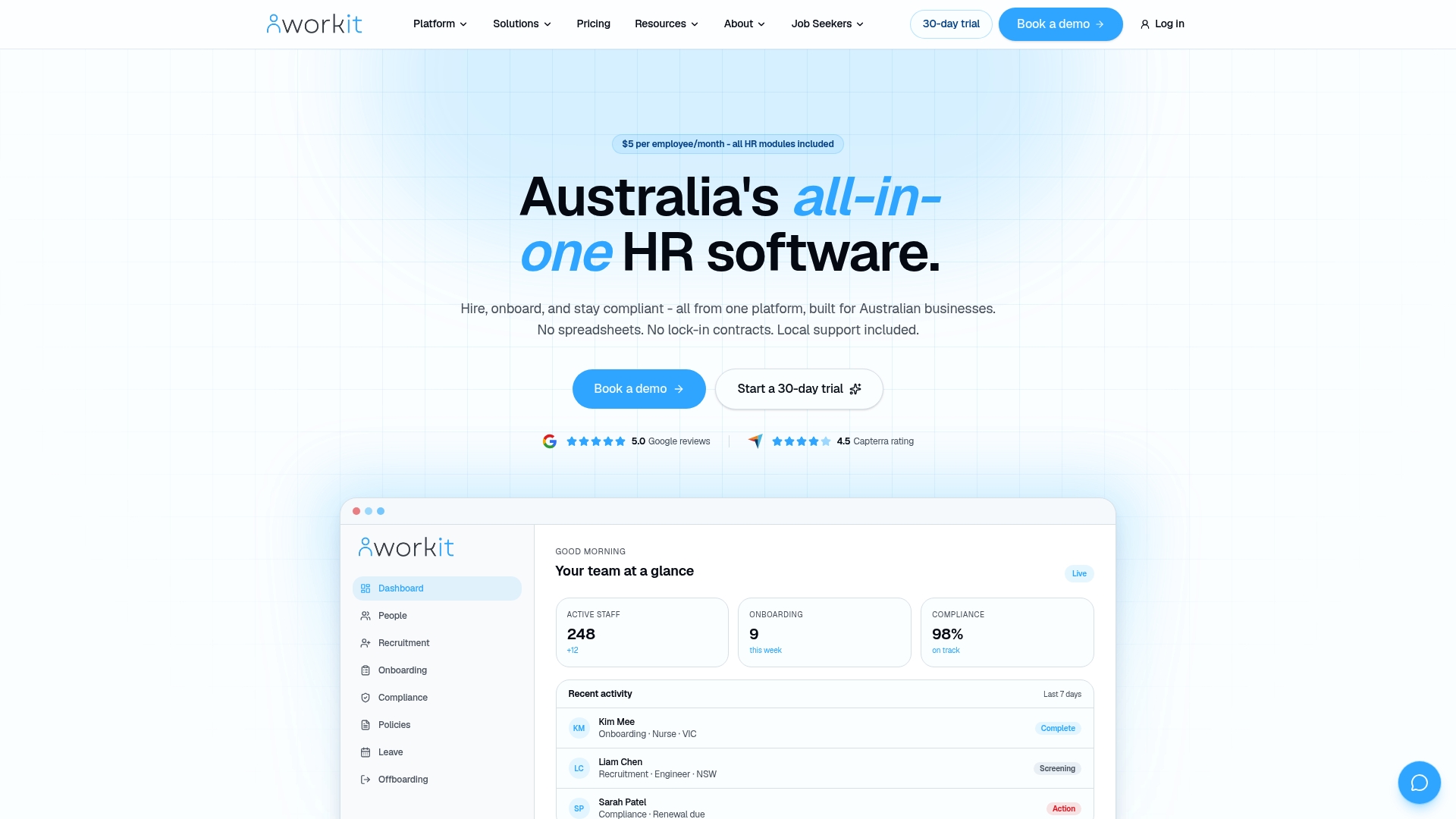
Workit gives Australian businesses a compliance-first HR platform at a price that makes sense: $5 per employee per month, every module included, no surprises at renewal. For a 50-person business, pricing is straightforward: $250 per month for the full stack — onboarding, HRIS, leave, compliance, performance, reporting, and local support.
Before your demo, bring a sample payroll file that includes at least one back-pay scenario, one termination, and employees across different award types. Ask the Workit team to walk through how the system handles each one for STP Phase 2 and Payday Super. That 20-minute exercise will tell you more than any feature comparison table.
To start a 30-day trial or book a demo, visit the Workit demo page. If you want to explore compliance-specific features first, the HR compliance software page covers the full governance and audit trail capabilities in detail.
Useful sources
- About Payday Super | Australian Taxation Office — ATO primary source on Payday Super timing, penalties, and the seven-business-day window.
FAQ
What is the best HR software for Australian businesses?
Workit is the recommended choice for most Australian businesses in 2026, combining STP Phase 2 support, Payday Super compliance, and transparent pricing at a low per-employee monthly rate with Australian-based support.
What are the top HRIS systems available in Australia?
Australian HR teams typically evaluate all-in-one HRIS platforms that support STP Phase 2, NES-aligned leave, and local payroll integrations with tools like Xero and KeyPay. Workit is purpose-built for this market.
What is the best payroll software in Australia?
Xero Payroll and KeyPay are widely used Australian payroll tools. Most businesses pair a dedicated payroll engine with an HRIS like Workit for the full employee lifecycle, rather than relying on payroll software alone for HR management.
How do I choose HR software for a small business in Australia?
Prioritise compliance first: confirm STP Phase 2 payload support and Payday Super handling, then check payroll integration depth and award interpretation. For small business HR software in Australia, transparent per-employee pricing and local support reduce both cost and risk.
This article is published by Workit and reflects general information about Australian HR software and compliance requirements. It is not legal or financial advice. Confirm current ATO requirements and employment obligations with the relevant primary sources or a qualified professional.