

Best HRIS Australia 2026: top picks for HR leaders
TL;DR:
- Workit is the leading all-in-one HRIS choice for Australian organizations in 2026, offering transparent pricing and local support. The platform fully supports compliance with new regulations like STP Phase 2 and payday super reforms, making it a suitable solution for SMBs and mid-market firms. Choosing the right HRIS requires mapping processes, verifying legal compliance, and assessing total cost of ownership through structured evaluation.
For most Australian organisations, Workit is the strongest all-in-one HRIS choice in 2026. It delivers transparent total cost of ownership, built-in compliance features, and local support from a team that understands Australian payroll obligations, with simple pricing for all modules included. No hidden fees, no spreadsheets, no guesswork on what’s covered.
That said, the right platform depends on your organisation’s size, complexity, and specific needs. Here’s a fast shortlist:
- Workit — best for SMBs to mid-market organisations wanting compliance-first, all-in-one HRIS with predictable pricing and Australian local support.
- Workday — best for large enterprises with global operations, complex analytics needs, and dedicated implementation teams.
- Deel — best for organisations hiring international contractors or needing employer-of-record (EOR) services across borders.
- Employment Hero — best for startups and small businesses that want integrated payroll and HR automation at SMB price points.
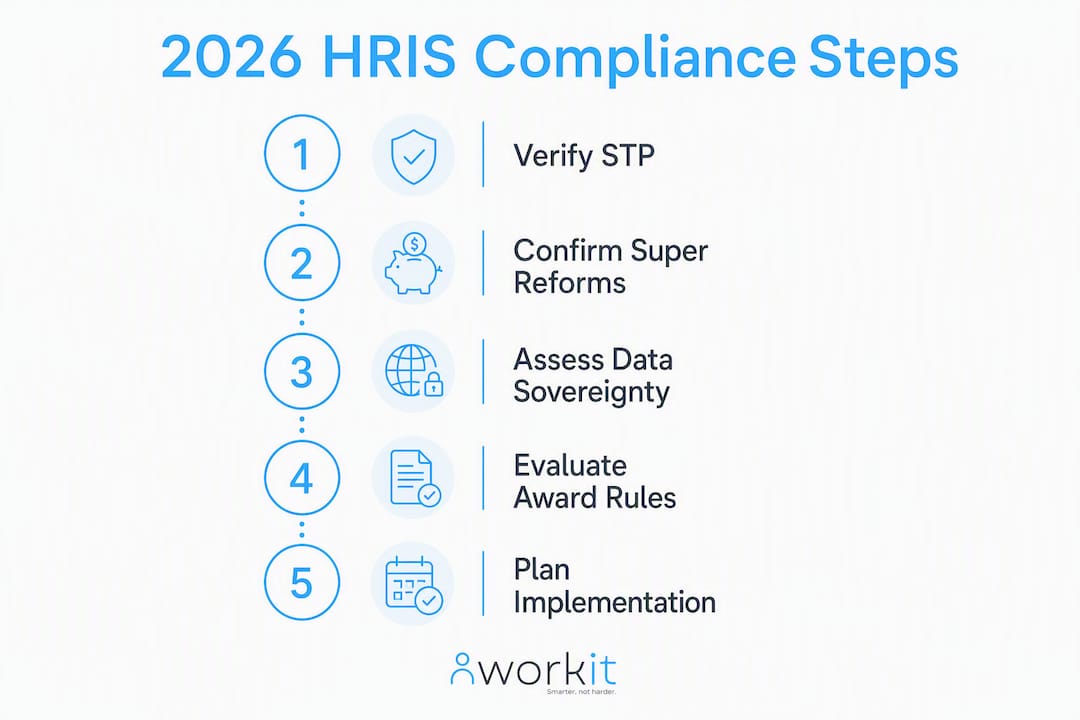
Three regulatory realities make 2026 a critical year to get your HRIS right. The ATO’s Single Touch Payroll Phase 2 requirements are now fully in effect, demanding richer payroll data fields from every reporting employer. Payday super reforms take effect 1 July 2026, requiring superannuation contributions to be paid on the same cycle as wages rather than quarterly. And under the Privacy Act 1988, your organisation remains responsible for employee data even when it sits on an offshore vendor’s servers. Your HRIS needs to handle all three without manual workarounds.
Table of Contents
- How do the best HRIS options in Australia compare?
- Vendor profiles: what each platform actually delivers in Australia
- How do you choose the right HRIS for your Australian organisation?
- How were these picks chosen?
- Why Australian compliance requirements make 2026 a pivotal year for HRIS selection
- Key takeaways
- What HR leaders often get wrong when choosing an HRIS
- Workit gives Australian teams one platform for the full employee lifecycle
- Useful sources for procurement and compliance verification
- FAQ
How do the best HRIS options in Australia compare?
The table below maps each platform against the dimensions that matter most for Australian buyers. Pricing models vary widely, so treat the price column as a shape indicator, not a quote.
| Platform | Best for | Pricing model | STP & ATO integration | Compliance (super, awards) | Core modules | Local support & hosting | Scalability |
|---|---|---|---|---|---|---|---|
| Workit | SMB to mid-market, compliance-first | $5/employee/month, all modules | Yes — built-in | Super, award tracking, reporting | Onboarding, ATS, leave, performance, LMS, compliance | Australian team, local hosting | SMB to mid-market |
| Sentrient | Mid-market, HR core + payroll connectivity | Per-employee, tiered | Via integration | Core compliance features | Core HR, onboarding, leave | Australian support | Mid-market |
| Employment Hero | Startups, SMBs with payroll needs | Per-employee, tiered plans | Yes — native | Award automation, super | HR, payroll, onboarding, leave | Australian team | SMB to lower mid-market |
| ELMO Software | SME to lower mid-market, modular | Per-module pricing | Yes — native | Super, award rules | HR, payroll, LMS, recruitment | ANZ-focused, local hosting | SME to mid-market |
| HiBob (bob) | Fast-scaling mid-market | Per-employee, tiered | Via integration | Core compliance | Core HR, onboarding, leave, performance | Global with AU support | Mid-market to lower enterprise |
| BambooHR | SMBs needing simple core HR | Per-employee, tiered | Via integration | Limited AU-specific | Core HR, onboarding, leave | US-based, no AU hosting | SMB |
| Rippling | Lean ops teams, HR + IT automation | Per-employee, modular | Via integration | Limited AU-specific | HR, IT provisioning, payroll | US-based | SMB to mid-market |
| Workday | Large enterprise, global | Per-employee, enterprise contract | Yes — configurable | Deep, configurable | Full HCM suite | Global, AU deployments | Enterprise |
| Deel | Global contractors, EOR | Per-contractor/employee | Limited AU payroll | EOR compliance, contractor | Contractor mgmt, EOR, payroll | Global support | Global scale |
| Happy HR | SMBs, compliance focus | Per-employee, tiered | Yes — AU-focused | Award rules, compliance | Core HR, compliance, leave | Australian support | SMB |
| Worknice | Small businesses, HR admin | Per-employee | Via integration | Core compliance | Core HR, onboarding, leave | Australian support | Small business |
| BrightHR | Shift-based, rostered workforces | Per-employee | Via integration | Leave, absence | Rostering, absence, HR core | AU support available | SMB to mid-market |
| Humanforce | Complex shift patterns, award obligations | Per-employee, modular | Yes — AU-focused | Deep award interpretation | WFM, rostering, payroll | Australian support | Mid-market to enterprise |
| Personio | Structured HR workflows, mid-market | Per-employee, tiered | Via integration | EU-focused, limited AU | Core HR, recruitment, performance | European-based | Mid-market |
A note on ratings: G2 and Capterra list Employment Hero and Worknice with verified Australian customer reviews. Treat vendor-supplied ratings with appropriate scepticism and cross-reference with independent review platforms before shortlisting. Always verify current product details directly with vendors, as modules and pricing change.
Vendor profiles: what each platform actually delivers in Australia
Australian HR software broadly falls into three categories: local SMB/mid-market HRIS with native payroll connectivity, best-of-breed specialist tools, and enterprise HCM suites. Matching your organisation to the right category prevents both over-buying and under-buying.
Workit
Workit is built specifically for Australian businesses, covering recruitment and applicant tracking, onboarding, employee directory, leave management, performance reviews, learning management, compliance tracking, incident reporting, policy distribution, and offboarding. All modules are included at $5 per employee per month, with no per-module add-on fees. Integration with Xero is available, and the platform is supported by an Australian team that responds during local business hours.

Best for: SMBs to mid-market organisations that want a single platform covering the full employee lifecycle without a complex implementation or unpredictable cost structure.
AU compliance notes: Built-in compliance features cover STP reporting, superannuation tracking, and award-aligned leave calculations. Local data hosting and an Australian support team mean regulatory questions get answered by people who know the Fair Work Act.
- Transparent, all-inclusive pricing with no hidden module fees
- Local support team familiar with Australian compliance requirements
- Full module suite from onboarding through to offboarding
- Optional paid implementation services for organisations that need structured rollout support
Employment Hero
Employment Hero packages HR, payroll, and rostering for Australian SMBs, with native STP reporting and award interpretation built into its payroll engine. It’s a popular choice for growing teams that want payroll and HR in one subscription rather than two separate tools. Pricing is tiered by plan and employee count, so costs can rise as headcount grows.

Best for: Startups and small businesses that want integrated payroll and HR automation without managing separate systems.
AU compliance notes: Native STP Phase 2 support and super calculations are included. Award interpretation covers common modern awards, though complex enterprise agreements may need manual configuration.
- Strong payroll and HR integration for SMBs
- Award automation for common modern awards
- Costs can increase materially at higher headcounts
ELMO Software
ELMO is an ANZ-focused suite covering HR, payroll, learning management, and recruitment as separate modules. Its modular structure lets organisations buy what they need now and add capability later, which suits modular scalability for growing teams. Per-module pricing means the total cost depends heavily on which modules you activate.
Best for: SMEs and lower mid-market organisations that want a local, modular suite and are comfortable managing module-by-module procurement.
AU compliance notes: Native STP and super support. Local ANZ focus means award rules and compliance updates are generally addressed in product releases.
HiBob (bob)
HiBob positions itself as a people-experience platform rather than a compliance-first system. Its integration marketplace is a genuine strength, connecting to payroll tools, ATS platforms, and productivity suites. Australian STP and super handling typically relies on a connected payroll integration rather than native processing.
Best for: Fast-scaling mid-market teams that prioritise employee experience, analytics, and a broad integration ecosystem.
AU compliance notes: Not a native Australian payroll processor. Organisations will need a connected payroll tool (such as KeyPay or Xero Payroll) to handle STP and super obligations.
BambooHR
BambooHR is widely recognised for its clean interface and fast onboarding setup. It suits SMBs that need core HR records, basic onboarding workflows, and leave tracking without heavy configuration. Australian payroll and STP support requires a third-party integration, and data is hosted on US infrastructure.
Best for: SMBs that prioritise ease of use and fast deployment over deep Australian compliance automation.
Rippling
Rippling’s differentiator is its HR-to-IT automation: when you onboard an employee, Rippling can simultaneously provision their laptop, software licences, and access credentials. For lean operations teams managing both HR and IT, that cross-department automation reduces manual handoffs. Australian payroll and STP are handled via integration rather than natively.
Best for: Lean operations teams that want HR and IT provisioning in one workflow, particularly for remote or distributed teams.
Workday
Workday is the enterprise standard for large, complex organisations with global payroll needs, deep analytics requirements, and dedicated HR technology teams. Implementation timelines typically run six to eighteen months, and total cost of ownership is substantial. For Australian organisations, Workday deployments are supported through local partners.
Best for: Large enterprises with specialist HR technology teams, global operations, and the budget and resourcing for a full HCM implementation.
AU compliance notes: STP and super are configurable, but configuration requires specialist implementation expertise. Local partner support is available in Australia.
Deel
Deel is purpose-built for cross-border hiring: contractor management, employer-of-record services, and international payroll in over 150 countries. For Australian organisations with a domestic-only workforce, Deel’s value proposition is limited. Where it shines is managing overseas contractors or hiring employees in countries where you don’t have a legal entity.
Best for: Organisations hiring international contractors or using EOR services to employ workers in countries where they lack a local entity.
Happy HR
Happy HR focuses on compliance for Australian SMBs, with an emphasis on Fair Work obligations, award rules, and HR documentation. Its UX is straightforward, and it’s designed for business owners and HR generalists rather than specialist HR technology teams.
Best for: SMBs where compliance confidence and simple documentation workflows are the primary requirement.
Worknice
Worknice is a regional HR tool oriented toward small businesses needing core HR administration and local support. Its profile on G2 and Capterra reflects a small but positive Australian customer base. It suits organisations that want simplicity over feature depth.
Best for: Small businesses needing core HR features without a steep learning curve.
BrightHR
BrightHR’s strength is workforce management for shift-based teams: rostering, absence tracking, and leave management for frontline or hospitality workforces. For shift-based workforces in aged care, retail, or construction, its rostering features are a practical fit.
Best for: Organisations with rostered or shift-based workforces that need strong absence and scheduling tools.
Humanforce
Humanforce specialises in award interpretation and complex rostering for industries with intricate shift patterns and penalty rate obligations. Its payroll engine is designed for Australian award complexity, making it a strong fit for hospitality, healthcare, and logistics operators.
Best for: Organisations with complex shift patterns, multiple modern awards, and high rostering volume.
AU compliance notes: Deep award interpretation and STP-connected payroll make it one of the stronger options for award-heavy industries.
Personio
Personio is a process-standardisation HRIS with strong mid-market adoption in Europe. Its structured HR workflows and clean module set suit organisations that want to formalise HR processes. Australian STP and super handling is not native, and its support infrastructure is primarily European-based.
Best for: Organisations that prioritise structured HR process standardisation and are comfortable managing Australian payroll compliance through a separate integration.
Pro Tip: When evaluating any platform that relies on a third-party integration for STP and super, ask the vendor to demonstrate a live end-to-end payroll run including STP lodgement during your demo. Don’t accept a slide deck as proof of compliance readiness.
How do you choose the right HRIS for your Australian organisation?
The most common selection mistake is letting a vendor’s demo drive the decision. Vendor demos should never replace an internal process map. Start with your own operations, not a vendor’s feature list.
Step-by-step evaluation checklist
- Map your current HR processes before speaking to any vendor. Document every workflow: onboarding, leave requests, performance cycles, payroll data flows, and offboarding. Identify where manual steps, spreadsheets, or compliance gaps exist.
- Define your non-negotiables. For Australian organisations in 2026, STP Phase 2 compliance and payday super readiness are non-negotiable. Add your specific requirements: award interpretation, state-based long-service leave rules, psychosocial safety reporting, or sector-specific needs.
- Shortlist by category fit. Use the three-category framework: SMB/mid-market HRIS with native payroll, best-of-breed specialist tools, or enterprise HCM. Avoid buying enterprise complexity for a 50-person team.
- Evaluate integrations with your existing stack. Payroll integration with Xero or MYOB is a common requirement. Confirm SSO compatibility and API availability for any custom workflows.
- Build a three-year TCO model. Advertised per-employee pricing often understates real implementation costs: add implementation fees, data migration, training, integration build costs, and ongoing support charges. A $3/employee/month platform with a $50,000 implementation can cost more than a $5/employee/month all-inclusive platform over three years.
- Run structured demos against your process map, not the vendor’s standard script. Ask vendors to demonstrate your specific workflows, not their highlight reel.
- Conduct reference calls with Australian customers. Ask specifically how the vendor handled a recent regulatory change post-deployment, and what their SLA response time is during Australian business hours.
Questions to ask vendors in demos
- Can you demonstrate a live STP Phase 2 lodgement, including the additional data fields?
- How does your platform handle payday super as of 1 July 2026?
- Where is our employee data hosted, and what is your data sovereignty policy?
- What security certifications do you hold (ISO 27001, SOC 2)?
- Can you provide two Australian customer references who have been through a Fair Work compliance update with you?
- What is the full implementation cost, including migration, training, and integration build?
Red flags to watch for
- No Australian customer references available
- Ambiguous or offshore-only data hosting with no clear sovereignty policy
- Per-feature or per-module pricing that makes TCO hard to model
- STP compliance described as “via a partner” with no clear SLA
- Demo environments that don’t reflect production functionality
Pro Tip: Ask for a written statement of data residency before signing any contract. Verbal assurances during a sales process are not enforceable. Under the Privacy Act, your organisation remains liable for data breaches even when the vendor is offshore.
Implementation timelines by organisation size
- SMB (under 100 employees): 4–8 weeks for a well-scoped implementation with clean data.
- Mid-market (100–500 employees): 8–16 weeks, including data migration and integration testing.
- Enterprise (500+ employees): 4–12 months, depending on configuration complexity and change management scope.
How were these picks chosen?
This shortlist was compiled using a structured evaluation framework weighted toward the factors that matter most for Australian HR buyers in 2026.
Evaluation criteria and weighting
- Compliance and payroll readiness (30%): Native STP Phase 2 support, super calculation accuracy, award interpretation capability, and payday super readiness.
- Local support and data hosting (20%): Australian-based support team, response times during AEST business hours, and data residency options.
- Scalability and modularity (15%): Ability to grow from SMB to mid-market without a platform change, and modular add-on capability.
- Integrations (15%): Native or well-documented integrations with Xero, MYOB, SSO providers, and common productivity tools.
- Price and TCO (10%): Transparency of pricing, all-inclusive vs. per-module cost structure, and realistic three-year TCO.
- User experience (10%): Ease of adoption for HR teams and employees, mobile self-service capability, and onboarding speed.
Sources used
Evaluation drew on regulator guidance from the ATO and OAIC, vendor documentation, independent industry guides, and customer reviews on G2 and Capterra where available. Public pricing was used where published; where pricing is not public, the model type (per-employee, per-module, enterprise contract) was noted. Third-party ratings from G2 and Capterra are included as one signal among several and should not be treated as definitive rankings.
Publisher disclosure
Workit is the publisher of this article and is one of the platforms evaluated. Workit’s inclusion was assessed on the same criteria as all other platforms. Its position in the shortlist reflects its transparent all-inclusive pricing, built-in Australian compliance features, and local support model. Readers should conduct their own due diligence, including vendor demos and reference calls, before making a purchase decision.
Why Australian compliance requirements make 2026 a pivotal year for HRIS selection
The regulatory environment for Australian payroll and HR has shifted materially in 2026, and your HRIS vendor’s readiness for these changes should be a primary evaluation criterion.
Single Touch Payroll Phase 2
STP Phase 2 expanded the data fields employers must report to the ATO with every pay run. Where Phase 1 required basic income and tax withholding data, Phase 2 requires disaggregated income type reporting, country of origin for working holiday makers, and child support deduction details. Vendors that haven’t fully implemented Phase 2 fields create compliance risk for every employer on their platform. Verify Phase 2 readiness explicitly during your demo, not just in marketing materials.
Payday super reforms from 1 July 2026
The payday super reform is the most significant change to superannuation administration in years. From 1 July 2026, employers must pay superannuation contributions on the same cycle as wages, rather than the previous quarterly schedule. This means your payroll and HRIS systems need to calculate, process, and report super with every pay run. Platforms that process super as a batch or quarterly calculation will require reconfiguration. Reference calls with Australian customers are the most reliable way to verify that a vendor has actually implemented this change, not just announced it.
Payroll automation becomes especially important in this environment. Automating payroll reconciliation reduces the manual effort of matching super contributions to each pay cycle and minimises the risk of missed or incorrect payments.
Privacy Act and data sovereignty
Under the Privacy Act 1988 and the Notifiable Data Breaches scheme, Australian businesses remain responsible for employee data privacy even when the vendor stores that data offshore. This means your vendor’s security certifications, encryption standards, and data residency policies are your compliance obligations, not just their product features. Ask for ISO 27001 or SOC 2 certification documentation, and confirm whether employee data can be hosted within Australia.
Compliance checklist for vendor validation
| Compliance area | What to verify with the vendor |
|---|---|
| STP Phase 2 | All expanded data fields implemented and tested in production |
| Payday super (from 1 July 2026) | Super calculated and lodged per pay cycle, not quarterly |
| Superannuation guarantee rate | Current rate applied automatically, with update process documented |
| Award interpretation | Modern awards covered, enterprise agreement configuration available |
| State long-service leave | Entitlements mapped by employee work location, not just HQ state |
| Psychosocial safety reporting | Incident reporting module available and aligned to Safe Work Australia guidance |
| Data residency | Australian hosting option available, or written data sovereignty statement |
| Notifiable Data Breaches | Vendor breach notification process and SLA documented |
Many Australian organisations also report that state-specific long-service leave entitlements and psychosocial safety obligations are frequent sources of HRIS complexity. A platform that maps entitlements by employee work location, rather than applying a single national rule, avoids costly manual corrections. Local Australian suites with native award interpretation reduce this manual compliance work compared with global platforms that rely on local partners for award rules.
For a practical HR compliance health check before you start vendor conversations, work through your current gaps first. It makes every vendor demo more productive.
Key takeaways
For most Australian organisations in 2026, the HRIS decision comes down to compliance readiness, transparent total cost of ownership, and local support. Workit delivers all three with all modules included under a clear per-employee pricing model and an Australian team behind it.
| Point | Details |
|---|---|
| Compliance is non-negotiable | Verify STP Phase 2, payday super readiness from 1 July 2026, and data residency before shortlisting any vendor. |
| Map processes before demos | Document your workflows first; operational fit matters more than feature lists in vendor presentations. |
| Model three-year TCO | Per-employee pricing understates real costs; include implementation, migration, training, and integration fees. |
| Match platform to org size | SMBs suit all-in-one local HRIS; enterprise needs warrant HCM suites with dedicated implementation teams. |
| Workit for most AU buyers | At $5 per employee per month with all modules and local support, Workit suits SMB to mid-market organisations. |
What HR leaders often get wrong when choosing an HRIS
The selection process for HR software has a predictable failure mode: organisations spend three months evaluating demos and almost no time mapping their own processes. A vendor with a polished demo and a confident sales team can look like the right answer right up until go-live, when the gap between the demo environment and production reality becomes apparent.
The second mistake is underestimating total cost of ownership. A platform priced at $3 per employee per month sounds cheaper than one at $5, until you add a $40,000 implementation fee, a $15,000 data migration, and $8,000 in annual integration maintenance. Three-year TCO modelling is not optional for any serious procurement process.
Award complexity is the third area where Australian buyers consistently underestimate risk. Global platforms often handle Australian modern awards through a local partner arrangement rather than native configuration. That works until the award gets updated, at which point the question becomes: who owns the update, how fast does it happen, and what’s the SLA? Ask that question explicitly in every vendor conversation.
One more thing worth saying plainly: reference calls matter more than any other due diligence step. A vendor’s existing Australian customers will tell you things no demo ever will, particularly about support responsiveness after go-live and how the vendor handled the last major regulatory change. Ask for references who have been through a Fair Work update or a superannuation rate change with the platform. If a vendor can’t provide two, that’s an answer in itself.
Workit gives Australian teams one platform for the full employee lifecycle
Most Australian HR teams are managing compliance obligations across multiple disconnected tools, and the cost of that fragmentation shows up in manual data entry, missed deadlines, and compliance gaps. Workit was built to fix exactly that.
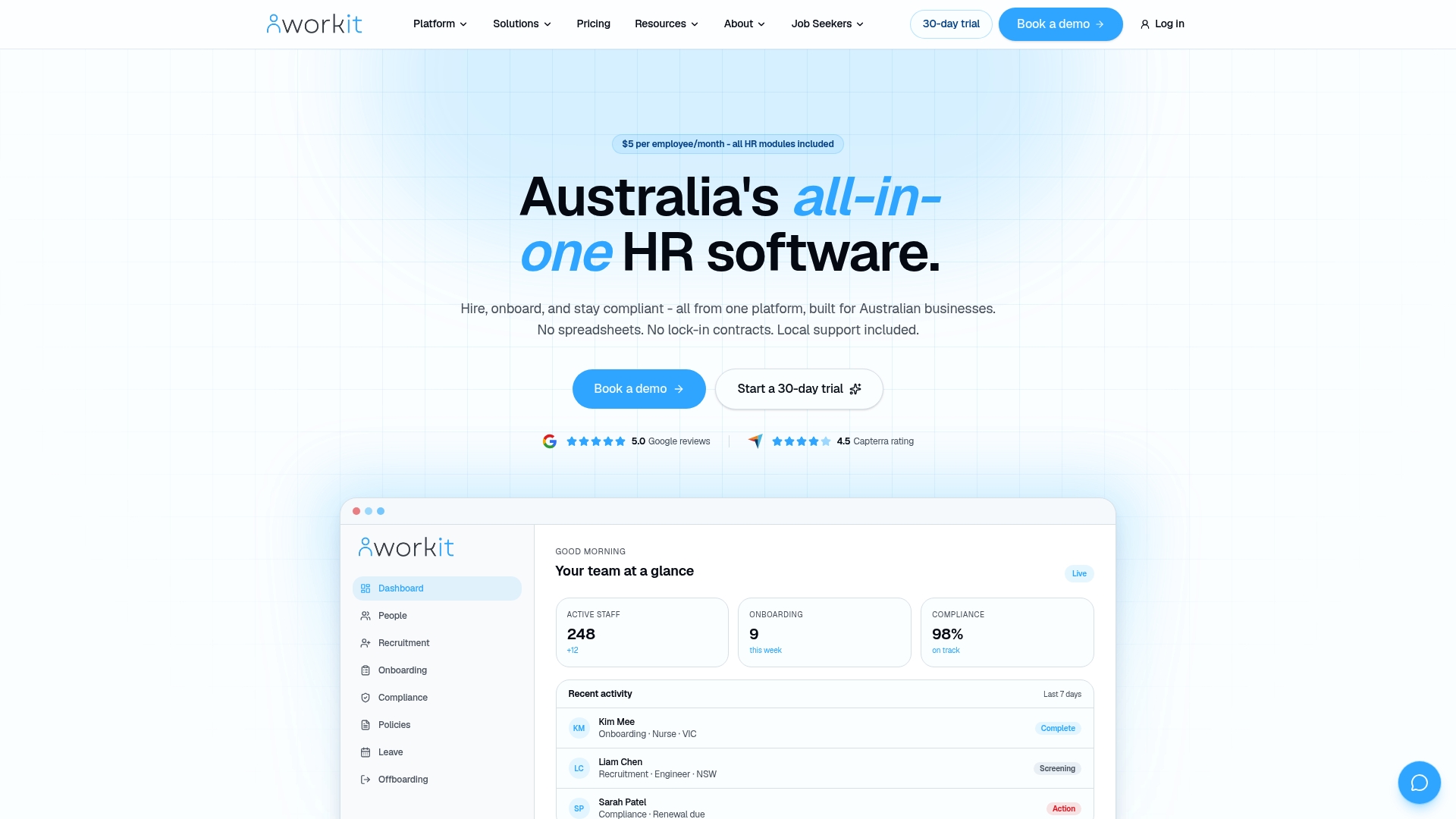
Workit covers the full employee lifecycle on one platform: recruitment and applicant tracking, onboarding, employee directory, leave management, performance reviews, learning management, compliance tracking, incident reporting, policy distribution, and offboarding. All modules are included under a straightforward per-employee pricing model, with no per-feature add-ons or surprise invoices at renewal. The platform integrates with Xero for payroll, and the support team is based in Australia and responds during AEST business hours.
For organisations that need a structured rollout, optional paid implementation services are available to get your data migrated, your workflows configured, and your team trained without the DIY risk.
If you’re ready to see how Workit handles your specific compliance requirements, book a demo or explore the full HRIS platform to see every module in detail.
Useful sources for procurement and compliance verification
Use these resources to verify vendor claims, check current regulatory requirements, and dig deeper into selection frameworks.
Regulator and compliance sources
- ATO — Single Touch Payroll reporting — Fair Work record-keeping obligations for employers
- OAIC — Australian Privacy Principles — data privacy obligations for HR data
- Business NSW — Payday super starts 1 July 2026 — reform details and employer obligations
Selection frameworks and industry guides
| Resource | What it covers |
|---|---|
| HRIS Selection Australia: Guide for Growing Businesses | Practical selection framework for Australian organisations, including compliance weighting |
| How to choose the right HRIS — LiquidHR | Category framework: SMB HRIS, best-of-breed, enterprise HCM |
| SMC — HR software selection advice | Independent advisory guidance on process mapping and TCO modelling |
| Camptra — Timekeeping payroll integration best practices | Practical integration checks for payroll and timekeeping systems |
Workit resources for procurement
- HR compliance software must-have features — feature checklist for Australian compliance requirements
- HR software cost Australia: 2026 pricing guide — TCO guidance and hidden fee categories
- HRIS for Fair Work compliance and audit-readiness — how an HRIS supports Fair Work obligations
FAQ
What are the top HRIS systems available in Australia?
The strongest options for Australian organisations in 2026 include Workit, Employment Hero, ELMO Software, Happy HR, and Humanforce for local compliance needs, with Workday and Rippling suited to enterprise and cross-functional use cases respectively. The best choice depends on your organisation’s size, award complexity, and whether you need native Australian payroll processing.
Does an HRIS handle STP and superannuation automatically?
Not all of them do. Local Australian platforms like Workit, Employment Hero, ELMO, and Humanforce include native STP Phase 2 support and superannuation calculations. Global platforms like BambooHR, HiBob, and Personio typically rely on a connected payroll integration to handle Australian STP and super obligations, which adds a dependency and potential compliance gap.
What are the five types of HRIS?
HRIS platforms generally fall into five functional categories: operational HRIS (core HR records and administration), tactical HRIS (recruitment, training, and compensation management), strategic HRIS (workforce planning and analytics), comprehensive HCM suites (all of the above in one platform), and specialist tools (payroll-only, WFM-only, or EOR-only). Most Australian SMBs are best served by a comprehensive all-in-one platform rather than assembling multiple specialist tools.
How much does HRIS software cost in Australia?
Pricing varies from around $3–$10 per employee per month for SMB-focused platforms to enterprise contracts priced on negotiation. Workit’s published pricing is $5 per employee per month with all modules included. The more important figure is three-year total cost of ownership: implementation, data migration, training, and integration costs can exceed the subscription cost in year one for mid-market and enterprise deployments.
What should Australian HR teams verify before signing an HRIS contract?
Verify STP Phase 2 compliance, payday super readiness from 1 July 2026, data residency and sovereignty policy, security certifications (ISO 27001 or SOC 2), and the vendor’s process for handling regulatory updates post-deployment. Request two Australian customer references who have been through a compliance change with the platform before committing.
This article is general information for procurement guidance purposes. Confirm current regulatory requirements with the ATO, OAIC, and Fair Work Commission, or a qualified adviser, for your specific situation.