

Business values: a practical guide for leaders
TL;DR:
- Business values are a small set of specific principles that guide behavior, decision-making, and culture. They should be limited to four to six observable and actionable traits to ensure consistency and recall. Leaders must model, reinforce, and embed these values into daily operations to create an engaged, aligned, and strong organizational culture.
Business values are the small set of guiding principles that define how your company behaves, makes decisions, and builds culture every day. They are not a mission statement or a vision. They are operational tools. Industry guidance recommends keeping your core principles to 4–6 values maximum so your team can actually remember and apply them. When business values are specific, observable, and consistently reinforced, they shape hiring decisions, resolve trade-offs, and give every employee a shared standard to work from. Workit helps Australian businesses put those principles into practice through HR processes that reflect and reinforce the values leaders set.
What are business values and why do they matter?
Business values are a concise set of principles that tell your team how to behave when no one is watching. They differ from mission and vision in one critical way: values describe how you operate, not what you are trying to achieve. A mission tells you where you are going. Values tell you how you get there.

The distinction matters because values govern daily trade-offs. When a sales manager decides whether to push a borderline deal or walk away, values provide the answer. When a hiring manager chooses between two candidates with similar skills, values determine the fit. Explicitly defined values keep decisions consistent as your company grows and founders cannot personally weigh in on every call.
Values also differ from strategy. Strategy changes as markets shift. Values, when chosen carefully, stay stable across years. That stability is what makes them useful. They become the structural guide your team reaches for when circumstances are ambiguous or pressure is high.
Why a concise set of core principles outperforms a long list
The most common mistake business leaders make is writing too many values. A list of ten principles is not a set of values. It is a wish list. Research recommends a maximum of 4–6 values for small to medium businesses because beyond that, they become impossible to recall in the moment they are needed.
Fewer values also force better thinking. When you must choose between “integrity” and “transparency,” you clarify what you actually mean. That discipline produces values that are specific to your company rather than generic labels that could belong to any organisation on the planet.
Here is what a concise set of core business principles delivers in practice:
- Distributed leadership judgment. Founders cannot be everywhere. Clear values give every team member the same decision-making framework, so the right call gets made without escalation.
- Culture fit in hiring. Values give interviewers concrete criteria beyond skills. A candidate who demonstrates the right behaviours in a structured interview is far more likely to thrive.
- Competitive advantage on culture. Smaller businesses cannot always compete on salary. A strong, lived culture built on clear values attracts people who want to work somewhere that means something.
- Reduced inconsistency. Without values, decisions vary by manager, by mood, and by circumstance. Values create a repeatable standard.
Pro Tip: Avoid values that sound aspirational but describe no specific behaviour. “Excellence” tells no one what to do. “We finish what we start, even when it gets hard” tells everyone exactly what is expected.
Generic values like “integrity” or “innovation” fail because they carry no behavioural instruction. Specific values tied to real company practices are the ones your team will actually use.
How do values shape employee engagement and culture?
The gap between written values and lived culture is where most organisations lose ground. Only 20% of employees report a strong connection to their company’s culture. That figure reveals how rarely values move from a wall poster to a daily reality.
The consequences of that gap are direct. A disconnect between company and personal values leads to lower engagement and weaker business performance. Employees who do not see their own principles reflected in how the organisation operates disengage quietly and gradually. That disengagement shows up in output, retention, and the quality of work.
The fix is recognition tied to values. Employees are 9 times more likely to report a sense of belonging when core values are regularly reinforced through recognition. That is not a marginal improvement. It is a structural shift in how connected people feel to the work and to each other.
To close the gap between stated and lived values, leaders need to act on four fronts:
- Model the values publicly. When a leader makes a decision that visibly reflects a company value, name it out loud. “I am choosing option B because it aligns with our commitment to client honesty.” That narration makes values real.
- Reinforce through recognition. Catch people living the values and call it out specifically. Generic praise does not build culture. Naming the value does.
- Address violations directly. Values without consequences are decorations. When behaviour contradicts a stated value, address it promptly and clearly.
- Track employee engagement scores regularly. Engagement data tells you whether your values are landing or sitting idle on a page.
When company and personal values align, engagement and performance both increase. That alignment does not happen by accident. It requires deliberate reinforcement at every level of the organisation.
How to define strong, actionable values for your organisation
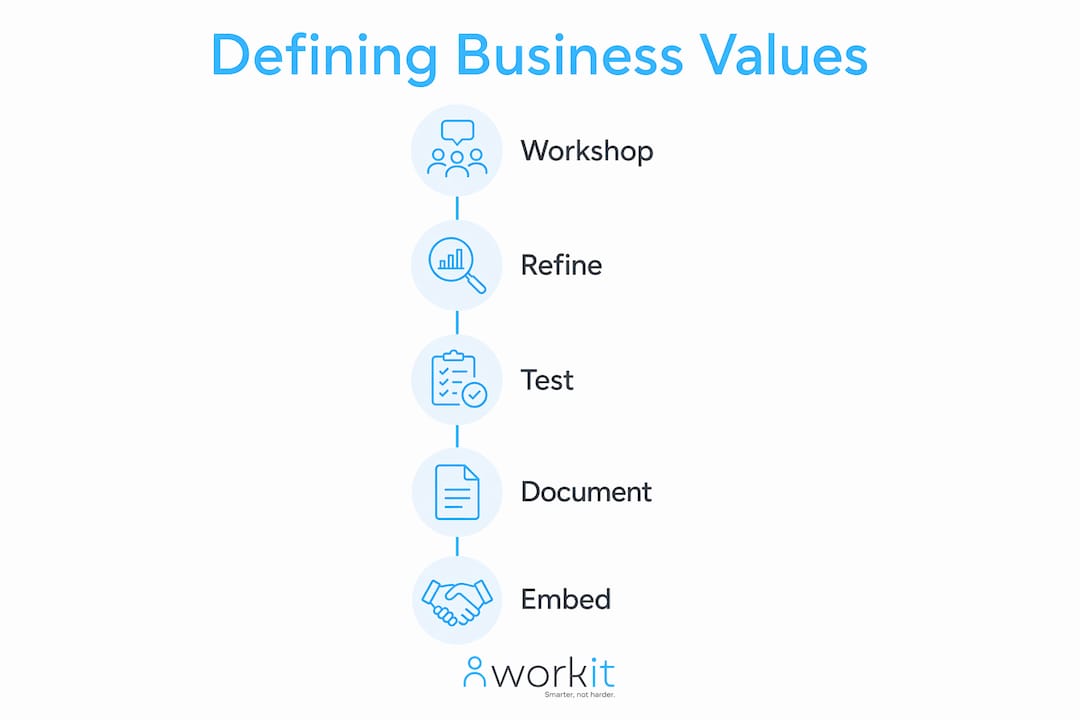
Defining values is not a retreat exercise. A focused four-hour workshop with your founding team is enough to produce a working set of values. The hard part is not the workshop. It is the discipline to cut, refine, and enforce what comes out of it.
Start with discovery before you write anything. Gather input from employees across levels and functions. Ask them to describe moments when the company was at its best. Ask what behaviours they would never want to lose. Those answers reveal what your culture already values in practice, which is far more useful than what leadership thinks it should value in theory.
Once you have that input, translate observations into principles using this approach:
- Identify recurring behaviours. If multiple people describe the same type of action, that is a candidate value.
- Write the value as a behaviour, not an adjective. “We tell clients the truth before we tell them what they want to hear” beats “honesty” every time.
- Link each value to 2–4 observable behaviours. Generic values like “transparency” fail without concrete behavioural definitions. Observable behaviours give employees something to practise and managers something to assess.
- Add a violation signal. For each value, define what it looks like when someone is not living it. This makes the value enforceable, not just aspirational.
- Cut until it hurts. If you have eight values, you have too many. Keep cutting until each one feels genuinely irreplaceable.
Pro Tip: Test each value by asking: “Would a competitor be embarrassed to copy this?” If the answer is no, the value is too generic. Your values should reflect something specific about how your company operates.
Document the final values in a format suitable for onboarding and daily reference. A one-page summary with the value, its behavioural definition, and its violation signal is enough. Aligning your website design with your brand values also reinforces consistency across every touchpoint your team and customers experience.
Embedding values into daily operations so they actually stick
Defining values is the beginning. Embedding them is the work. Values only become part of culture when they are recognised in everyday behaviour through leadership modelling and structured reinforcement.
The most effective way to embed values is to build them into the systems your team already uses. Here is a practical sequence:
- Add values to job descriptions and interview criteria. Write behavioural interview questions that test for each value directly. “Tell me about a time you delivered bad news to a client” tests honesty far better than asking “Are you honest?”
- Introduce values on day one. Onboarding new employees with real examples of values in action sets the cultural standard before habits form. Stories beat slogans every time.
- Include values in performance reviews. Each value should appear as a named criterion in your review framework. Managers rate behaviours, not attitudes. That specificity makes feedback useful rather than vague.
- Build a recognition programme around values. Celebrate specific examples of values in action in team meetings, internal channels, or written communications. Name the value, name the person, name the behaviour.
- Create a feedback loop. Encourage team members to name values in real time when they see them demonstrated. “That decision was a perfect example of our commitment to client clarity.” That habit scales culture without requiring management to be present everywhere.
The performance review process is one of the most underused tools for values reinforcement. When values appear in formal reviews, they carry weight. When they are absent from reviews, they signal that leadership does not actually prioritise them.
Values also need to be visible in physical and digital workspaces. Post them where decisions get made. Reference them in leadership communications. Repeat them in all-hands meetings with specific examples. Repetition is not redundancy. It is how culture forms.
Key takeaways
Strong business values are a small set of specific, observable principles that guide decisions, shape hiring, and build culture. They only work when leadership models them, recognition reinforces them, and systems embed them into daily operations.
| Point | Details |
|---|---|
| Keep values to 4–6 | More than six values become impossible to recall and consistently apply in daily decisions. |
| Write behaviours, not adjectives | Each value needs 2–4 observable behaviours so employees know exactly what is expected. |
| Recognition multiplies belonging | Employees are 9x more likely to feel belonging when values are reinforced through recognition. |
| Embed values in systems | Job descriptions, onboarding, and performance reviews must all reference values to make them real. |
| Leadership modelling is non-negotiable | Values without visible leadership behaviour behind them become decorative and lose credibility fast. |
Values on paper versus values in practice
I have worked with enough leadership teams to say this plainly: most organisations do not have a values problem. They have an enforcement problem.
The values document exists. It was written in a workshop, approved by the board, and printed on the office wall. What never happened was the hard conversation when a high performer violated one of those values and nothing was done about it. That single moment of inaction does more damage to a culture than any amount of poster printing can repair.
The discipline of cutting values to the essential few is genuinely difficult. Every leader wants to include “respect,” “innovation,” and “customer focus” because they feel safe. But safe values are useless values. The ones worth keeping are the ones that would cause real disagreement if removed, because they reflect something your company actually does differently.
Values must align tightly with business strategy to avoid backlash from customers, regulators, and investors. That is not just a reputational concern. It is an operational one. When values and strategy pull in different directions, employees notice first and disengage quietly.
My strongest advice: involve your team in defining values, not just leadership. The people doing the work every day know what the culture actually is. Their input makes values credible. Without it, values become something leadership says and employees tolerate.
— Stephen
How Workit supports values-based people management
Building a culture around clear principles requires more than good intentions. It requires systems that make values visible, repeatable, and measurable across your team.
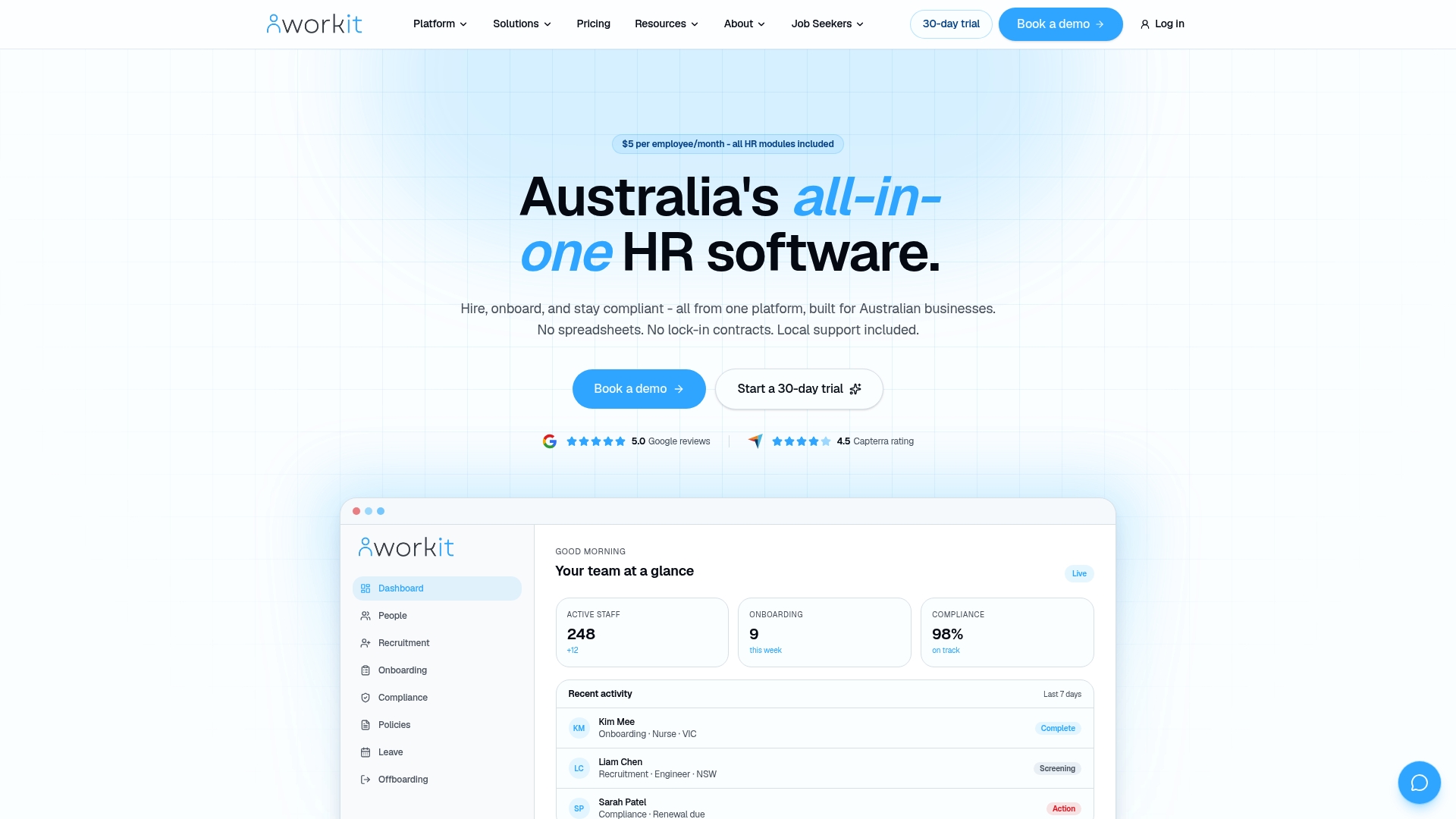
Workit is built for Australian businesses that want HR processes to reflect the culture they are building. The platform supports values-based onboarding so new starters experience your principles from day one, not week three. Performance review tools let managers assess behaviour against named values, not just output. Recognition features give leaders a structured way to celebrate values in action across the team. At $5 per employee per month with all modules included, Workit removes the cost barrier that stops smaller businesses from building proper people management systems. Book a demo to see how it works for your organisation.
FAQ
What are business values?
Business values are a small set of principles that define how a company behaves and makes decisions. They are operational tools, not marketing slogans, and should be specific enough to guide real trade-offs.
How many values should a business have?
Industry guidance recommends 4–6 values as the maximum. More than six become difficult to remember and consistently apply in daily decisions.
How do values affect employee engagement?
Only 20% of employees report a strong connection to their company’s culture. When values are regularly reinforced through recognition, employees are 9 times more likely to report a sense of belonging.
What makes a business value effective?
An effective value links to 2–4 concrete, observable behaviours. Generic labels like “transparency” or “excellence” fail without a clear behavioural definition and a visible violation signal.
How do you embed values into company operations?
Include values in job descriptions, onboarding programmes, performance reviews, and recognition systems. Leadership must model values publicly and address violations directly for them to shape culture over time.