

Sample employee handbook: a practical guide for small businesses
TL;DR:
- A good employee handbook protects small businesses by clearly defining policies, legal obligations, and company culture. It should include five mandatory sections, be customized to your industry and state, and be distributed before the employee’s first day. Regular updates, legal review, and proper record-keeping ensure ongoing compliance and effectiveness.
A sample employee handbook is a foundational document that sets out your company’s policies, culture, and legal obligations in one place. For Australian small businesses, the standard industry term is an employee policy manual, though “employee handbook” is widely used and understood. Getting this document right protects your business, sets clear expectations, and gives new starters confidence from day one. The Fair Work Act 2009 and the Fair Work Ombudsman both provide the compliance framework your handbook must reflect. A well-built handbook is not just a legal shield. It is the clearest signal you can send about how your business operates.
What key sections must a sample employee handbook include?
A standard small business handbook covers 15 to 40 pages and must include five foundational elements for compliance and protection. These are not optional extras. They are the baseline every Australian employer needs.
The five required sections are:
- At-will employment statement (or, in the Australian context, a clear statement of employment terms and termination conditions under the Fair Work Act)
- Equal employment opportunity (EEO) policy covering protected attributes under the Age Discrimination Act 2004, Sex Discrimination Act 1984, and Racial Discrimination Act 1975
- Anti-harassment and anti-bullying policy aligned with Safe Work Australia guidelines
- Code of conduct outlining expected workplace behaviour
- Acknowledgement form signed by every employee before their first day
Beyond these five, your handbook should also cover the policies your team will actually use day to day.
Recommended policies to include:
- Standard hours of work and flexible arrangements
- Compensation, pay cycles, and superannuation obligations
- Leave entitlements under the National Employment Standards (NES)
- Remote work expectations and home office requirements
- Technology use, social media, and data privacy
- Confidentiality and intellectual property
The table below shows the difference between what you must include and what you should include.
| Category | Required | Recommended |
|---|---|---|
| Employment terms | At-will or fixed-term statement | Probation period details |
| Discrimination and harassment | EEO and anti-harassment policies | Complaint resolution process |
| Conduct | Code of conduct | Dress code, social media policy |
| Leave | NES entitlements | Parental leave top-up, study leave |
| Acknowledgement | Signed form before Day 1 | Digital e-signature tracking |
Equal employment opportunity and anti-harassment policies satisfy both federal and state laws. They also limit your business liability if a dispute arises.
Pro Tip: Add a corporate photo policy to your code of conduct section. It sets clear expectations around professional imagery used in team directories, LinkedIn profiles, and marketing materials, which is a detail most small businesses overlook until it becomes awkward.
How to choose and customise an employee handbook template
Templates reduce the time it takes to build a handbook, but the right template depends on your business size, industry, and culture. Choosing the wrong one creates more problems than it solves.
Three common template styles exist:
- Fill-in-the-blank templates work well for businesses with straightforward policies and limited HR resources. You supply the specifics; the structure is already there.
- Fully customisable templates suit businesses with unique culture or operational needs. They take more time but produce a document that genuinely reflects how you work.
- Industry-specific templates are built for sectors like retail, hospitality, or healthcare. They include relevant award and enterprise agreement references from the outset.
Avoid large enterprise-level templates that include policies on global mobility, share option plans, or complex leave structures irrelevant to a team of ten. These sections confuse employees and dilute the policies that actually matter.
When customising your chosen template, align the tone with your company values. A construction business and a creative agency both need an EEO policy, but the language and examples should feel natural to each team. Workit’s corporate values guide offers a practical framework for translating your values into written policy language.
State-specific legal requirements also affect how you write certain sections. Overtime rules, meal break entitlements, and long service leave conditions vary across Queensland, Victoria, New South Wales, and Western Australia. Your template must reflect the state where your employees actually work.
Pro Tip: Always include a clear “not a contract” disclaimer on the first page. Courts may treat handbooks as contracts without this language, which can undermine your at-will or fixed-term employment arrangements and create unintended legal obligations.
What are practical steps to implement and maintain your handbook?
Building the handbook is only half the job. How you roll it out and keep it current determines whether it actually protects your business.
1. Distribute before Day 1

Send the handbook to new starters before their first day, not on it. This gives them time to read it properly and arrive with questions rather than confusion.
2. Collect signed acknowledgements
Every employee must sign an acknowledgement form confirming they have read and understood the handbook. Collect this before the employee begins work. Workit’s onboarding software handles digital distribution and e-signature collection in one place, so nothing falls through the cracks.
3. Use e-signature tracking
E-signature tracking for acknowledgements is best practice for audit and compliance purposes. A paper form in a filing cabinet is not sufficient when a dispute reaches Fair Work. A digital record with a timestamp is.
4. Schedule annual reviews
Update your handbook at least annually or whenever a relevant law changes. The Fair Work Act, NES entitlements, and state-based long service leave legislation all change periodically. An outdated policy creates risk, not protection. Workit’s employment variation management tools make it straightforward to track and document policy updates over time.
5. Communicate changes to existing staff
When you update the handbook, tell your team. Send a summary of what changed, why it changed, and where to find the updated version. Collect a fresh acknowledgement for any material policy change.
6. Store records accessibly
Keep signed acknowledgement forms in each employee’s personnel file. Employees should be able to access the current version of the handbook at any time, whether through a shared drive, your HR platform, or a printed copy in the office.
Pro Tip: Build your review schedule into your HR calendar at the start of each financial year. Tying it to the July 1 Fair Work minimum wage update is a practical anchor point that most Australian businesses already track.
What common mistakes should small businesses avoid?
Most handbook problems come from one of five predictable errors. Knowing them in advance saves you from fixing them after a dispute.
-
Copying enterprise-level templates without editing them. A 120-page handbook built for a multinational is not appropriate for a 15-person business. Less is more for small teams. Focus on the policies your employees will actually encounter.
-
Omitting mandatory policies or legal disclaimers. Missing an EEO policy or forgetting the “not a contract” disclaimer are not minor oversights. They expose your business to claims and unintended legal obligations.
-
Skipping legal review. Employment attorneys should review any state-specific sections before you distribute the handbook. Legal review is not a luxury for small businesses. It is the step that makes the document defensible.
-
Ignoring state-specific labour laws. Federal standards set the floor, but states like Victoria and Queensland have additional requirements around long service leave, public holidays, and workplace safety. A handbook that ignores these gaps is incomplete.
-
Treating the handbook as a one-time task. The handbook is a living document that must evolve with your business and the law. Businesses that set and forget their handbook are the ones that end up in Fair Work disputes over outdated policies.
One more mistake worth calling out: writing policies that sound good but do not reflect how your business actually operates. A remote work policy that says “employees must be available 9 to 5” when your team works flexibly creates friction and distrust. Write policies that match your real workplace, not an idealised version of it.
Key takeaways
A well-built employee handbook is your single most effective tool for protecting your business and setting clear expectations with every new starter.
| Point | Details |
|---|---|
| Five required sections | Every handbook needs at-will terms, EEO, anti-harassment, code of conduct, and a signed acknowledgement. |
| Match the template to your size | Avoid enterprise-level templates; choose one suited to your team size and industry. |
| Distribute before Day 1 | Send the handbook before the employee starts and collect a signed acknowledgement immediately. |
| Review at least annually | Update the handbook every year or when Fair Work legislation changes to stay compliant. |
| Legal review is non-negotiable | Have an employment solicitor check state-specific sections before distribution. |
Why most small business handbooks miss the point
The handbooks I see most often in small businesses fall into one of two categories. Either they are a 90-page document copied from a large company template, full of policies that will never apply. Or they are a two-page list of rules that offers no real protection when something goes wrong.
The best handbooks I have worked with share one quality: they read like the business actually wrote them. The tone matches how the leadership team speaks. The policies reflect what the business genuinely expects. The leave section matches the awards and agreements in place. When a new starter reads it, they feel like they understand the place they have just joined.
The compliance angle matters, of course. Missing an EEO policy or skipping the “not a contract” disclaimer can cost you significantly in a Fair Work dispute. But compliance alone does not make a handbook useful. A handbook that aligns employee behaviour with company culture reduces confusion, reduces claims, and reduces the number of times you have to have the same difficult conversation twice.
My honest advice: start with a template sized for your business, strip out anything that does not apply, and then rewrite the remaining sections in your own voice. Get a solicitor to check the state-specific parts. Then treat it as a living document, not a finished product. The businesses that do this well spend less time managing people problems and more time running their business.
— Stephen
Workit makes handbook management straightforward
Building a compliant, well-structured handbook is one thing. Making sure every employee has read it, signed it, and can access it at any time is another challenge entirely.
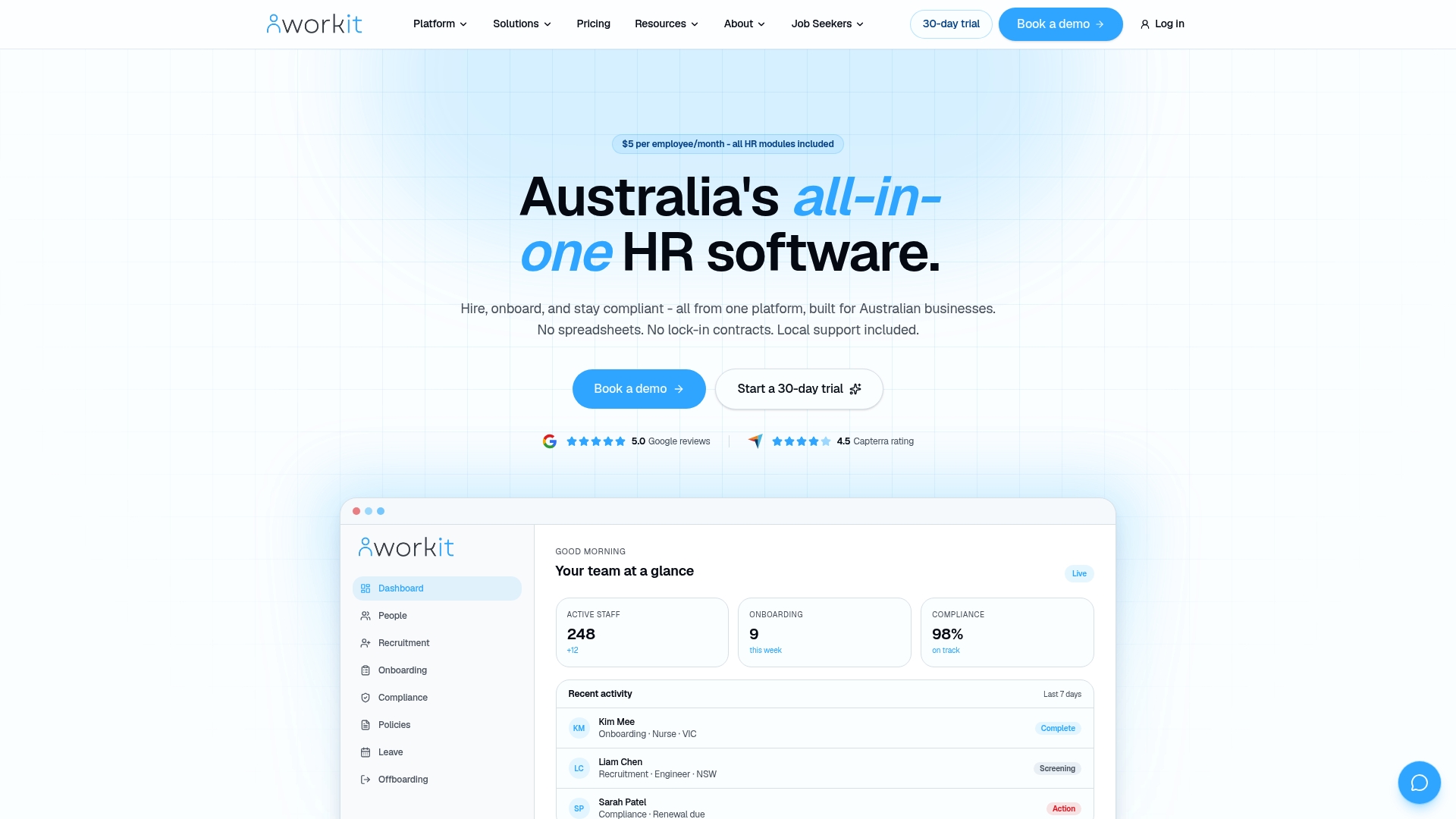
Workit is an all-in-one HR platform built specifically for Australian businesses. It handles digital policy distribution, e-signature collection, and compliance tracking in one place, so you are not chasing paper forms or digging through email threads to prove acknowledgement. At $5 per employee per month with all modules included, Workit gives small businesses the same compliance infrastructure that larger organisations rely on, without the complexity or the cost. If you are ready to take the manual work out of handbook management, book a demo with Workit and see how it fits your business.
FAQ
What must an employee handbook include in Australia?
An Australian employee handbook must include employment terms aligned with the Fair Work Act, an EEO policy, an anti-harassment policy, a code of conduct, and a signed acknowledgement form. National Employment Standards entitlements such as leave and notice periods should also be clearly documented.
How long should a small business employee handbook be?
A standard small business handbook runs 15 to 40 pages. Keep it focused on policies relevant to your team size and industry, and remove any enterprise-level content that does not apply.
Do I need a lawyer to write my employee handbook?
You do not need a lawyer to draft the entire handbook, but an employment solicitor should review any state-specific sections before you distribute it. Legal review protects the document’s defensibility if a dispute arises.
How often should I update my employee handbook?
Update your handbook at least once a year or whenever relevant legislation changes. Tying your review to the annual Fair Work minimum wage update on 1 July is a practical approach for most Australian businesses.
What is the purpose of a “not a contract” disclaimer in a handbook?
A “not a contract” disclaimer preserves your at-will or fixed-term employment arrangements by making clear the handbook does not create contractual obligations. Without it, courts may interpret handbook language as binding contractual terms.