

Performance review guide for Australian managers and employees
A performance review is a structured conversation between a manager and an employee that evaluates past performance, clarifies expectations, and sets goals for the period ahead. Done well, it drives engagement, surfaces development opportunities, and creates a defensible record if employment issues arise later. Done poorly, it wastes everyone’s time and can expose your business to legal risk under the Fair Work Act 2009.
The most effective reviews share a few non-negotiable elements:
- Clear criteria: performance is assessed against the role description and agreed KPIs, not vague impressions
- Two-way dialogue: the employee speaks as much as the manager, and their perspective is recorded
- Evidence base: specific examples, metrics, and feedback from stakeholders replace generalisations
- Documented outcomes: agreed goals, development actions, and timelines are written down and signed off
- Follow-through: a scheduled check-in within 30–90 days keeps commitments alive
Workit’s performance review software gives Australian businesses a single platform to schedule reviews, capture notes, track goals, and store records securely, without spreadsheets or disconnected email threads.
Table of Contents
- How to prepare for a performance review
- How to give constructive feedback and set clear expectations
- Phrases and comments that actually work in performance reviews
- How to get the most out of your performance review
- Legal and compliance considerations for Australian performance reviews
- How to handle poor performance effectively
- Workit makes performance reviews easier for Australian teams
- Key takeaways
- FAQ
How to prepare for a performance review
Preparation is where most reviews are won or lost. Managers who walk in with only a vague recollection of the past six months, and employees who arrive empty-handed, both leave the conversation feeling like it was a formality.
For employees, preparation means building your case:
- Compile a list of achievements with numbers where possible (projects delivered, revenue influenced, customer satisfaction scores)
- Gather client or stakeholder feedback received during the review period
- Note any obstacles that affected output and how you addressed them
- Review your goals from the last cycle and assess your progress honestly
- Identify two or three development areas you want to raise yourself, before your manager does
Maintaining a running log throughout the year, rather than scrambling the week before, gives you far stronger material. Business.gov.au recommends documenting impact with metrics and client feedback as a core preparation strategy.
For managers, preparation means doing the homework:
- Re-read the employee’s role description and the KPIs agreed at the last review
- Pull together performance data: output metrics, attendance, project outcomes, peer or client feedback
- Review any informal feedback conversations you have had during the period
- Note specific examples for both strengths and areas needing improvement
- Prepare questions that invite the employee to reflect, not just respond
Pro Tip: Send the employee a brief self-assessment form at least a week before the meeting. Their written responses often surface issues or achievements you were not aware of, and they arrive better prepared for a genuine conversation.

How to give constructive feedback and set clear expectations
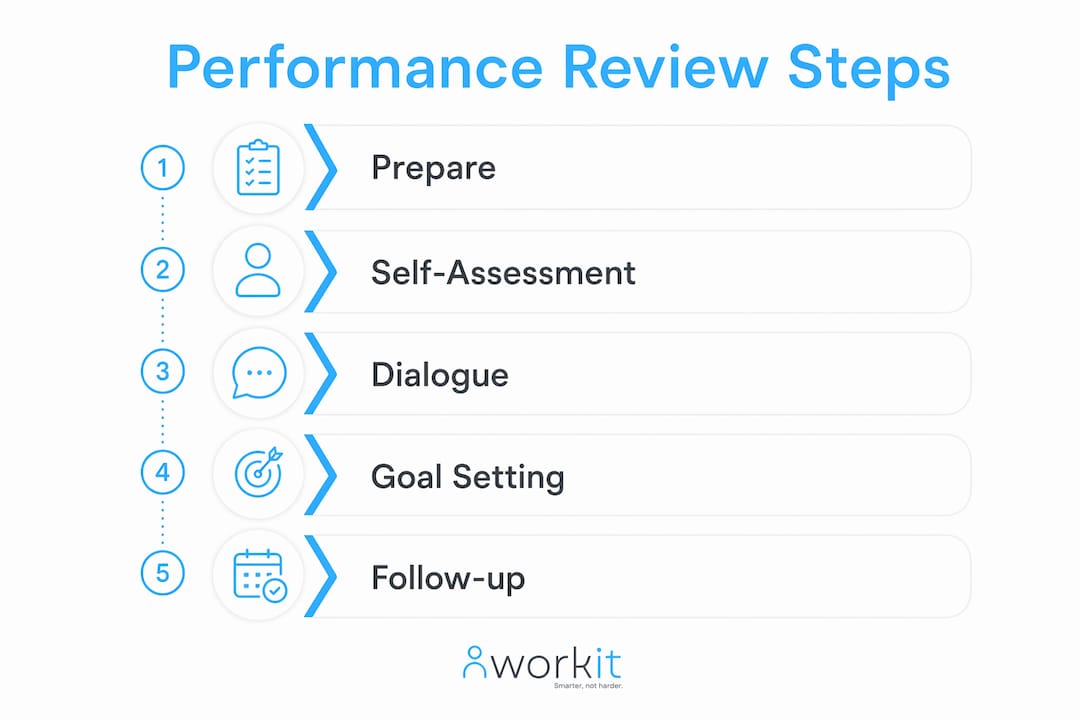
Feedback lands best when it is specific, tied to observable behaviour, and framed around impact rather than personality. “You missed three project deadlines in Q2, which pushed the client delivery back by two weeks” is useful. “You’re not very organised” is not.
Techniques that work:
- Describe the behaviour or outcome, not the person
- Anchor every point to a concrete example from the review period
- Balance strengths and development areas; do not save all the positives for the end
- Invite the employee’s perspective before moving to solutions
- Avoid language that could be construed as discriminatory or retaliatory
The Fair Work Commission is clear that performance reviews must be conducted as genuine two-way dialogues with a professional, respectful tone. Reviews that feel like a verdict being handed down, rather than a conversation, create adverse action risk.
Setting goals collaboratively during the review is just as important as the feedback itself. SMART goals (Specific, Measurable, Achievable, Relevant, Time-bound) give both parties a shared reference point for the next cycle. Vague goals like “improve communication” are almost impossible to assess fairly at the next review. A SMART version might be: “Present a project update to the leadership team once per quarter, starting in March, with written feedback collected after each session.”

Pro Tip: When a difficult topic comes up, name it directly and then ask an open question. “I noticed the client escalations increased in Q3. What was driving that from your perspective?” keeps the conversation factual and gives the employee room to explain context you may not have.
Phrases and comments that actually work in performance reviews
The right words make a real difference. Vague praise or softened criticism leaves employees unsure of where they stand. The phrases below are grouped by theme and mapped to common review contexts.
| Theme | Example phrase | Context |
|---|---|---|
| Strengths: communication | “Your written updates to the client kept the project on track during a difficult period.” | Client-facing or project roles |
| Strengths: initiative | “You identified the process gap before it became a problem and proposed a workable fix.” | Operations, project management |
| Strengths: teamwork | “Your willingness to support the new team members reduced onboarding friction noticeably.” | Team-based roles |
| Development: time management | “Deadlines were met on most projects; the two exceptions both involved competing priorities we should plan for next cycle.” | Any role with multiple workstreams |
| Development: technical skills | “There is an opportunity to build confidence with the reporting tools; training in Q1 would address this directly.” | Data, finance, technical roles |
| Goals | “By June, you will have completed the leadership programme and taken ownership of one cross-functional project.” | All roles |
| Development planning | “We have agreed on monthly check-ins and access to the mentoring programme starting in February.” | Career development conversations |
Quick-reference phrases for balanced dialogue:
- “One thing you handled particularly well this period was…”
- “An area where I’d like to see growth is… and here is what support looks like…”
- “What do you feel most proud of from the last six months?”
- “What has been your biggest challenge, and what would have helped?”
- “What does success look like for you in the next 12 months?”
These questions shift the review from a monologue to a genuine exchange, which is where the most useful information tends to surface.
How to get the most out of your performance review
The review meeting itself is only part of the process. What happens before and after determines whether it actually changes anything.
Before the meeting:
- Both parties should arrive with written notes, not just mental impressions
- Employees: quantify your impact wherever you can; numbers carry more weight than adjectives
- Managers: confirm the time, location, and agenda at least 48 hours in advance so the employee can prepare properly
During the meeting:
- Spend the first few minutes on the employee’s self-assessment before sharing your own view
- Take notes in real time; do not rely on memory to write up outcomes later
- Agree on no more than three to five goals for the next cycle; too many dilutes focus
After the meeting:
- Send a written summary within 24 hours while the conversation is fresh
- Set a calendar reminder for a progress check-in at the 30, 60, or 90-day mark
- If a development plan was agreed, confirm who is responsible for each action and by when
Career coach Leah Lambart advises that regular feedback conversations throughout the year are the single most effective way to avoid being blindsided at a formal review. When feedback flows continuously, the formal review becomes a summary of an ongoing conversation rather than a high-stakes reveal.
Legal and compliance considerations for Australian performance reviews
Performance reviews are not legally mandatory under the Fair Work Act 2009 or the National Employment Standards, unless your employment contracts, enterprise agreements, or workplace policies specify otherwise. That said, skipping them creates real legal exposure when performance issues escalate.
The Fair Work Commission looks closely at process when an unfair dismissal claim is lodged. Specifically, it considers whether the employee was warned about unsatisfactory performance and given a genuine opportunity to improve before any dismissal decision was made. There is no fixed number of warnings required, but the employee must have had a fair chance to understand the concern and respond to it.
Key compliance practices for Australian managers:
- Document every review with signed copies held by both parties
- Keep performance records for at least seven years to demonstrate procedural fairness
- Ensure review criteria are applied consistently across your team
- Never use a review to retaliate against an employee for exercising a workplace right (this constitutes adverse action under the Fair Work Act)
- Avoid language that could be construed as discriminatory on the basis of age, gender, disability, or other protected attributes
Compliance note: The Fair Work Commission has consistently upheld unfair dismissal claims where an employee was not expressly warned that their employment was at risk, or was not given a reasonable period to improve. Documentation is your protection.
Pro Tip: Store performance review records in a secure, centralised system rather than individual manager inboxes. Workit’s Fair Work compliance features give you audit-ready records with access controls, so the right people can retrieve documentation quickly if a dispute arises.
How to handle poor performance effectively
Poor performance needs to be addressed early, clearly, and with genuine support. The Fair Work Ombudsman’s guidance is direct: address issues as soon as they arise rather than letting them compound. A small issue left unaddressed for three months becomes a much harder conversation.
When you identify a performance concern, the first step is a private meeting with the employee. Give them advance notice of the topic, and let them know they can bring a support person. In the meeting, be specific about what the concern is, what the expected standard looks like, and what support you will provide to help them reach it.
From there, a written performance improvement plan (PIP) sets out the specific behaviours or outcomes required, the timeframe for improvement, and the consequences if performance does not improve. The Fair Work Commission has found dismissals unfair where employers could not demonstrate that the employee understood their employment was genuinely at risk. Pre-prepared scripts and meetings that feel like a formality, rather than a real opportunity to respond, have also been found to undermine the validity of warnings.
Follow-up meetings are not optional. They give the employee a chance to demonstrate progress, and they give you a documented record of the support you provided. Where performance improves, recognise it explicitly. Where it does not, you have a clear, defensible record of the steps taken before any further action.
Workit makes performance reviews easier for Australian teams
Running a compliant, consistent performance review process across your whole team takes more than good intentions. It takes a system that keeps records, tracks goals, and surfaces the right information at the right time.
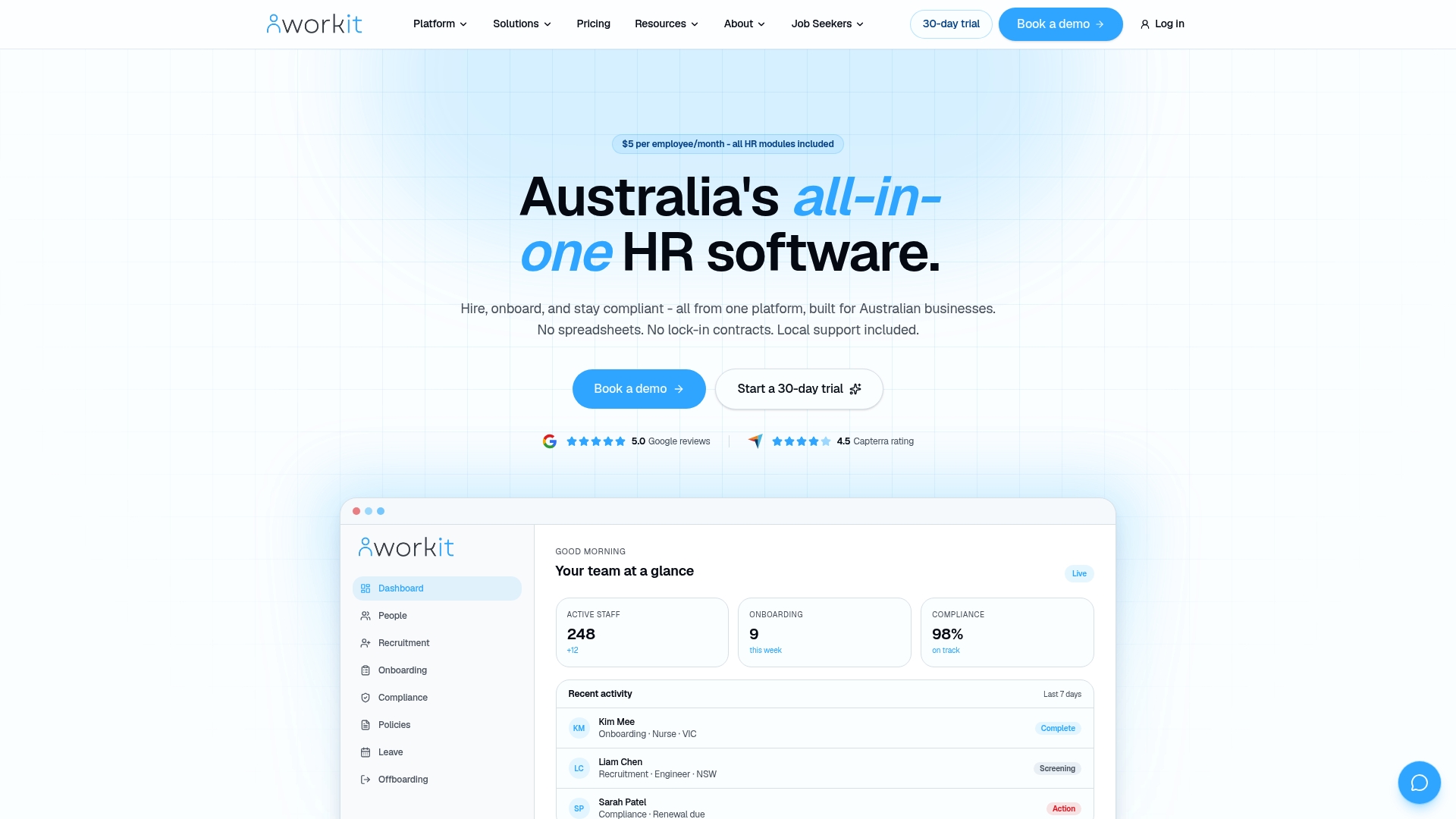
Workit is built specifically for Australian businesses, with a monthly fee per employee that includes every HR module. No hidden fees, no separate add-ons for compliance or reporting. From scheduling reviews and capturing structured feedback to storing signed records securely for seven years, Workit handles the administrative side so you can focus on the conversation that actually matters.
Whether you manage a team of five or five hundred, Workit gives you the tools to run fair, documented, and legally defensible reviews without spreadsheets or disconnected systems. Book a demo at workit.com.au and see how Australian HR teams are running better reviews in less time.
Key takeaways
Effective performance reviews require preparation, honest two-way dialogue, documented outcomes, and consistent follow-through to drive real improvement and protect your business legally.
| Point | Details |
|---|---|
| Preparation is critical | Both managers and employees should arrive with evidence, examples, and written notes. |
| Two-way dialogue is required | The Fair Work Commission expects reviews to be genuine conversations, not one-sided verdicts. |
| SMART goals improve outcomes | Goals set during reviews should be Specific, Measurable, Achievable, Relevant, and Time-bound. |
| Records must be kept for seven years | Australian businesses must retain performance review documentation for at least seven years. |
| Workit centralises the process | Workit’s all-in-one HR platform with a monthly fee per employee supports compliant, audit-ready performance reviews for Australian teams. |
FAQ
What should I say in a performance review?
Focus on specific examples tied to your role and KPIs. Employees should highlight achievements with measurable impact, acknowledge development areas honestly, and raise goals for the next period. Managers should balance strengths with clear, evidence-based feedback on areas for improvement.
Can a performance review lead to dismissal?
Yes, but only when a fair process has been followed. The Fair Work Commission requires that an employee was warned about the performance concern, understood their employment was at risk, and was given a genuine opportunity to improve before any dismissal decision is made.
What are five reasons to conduct employee performance reviews?
Reviews clarify expectations, surface development needs, align individual goals with business objectives, create a documented record for legal defensibility, and give employees a structured opportunity to raise concerns or career aspirations.
How do I write my own performance review?
List your key achievements from the review period with specific examples and numbers where possible. Assess your progress against the goals set at the last review, identify two or three areas for growth, and outline what support or development you need in the next cycle.