

Best Rippling alternatives for Australian businesses in 2026
TL;DR:
- Workit is an Australia-native HR platform offering all modules at a transparent per-employee per-month price, with native Xero integration and local support. Australian businesses seeking compliance with Fair Work, modern awards, and STP Phase 2 should prioritize payroll-first platforms like Workit or employment-specific solutions such as Employment Hero. Verification of award automation, support hours, and data residency is essential before selecting an HR system to ensure a smooth transition from Rippling.
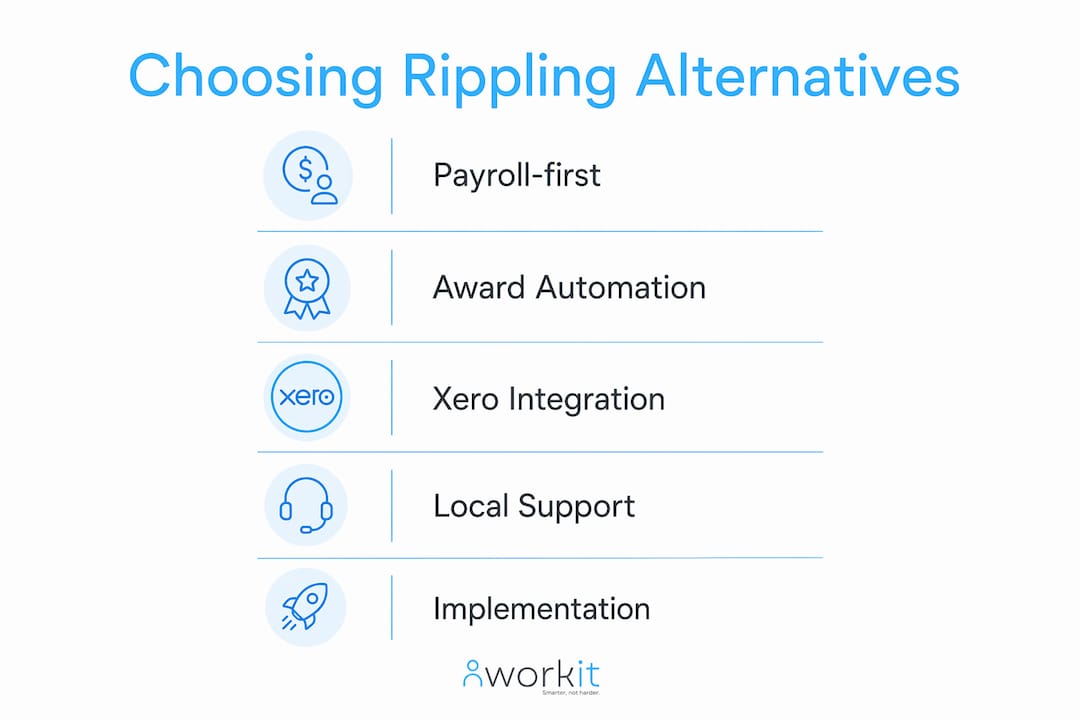
For Australian businesses, Workit is the recommended Australia-native alternative to Rippling: all modules included at $5 per employee per month, built for Fair Work compliance, with local support and native Xero payroll integration. If your needs extend beyond that, here is a practical shortlist to trial first.
Quick shortlist for Australian buyers:
- Workit — Best for: Australian SMEs and mid-market teams wanting a single platform with transparent PEPM pricing, NES-aligned leave tracking, and local support. Strong on onboarding, compliance, and Xero integration. Verify: STP Phase 2 readiness and award-aware timesheets in your demo.
- Employment Hero — Best for: Australian businesses that want a combined HRIS and payroll product with built-in award interpretation. Verify: modular pricing adds up quickly; confirm total cost before signing.
- KeyPay (now part of Employment Hero) — Best for: Payroll-first teams that need deep award automation and STP Phase 2 compliance. Strong local payroll architecture; less comprehensive on core HR modules.
- Xero Payroll — Best for: Small businesses already on Xero that need payroll compliance without a full HRIS. Limited standalone HR features; pair with a dedicated HRIS for full coverage.
- ADP (Australia) — Best for: Mid-to-large enterprises needing managed payroll services with local compliance support. Higher cost; verify Australian award coverage depth in demos.
- Global EOR platforms (Deel, Remote, Multiplier, Papaya Global) — Best for: Teams hiring contractors or employees across multiple countries. Verify: Australian data residency and local entity support before committing.
- BambooHR — Best for: Small-to-mid businesses prioritising people management and HR workflows over payroll depth. Limited Australian payroll integration; pair with a local payroll tool.
- Zoho People — Best for: Cost-conscious teams already in the Zoho ecosystem. Verify: Australian award automation is limited; confirm payroll integration options.
Australia-relevance note: Workit, Employment Hero, KeyPay, Xero Payroll, and ADP Australia have the strongest local compliance credentials. Global EOR platforms require extra verification on STP Phase 2, data residency, and award automation. BambooHR and Zoho People are solid HR workflow tools but typically need a local payroll partner to cover Australian obligations fully.
Table of Contents
- Which Rippling alternatives suit Australian buyers at a glance?
- Why do Australian teams look for alternatives to Rippling?
- How do you choose the right alternative for your Australian business?
- What are the top alternatives by category for Australian buyers?
- How do pricing models affect your total cost of ownership?
- Why do Australian compliance and local support matter so much?
- Which alternatives should you trial first, and how?
- Per-vendor profiles: pros, cons, and best-fit guidance
- What support and training do Australian businesses actually need?
- Key takeaways
- What Australian HR implementations actually teach you
- Workit: the Australia-native HR platform built for this
- Useful sources for deeper verification
- FAQ
Which Rippling alternatives suit Australian buyers at a glance?
The table below maps each platform category against the dimensions that matter most for Australian procurement decisions. Use it to filter quickly: if award automation is your priority, focus on payroll-first local platforms. If global contractor coverage is the driver, look at EOR specialists. If cost predictability is paramount, PEPM all-in-one platforms are the clearest path.
| Platform category | Best for | Pricing model | Australia payroll & awards | Global payroll / EOR | Core HR features | Key integrations | Implementation & local support | Data residency |
|---|---|---|---|---|---|---|---|---|
| Australia-native all-in-one HRIS (e.g. Workit) | Australian SMEs and mid-market | PEPM all-in-one, all modules included | Strong: NES, STP Phase 2, Xero native | Limited; focus is local | Onboarding, leave, compliance, performance, LMS, offboarding | Xero, payroll, time & attendance | Local team, fast response | Australian |
| Payroll-first local platform (e.g. KeyPay) | Award-heavy industries | Modular PEPM | Very strong: award automation, STP Phase 2 | Limited | Basic HR; strong payroll | Xero, MYOB, accounting tools | Local support | Australian |
| Combined HRIS + payroll (e.g. Employment Hero) | Growing Australian businesses | Modular; can escalate | Strong: built-in award interpretation | Limited | Broad HR modules | Xero, accounting | Local team | Australian |
| Small-business payroll (e.g. Xero Payroll) | Xero-first small businesses | Bundled with Xero plan | Good: STP Phase 2, super | None | Payroll only; no HRIS | Native Xero | Online support | Australian |
| Enterprise managed payroll (e.g. ADP Australia) | Mid-to-large enterprise | Quoted; service-based | Strong: managed compliance | Some global capability | HR modules available | ERP, accounting | Dedicated account team | Australian |
| Global EOR / contractor (e.g. Deel, Remote, Multiplier, Papaya Global) | Cross-border hiring | EOR per-employee fee | Variable; verify locally | Strong: multi-country EOR | Basic HR; contractor focus | Accounting, HRIS | Global support; verify AU hours | Verify per vendor |
| SME people management HRIS (e.g. BambooHR) | People-first SMEs | PEPM modular | Weak standalone; needs local payroll partner | None | Strong: onboarding, performance, leave | Payroll partners, accounting | Online; no local AU team | US-based; verify |
| Ecosystem HRIS (e.g. Zoho People) | Zoho ecosystem users | Modular PEPM | Limited AU award automation | None | Broad modules | Zoho suite, accounting | Online; no dedicated AU team | Verify |
Three quick disqualifiers to apply before shortlisting:
- No STP Phase 2 support. Any platform that cannot demonstrate STP Phase 2 earnings category exports in a live sandbox is a compliance risk for Australian payroll.
- Opaque modular pricing. If a vendor cannot give you a clear total cost per employee per month with all required modules included, budget overruns are likely.
- No Australian support hours. A vendor whose support team operates only in US or European time zones creates real risk when a payroll issue surfaces at 8 AM AEST on a Tuesday.
Why do Australian teams look for alternatives to Rippling?
Rippling is a well-regarded global HR and IT platform, but several specific pain points drive Australian teams to look elsewhere.
Common triggers:
- Complex, escalating pricing. Rippling’s modular pricing means costs rise as you add payroll, device management, and compliance modules. Many Australian buyers find the total cost hard to predict.
- Gaps in Australian award automation. Australia’s modern awards system is one of the most complex payroll environments in the world. Platforms built primarily for the US market often lack the award interpretation depth Australian teams need.
- Limited local payroll depth. STP Phase 2, superannuation calculations, casual loadings, and penalty rates require purpose-built local logic. Global platforms sometimes handle these through middleware or manual configuration.
- Poor local support. When a payroll issue surfaces, you need someone who understands Australian obligations and is available in your time zone.
- Data residency concerns. Some Australian businesses, particularly in financial services and government-adjacent sectors, require data to be held on Australian servers.
- Heavy IT dependency. Rippling’s strength in device management and IT automation is a feature for some teams and unnecessary complexity for others, particularly HR-led implementations.
Decision-tree prompt: If awards and payroll depth are the core issue, prioritise payroll-first local platforms. If global contractor coverage is the driver, evaluate EOR specialists. If cost predictability and simplicity are paramount, an all-in-one PEPM platform like Workit is the clearest starting point.
Migration warning: The most common migration pitfall is underestimating payroll edge cases. Back pay calculations, casual loading history, and STP Phase 2 category mapping all require careful data mapping before go-live. Verify these edge cases with your vendor before you sign, not after.
How do you choose the right alternative for your Australian business?
The single most important criterion when evaluating HR software alternatives for an Australian business is payroll and compliance automation: specifically, whether the platform handles STP Phase 2, modern awards, superannuation, and Fair Work obligations natively, or relies on fragile middleware. Native payroll integration reduces compliance risk and manual reconciliation far more than any additional HR feature.

Payroll architecture
Ask vendors directly: is payroll logic built into the platform, or does it sync via an API to a third-party engine? A platform where payroll rules are authoritative and the HRIS extends payroll prevents the category of migration problems that occur when HR data is forced to conform to a payroll system built for another jurisdiction. Ask for a live sandbox demonstration with your actual pay categories, not a scripted walkthrough.
STP Phase 2 and award coverage
Request a demonstration of STP Phase 2 earnings category exports, automated delivery of the Fair Work Information Statement and Casual Employment Information Statement, and documented Notifiable Data Breaches processes. Australian buyer checklists consistently include award-aware timesheets, time and rostering change logs, and seven-year record retention as non-negotiable verification points.
Integration with Xero Payroll
For most Australian SMEs, Xero is the accounting backbone. Ask whether the integration is native (direct API maintained by the vendor) or relies on a third-party connector. A native Xero link means payroll journals post automatically and leave balances reconcile without manual exports.
Implementation team and timelines
Ask for a named implementation lead with Australian payroll experience, not a generic onboarding queue. For a medium-sized professional services firm (50–200 employees), expect a realistic timeline of four to six weeks for pilot, eight to twelve weeks for full implementation, and a parallel payroll run of at least two pay cycles before go-live.
Australian references and update cadence
Require named Australian customer references in your industry segment, not just global case studies. Ask how quickly the vendor pushed STP Phase 2 updates and Payday Super changes to customers. Compliance is an ongoing process; vendors should deliver fast rule updates and local support to avoid manual reconfigurations when employment law shifts.
Red flags that should stop a procurement
- No named Australian references in your industry
- No audit logs or seven-year record retention capability
- Pricing that requires a custom quote for every module combination
- Security certifications (ISO 27001 or SOC 2) not available on request
Pro Tip: Ask the vendor’s sales team to name the person who will lead your implementation and confirm their Australian payroll experience. If they cannot name that person before contract, treat it as a red flag.
What are the top alternatives by category for Australian buyers?
Australia-native payroll-first HRIS
This category covers platforms built from the ground up for Australian compliance: STP Phase 2, modern awards, superannuation, and Fair Work obligations are core architecture, not bolt-ons.
Workit sits in this category as the recommended all-in-one option. All modules (onboarding, leave, compliance, performance, LMS, offboarding, reporting) are included at a single transparent price without quoting a specific dollar amount. The Xero payroll integration is native, and the support team operates in Australian business hours. For a buyer coming off Rippling, the migration path is straightforward: Workit’s onboarding module handles new-starter documentation, Fair Work statements, and policy distribution in one workflow.
Employment Hero combines HRIS and payroll with built-in award interpretation. It suits growing Australian businesses that want a single vendor for both HR and payroll. The modular pricing model means costs can escalate as you add features; confirm the total per-employee cost with all required modules before signing.
KeyPay (now integrated into Employment Hero’s payroll engine) is the strongest purpose-built option for award-heavy industries: hospitality, retail, and healthcare. Its award automation and STP Phase 2 handling are among the deepest available. The trade-off is that standalone HR features are thinner; it works best paired with a dedicated HRIS or as the payroll engine behind Employment Hero.
What to verify in a demo: STP Phase 2 earnings category mapping, casual loading calculations, and back pay scenario handling.
Global EOR and contractor platforms
Deel, Remote, Multiplier, and Papaya Global all serve Australian businesses that need to hire employees or contractors across multiple countries. Their strength is multi-country employer-of-record (EOR) infrastructure; their limitation is that Australian-specific payroll depth (award automation, STP Phase 2) varies and requires verification.
For Australian-based teams with primarily local headcount, these platforms are typically overkill. Where they add genuine value is for businesses expanding into Southeast Asia, Europe, or the Americas while maintaining an Australian HQ. In that scenario, pair a global EOR platform with a local HRIS like Workit for the Australian workforce.
What to verify: Data residency location, Australian entity support, STP Phase 2 capability, and support hours in AEST.
Small-business payroll and HRIS
Xero Payroll is the natural starting point for small businesses already on Xero. STP Phase 2 compliance and superannuation calculations are handled natively. The limitation is that Xero Payroll is payroll, not an HRIS: there is no onboarding workflow, performance management, or compliance document tracking. Pair it with a dedicated HRIS for full coverage.
BambooHR is a well-regarded people management platform with strong onboarding, performance, and leave features. Its limitation for Australian buyers is payroll: BambooHR does not have a native Australian payroll engine, so you will need a local payroll partner. If your payroll is already handled by Xero or a managed service, BambooHR is worth evaluating for the HR workflow layer.
Zoho People suits teams already invested in the Zoho ecosystem. The module breadth is wide, and the pricing is competitive. Australian award automation is limited, so verify payroll integration options carefully before committing.
Enterprise managed payroll
ADP Australia targets mid-to-large enterprises that want managed payroll services with dedicated compliance support. The pricing is service-based and quoted; it is rarely the most cost-effective option for businesses under 200 employees. For larger organisations with complex payroll requirements, ADP’s local compliance team and managed service model reduce internal resource burden.
How do pricing models affect your total cost of ownership?
Three pricing shapes dominate the Australian HR software market, and each has a different total cost of ownership (TCO) profile over a three-year period.
PEPM all-in-one (per employee per month, all modules included) gives the most predictable budget. You pay one rate regardless of which modules you use. Workit’s per employee per month (PEPM) model is a clear example of transparent pricing with no module add-ons or hidden fees. Australian buyers increasingly prefer this model for budget predictability.
Modular a la carte pricing starts lower but escalates as you add payroll, performance, and compliance modules. The headline per-employee rate is rarely the real cost; always request a fully-loaded quote with every module you need.
EOR per-employee fees apply to global contractor platforms. These are typically charged per active contractor per month and can be significant at scale. They are appropriate when you genuinely need multi-country EOR infrastructure; they are expensive if you are using a global platform primarily for Australian headcount.
Sample TCO comparison (hypothetical, 100 employees, 3 years):
| Cost item | PEPM all-in-one | Modular platform | EOR platform |
|---|---|---|---|
| Payroll services | Included or via Xero | Additional module | Included |
| Support & maintenance | Included | Varies | Included |
| Migration labour (internal) | Low | Medium–High | Low–Medium |
Note: All figures are illustrative estimates for planning purposes only. Actual costs depend on vendor, configuration, and headcount.
Hidden costs to watch for:
- Data export fees when switching vendors
- Custom award configuration charges
- Mid-year legislative update fees (some vendors charge for rule updates)
- Integration build costs for non-native connectors
- Internal resource time for parallel payroll runs
For a practical breakdown of HR software pricing in Australia, including PEPM versus modular comparisons, the Workit pricing guide covers the key variables.
Procurement levers to reduce TCO: Run a paid pilot to validate award automation before full commitment. Negotiate a fixed-scope implementation with defined deliverables. Stage the rollout (payroll first, then performance and LMS) to reduce change management risk.
Why do Australian compliance and local support matter so much?
Australia’s modern awards system covers more than 120 industry and occupation awards, each with specific pay rates, penalty loadings, allowances, and overtime rules. Market analysis in 2026 confirms an accelerated move to cloud-native, Australian-centric HR platforms precisely because award complexity makes local automation and rapid rule updates high-value features. Analysts point to the potential to reduce manual admin by 80–90% and prevent underpayment before payroll runs as the core value proposition for local platforms.
Australian compliance checklist for vendor evaluation:
- STP Phase 2: earnings category mapping, year-to-date reporting, and ATO submission capability
- Superannuation: correct calculation, fund selection, and SuperStream compliance
- Modern awards: automated rate application, penalty loadings, and allowance calculations
- Payday Super (effective 1 July 2026): super contributions paid on each payday, not quarterly
- Fair Work Information Statement and Casual Employment Information Statement: automated delivery at onboarding
- Record retention: seven-year payroll and HR record storage with audit trail
- Data residency: Australian server location or documented cross-border data handling
- Notifiable Data Breaches: documented process and vendor responsibility
Local support in the Australian time zone materially reduces resolution times for compliance tickets. When the Fair Work Commission updates a modern award, you need a vendor who pushes that update to your system within days, not weeks. Regional specialists maintain strong footholds in the Australian market precisely because of this deeper understanding of Fair Work obligations.
The most common migration pitfall is overlooking payroll edge cases during the transition. Casual loading history, back pay calculations, and STP category mapping all require careful data mapping. Practitioners consistently recommend a payroll-first architecture where the HRIS extends local payroll rather than attempting to replace it without deep local logic.
Which alternatives should you trial first, and how?
Start with an Australia-native payroll-first HRIS. Workit is the recommended first trial for most Australian businesses: transparent PEPM pricing, all modules included, native Xero integration, and local support. If you need multi-country contractor coverage, add a specialist global EOR platform as a second layer. If cost predictability is the overriding concern and your payroll is already handled, evaluate a small-business HRIS for the HR workflow layer.
6-point pilot checklist for a 4–6 week trial:
- Data migration sample: Import a representative sample of employee records (including casuals and part-timers) and verify data integrity, leave balances, and pay category mapping.
- STP Phase 2 test: Run a test payroll submission and verify earnings category exports match ATO requirements.
- Award timesheet test: Configure at least one modern award and run a timesheet scenario with penalty loadings and overtime. Confirm the calculated pay matches your manual calculation.
- Xero payroll integration: Complete a full payroll cycle and verify that journals post correctly to Xero, leave balances reconcile, and superannuation is calculated accurately.
- Named implementation lead: Confirm your implementation lead’s name, Australian payroll experience, and availability before the pilot begins.
- Support SLA verification: Log a test compliance query and measure response time. Confirm support hours cover Australian business hours.
Estimated timelines for a medium professional services firm (50–200 employees):
- Pilot: 4–6 weeks
- Full implementation: 8–12 weeks
- Parallel payroll runs: minimum 2 pay cycles before go-live
- Total from contract to go-live: 12–16 weeks
Per-vendor profiles: pros, cons, and best-fit guidance
Workit
Best for: Australian SMEs and mid-market businesses wanting a single platform with no module add-ons.
Pros: Transparent $5 PEPM pricing with all modules included; native Xero integration; local Australian support team; covers onboarding, leave, compliance, performance, LMS, offboarding, and reporting in one platform; Fair Work compliance and audit-readiness built in.
Cons: Primarily focused on the Australian market; not the right choice if global EOR is your primary need.
Verify in demo: STP Phase 2 earnings category exports, award-aware timesheet configuration, and Xero payroll journal posting.
Employment Hero
Best for: Growing Australian businesses wanting combined HRIS and payroll under one vendor.

Pros: Built-in award interpretation; broad HR module set; strong local market presence.
Cons: Modular pricing escalates; confirm total cost with all required modules before signing.
Verify in demo: Award automation depth for your specific industry award, total per-employee cost with all modules, and implementation timeline.
KeyPay
Best for: Award-heavy industries (hospitality, retail, healthcare) needing deep payroll automation.
Pros: Among the strongest award automation engines in the Australian market; STP Phase 2 native.
Cons: Thinner standalone HR features; works best as a payroll engine paired with a dedicated HRIS.
Verify in demo: Penalty loading calculations, casual conversion rules, and STP Phase 2 category mapping.
Xero Payroll
Best for: Small businesses already on Xero that need compliant payroll without a full HRIS.
Pros: Native Xero integration; STP Phase 2 compliant; superannuation and SuperStream handled.
Cons: Payroll only; no onboarding, performance, or compliance document management.
Verify in demo: Award rate updates and Payday Super readiness from 1 July 2026.
ADP (Australia)
Best for: Mid-to-large enterprises wanting managed payroll services with dedicated compliance support.
Pros: Strong local compliance team; managed service reduces internal resource burden; handles complex payroll scenarios.
Cons: Higher cost; typically not cost-effective under 200 employees; implementation timelines can be long.
Verify in demo: Australian award coverage for your industry, implementation timeline, and named account manager.
Deel, Remote, Multiplier, Papaya Global
Best for: Businesses hiring employees or contractors across multiple countries.
Pros: Multi-country EOR infrastructure; contractor management; global payroll capability.
Cons: Australian payroll depth varies; data residency requires verification; support hours may not cover AEST; higher cost for primarily Australian headcount.
Verify in demo: Australian data residency, STP Phase 2 capability, and support hours in AEST.
BambooHR
Best for: People-first SMEs prioritising HR workflows, onboarding, and performance management.
Pros: Strong onboarding and performance features; clean interface; good reporting.
Cons: No native Australian payroll engine; requires a local payroll partner for full compliance coverage.
Verify in demo: Integration with your existing payroll tool and leave balance synchronisation.
Zoho People
Best for: Cost-conscious teams already in the Zoho ecosystem.
Pros: Wide module breadth; competitive pricing; integrates with Zoho Books and Zoho Payroll.
Cons: Australian award automation is limited; no dedicated Australian support team.
Verify in demo: Payroll integration options for Australian compliance and award configuration capability.
What support and training do Australian businesses actually need?
Support quality is where global platforms and local specialists diverge most sharply. For Australian businesses, the practical requirements are specific.
Response time in AEST. A payroll issue at 8 AM on a Tuesday cannot wait 24 hours for a US-based support team to start their day. Require a documented SLA for response times during Australian business hours, and test it during your pilot by logging a real query.
Named implementation lead. The difference between a smooth go-live and a painful one often comes down to a single person who knows your configuration, your award structure, and your payroll edge cases. Ask for that person’s name and credentials before you sign. Implementation success depends heavily on local support and named implementation leads who understand Australian awards and payroll edge cases.
Training formats. Australian HR teams typically need a combination of live onboarding sessions, recorded walkthroughs for new starters, and a searchable knowledge base for ongoing reference. Ask vendors whether training is included in the implementation fee or charged separately, and whether it covers your specific award and payroll configuration.
Legislative update communication. When the Fair Work Commission updates a modern award or the ATO changes STP reporting requirements, you need to know immediately and you need the platform updated without manual intervention. Ask vendors for their documented process for pushing legislative updates, including how quickly STP Phase 2 changes were delivered to customers.
Ongoing support channels. Live chat, phone, and email support during Australian business hours are the baseline. For enterprise buyers, a dedicated customer success manager who can advise on configuration changes as your business grows is worth negotiating into the contract.
Workit’s local support model is built around Australian business hours, with a team that understands Fair Work obligations and can advise on configuration for specific awards. For buyers coming off a global platform, that local context reduces the time to resolve compliance queries significantly.
Key takeaways
For Australian businesses evaluating Rippling alternatives, the clearest path to a successful switch is to prioritise payroll-first architecture, transparent PEPM pricing, and demonstrable STP Phase 2 and award automation before signing any contract.
| Point | Details |
|---|---|
| Payroll-first architecture wins | Platforms where payroll rules are authoritative reduce migration problems and compliance risk for Australian businesses. |
| Transparent PEPM pricing saves budget | All-in-one PEPM models (like Workit at $5 per employee per month) are more predictable than modular pricing that escalates with add-ons. |
| STP Phase 2 and awards are non-negotiable | Verify STP Phase 2 earnings category exports and award automation in a live sandbox before committing to any platform. |
| Local support in AEST reduces risk | Require a documented SLA for Australian business hours support and a named implementation lead with local payroll experience. |
| Workit is the recommended Australia-native option | Workit covers all HR modules with a transparent per employee per month pricing model, native Xero integration, local support, and Fair Work compliance built in. |
What Australian HR implementations actually teach you
The gap between what a vendor demonstrates in a sales environment and what your team experiences on day one of go-live is where most HR software projects run into trouble. That gap is almost always widest in payroll.
Award interpretation is genuinely complex. A retail business running a mix of full-time, part-time, and casual staff across multiple Modern Award classifications will surface edge cases that no scripted demo covers. The platforms that handle this well are the ones where payroll engineers have spent years building Australian award logic, not the ones that added an “Australia module” to a US-built system. That distinction shapes everything from your first parallel payroll run to your first Fair Work audit.
Change management is consistently underestimated. HR teams often focus on the technical migration and underinvest in preparing managers and employees for new workflows. Self-service leave requests, digital policy acknowledgements, and onboarding checklists all require behavioural change, not just system access. Budget time for this explicitly.
The vendors worth trusting are the ones who push legislative updates proactively and communicate clearly about what changed and why. When Payday Super takes effect from 1 July 2026, requiring super contributions on each payday rather than quarterly, your platform needs to handle that automatically. Ask your vendor now how they are preparing for it, and what the update process looks like for your configuration.
Finally, do not underestimate the value of a single, predictable price. The cognitive overhead of tracking module costs, API fees, and implementation add-ons across a modular platform is real admin burden. A transparent $5 PEPM model removes that entirely and lets your team focus on the work, not the invoice.
Workit: the Australia-native HR platform built for this
If the alternatives you have just reviewed feel like they require too much configuration, too many integrations, or too much verification to get to a compliant Australian payroll, Workit is the direct answer. Every module is included at a transparent $5 per employee per month rate: onboarding, leave tracking aligned to NES entitlements, compliance management, performance reviews, LMS, offboarding, and real-time reporting. No add-ons. No hidden fees.
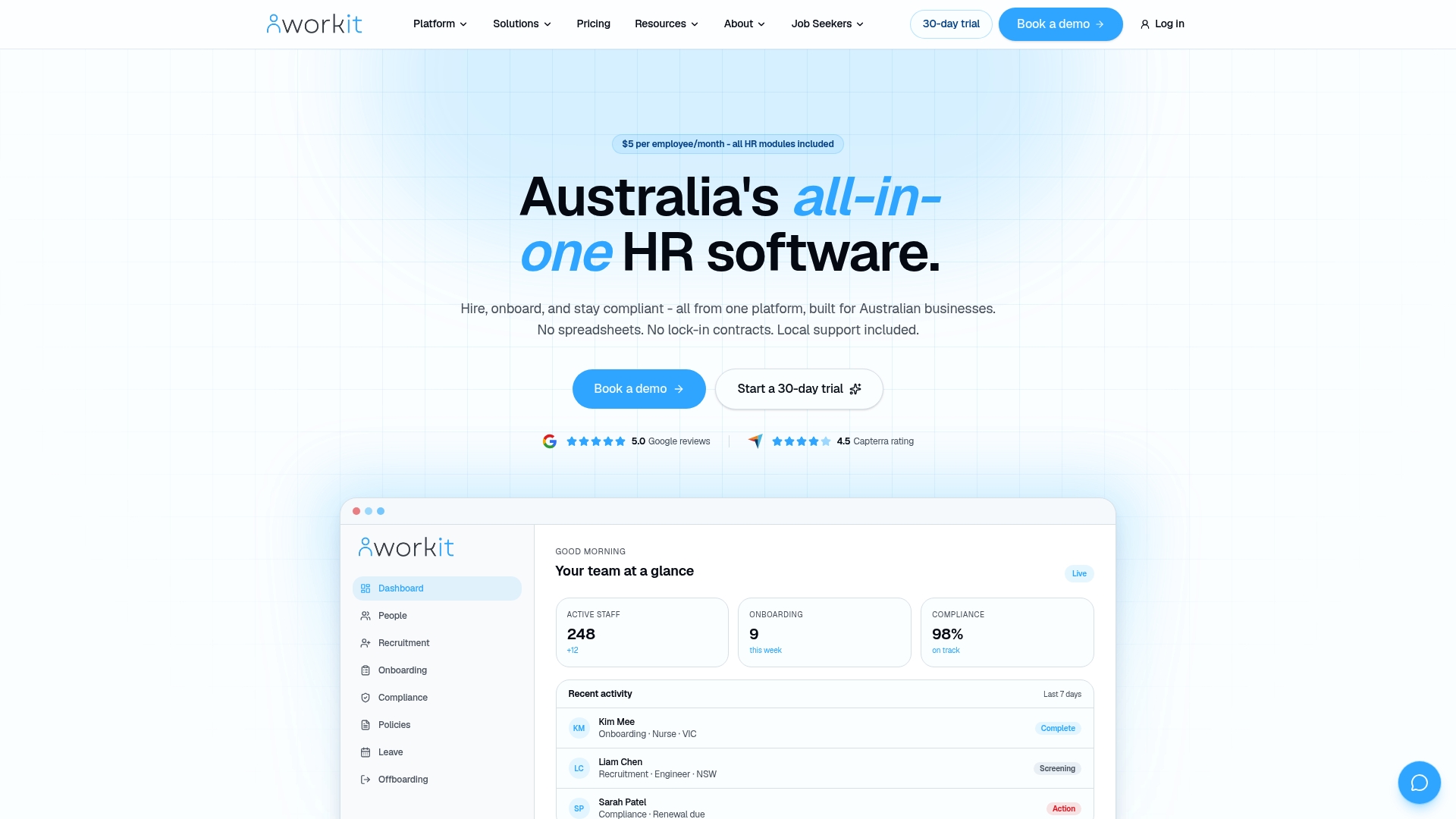
The Xero payroll integration is native, STP Phase 2 is supported, and the support team operates in Australian business hours with real people who understand Fair Work obligations. For businesses coming off Rippling or any global platform, Workit’s implementation team handles the migration with a named lead and a structured onboarding process.
Book a demo to see Workit’s award-aware timesheets, STP Phase 2 exports, and Xero integration in a live environment with your own pay categories. Or explore the full HRIS module overview to compare capabilities before your trial.
Useful sources for deeper verification
Use these resources to validate vendor claims, run your own compliance checks, and build your procurement shortlist.
- Gartner Peer Insights: Rippling alternatives — Independent analyst listings and peer reviews of HR platforms; useful for enterprise buyers running formal RFPs.
- Capterra Australia: Rippling alternatives — User reviews and feature comparisons from Australian and global buyers; good for cross-referencing vendor claims.
- G2: Rippling competitors and alternatives — Peer review data and feature grids; useful for comparing user satisfaction scores across platforms.
- How to choose HR software for Australian businesses in 2026 — Practical buyer checklist covering STP Phase 2, award automation, and vendor due diligence steps.
- Choosing the best HR software for small business Australia (2026) — Covers payroll-first architecture, integration quality, and implementation considerations for Australian SMEs.
- Australia HR payroll software market — Market analysis covering local versus global platform trade-offs and the value of award automation.
- HR software pricing guide Australia — Workit’s breakdown of PEPM versus modular pricing with worked examples for Australian buyers.
- HR compliance software buyer guide — Workit’s compliance checklist covering STP Phase 2, award automation, audit trails, and record retention.
- How to choose HR software in Australia — Step-by-step procurement guidance tailored to Australian buyers, including demo verification steps.
- HRIS and Fair Work compliance guide — Practical guide to audit readiness and compliance documentation for Australian HR teams.
- HR software for small business: buyer’s guide — Neutral secondary perspective on vendor selection criteria for small businesses.
FAQ
Who is Rippling’s biggest competitor in Australia?
Employment Hero is widely cited as Rippling’s closest direct competitor in the Australian market, given its combined HRIS and payroll offering with built-in award interpretation. Workit is the recommended Australia-native alternative for businesses prioritising transparent PEPM pricing and local support.
What are the top HRIS systems for Australian businesses?
The strongest options for Australian businesses are platforms with native STP Phase 2 support, modern award automation, and local implementation teams: Workit, Employment Hero, and KeyPay lead on local compliance depth, while BambooHR and Zoho People suit businesses with a separate payroll solution already in place.
Is Rippling suitable for Australian payroll compliance?
Rippling handles many HR workflows well, but its payroll depth for Australian modern awards and STP Phase 2 requires careful verification. Australian buyers should test award automation, casual loading calculations, and STP Phase 2 earnings category exports in a live sandbox before committing.
What should I prioritise when switching from Rippling to an alternative?
Prioritise payroll-first architecture and demonstrable STP Phase 2 and award automation. Run the three payroll edge cases (new starter with pre-start leave, casual with penalty loadings, and a back pay scenario) in a live demo, and require a named Australian implementation lead before signing.
How long does it take to implement an HR platform in Australia?
For a medium professional services firm of 50–200 employees, expect 4–6 weeks for a pilot, 8–12 weeks for full implementation, and a minimum of two parallel payroll cycles before go-live, giving a total timeline of roughly 12–16 weeks from contract to production.