

Why real-time HR data matters for Australian businesses
Real-time HR data is the live, continuously updated information about your workforce that lets you act on what is happening now, not what happened last quarter. For Australian HR professionals and business managers, this distinction is the difference between catching a compliance gap before it becomes a penalty and discovering it during an audit. The 2026 HR Industry Benchmark Report found that only 23% of Australian organisations use a fully centralised HR platform, and 32% still rely on manual processes for core HR metrics. That gap leaves most teams flying on outdated information at exactly the moment boards expect sharper workforce decisions.
Here is why real-time HR data matters for your organisation right now:
- Faster decisions: You respond to staffing shortfalls, compliance risks, and engagement dips before they escalate.
- Greater accuracy: Live data removes the lag and transcription errors that plague spreadsheet-based reporting.
- Proactive retention: You spot flight-risk signals weeks before a resignation letter lands on your desk.
- Compliance confidence: Continuous tracking keeps you aligned with Fair Work obligations and WHS requirements.
- Evidence-based planning: Workforce forecasts are grounded in current reality, not last year’s headcount snapshot.
What is real-time HR data and how does it work in your organisation?
Real-time HR data refers to workforce information that updates continuously as events occur, rather than being compiled in periodic batch reports. Think of it as the difference between checking yesterday’s weather forecast and looking out the window right now.
The data flows from several interconnected sources within a modern HR function:
- Human Capital Management (HCM) platforms that record employment status, role changes, and contract details as they happen.
- Time and attendance systems that capture hours worked, leave taken, and shift patterns in the moment.
- Payroll integrations that flag discrepancies between planned and actual labour costs.
- Engagement and pulse survey tools that surface wellbeing and satisfaction signals between annual review cycles.
- Onboarding and offboarding workflows that update headcount and skills data the moment a new starter completes their paperwork.
A practical example: a retail group with stores across three states notices an absenteeism spike in its Queensland locations on a Monday morning. With real-time data, the HR manager sees the pattern within hours, cross-references it with recent rostering changes, and contacts the state manager before the week’s productivity is affected. With monthly batch reporting, that same pattern would surface six weeks later, long after the damage is done.
Traditional batch reporting treats workforce data as a historical record. Real-time HR data treats it as a live signal, giving you the chance to act while the window is still open.
Why does real-time HR data matter to managers and HR professionals in practice?
The practical case for real-time workforce data comes down to one thing: by the time lagging indicators like turnover show up in a report, the underlying problem has usually been building for months. Australian HR leaders at organisations like Australian Payments Plus now track predictive indicators, including engagement, wellbeing, and productivity scores, precisely because they want to interrupt the pipeline before it flows through to exits.
The benefits HR professionals and managers gain from real-time access include:
- Proactive risk management: Monitoring predictive indicators such as wellbeing scores and workload disparities lets managers support employees before issues escalate.
- Faster resource allocation: When a project team is running short-staffed, you see it immediately and can redeploy rather than scramble for a last-minute hire.
- Compliance agility: Real-time payroll and time-tracking data surfaces discrepancies before they become Fair Work breaches.
- Evidence-based conversations: HR business partners walk into meetings with operational managers carrying hard numbers, not instincts.
Poor hiring decisions cost Australian businesses millions annually, and replacing an employee costs between half to two times their annual salary. Real-time data does not eliminate turnover, but it gives you enough warning to intervene before the cost is locked in.
The risk of relying on fragmented or outdated data is equally concrete. When time-tracking, payroll, and HR records sit in separate systems, compliance gaps are almost inevitable. Data gets duplicated, errors propagate, and by the time a discrepancy surfaces, unwinding it is costly. Real-time integration removes that lag and gives decision-makers a chance to act while the problem is still small.

Key HR metrics to track with real-time data for maximum impact
Not every metric benefits equally from real-time tracking. The ones that matter most are those where a delay in information directly translates to a delay in action. For Australian businesses, the most critical HR metrics to monitor in real time fall into four categories: workforce stability, recruitment efficiency, engagement, and compliance.
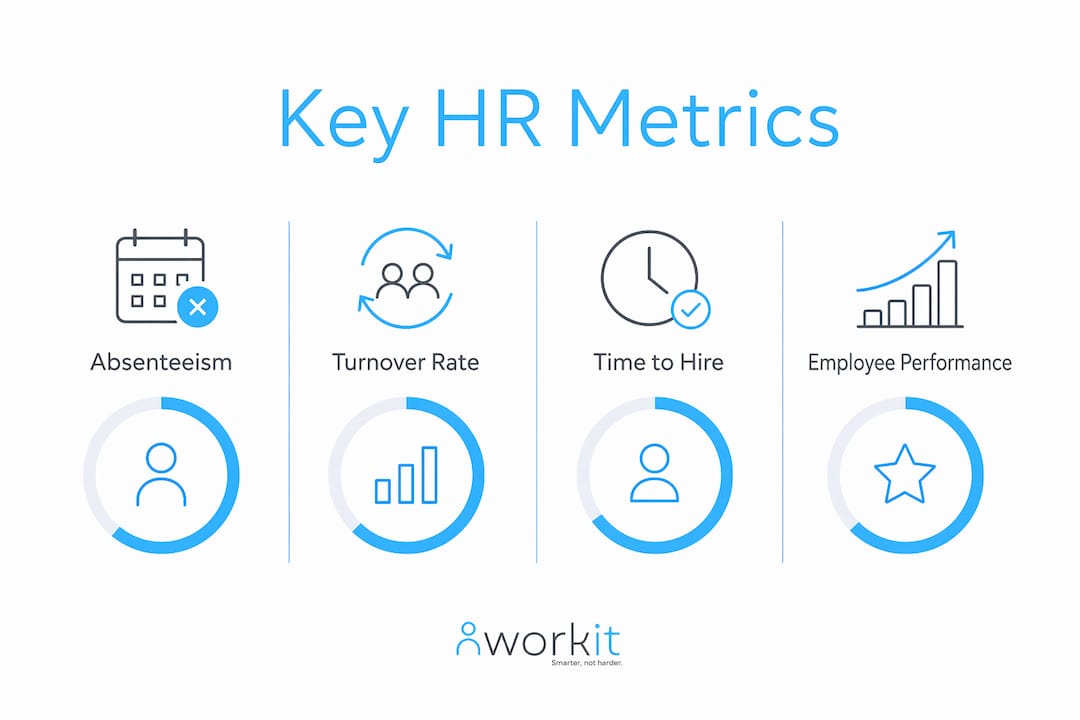
| Metric | Why it matters | Real-time advantage |
|---|---|---|
| Turnover rate | Replacing staff costs half to two times annual salary | Spot team-level spikes before they spread |
| Time to fill | Rising to 25 days nationally in 2026 | Identify bottlenecks in the hiring pipeline early |
| Absenteeism rate | Signals wellbeing and rostering issues | Act within days, not weeks |
| Engagement score | Predicts productivity and retention risk | Quarterly or pulse tracking beats annual surveys |
| Cost per hire | Direct measure of recruitment efficiency | Adjust sourcing channels while the campaign is live |
| Time to productivity | Nationally at — in 2026 | Identify onboarding gaps before new starters disengage |
| Overtime and penalty spend | Hidden cost driver in many Australian businesses | Surface roster inefficiencies in real time |
Prioritise these metrics for real-time tracking in Australian businesses:
- Absenteeism and leave balances (wellbeing and financial liability signal)
- Turnover by team and tenure band (lagging indicator with leading predictors)
- Engagement and wellbeing pulse scores (early warning system)
- Time to fill and offer acceptance rate (recruitment pipeline health)
- Compliance training completion rates (Fair Work and WHS readiness)
Performance data driven by analytics rather than intuition identifies top performers who deliver dramatically more productivity, enabling better talent decisions. The key is connecting each metric to a business outcome, not tracking numbers for their own sake.
Pro Tip: Start with two or three metrics directly tied to a business outcome your leadership team is already focused on. A small set of well-chosen metrics tracked in real time is far more powerful than a sprawling dashboard nobody acts on.
How to use real-time HR data effectively for better workforce decisions
Collecting real-time data is the easy part. Turning it into decisions that actually move the dial requires a clear process and the right mindset.
-
Define the business outcome first. Before choosing a metric, ask what organisational result you need to move in the next 12–24 months. Recruitment cost? Retention in a specific team? Compliance audit readiness? The outcome determines the data, not the other way around.
-
Audit your data sources. Map where your workforce data currently lives. Payroll, time tracking, onboarding, and engagement tools that do not communicate with each other create the fragmentation that makes real-time insight impossible.
-
Establish data ownership. Integration is a governance issue, not just a technical one. Assign clear responsibility for which team owns which data, how it is validated, and how quickly the organisation acts when something looks wrong.
-
Partner with finance. HR and finance working together can generate high-impact workforce insights without a costly transformation program. Finance brings modelling discipline; HR brings context about roles and behaviours. Together, they produce analytics that drive decisions rather than just inform them.
-
Use a platform that connects your data. Workit’s all-in-one HRIS gives Australian businesses a single source of truth, with real-time compliance tracking, reporting, and workforce data updated as events occur, without spreadsheets or manual entry.
-
Build a rhythm of review. Real-time data does not mean constant monitoring. Set a cadence: daily exception alerts for compliance and absenteeism, weekly check-ins on recruitment pipeline, monthly deep dives on engagement and turnover trends.
-
Avoid analysis paralysis. Chasing every interesting number leads to false patterns built on small samples. Focus on a small number of metrics, then pull on the threads when something looks unusual. Explore anomalies with curiosity before assuming crisis.
The cultural shift matters as much as the technology. Data and analytics create value only when the CEO, executive team, and HR sit together, define the right questions, and respond constructively to what the data shows. A sophisticated dashboard used by nobody changes nothing.

Real-time HR data in Australia: bridging the adoption-impact gap
Australia’s HR function is at an inflection point. AI adoption is widespread, cloud-based platforms are accessible, and the tools available to a mid-sized Australian business today would have required enterprise-level investment five years ago. Yet the 2026 HR Industry Benchmark Report tells a more complicated story.
Only 23% of Australian organisations use a fully centralised HR platform, and 32% still rely on manual processes for core HR metrics. This means the majority of Australian HR teams are making workforce decisions on fragmented, delayed data, even as boards expect real-time answers.
The adoption-impact gap is real. Many Australian HR teams have invested in technology but struggle to measure what it is actually delivering. The barrier is rarely the tool itself. It is the fragmentation of source systems, the absence of clear data ownership, and a cultural tendency to collect metrics without connecting them to business outcomes.
Smaller Australian organisations often outpace large enterprises on analytics agility, precisely because they can access their data faster and with less bureaucracy. A 200-person professional services firm running a single integrated platform can answer a board question about gender pay equity in real time. A large corporate locked into legacy systems across multiple regions often cannot.
Workit was built specifically for this gap. As an Australian all-in-one HR platform, it connects hiring, onboarding, compliance, and reporting in a single system at $5 per employee per month, with no hidden fees and local support from a team that understands the Australian regulatory environment. Organisations using Workit report faster onboarding, reduced manual data entry, and the ability to track compliance obligations in real time rather than discovering gaps after the fact. You can explore how Australian businesses have put this into practice through Workit’s case studies.
Data privacy and compliance add another layer of complexity for Australian organisations. The Privacy Act 1988 and the Australian Privacy Principles govern how employee data is collected, stored, and used. Real-time HR systems must be configured with appropriate access controls, data retention policies, and audit trails. A well-governed platform does not just make data available faster; it makes it available to the right people, in the right way, with a clear record of who accessed what and when.
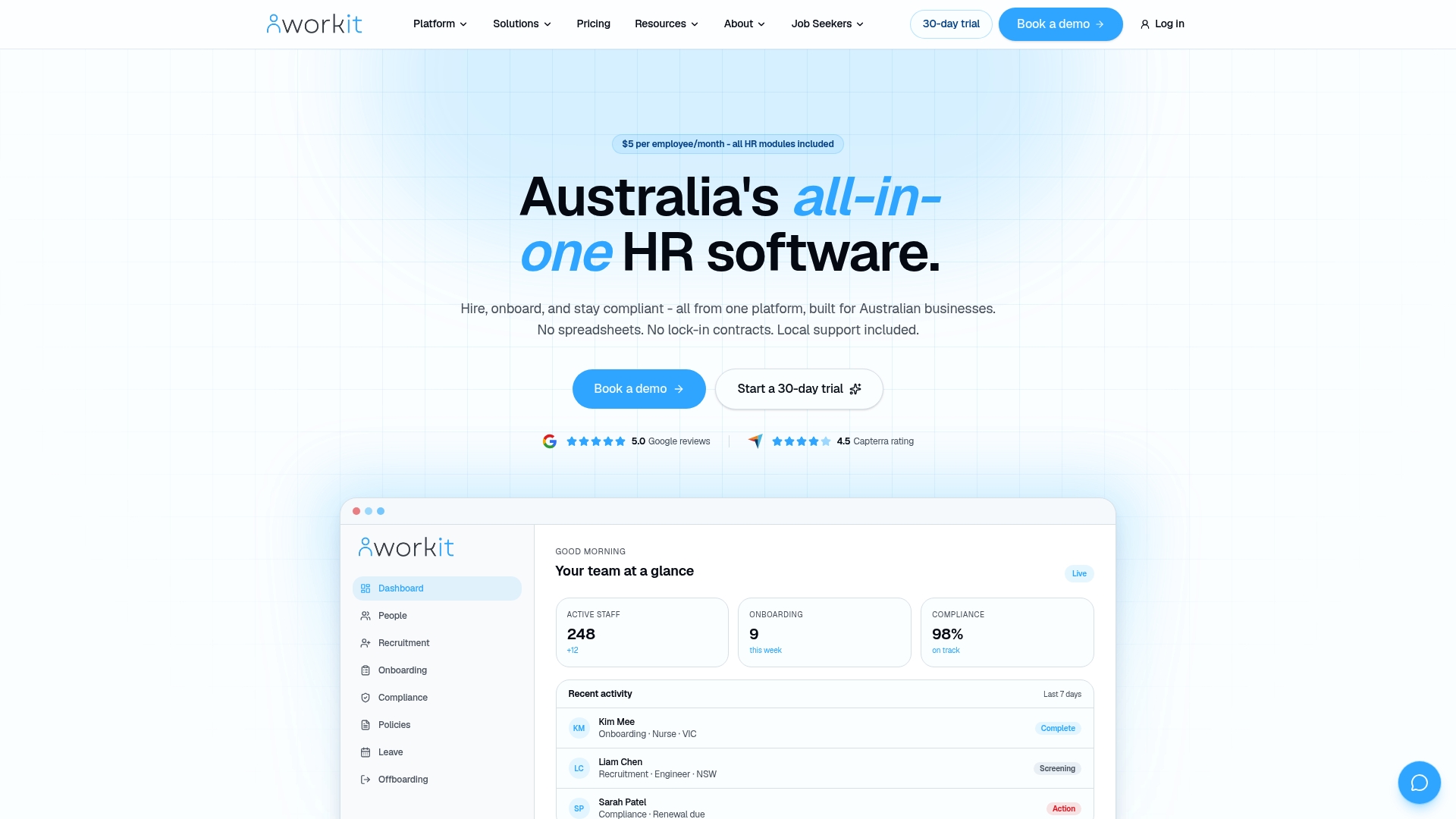
Ready to see what real-time HR data looks like in practice? Book a demo with Workit and find out how Australian businesses are making faster, more confident workforce decisions on one platform.
Key takeaways
Real-time HR data gives Australian HR professionals and managers the live workforce intelligence they need to act before problems escalate, not after.
| Point | Details |
|---|---|
| Adoption gap is wide | Only 23% of Australian organisations use a fully centralised HR platform, and 32% still rely on manual processes for core HR metrics, leaving most teams on fragmented data. |
| Lagging indicators arrive too late | Turnover is an outcome measure; track engagement, wellbeing, and absenteeism in real time to intervene earlier. |
| Governance drives data quality | Clear data ownership and validation protocols matter more than the technology itself for trustworthy dashboards. |
| Finance partnership multiplies impact | HR and finance working together produce analytics that drive decisions, not just reports. |
| Purpose keeps analytics on track | Connect every metric to a specific business outcome, or the data will generate noise rather than action. |
FAQ
Why does real-time data matter for HR decisions?
Real-time data lets HR professionals and managers act on workforce signals as they emerge, rather than weeks later when the cost of inaction has already compounded. Decisions about staffing, compliance, and retention are only as good as the data behind them.
Why is HR data accuracy so important?
Inaccurate HR data leads directly to compliance breaches, poor hiring decisions, and retention failures that cost Australian businesses millions annually. Accurate, up-to-date data is the foundation for every workforce decision that follows.
What are the 5 Cs of HR?
Definitions of the 5 Cs vary across frameworks and organisations, so there is no single canonical version. Common versions include competence, commitment, culture, communication, and compliance, though the specific list depends on the framework your organisation uses.
Why does HR matter more than ever in 2026?
Australian boards now expect HR to deliver measurable business outcomes, not just operational reporting. With tight labour markets, rising employee expectations, and time to fill at 25 days nationally, the cost of slow or uninformed people decisions has never been higher.
How does HR software improve data accuracy?
Integrated HR software eliminates the manual data entry and system fragmentation that cause errors in batch reporting. Platforms like Workit connect hiring, onboarding, compliance, and reporting in one place, so your workforce data updates automatically and stays consistent across every module.