

Background screening in Australia: a complete employer guide
What is background screening and why does it matter?
Background screening is the process Australian employers use to verify that a job candidate is who they say they are, has the legal right to work, and meets the specific requirements of the role before an offer is finalised. It covers identity confirmation, criminal history checks, work rights verification, and credential checks, all governed by the Privacy Act 1988 and relevant anti-discrimination legislation.

Done well, pre-employment screening protects your organisation, your team, and the people you serve. Done poorly, or not at all, it exposes you to negligent hiring claims, regulatory penalties, and real safety risks.
The core checks Australian employers rely on include:
- National Police Check: confirms criminal history relevant to the role
- Working with Children Check (WWCC): mandatory for child-related work across all states and territories
- Visa Entitlement Verification Online (VEVO): confirms a candidate’s legal right to work in Australia
- Identity verification: confirms the person is who they claim to be
- Qualification and credential checks: validates degrees, licences, and professional memberships
- Employment history verification: confirms previous roles, titles, and conduct
The governing standard, Standards Australia AS 4811:2022, provides a national framework for building a legally defensible screening policy. Compliance protects both you as the employer and the candidates you assess.
Table of Contents
- Key types of background checks for Australian employers
- What laws govern background screening in Australia?
- How to run a compliant background screening process
- Best practices and common challenges in Australian background screening
- Resources and service providers for background checks in Australia
- Workit makes compliance tracking part of every hire
- Key takeaways
- FAQ
Key types of background checks for Australian employers
Not every check applies to every role. The WA Audit Office distinguishes between baseline checks that apply universally and role-specific checks triggered by the nature of the work.
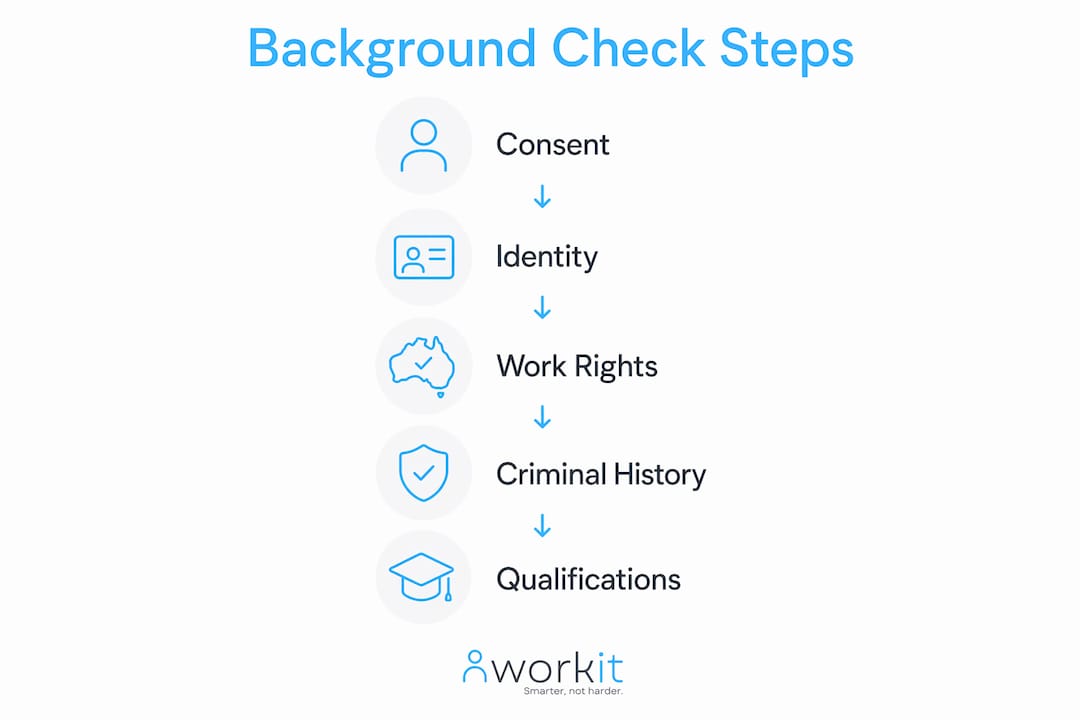
| Check type | Purpose | Typical timeline | Legal consideration |
|---|---|---|---|
| Identity verification | Confirm the candidate is who they claim to be | Immediate to 1 day | Required for all hires |
| VEVO work rights check | Confirm legal right to work in Australia | Minutes (online) | Mandatory for all candidates |
| National Police Check | Assess criminal history relevant to the role | Varies by processing time | Role-dependent; consent required |
| Working with Children Check | Screen for child-related work suitability | Time varies by state | Mandatory for child-related roles |
| Qualification verification | Confirm degrees, licences, and registrations | Processing time varies | Required for licensed professions |
| Employment history check | Validate previous roles and conduct | Processing time varies | Role-dependent |
| Credit history check | Assess financial responsibility | Processing time varies | Finance and trust roles only |
Key points to keep in mind:
- VEVO and identity checks are baseline requirements for every new hire
- National Police Checks are role-dependent, not universal
- WWCC requirements vary by state and territory legislation
- Credit checks apply only where financial responsibility is an inherent job requirement
Pro Tip: State the specific checks required in your job advertisement. AS 4811:2022 recommends this approach, and it sets clear expectations with candidates from the outset.
What laws govern background screening in Australia?
Australian pre-employment screening sits at the intersection of several legal frameworks. Understanding each one prevents costly compliance failures.

Privacy Act 1988 and the Australian Privacy Principles (APPs) regulate how you collect, store, use, and disclose candidate personal information. Criminal history is classified as sensitive information under the APPs, which means you need explicit consent before collecting it and must limit its use to the purpose for which it was collected.
Anti-discrimination legislation at both federal and state levels restricts how you use criminal history findings. The Australian Human Rights Commission is clear: a criminal record should not be an automatic bar to employment. You must assess whether the specific offence is relevant to the inherent requirements of the role, and you must give the candidate an opportunity to respond before making a final decision.
Worker Screening Act 2020 governs WWCC requirements nationally, though each state and territory administers its own scheme. A WWCC issued in one jurisdiction is not always recognised in another, so check the rules for every location where your staff work.
Additional compliance points:
- Candidate consent must be informed and written before any check begins
- Screening requirements must be disclosed in the job advertisement or application process
- Results must be stored securely and accessed only by those with a legitimate need
- Effective policies combine national standards with state-specific appendices
Pro Tip: Build your screening policy around AS 4811:2022 as the national baseline, then add a state-specific appendix for WWCC and any sector-specific obligations. This structure makes audits straightforward and keeps your policy current when state laws change.
How to run a compliant background screening process
A structured process prevents gaps, protects candidate rights, and gives you a defensible record if a hiring decision is ever challenged. The NSW Public Service Commission recommends completing checks before a formal offer wherever possible, with a conditional offer used only when timing makes that impractical.
Step-by-step process:
- Define screening requirements for the role. Identify which checks are mandatory (VEVO, identity) and which are role-specific (National Police Check, WWCC, credit check). Document your reasoning.
- Disclose requirements to candidates. State all required checks in the job advertisement or application form. Candidates must know their employment is conditional on satisfactory results.
- Obtain written, informed consent. Before initiating any check, provide candidates with a clear consent form explaining what will be collected, why, and how results will be used.
- Conduct baseline checks first. Run VEVO and identity verification for every candidate. These are quick and confirm the basics before you invest in role-specific checks.
- Run role-specific checks. Initiate National Police Checks, WWCC applications, qualification verifications, and any other role-relevant checks once consent is confirmed.
- Make a conditional offer if needed. If checks are still in progress when you want to move forward, make a conditional offer. The candidate must not start work until all required checks are cleared.
- Evaluate results against the role. Assess findings relative to the inherent requirements of the position, not as a blanket pass or fail. Give candidates the opportunity to respond to any adverse findings before you make a final decision.
- Document and store results securely. Record the outcome of each check, your assessment rationale, and any candidate response. Store this data with restricted access and retain it only as long as legally required.
Best practices and common challenges in Australian background screening
Consistency is the single biggest risk factor in screening programmes. Applying checks unevenly across candidates in the same role creates discrimination exposure and undermines the defensibility of your process.
Best practices to follow:
- Apply the same checks to every candidate shortlisted for a given role
- Assess criminal history only against the inherent job requirements, not as a blanket disqualifier
- Store screening data securely, limit access, and retain records only as long as necessary under privacy law
- Communicate clearly with candidates throughout the process, including timelines and what happens if a check returns adverse results
- Give candidates a genuine opportunity to explain adverse findings before you finalise a decision
Common challenges:
- WWCC jurisdictional differences. A check issued in Victoria does not automatically satisfy requirements in Queensland. If you hire across state lines, verify the rules for each location.
- Delays in police checks. National Police Checks generally have variable processing times that can be extended in complex cases. Build buffer time into your hiring timeline.
- Candidate confusion about consent. Some candidates misunderstand what they are consenting to. A plain-language consent form reduces friction and protects you legally.
- Over-screening. Requiring a National Police Check for every role regardless of relevance creates legal risk and candidate friction. Match checks to role requirements.
For equal opportunity compliance, document your assessment rationale for every candidate where a check returns a finding. That paper trail is your protection if a decision is ever challenged.
Resources and service providers for background checks in Australia
Several government portals and accredited providers support the background verification process for Australian employers.
Government portals:
- VEVO (Visa Entitlement Verification Online): accessed via the Department of Home Affairs; free for employers with a registered account
- Australian Federal Police (AFP) National Police Check: available directly through the AFP website or via accredited bodies
- AusCheck: the Australian Government’s background checking scheme for aviation and maritime security identification card holders
- Office of the Children’s Guardian (NSW) and state equivalents: administer WWCC applications and employer verification
Accredited screening providers offer consolidated services covering police checks, identity verification, qualification checks, and employment history in a single workflow. When selecting a provider, confirm they are accredited under the Australian Criminal Intelligence Commission (ACIC) framework for police checks, hold an Australian Privacy Principles compliance record, and offer audit-ready reporting.
For education and government employers, where mandatory checks are particularly layered, a provider with sector-specific experience reduces the risk of missing a jurisdiction-specific requirement.
Pro Tip: Integrate your screening provider’s workflow directly into your onboarding platform. When checks are triggered automatically at the conditional offer stage, nothing falls through the cracks and your compliance records are centralised from day one.
Workit makes compliance tracking part of every hire
Managing background checks across multiple providers, consent forms, and state-specific rules is genuinely complex. Workit is the all-in-one HR compliance platform built specifically for Australian businesses, and it brings your screening workflow, onboarding, and compliance tracking into a single place at $5 per employee per month with no hidden fees.
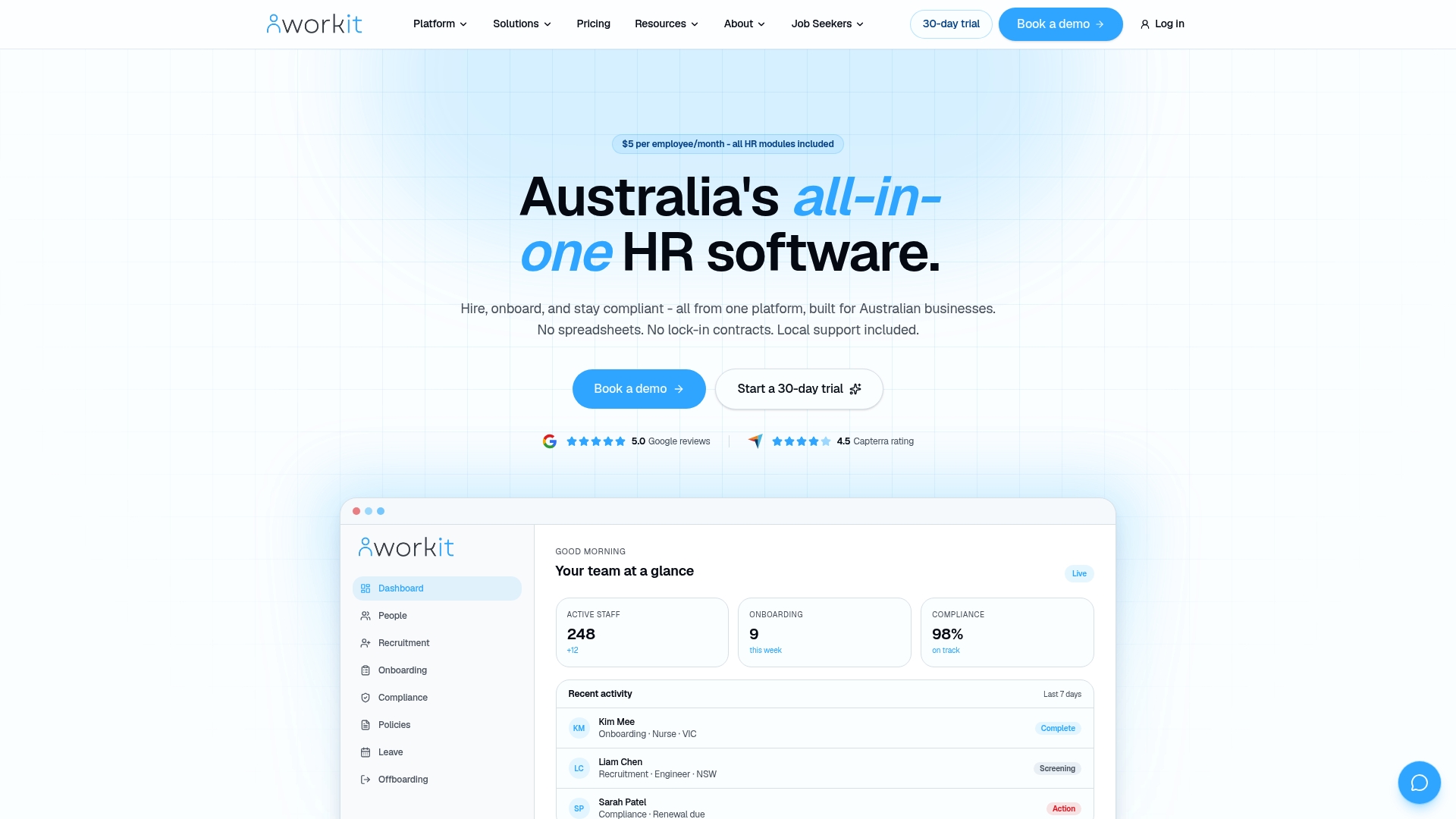
Where most HR teams are juggling spreadsheets, email chains, and separate provider portals, Workit centralises consent collection, check status tracking, and document storage so your team always knows where each candidate stands. Every module is included, local support is available when you need it, and the platform is built around Australian law, not adapted from an overseas product.
Ready to see how it works for your team? Book a demo and get a walkthrough tailored to your industry and hiring volume.
Key takeaways
Compliant background screening in Australia requires matching specific checks to role requirements, obtaining written consent, and assessing results against the inherent demands of the job, not as a blanket pass or fail.
| Point | Details |
|---|---|
| Baseline checks for every hire | VEVO and identity verification are mandatory for all candidates, regardless of role. |
| Role-specific checks | National Police Checks, WWCC, and credit checks apply only where the role requires them. |
| Consent before every check | Written, informed consent must be obtained before initiating any background check. |
| Assess findings fairly | Criminal history must be assessed against inherent job requirements; candidates must have a chance to respond. |
| Workit for compliance tracking | Workit centralises consent, check status, and documentation for Australian employers at $5 per employee per month. |
FAQ
What does background screening mean?
Background screening is the process of verifying a job candidate’s identity, legal right to work, qualifications, and criminal history before employment. In Australia, it is governed by the Privacy Act 1988 and relevant anti-discrimination legislation.
How do you run a background check on someone in Australia?
Obtain the candidate’s written consent, then use government portals such as VEVO for work rights and the AFP or an ACIC-accredited provider for a National Police Check. Role-specific checks like WWCC are managed through state and territory bodies.
What shows up on a background screening report?
Results typically include criminal history findings, identity confirmation, work rights status, employment history, and qualification verification. What appears depends on which checks were requested and the candidate’s individual record.
What causes a red flag on a background check?
Common red flags include undisclosed criminal convictions relevant to the role, inability to verify work rights via VEVO, discrepancies in employment history or qualifications, and an expired or missing WWCC for child-related roles. Each finding must be assessed against the specific requirements of the position before any hiring decision is made.