

Employee lifecycle management stages: a practical guide for HR
TL;DR:
- Most Australian HR teams typically follow a six-stage employee lifecycle model, which covers attraction, recruitment, onboarding, development, retention, and separation. The widely used six-stage model aligns with legal compliance and is manageable without dedicated analysts, making it suitable for most businesses. Implementing clear ownership, measuring process and experience KPIs, and automating documentation are key to effective lifecycle management.
Most Australian HR teams are working with either a 6-stage or 7-stage model. The six stages — attraction, recruitment, onboarding, development, retention, and separation — suit the majority of Australian organisations. The seven-stage version adds a recognition or advocacy stage between retention and separation, which works well for larger teams where employee experience programmes are already mature.
Quick answer:
- 4 stages (attract, hire, develop, exit): minimal, suits very small businesses or early-stage startups
- 5 stages (add onboarding as a distinct phase): better for teams with compliance obligations
- 6 stages (add retention/engagement): the recommended model for most Australian employers
- 7 stages (add recognition or advocacy): suited to enterprise teams with dedicated EX programmes
Recommended model: the 6-stage model. It maps cleanly to Fair Work compliance checkpoints, covers the full employment relationship, and is manageable for HR teams without a dedicated lifecycle analyst.
TL;DR — three quick next steps:
- Map your current processes against the six stages and identify gaps
- Assign a named owner to each stage (HR, hiring manager, or payroll)
- Run a 6–8 week onboarding pilot with one role or team to prove ROI before scaling
Table of Contents
- What the employee lifecycle is and why different models exist
- Why a structured employee lifecycle strategy pays off
- How do the 4, 5, 6 and 7-stage models compare?
- Stage-by-stage playbook: goals, activities, KPIs and best practices
- Onboarding is your highest-impact stage: checklist and compliance notes
- How to design and roll out your lifecycle strategy
- Measuring success: KPIs, surveys and feedback cadence
- Australian compliance checklist for every lifecycle stage
- Key takeaways
- The part most HR teams get wrong
- Workit makes lifecycle management practical for Australian HR teams
- Useful sources and further reading
- FAQ
What the employee lifecycle is and why different models exist
The employee lifecycle is the sequence of stages an employee moves through from first becoming aware of your organisation to the day they leave it. It is the HR framework that sits behind every hiring decision, onboarding workflow, performance conversation, and offboarding process your business runs.
Different organisations use different stage counts for practical reasons, not because one model is objectively correct. A small business with a single HR generalist needs a model simple enough to manage without a dedicated team. A large enterprise running structured talent programmes needs enough granularity to assign clear ownership and track stage-level KPIs. Sector also plays a role: healthcare and construction employers with WHS obligations tend to expand the onboarding stage, while professional services firms often add a formal advocacy or alumni stage.
The common variants break down like this:
- 4 stages: attract, hire, develop, exit — minimal, fast to implement, limited measurement
- 5 stages: adds onboarding as a distinct phase, separating it from recruitment
- 6 stages: adds retention/engagement as a named stage, the most widely used model
- 7 stages: adds recognition or advocacy, suited to mature EX programmes
HR typically owns lifecycle mapping, but the work spans hiring managers (recruitment and onboarding), payroll and compliance teams (onboarding documentation, separation), and line managers (development and retention). Getting those owners aligned before you build the model is what makes the difference between a framework that lives in a document and one that actually runs.
Why a structured employee lifecycle strategy pays off
A structured approach to the employee lifecycle reduces time-to-productivity, improves retention, and closes compliance gaps that cost Australian businesses real money. Those three outcomes are not aspirational — they follow directly from having clear processes, named owners, and measurable checkpoints at each stage.
The onboarding stage is where the evidence is strongest. Structured onboarding increases initial engagement and reduces compliance gaps, particularly where digital document collection replaces paper-based processes. New starters who complete a consistent onboarding experience reach full productivity faster and are significantly less likely to leave within their first year.
Retention is the other high-stakes area. When employees move through a managed lifecycle with regular development conversations and clear recognition, voluntary turnover drops. The cost of replacing a mid-level employee in Australia typically runs to several months of salary once you account for recruitment, lost productivity, and onboarding time for the replacement. A lifecycle strategy that keeps one or two more people per year pays for itself quickly.
From a compliance perspective, the separation stage carries the most legal risk. Notice periods, final pay calculations, and record-keeping obligations under the Fair Work Act 2009 all require documented processes. Organisations without a named owner for the separation stage are the ones most likely to miscalculate final pay or miss a notice requirement.
Pro Tip: Track voluntary turnover by lifecycle stage, not just as a single annual figure. If most exits happen in the first 90 days or after 18 months, that tells you exactly which stage needs attention.
How do the 4, 5, 6 and 7-stage models compare?
Most Australian employers should use the 6-stage model. It covers the full employment relationship, maps to Fair Work compliance checkpoints, and is practical for HR teams without a dedicated lifecycle specialist. The 7-stage model is worth considering once your EX programme is mature enough to measure advocacy separately.
| Stage | 4-stage model | 5-stage model | 6-stage model | 7-stage model |
|---|---|---|---|---|
| Attraction | ✓ | ✓ | ✓ | ✓ |
| Recruitment | ✓ | ✓ | ✓ | ✓ |
| Onboarding | (part of hire) | ✓ | ✓ | ✓ |
| Development | ✓ | ✓ | ✓ | ✓ |
| Retention/engagement | (part of develop) | (part of develop) | ✓ | ✓ |
| Recognition/advocacy | — | — | — | ✓ |
| Separation | ✓ | ✓ | ✓ | ✓ |
The 7-stage variant adds recognition or advocacy as a distinct stage, which is valuable when you want to track referral rates, alumni engagement, or employer brand metrics separately from general retention.
Which model fits your organisation:
- 4 stages: fewer than 20 employees, no dedicated HR function, minimal compliance complexity
- 5 stages: growing SME with onboarding compliance obligations (WHS, TFN, right-to-work checks)
- 6 stages: most Australian businesses with a HR generalist or small HR team
- 7 stages: enterprise employers with structured EX programmes, high referral hiring, or alumni networks
Diagram note for designers: a simple left-to-right flowchart with six labelled boxes and directional arrows works well for internal presentations. Add a feedback loop arrow from separation back to attraction to show the lifecycle as continuous rather than linear.
Stage-by-stage playbook: goals, activities, KPIs and best practices
Each stage has a distinct goal, a set of core activities, and measurable KPIs. The table below maps the key metrics; the stage notes that follow give you the practical detail.
| Stage | Primary KPI | Secondary KPI | Lagging indicator |
|---|---|---|---|
| Attraction | Cost per applicant | Employer brand awareness | Quality of hire |
| Recruitment | Time-to-hire | Offer acceptance rate | 90-day retention |
| Onboarding | Time-to-productivity | Onboarding satisfaction score | 90-day voluntary turnover |
| Development | Training completion rate | Internal mobility rate | Performance rating distribution |
| Retention | eNPS (employee Net Promoter Score) | Voluntary turnover rate | Absenteeism rate |
| Separation | Time-to-backfill | Exit interview completion rate | Regrettable attrition rate |
Attraction
Goal: build a talent pipeline before you need it. Core activities include writing accurate job briefs, maintaining your careers page, building relationships with universities and industry bodies, and monitoring employer review platforms. In the Australian market, LinkedIn, Seek, and Indeed remain the dominant sourcing channels for most roles, while sector-specific boards (e.g. Ethical Jobs for not-for-profits, CareersInGov for public sector) deliver better quality for specialist hires.

Best practices: audit your job ads for inclusive language annually, track source-of-hire data so you know which channels deliver quality candidates, and brief hiring managers on realistic role expectations before a vacancy opens.
Recruitment
Goal: select the right person efficiently and compliantly. Core activities cover job posting, screening, automated candidate assessment, structured interviews, reference checks, and offer management. Offer acceptance rate is the clearest signal of whether your compensation and process are competitive.
Best practices: use a structured interview scorecard for every role, document selection decisions to support Fair Work compliance, and set a target time-to-hire by role level so hiring managers have a shared benchmark.
Onboarding
Covered in depth in the next section. The headline KPI is time-to-productivity; the most common failure point is the gap between offer acceptance and day one, where new starters receive no communication and arrive disengaged.
Development
Goal: grow capability and career clarity. Core activities include individual development plans, performance review cycles, access to training (formal and on-the-job), mentoring, and internal mobility conversations. Performance review stages should be tied to clear role expectations, not just annual ratings.
Best practices: set development goals at the 90-day mark, not the annual review; give managers a simple template for development conversations; track training completion rates by team to identify where investment is not landing.
Retention
Goal: keep your best people engaged. Core activities include regular one-on-ones, pulse surveys, recognition programmes, flexible work arrangements, and career pathing conversations. eNPS is the most widely used single metric for engagement health. For practical talent retention strategies, the research consistently points to manager quality and career clarity as the two strongest drivers.

Best practices: run a quarterly pulse survey of no more than five questions, act visibly on at least one piece of feedback each cycle, and train managers to have career conversations rather than leaving them to HR alone.
Separation
Goal: exit employees compliantly and preserve the relationship where possible. Core activities include resignation acceptance, notice period management, final pay calculation, exit interviews, knowledge transfer, and system access removal. Under the National Employment Standards, minimum notice periods range from one week (under one year of service) to four weeks (over five years), with an additional week for employees over 45 with at least two years of continuous service.
Best practices: complete exit interviews within the last week of employment, not after the person has left; assign a named owner for final pay reconciliation against the applicable Award or Enterprise Agreement; and document the offboarding process steps so nothing falls through the gaps when a manager is the one leaving.
Pro Tip: The most common offboarding failure is not the legal steps — it is knowledge transfer. Build a one-page handover template into your separation checklist and make it the outgoing employee’s first task, not their last.
Onboarding is your highest-impact stage: checklist and compliance notes
Onboarding is the single stage where investment pays back fastest. Industry feedback consistently identifies it as the highest-impact phase for setting time-to-productivity and long-term retention. Get it right and you reduce early attrition, close compliance gaps, and give new starters the confidence to contribute quickly. Get it wrong and you spend the next six months managing disengagement you created on day one.
The onboarding window runs from offer acceptance through to the 90-day mark. Practical checklists recommend pre-start, day one, week one, month one, and month two–three checkpoints to deliver a consistent experience.
Australian onboarding document checklist
| Document / action | When required | Notes |
|---|---|---|
| Signed employment contract | Before or on day one | Must reflect Award/EA conditions |
| Tax File Number (TFN) declaration | Day one | ATO requirement; payroll cannot process without it |
| Superannuation choice form | Within 28 days of start | Stapled super applies if no choice made |
| Right-to-work verification | Before start date | Passport, visa, or birth certificate + Medicare |
| WHS induction sign-off | Day one | Required under Work Health and Safety Act 2011 |
| Fair Work Information Statement | Day one | Legal requirement for all new employees |
| Casual Employment Information Statement | Day one (casual only) | Required for casual employees |
| Bank account details | Day one | For payroll setup |
| Emergency contact form | Day one | Standard HR record |
| Policy acknowledgements (code of conduct, IT, privacy) | Week one | Signed and filed |
Automating the collection of these documents removes the most common compliance gaps. Collecting 15 or more onboarding documents digitally reduces administrative errors and shortens time-to-productivity compared to manual paper processes. Pre-start digital workflows — where new starters complete forms before day one — mean HR and payroll are ready to go from the moment the person walks in.
Australian compliance reminders:
- Right-to-work checks must be completed before the employee starts, not after
- The Fair Work Information Statement must be given to every new employee; the Casual Employment Information Statement applies to casuals
- WHS induction is a legal obligation under the Work Health and Safety Act 2011; document it
- Superannuation choice must be offered within 28 days; if no choice is made, use the employee’s stapled fund via the ATO
- Keep employment records for seven years under the Fair Work Act 2009
For a detailed walkthrough of onboarding software best practices, including how to build pre-start workflows and automate document collection, Workit’s buyer guide covers the full checklist.
How to design and roll out your lifecycle strategy
The simplest rollout sequence is: map your current state, assign stage owners, select tools against clear criteria, run a pilot, then measure and scale. That sequence works whether you are starting from scratch or formalising processes that already exist informally.
Implementation steps for a 6–12 week pilot:
- Map current state (week 1–2): document what actually happens at each stage today. Interview two or three hiring managers and one or two recent new starters. Note where processes are undocumented, inconsistent, or owned by no one.
- Assign stage owners (week 2): name one person responsible for each stage. HR typically owns attraction, onboarding, and separation. Hiring managers own recruitment and early development. Line managers own retention and ongoing development.
- Select tools (week 2–3): evaluate HR software against the criteria below. Prioritise compliance features and document automation for Australian employers.
- Build the pilot (week 3–4): choose one role type or one team. Build the onboarding workflow end-to-end: pre-start documents, day-one checklist, 30-day check-in, 90-day review.
- Run the pilot (week 4–10): execute the process for two or three new starters. Track time-to-productivity and onboarding satisfaction scores.
- Measure and present (week 10–12): compare pilot results against your baseline. Present findings to leadership with a recommendation to scale.
Tool selection criteria for Australian employers:
- Australian payroll compliance (Award interpretation, STP Phase 2 reporting)
- Digital document collection and e-signature capability
- Pre-start workflow automation
- Fair Work record-keeping (seven-year retention)
- Reporting on stage-level KPIs
- Local support team with knowledge of Australian employment law
A compliance-focused HRIS that covers these criteria removes the need to manage compliance manually across multiple systems.
Pilot checklist:
- Named owner for each stage confirmed
- Onboarding document list finalised and loaded into the system
- Survey cadence set (pre-start, day 7, 90 days)
- Baseline metrics recorded (current time-to-productivity, 90-day turnover)
- Success criteria agreed with leadership before the pilot starts
Measuring success: KPIs, surveys and feedback cadence
Measure both process KPIs and experience KPIs. Process KPIs (time-to-hire, time-to-productivity, time-to-backfill) tell you whether your workflows are efficient. Experience KPIs (eNPS, onboarding satisfaction, exit interview themes) tell you whether your people are actually having a good time moving through those workflows. You need both.
The most actionable early feedback comes from short, targeted surveys at defined intervals rather than long annual engagement surveys. Pulse checks at pre-start, day seven, and the 90-day mark give you enough signal to fix problems before they become attrition.
Survey timing checklist:
- Pre-start (2–3 days before day one): confirm logistics, check for any concerns, set expectations. Three to five questions maximum.
- Day 7: first-week experience, clarity of role, quality of induction. Five questions maximum.
- 30-day check-in: manager relationship, workload, access to tools and information. Can be a structured conversation rather than a survey.
- 90-day review: overall onboarding experience, development goals set, likelihood to recommend the organisation (eNPS proxy). This is your primary onboarding quality metric.
- Exit interview: reasons for leaving, what would have changed the decision, what the organisation does well. Complete before the last day of employment.
Feedback governance:
- HR reviews survey results within 48 hours of each collection point
- Stage owners receive a summary report within one week
- Any score below a defined threshold (e.g. onboarding satisfaction below 7/10) triggers a follow-up conversation within five business days
- Quarterly review of aggregate data by HR leadership, with findings presented to the executive team
HR reporting software that surfaces these metrics in real time removes the manual aggregation work and makes it easier to spot trends before they become problems.
Australian compliance checklist for every lifecycle stage
Australian employment law creates specific obligations at each stage of the lifecycle. The checklist below covers the most common compliance requirements; always reconcile against the applicable Modern Award or Enterprise Agreement for your industry, and seek legal advice for complex situations.
Attraction and recruitment:
- Job ads must not discriminate on protected attributes under the Fair Work Act 2009 and relevant state anti-discrimination legislation
- Right-to-work verification must be completed before the employee starts work
- Keep records of selection decisions to support any future Fair Work inquiry
Onboarding:
- Issue the Fair Work Information Statement to every new employee on or before day one
- Issue the Casual Employment Information Statement to casual employees
- Complete WHS induction and document it; obligations sit under the Work Health and Safety Act 2011
- Collect TFN declaration and superannuation choice form within the required timeframes
- Verify right-to-work documents and retain copies
Engagement and development:
- The right to disconnect under the Fair Work Act 2009 means employees may reasonably refuse to monitor or respond to contact outside working hours; set communication expectations clearly during onboarding and in development conversations
- Performance management processes must be procedurally fair; document all formal performance conversations
Separation:
- Written notice of termination is required under the National Employment Standards; minimum periods range from one week to four weeks depending on length of service, plus one additional week for employees over 45 with at least two years of continuous service
- Casual service does not count toward continuous service for notice calculations
- Employers may pay in lieu of notice at the full rate of pay
- Final pay must reconcile with the applicable Award or Enterprise Agreement, including any accrued leave entitlements
- Employment records must be retained for seven years
Record-keeping:
- Pay slips must be issued within one working day of each pay period
- Employment records (pay, hours, leave) must be kept for seven years and be accessible for Fair Work inspection
For a step-by-step Fair Work compliance health check, Workit’s guide walks through each record-keeping obligation in plain language.
Local hiring channels for Australian employers:
- Seek and LinkedIn for most professional and trade roles
- Indeed for volume hiring
- Ethical Jobs for not-for-profit and social enterprise roles
- CareersInGov for public sector positions
- University careers portals for graduate programmes
- Industry associations (e.g. AHRI for HR roles) for specialist positions
Key takeaways
The 6-stage employee lifecycle model is the most practical framework for Australian employers, with onboarding as the highest-impact stage and compliance documentation as the non-negotiable foundation at every transition point.
| Point | Details |
|---|---|
| Choose the right model | Most Australian employers should use the 6-stage model; add a 7th stage only when your EX programme is mature enough to measure advocacy separately. |
| Prioritise onboarding | Onboarding drives time-to-productivity and early retention; digital document collection reduces compliance gaps and administrative errors. |
| Assign named owners | Each stage needs one named owner; without accountability, lifecycle processes stay in documents and never run. |
| Measure process and experience | Track both process KPIs (time-to-hire, time-to-productivity) and experience KPIs (eNPS, onboarding satisfaction) at defined survey intervals. |
| Workit for Australian teams | Workit covers onboarding automation, compliance tracking, and lifecycle reporting at $5 per employee per month, with all modules included. |
The part most HR teams get wrong
There is a gap between designing a lifecycle framework and actually running one. Most HR teams I see have a version of the model documented somewhere. The problem is not the model. It is the handover points.
The transition from recruitment to onboarding is where the most damage happens. A candidate accepts an offer, and then nothing happens for two weeks. No pre-start communication, no documents sent, no system access arranged. They arrive on day one to find their laptop is not ready and their manager is in back-to-back meetings. That experience sets the tone for everything that follows.
The second failure point is development. Organisations invest in onboarding, run a 90-day review, and then leave development entirely to the annual performance cycle. Twelve months is too long a gap. Employees who do not have a development conversation within their first six months are far more likely to start looking elsewhere by month nine or ten.
The fix for both is not a new framework. It is named ownership and a short checklist at each transition. Who is responsible for the pre-start communication? Who books the 90-day review? Who initiates the development plan conversation? When those questions have a named answer, the lifecycle runs. When they do not, it stalls.
My practical recommendation: before you invest in new tools or redesign your model, spend one hour mapping the handover points between each stage and writing down who owns each one. That single exercise will surface more improvement opportunities than any framework redesign.
Workit makes lifecycle management practical for Australian HR teams
Managing the employee lifecycle across six stages, multiple owners, and a stack of compliance obligations is genuinely complex work. Workit is built specifically for Australian businesses to handle exactly that, without the spreadsheets and without the hidden fees.
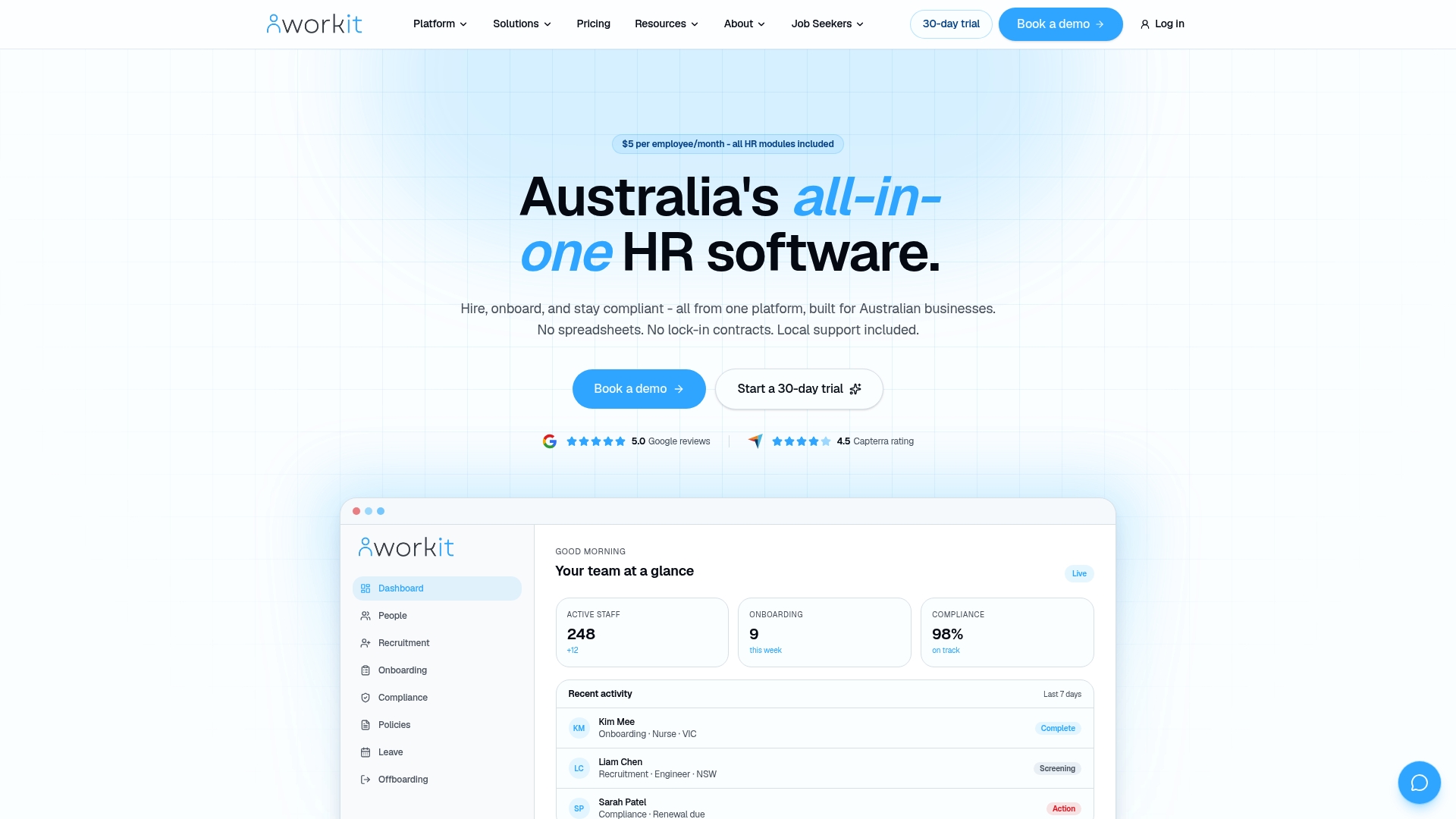
Workit covers the full lifecycle in one platform: digital onboarding workflows with pre-start document collection, compliance tracking aligned to Fair Work requirements, and reporting dashboards that surface your stage-level KPIs in real time. Every module is included at $5 per employee per month — no add-ons, no surprises.
- Onboarding: pre-start workflows, digital document collection, e-signatures, and automated reminders so nothing gets missed before day one
- Compliance: real-time tracking of record-keeping obligations, right-to-work status, and WHS induction sign-offs
- Reporting: lifecycle KPIs and executive dashboards built for Australian HR teams
If you are ready to move from a lifecycle framework on paper to one that actually runs, book a demo and see how Workit handles the compliance and automation work so your team can focus on the people side.
Useful sources and further reading
The sources below are the primary references for Australian employment law, HR practice, and lifecycle management. For specific legal questions, always consult the applicable Modern Award or Enterprise Agreement and seek advice from a qualified employment lawyer.
- Fair Work Ombudsman — primary source for National Employment Standards, notice periods, record-keeping obligations, and the Fair Work Information Statement
- Safe Work Australia — WHS induction requirements and workplace health and safety obligations
- Australian Human Rights Commission — anti-discrimination obligations in recruitment and employment
- Fair Work Act 2009 — s.117 Notice of termination — the legislative source for minimum notice periods
- Sprintlaw — employee onboarding legal checklist — practical legal checklist for Australian onboarding compliance
- Workit — employee onboarding software — product page for onboarding automation and pre-start workflows
- Workit — onboarding buyer guide — evaluation criteria and implementation tips for onboarding software
Note: Award and Enterprise Agreement obligations vary by industry and role. Always reconcile final pay, notice periods, and leave entitlements against the specific instrument that applies to your employees. This article is general information, not legal advice. Confirm current requirements with the Fair Work Ombudsman or a qualified employment lawyer for your specific situation.
FAQ
What are the most commonly used employee lifecycle stages?
The most widely used model has six stages: attraction, recruitment, onboarding, development, retention, and separation. Some organisations use a 7-stage version that adds a recognition or advocacy stage between retention and separation.
What are the 7 stages of the employee life cycle?
The 7-stage model covers attraction, recruitment, onboarding, development, retention, recognition (or advocacy), and separation. The seventh stage is most useful for enterprise employers tracking referral hiring, alumni engagement, or employer brand metrics as distinct outcomes.
What are the 4 phases of the employment cycle?
A simplified 4-phase model groups the lifecycle into attract, hire, develop, and exit. This works for very small businesses but lacks the granularity needed for compliance-heavy onboarding or structured retention programmes.
What notice period is required when terminating an employee in Australia?
Under the National Employment Standards, minimum notice periods range from one week (under one year of service) to four weeks (over five years of service). Employees over 45 with at least two years of continuous service receive one additional week. Casual service does not count toward continuous service for this calculation.
How does Workit support employee lifecycle management?
Workit covers onboarding automation, compliance tracking, and lifecycle KPI reporting in one platform, built specifically for Australian businesses. All modules are included at $5 per employee per month, with no hidden fees.