

25 exit interview questions for HR teams in Australia
TL;DR:
- Effective exit interviews use neutral interviewers, open-ended questions, and aggregated responses to identify organizational trends. Conduct them promptly before the employee’s final week, ensuring participation is voluntary and responses are kept confidential. They help uncover root causes of turnover, improve policies, and reduce legal risks through anonymous trend analysis.
The most effective exit interviews use a neutral interviewer, open-ended job-focused questions, and aggregated responses to identify trends. Run them before the departing employee’s final week, keep participation voluntary, and never use the session to pressure, blame, or to gather information about protected attributes.
Quick checklist before you start:
- Schedule the interview shortly after resignation, ideally 1–2 weeks before the last day
- Assign a neutral HR professional or external facilitator, not the employee’s direct manager
- Confirm participation is voluntary and explain how notes will be stored and used
- Provide a short privacy notice before the first question
- Take written notes or summaries only; do not record without written consent
- Keep raw notes restricted to authorised HR personnel
Copyable core question list:
- What prompted you to start looking for a new role?
- What was the main factor in your decision to leave?
- How would you describe your day-to-day workload and responsibilities?
- Did you feel your skills were well used in this role?
- How would you describe your working relationship with your manager?
- Did you feel supported and recognised in your team?
- How would you describe the culture here?
- Did you feel psychologically safe raising concerns at work?
- Did your pay and benefits meet your expectations?
- Were there career development or training opportunities you needed but didn’t have access to?
- Were there any processes, tools or systems that made your work harder than it needed to be?
- Is there anything about this role or organisation you’d like leadership to know?
- What would have changed your decision to leave?
Warning: Never ask about age, religion, health status, sexual orientation, pregnancy, union activity, or any other protected attribute. If the employee raises allegations of bullying, harassment, or a workplace health and safety breach, treat it as a live issue and follow your investigation policy immediately, regardless of the fact they are leaving.
Table of Contents
- Why exit interviews matter for retention, culture and risk
- The best exit interview questions, grouped by purpose
- How and when to run the exit interview
- Australian legal and ethical considerations you need to know
- How to turn exit interview responses into change
- Copyable exit interview script and template
- Key takeaways
- What most HR teams get wrong about exit interviews
- How Workit helps Australian HR teams run and act on exit interviews
- Useful Australian sources and further reading
- FAQ
Why exit interviews matter for retention, culture and risk
Exit interviews are valuable because they surface root causes that improve retention and inform policy decisions. A single departing employee’s comments are an anecdote. Fifty responses coded into themes are a business case.
The Australian Bureau of Statistics reported that 2.1 million Australians left or lost a job in the year to February 2025. That scale of movement means most Australian employers are sitting on a recurring source of organisational intelligence they are not fully using.
The strategic value is cumulative. Anonymise and aggregate responses into trend reports rather than circulating attributed comments, and you shift the conversation from “who said what” to “what needs to change.” According to business.gov.au, exit interviews help employers identify morale and process issues, and improve recruitment, selection, and training.
Outcomes you can expect from a well-run programme:
- Identify the real reasons staff leave (pay, progression, management, culture)
- Benchmark your compensation against what the market is offering
- Pinpoint managers or teams with recurring issues before they become systemic
- Improve onboarding and role design based on what new starters actually experience
- Reduce legal and reputational risk by catching serious allegations early
- Build a credible evidence base for leadership investment in people programmes
Statistic: Common drivers of staff leaving in Australia include pay, limited career progression, and issues with direct management or culture — making these the three themes most worth probing in every exit conversation.
The best exit interview questions, grouped by purpose
Each group below starts with a one-line intent so you know what you’re listening for. Follow-up prompts are included to push past surface answers. Sample phrasing is neutral and avoids protected attributes, keeping you on the right side of Australian anti-discrimination law.
1. Reasons for leaving
Listen for: the trigger event versus the underlying cause. The stated reason is rarely the whole story.
- What first prompted you to consider other opportunities?
- Was there a specific event or moment that made you decide to leave?
- Follow-up: “Can you walk me through what happened and how it was handled?”
- What would have needed to change for you to stay?
2. Role and responsibilities
Listen for: misalignment between the job description and the actual role, workload issues, and skill underuse.
- How well did your day-to-day work match what you expected when you joined?
- Did you feel your skills were fully used in this role?
- Follow-up: “Were there tasks you felt over- or under-qualified for?”
- Were your workload and priorities manageable?
3. Manager and team
Listen for: specific behaviours, not personality judgements. Probe for examples.
- How would you describe your working relationship with your direct manager?
- Follow-up: “Can you give me a specific example of something that worked well, or didn’t?”
- Did you feel your contributions were recognised?
- How well did your team collaborate and support each other?
4. Culture and wellbeing
Listen for: psychological safety, inclusion, and whether stated values matched lived experience.
- How would you describe the culture here in your own words?
- Did you feel comfortable raising concerns or disagreeing with decisions?
- Did you feel respected and included in your team and the broader organisation?
5. Career, training and progression
Listen for: unmet development expectations and gaps in your learning and development offering.
- Did you have access to the training or development you needed to grow in this role?
- Follow-up: “Was there a specific skill or qualification you wanted to pursue that wasn’t supported?”
- Did you have a clear picture of your career path here?
6. Pay and benefits
Listen for: whether pay was the primary driver or a proxy for feeling undervalued.
- Did your remuneration meet your expectations for this role?
- Were there specific benefits you needed that weren’t available?
- Follow-up: “Was pay the main factor, or was it part of a broader picture?”
7. Processes, tools and systems
Listen for: operational friction that HR can escalate to operations or IT.
- Were there any tools, systems or processes that made your work harder than it needed to be?
- Is there anything about how work gets done here that you’d change?
8. Handover and risk
Listen for: knowledge gaps, unfinished work, and anything that needs immediate attention.
- Is there anything about your role or current projects that you think leadership should know before you leave?
- Are there relationships with clients, suppliers or stakeholders that need a warm handover?
9. Open feedback and final suggestions
Listen for: anything that didn’t fit the earlier questions, and the employee’s overall sentiment.
- Is there anything else you’d like to share that we haven’t covered?
- What’s one thing you’d tell your replacement to help them succeed in this role?
- What’s one thing you’d change about this organisation if you could?
Short survey variant (3–5 pulse questions for when a full interview isn’t possible):
- On a scale of 1–5, how satisfied were you with your role overall?
- What was the primary reason for your decision to leave? (Multiple choice: pay, career progression, management, culture, personal reasons, other)
- Did you feel supported in your development here? (Yes / No / Somewhat)
- Would you recommend this organisation as a place to work? (Yes / No / Maybe)
- Is there one thing the organisation could do to improve the employee experience?
Face-to-face or video interviews are preferred for depth; short surveys work well as a supplement when timing or geography makes a full conversation difficult.
How and when to run the exit interview
Schedule the interview shortly after the employee hands in their resignation, ideally before their final week. Leaving it to the last day risks a sanitised conversation, farewell distractions, and a rushed process that yields little useful data.

Who should conduct it? A neutral HR professional or an external facilitator. The employee’s direct manager should not run the interview with their own direct report. A neutral interviewer yields more candid feedback and removes the power dynamic that makes honest answers unlikely.
Pre-interview checklist:
- Send a calendar invite with a clear subject line (e.g. “Exit conversation with [HR name]”)
- Attach or read aloud a short privacy notice explaining how notes will be stored and used
- Confirm the session is voluntary and the employee can decline or stop at any time
- Block 30–60 minutes; most interviews run 30–45 minutes
- Prepare your question set in advance; don’t wing it
- Take written notes during the session; do not audio-record without written consent
Format comparison:
| Format | Strengths | Limitations |
|---|---|---|
| In-person | Deeper insight, non-verbal cues, easier to probe | Resource-intensive, lacks anonymity, requires skilled interviewer |
| Phone or video | Accessible for remote staff, lower cost | Harder to read non-verbal signals |
| Written survey | Anonymous, scalable, easy to aggregate | Less depth, no follow-up possible |
| Combined (interview + survey) | Depth and breadth, higher response rate | Requires more coordination |
Pro Tip: Send a short anonymous survey 24–48 hours before the face-to-face interview. Employees who have already answered questions in writing tend to be more candid in the conversation that follows, because they’ve had time to reflect.
Australian legal and ethical considerations you need to know
Exit interviews are not legally mandatory under the Fair Work Act 2009, but they are recommended as good practice. Participation must always be voluntary. Running a compliant interview means knowing what to avoid asking and what you must act on if it comes up.
Topics to avoid and why:
- Age, religion, ethnicity, sexual orientation, pregnancy, disability, or union activity — asking about protected attributes breaches anti-discrimination law at both federal and state level
- Health or medical history — invasive and not relevant to the employment relationship ending
- Details about the new employer — employees have no obligation to disclose this; pressing for it creates legal exposure
- Requests for waivers or releases — an exit interview is not the place to seek sign-off on entitlements or confidentiality agreements; that is a separate legal process
- Performance criticism — the interview is for feedback, not a final performance review
Recording rules: Recording an exit interview without informed, written consent may breach state listening and surveillance laws. Even with consent, written notes and summaries are safer for privacy and legal discovery purposes. Treat exit interview records as sensitive personnel data and restrict raw, identified notes to authorised HR personnel.
Legal reminder: Exit interviews are voluntary. Never link participation to a reference, final pay, or any other entitlement. If you do, you risk a coercion claim under the Fair Work Act 2009. Keep the session entirely separate from offboarding entitlements.
If serious allegations surface: If a departing employee raises concerns about bullying, sexual harassment, or a WHS breach, the employer has a duty to investigate regardless of the fact they are leaving. Note the allegation, refer it to the appropriate investigation workflow, and apply confidentiality controls. Sprintlaw’s guidance on exit interviews and business.gov.au are useful starting points for understanding your obligations.

How to turn exit interview responses into change
The value of exit feedback comes from aggregated trends and prioritised action, not individual anecdotes. One person’s comment about their manager is a data point. Ten people saying the same thing is a finding that warrants a response.
Step-by-step analysis process:
- Anonymise raw notes immediately after each interview; remove names and identifying details before any analysis
- Code responses into themes (reasons for leaving, management, culture, pay, development, processes)
- Quantify frequency: how many respondents mentioned each theme in the last quarter or year?
- Build a short trend report for leadership: top three themes, frequency, and a recommended action for each
- Track interventions: record what changed and measure whether turnover or engagement scores shift in the following period
Theme coding template:
| Theme | Sample response | Frequency | Impact rating | Recommended action |
|---|---|---|---|---|
| Management behaviour | “Feedback was inconsistent” | High | High | Manager coaching programme |
| Career progression | “No clear path forward” | High | Medium | Career pathway framework |
| Pay competitiveness | “Below market rate” | Medium | High | Compensation benchmarking review |
| Workload | “Constantly under-resourced” | Medium | Medium | Headcount review |
| Processes and tools | “Outdated systems slowed me down” | Low | Low | IT audit |
Effective labour resource management often reveals that the same operational friction points appear repeatedly in exit feedback, making them worth prioritising even when individual comments seem minor.
Checklist for responding to serious claims:
- Document the allegation in a secure, restricted file immediately
- Refer to your workplace investigation policy and assign a case owner
- Apply confidentiality controls: limit access to those directly involved in the investigation
- Do not share the allegation in aggregate reporting without appropriate de-identification
- Follow up with the relevant manager or leadership team once the investigation concludes
Copyable exit interview script and template
Use the opener below verbatim or adapt it to your organisation’s tone. The script covers the privacy notice, voluntary participation, and time box that Sprintlaw recommends for a legally sound start.
Script variant 1: In-person or video interview
Work through the grouped questions from Section 3, taking written notes. Close with:
Script variant 2: Email or survey follow-up
Fillable template for HR records
Employee exit interview record
- Role: _______________
- Department: _______________
- Tenure: _______________
- Interview date: _______________
- Interviewer: _______________
- Format: In-person / Video / Survey
Core questions and notes:
- Primary reason for leaving: _______________
- Manager and team experience: _______________
- Role fit and development: _______________
- Culture and wellbeing: _______________
- Pay and benefits: _______________
- Processes and tools: _______________
- Final suggestions: _______________
Serious allegations raised? Yes / No — if yes, refer to investigation workflow immediately.
Offboarding tasks confirmed: Equipment return / System access revoked / Final pay processed / Knowledge transfer complete
Integration note: Log the completed record in your HRIS or offboarding software immediately after the interview. If a serious allegation was noted, open a separate investigation workflow and restrict access to the exit record until the matter is resolved. Structured exit interview templates help SMEs obtain comparable feedback across cohorts, making trend analysis far more reliable over time.
Key takeaways
Effective exit interviews depend on neutral interviewers, voluntary participation, and anonymised aggregation — without all three, the data you collect will be incomplete or unusable.
| Point | Details |
|---|---|
| Timing and interviewer | Schedule before the final week and use a neutral HR professional, not the departing employee’s manager. |
| Legal compliance | Exit interviews are voluntary under Australian law; never link participation to references or final entitlements. |
| Serious allegations | Bullying, harassment, or WHS disclosures must trigger an investigation immediately, even after the employee leaves. |
| Aggregate for action | Anonymise and code responses into themes; one comment is anecdote, repeated themes are a business case for change. |
| Workit for offboarding | Workit’s offboarding workflows and reporting tools centralise exit records, anonymise data, and surface trends for Australian HR teams. |
What most HR teams get wrong about exit interviews
The conventional wisdom is that exit interviews are primarily a retention tool. Run them well, the thinking goes, and you’ll understand why people leave and fix it. That framing is right but incomplete, and it leads most teams to focus on the wrong thing.
The bigger risk is treating exit feedback as a performance review in reverse. HR teams that use the session to probe for specific names, validate a manager’s version of events, or gather ammunition for a disputed termination are misusing the process entirely. The employee has nothing to gain from candour in that environment, and the organisation ends up with sanitised answers that confirm whatever it already believed.
The non-obvious insight is this: the most valuable exit interviews are the ones where nothing dramatic is said. A pattern of “I just got a better offer” responses, consistently across one team or one tenure band, tells you something precise about compensation or career pathing that no single dramatic resignation ever could. That’s the aggregation principle in practice, and it’s why anonymised trend reporting matters more than any individual conversation.
For small teams and SMEs, there’s a real tension between anonymity and usefulness. If only three people leave in a year, even anonymised themes can be traced back to individuals. The practical answer is to aggregate across a longer time window (12–18 months) or combine results with pulse survey data so no single response is identifiable. Protecting anonymity isn’t just an ethical obligation; it’s what makes future employees willing to be honest when their turn comes.
How Workit helps Australian HR teams run and act on exit interviews
Running a consistent exit interview process is straightforward in theory and surprisingly hard to maintain in practice, especially when HR teams are managing offboarding across multiple roles at once. Workit is built specifically for Australian businesses, and its offboarding module gives HR teams a single place to manage the whole process: templated question sets, secure notes storage, anonymised reporting, and HR metrics dashboards that surface trends without exposing individual responses.
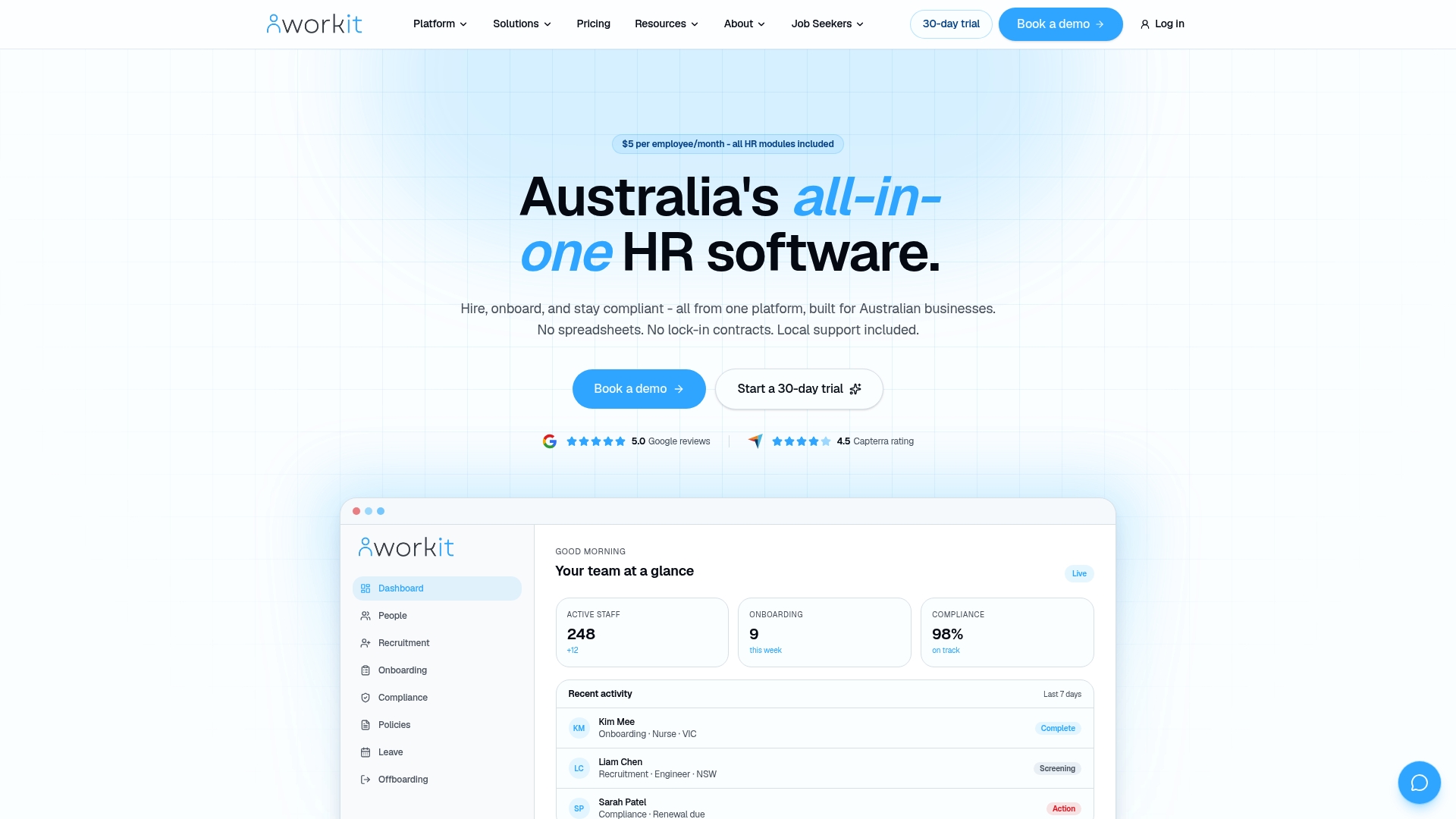
At $5 per employee per month with all modules included, Workit removes the need for separate tools or manual spreadsheet tracking. The offboarding workflows cover everything from equipment return checklists to final pay confirmation, so nothing falls through the gaps during a busy handover period. Local support from a team that understands Australian compliance requirements means you get practical help quickly, not a generic offshore response.
If exit feedback is pointing to broader HR process gaps, Workit’s HR reporting tools let you build trend reports for leadership without manual data wrangling. Ready to see how it works for your team? Book a demo, and a local Workit specialist will walk you through the offboarding and reporting features in under 30 minutes.
Useful Australian sources and further reading
- business.gov.au — End employment: The Australian Government’s practical guidance on ending employment, including exit interview purpose and employer obligations.
- Sprintlaw — Conducting exit interviews: Legal essentials for Australian employers: what to ask, what to avoid, recording rules, and how to handle serious allegations.
- NSW Public Service Commission — Exit interviews: Best practice guidelines for conducting and acting on exit interviews, including principles for confidentiality, question design, and reporting.
- MyHR Works — Exit interviews for Australian employers: Practical tips on timing, format, and interviewer choice for Australian HR teams.
- Scalesuite — The Exit Interview Toolkit: Scripts, templates, and an analysis framework designed for Australian SMEs.
- Workit — Offboarding software: Workit’s offboarding module for Australian HR teams, covering workflows, templates, and secure record-keeping.
FAQ
What are the most important exit interview questions to ask?
Focus on the primary reason for leaving, the employee’s experience with their manager, whether they felt their career was progressing, and what the organisation could do differently. These four areas cover the most common drivers of turnover in Australia: pay, progression, management, and culture.
What should an exit interview include?
A short privacy notice, confirmation that participation is voluntary, and a structured set of open-ended questions covering reasons for leaving, role fit, manager and team experience, culture, pay, and final suggestions. The NSW Public Service Commission recommends limiting the number of questions to maintain response quality.
What’s the best way to answer an exit interview as an employee?
Be honest but constructive. Focus on specific situations rather than personal criticism, and frame feedback around what the organisation could improve. Avoid burning bridges; many industries in Australia are smaller than they seem.
What should you avoid saying in an exit interview?
Avoid vague generalisations, personal attacks on colleagues, and anything you wouldn’t want attributed to you in writing. As an employer running the interview, avoid asking about protected attributes, health details, or the employee’s new employer.
Are exit interviews legally required in Australia?
No. Exit interviews are not mandatory under the Fair Work Act 2009. They are recommended as good practice, and participation must always be voluntary. Never link attendance to a reference, final pay, or any other entitlement.