

Policy management best practices: an audit-ready checklist
Eight practices separate a policy library that survives an audit from one that collapses under the first hard question: a single source of truth, one named owner per policy, clear audience-tailored writing, version control with an immutable archive, version-linked employee attestations, scheduled reviews with defined triggers, role-based distribution, and automation for reminders and reporting. Each one closes a specific gap auditors and regulators look for.
- Single source of truth. Scattered copies in shared drives and email threads are the number one reason organisations fail acknowledgement checks.
- One named owner and approver. Without a person accountable for a policy, nobody updates it when the law changes.
- Clear, audience-tailored writing. A safety policy written for lawyers gets skimmed, not followed.
- Version control and an immutable archive. Never overwrite a current version — keep every superseded copy retrievable.
- Version-linked attestations. An acknowledgement tied to an old version proves nothing about the current one.
- Scheduled reviews with real triggers. Set a review date at approval, and a trigger for regulatory change, incident, or restructure.
- Role-based distribution. Send people the policies relevant to their job, not everything at once.
- Automation for reminders and reporting. Manual chasing is where most policy programs quietly fail.
Get these eight right and you have converted a folder of documents into something an auditor can actually rely on.
Key Takeaways
Effective policy management works because it converts written documents into evidenced controls through named ownership, version-linked attestations, and measurable completion tracking.
| Point | Details |
|---|---|
| Centralise everything | Consolidate every policy into one repository with owner, version, and review date metadata attached. |
| Assign named accountability | Give every policy one owner and one approver recorded by name, not by department. |
| Link acknowledgements to versions | Tie every attestation to a specific version and timestamp so old signatures cannot cover new obligations. |
| Automate distribution and reminders | Use role-based rollout and automated escalation to fix the most common failure point: manual chasing. |
| Choose audit-ready software | Workit bundles policy management, version history, and attestation tracking into its $5 per employee per month platform. |
Table of Contents
- Policy management best practices in detail
- The policy lifecycle from audit to retirement
- Ownership and governance: who is accountable when things go wrong
- Version control and attestations that survive an audit
- Getting policies to the right people, fast
- Which automation features actually change outcomes
- What auditors actually ask to see
- Where policy programs usually fall apart
- A 90-day plan to bring your policies under control
- Assessing risk before you write a single policy
- Aligning policies with the rules that actually govern your business
- Getting staff to actually read and follow policies
- Handling exceptions and violations without undermining the policy
- Using feedback and metrics to keep improving
- Lessons from bringing policy management in-house
- How Workit brings your policy library up to audit standard
- Sources
- FAQ
Policy management best practices in detail
Turning that checklist into daily practice means fixing the mechanics behind each item. The gap between “we have a policy on that” and “we can prove it was followed” is almost always a mechanics problem, not a writing problem.
Set up a single source of truth with real metadata
A single source of truth is not just one folder. It is one platform where every policy carries the same metadata: title, owner, approver, version number, effective date, next review date, and status (current, under review, or archived). Without that metadata, nobody can answer “is this the current version?” in under thirty seconds, which is exactly the question an auditor asks first.
Standardise a template with these fields before you migrate a single document:
- Purpose — one sentence stating what the policy governs.
- Scope — who it applies to (all staff, a specific role, contractors).
- Owner — the person accountable for content accuracy.
- Approver — the person or committee who signs off on changes.
- Version number — following a consistent numbering convention.
- Effective date and next review date — both visible on the document itself, not buried in a separate spreadsheet.
Pro Tip: Put the review date in the document header, not just in your tracking system. When someone opens the PDF six months from now, they should know instantly whether it is still current.
Define approval flows that hold up under scrutiny
A workable approval flow looks like this: the owner drafts or updates the content, a subject-matter expert or legal reviewer checks it, the named approver signs off, and the policy is published with a timestamped record of who approved what and when. Skipping the record-keeping step is the most common shortcut, and it is the first thing a six-step GRC build for Australian businesses flags as a governance weakness.
Use a version numbering convention that means something
Major versions (2.0, 3.0) should represent substantive changes to obligations or scope. Minor versions (2.1, 2.2) cover wording fixes, formatting, or clarifications that do not change what someone must do. Every version needs a one-line change summary, so a reviewer six months later can see what changed without reading the whole document again.
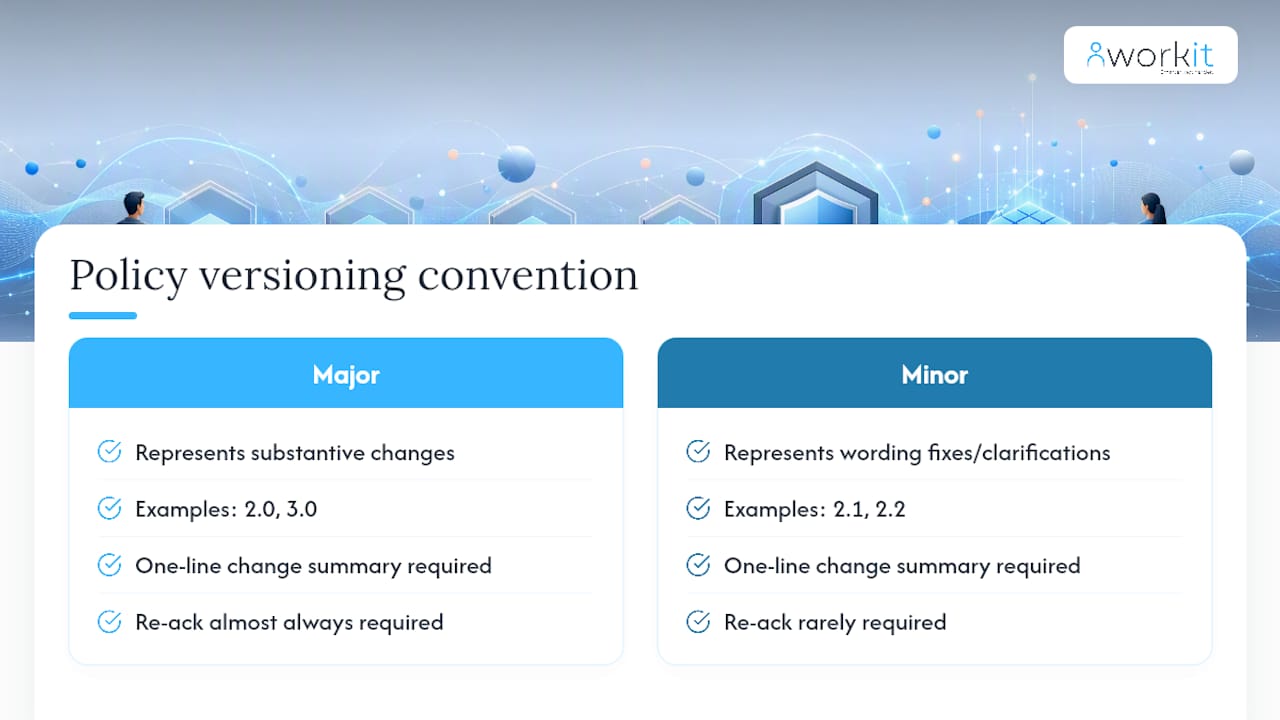
This distinction matters for re-acknowledgement. A minor edit rarely needs a fresh signature. A major version almost always does, because an acknowledgement tied to an earlier version does not prove acceptance of new obligations. Set a re-acknowledgement window, typically 14 to 30 days from publication, and track who has and has not signed by that deadline.
Map policies to roles, not to everyone
Blanket “read this” emails to the whole company are how policy fatigue starts. A warehouse safety policy means nothing to someone in finance, and a data handling policy means nothing to someone on the loading dock. Map each policy to the roles or teams it actually governs, and only notify those people.
A short change-notification template works better than a long email: state what changed, why, what the person needs to do (read, acknowledge, complete training), and the deadline. Keep it to four lines. People act on short notifications faster than long ones, and shorter notices also make it easier to spot who has not responded yet.
The policy lifecycle from audit to retirement
Treat policy management as a repeating cycle, not a one-off project. Six stages carry a document from first draft to formal retirement, and skipping any one of them is where control breaks down.
- Audit and register. List every existing document and tag its status as current, archived, or missing entirely. Most organisations discover duplicates and orphaned drafts at this stage.
- Draft with SME and legal input. The policy owner writes the first pass, then a subject-matter expert and, where relevant, legal counsel review it before it goes further.
- Stakeholder review. Circulate the draft to affected teams for practical feedback before locking the wording.
- Approve and publish. The named approver signs off, and the system timestamps the approval record automatically.
- Distribute and log acknowledgement. Push the policy to mapped roles and record who has acknowledged which version.
- Monitor, review, and retire. Track completion rates on a dashboard, hold formal reviews on schedule, and retire policies that are no longer relevant with a documented reason.
This sequence mirrors the repeatable build many GRC programs follow: consolidate, assign ownership, standardise, distribute, capture evidence, then review. Skip the audit stage and you inherit every duplicate and orphaned draft the last reorganisation left behind.
Ownership and governance: who is accountable when things go wrong
Every policy needs exactly one accountable owner and one approver, recorded by name, not by department. “HR owns this” is not an answer an auditor accepts. “Sarah Chen, People and Culture Manager, approved version 3.1 on 14 March” is.
- Record the owner and approver on the document itself, not just in a separate governance register that someone has to cross-reference.
- Build an escalation route for disputed content. If a manager disagrees with a policy’s application, define who resolves it: usually the owner first, then a governance committee if unresolved.
- Set review triggers beyond the calendar date. A change in Fair Work legislation, a safety incident, or a restructure should all trigger an interim review regardless of the scheduled date. Distribution and acknowledgement remain the most common failure points for Australian organisations, which is exactly why triggers need to be documented, not assumed.
- Document every decision, including the decision not to change something. If a review concludes the policy stays as is, record that outcome with a date and the reviewer’s name.
For AFSL holders and other regulated entities, this record-keeping is not optional paperwork. ASIC guidance expects documented compliance measures and evidence of training and supervision, not just a policy that exists somewhere. A governance record that shows who approved what, and when a review happened, is the difference between a defensible position and a guess during an investigation.
Version control and attestations that survive an audit
The rule is simple to state and easy to get wrong in practice: never overwrite a current version. Every update creates a new version number, and the old one moves to an archive that stays retrievable, not deleted.
- Use major and minor versioning consistently, with a short change summary attached to every version, however small the edit.
- Link every acknowledgement to a specific version and timestamp. A signature against version 2.0 says nothing about whether someone accepted version 3.0’s new obligations.
- Set retention periods with legal input. Employment-related policies commonly use a seven-year baseline, though regulated sectors may need longer, so confirm the figure with counsel rather than assuming it applies universally.
- Manage transition windows deliberately. Give staff a defined period, commonly two to four weeks, to acknowledge a new major version before the old one is marked superseded in reporting.
Policy management software that pairs version control with attestations creates a closed accountability loop: what was approved, by whom, which version applied, and who acknowledged it and when. That loop is what shortens audit preparation from weeks of document hunting to a report you can generate in minutes.
Getting policies to the right people, fast
Findability fails long before acknowledgement does. If staff cannot locate the policy that applies to them, they cannot be expected to follow it.
- Map policies to roles or teams, not to the whole organisation by default. A finance-specific expenses policy belongs with finance, not in a general staff broadcast.
- Tag every document with metadata: department, policy type, effective date, and review status, so search actually returns the current version first.
- Write a two-line abstract for every policy that answers “what does this mean for you,” placed above the full text. Most people read the abstract and skip the rest, which is fine if the abstract is accurate.
- Stage notifications instead of blasting everyone at once. Roll a new policy out to one team, confirm the distribution logic works, then expand. This also reduces alert fatigue, which is the quiet reason completion rates drop over time.
Which automation features actually change outcomes
Not every feature in a policy management platform earns its place. A handful of capabilities do the heavy lifting, and the rest is convenience.
- Version locking with an immutable archive so nobody can quietly edit a published policy without creating a new version.
- Automated attestation requests with escalation rules that chase non-responders after a set number of days rather than relying on a manager to remember.
- Dashboards showing completion rates and overdue acknowledgements by team, so compliance staff can intervene before a review, not after.
- Integrations with HRIS, learning management, and payroll systems to keep role mapping accurate as people change jobs or leave.
Pro Tip: If your organisation has fewer than fifty employees and a handful of policies, a well-structured shared drive with strict naming conventions can work for a while. Past that point, manual chasing becomes the single biggest point of failure, and dedicated software earns its cost quickly.
Deciding between an off-the-shelf policy module and a lighter manual setup usually comes down to headcount and audit exposure. Regulated sectors and anything above a few hundred staff should lean toward automation early, not after the first failed audit.
What auditors actually ask to see
Auditors rarely ask for the policy document itself. They ask for evidence that it was communicated, acknowledged, and reviewed on schedule.
- Acknowledgement completion by role, showing which teams have signed off on the current version and which have not.
- Overdue reviews, flagged against the scheduled review date set at approval.
- Version-linked acknowledgement records, proving that signatures correspond to the version currently in force, not a superseded one.
| Report | What it proves |
|---|---|
| Acknowledgement completion by role | Which teams have accepted the current policy version |
| Overdue review register | Policies past their scheduled review date |
| Version history with approvals | Who approved each version and when |
| Escalation log | How unresolved disputes or non-compliance were handled |
Use these same reports internally, not just for auditors.
Where policy programs usually fall apart
Four failures show up again and again, and each has a fast fix.
- Scattered duplicates across drives and inboxes. Run an immediate audit, consolidate into one repository, and archive everything else.
- No named owner. Start with your highest-risk policies (safety, code of conduct, data handling) and assign an owner within a week.
- Acknowledgements not linked to versions. Switch to version-specific attestations before your next audit cycle, not after.
- Over-notification causing alert fatigue. Move to role-based, staged rollouts instead of all-staff blasts for every update.
A 90-day plan to bring your policies under control
- Weeks 1 to 4: Audit every existing document, register its status, assign a named owner to each, and lock in a standard template.
- Month 2: Configure version control rules, set up role-based distribution, and pilot attestations with one team before wider rollout.
- Month 3: Roll out organisation-wide, switch on completion dashboards, publish the review calendar, and report the first set of metrics to leadership.
Pro Tip: Pick one visible quick win for month one, such as closing the acknowledgement gap on your code of conduct. A fast, measurable result builds the case for investing further in the rest of the rollout.
Track success against three numbers: percentage of policies with a named owner, percentage of staff acknowledgements linked to the current version, and number of overdue reviews closed out. Those three figures tell leadership more than a narrative update ever will.
Assessing risk before you write a single policy
Drafting a policy before understanding what it needs to control is how organisations end up with rules nobody follows. Before writing anything, map the specific risk the policy addresses: a workplace incident pattern, a regulatory gap, a new operational process introducing exposure that did not exist before.

Impact analysis should ask who the policy affects, what it costs them in time or process change, and whether existing policies already cover part of the ground. Overlapping policies confuse staff and create contradictions that surface during disputes, so checking against the existing register before drafting saves rework later.
For higher-risk areas, involve the people who will actually be affected before finalising the draft. A safety policy written without input from the floor staff who follow it daily tends to miss practical failure points that only show up once the policy is live. The same applies to data handling policies drafted without IT input, or leave policies drafted without payroll’s involvement.
Rank policies by risk level rather than treating them all as equally urgent. A code of conduct breach and a stationery ordering procedure do not carry the same consequence if ignored, and your review frequency, approval rigour, and acknowledgement requirements should reflect that difference. Building this risk lens in early also makes the ownership and governance decisions covered earlier in this article far easier to assign correctly the first time.
Aligning policies with the rules that actually govern your business
A policy that reads well but does not map to a specific legal or regulatory obligation is decoration, not compliance. Every policy touching safety, discrimination, privacy, or financial conduct should trace back to a named piece of legislation or a regulator’s guidance, and that link should be documented, not assumed.
For AFSL holders, this is explicit: ASIC expects representatives to comply with financial services laws, and policy management is one of the mechanisms that demonstrates this. The same principle extends to Fair Work obligations, work health and safety legislation, and privacy law, each of which sets a floor your policies cannot sit below.
Governance frameworks such as AS ISO 30408:2019 on human governance give structure to this alignment work, offering a consistent way to check that policy design connects to organisational objectives rather than existing as a standalone document. When regulations change, the review trigger process covered earlier should catch it, but only if someone is explicitly tasked with monitoring the relevant regulator’s updates. Assign that monitoring role the same way you assign policy ownership, with a name and a defined check frequency, not as a vague shared responsibility that nobody actually performs.
Getting staff to actually read and follow policies
Publishing a policy and hoping people read it is not a communication strategy. Effective adoption needs a deliberate rollout: a short explanation of why the policy exists, what specifically changed if it is an update, and what the person needs to do next.
Training works best when it is proportional to risk. A minor formatting change to an expenses policy needs a one-line notification. A new code of conduct or a safety procedure change warrants a short briefing, whether that is a team meeting, a recorded video, or a structured e-learning module through your learning management system. Matching the training format to the policy’s actual risk level stops people from tuning out low-stakes updates delivered with the same weight as critical ones.
Managers play a bigger role in adoption than most compliance teams credit. Staff take a policy seriously when their direct manager references it in team meetings and applies it consistently, not just when compliance sends an email. Equip managers with a short talking-point summary for each significant policy change, so the message reaches teams through the person they trust, not just through a broadcast they can archive unread.
Measure adoption the same way you measure acknowledgement: by role, by team, and against a deadline.
Handling exceptions and violations without undermining the policy
Every policy eventually meets a situation it did not anticipate. A documented exception process, separate from the policy itself, lets a manager or the policy owner approve a temporary deviation without rewriting the rule for one case.

Record every exception granted, including who approved it, why, and for how long it applies. Without that record, one quiet exception becomes an informal precedent, and the next person who breaches the same rule points to it as justification.
Violations need a consistent response path that does not depend on which manager happens to be handling it. Define, in advance, what triggers a formal investigation, who conducts it, and what range of outcomes is available. Consistency here matters more than severity: staff lose faith in a policy fast if enforcement looks arbitrary from one case to the next.
Feed both exceptions and violations back into your review cycle. A policy that generates repeated exception requests for the same reason is not being violated, it is poorly designed for how the business actually operates, and that is a signal to revise it at the next scheduled review rather than waiting for the calendar date to force the conversation.
Using feedback and metrics to keep improving
A policy library is never finished. The organisations that keep their policies genuinely useful build a feedback loop directly into the process, rather than treating review dates as the only checkpoint.
Give staff a simple way to flag a policy that is unclear, outdated, or impractical, ideally right where they read it, not through a separate complaints channel most people never use. Route that feedback to the named owner, who decides whether it warrants an interim review or can wait for the scheduled one.
Metrics do more than satisfy auditors. Acknowledgement completion rates, time-to-acknowledge, and the volume of exception requests all point to where a policy is failing in practice. A policy with a low completion rate three months after rollout usually has a distribution problem, a clarity problem, or both, and the metric tells you which teams to investigate first rather than guessing.
Review these metrics on a set cadence, quarterly for most organisations, and treat a persistent problem the same way you would treat a regulatory trigger: as a reason to bring the review forward rather than waiting for the next scheduled date.
Lessons from bringing policy management in-house
Leadership buy-in comes faster with evidence than with argument.
Resistance rarely looks like refusal. It looks like policies quietly acknowledged without being read, or managers treating the rollout as a box-ticking exercise. The lever that works is making the owner, not compliance, accountable for their team’s completion rate. People respond to a number with their name attached to it.
Owners need a measurable KPI, not a vague responsibility. Tie completion rates and review timeliness to something visible, and the whole program moves faster than any policy on paper ever could.
How Workit brings your policy library up to audit standard
Everything covered above, the single repository, version-linked attestations, role-based distribution, and completion dashboards, is exactly what Workit’s policy management module is built to handle. Instead of stitching together a shared drive, a spreadsheet tracker, and manual email reminders, you get one system where every policy carries its owner, version history, and acknowledgement record automatically.

Because Workit includes policy management inside its $5 per employee per month pricing with no separate module fee, you are not paying extra to close the exact gaps auditors flag most often, missing owners, stale acknowledgements, and no audit trail. Local Australian support means when you are setting up review triggers or mapping roles for distribution, you get a real person who understands Fair Work obligations, not a generic support ticket queue. If your team is also planning to roll attestations into new starter workflows, the same platform handles that through Workit’s onboarding tools.
If your current policy setup would not survive a surprise audit request tomorrow, book a demo of Workit’s HR platform and see how quickly a proper policy management setup comes together.
Sources
For deeper reading on the standards and guidance behind these practices, see ASIC and AFSL policy management guidance from MIntegrity, the six-step GRC build for Australian businesses, version control best practices from Policy Confirm, and AS ISO 30408:2019 human governance guidelines from Standards Australia. For a broader compliance perspective across jurisdictions, see this global hiring compliance guide.
- How To Set Up Policy Management In GRC: A Six Step Build For Australian Businesses
- Policy version control best practices | Policy Confirm
- How Policy Management Software Improves Accountability Through Version Control and Attestations - Pick-Kart .com
- Human resource management – Guidelines on human governance — Standards Australia
FAQ
What are the five key areas of a good policy?
A good policy covers purpose, scope, ownership and approval, version control, and a review schedule. Missing any one of these leaves a gap that shows up first during an audit or a dispute.
What are the golden rules of effective policy management?
The core rules are: one source of truth, one named owner per policy, version-linked acknowledgements, scheduled reviews with real triggers, and role-based distribution so people only receive what applies to them.
What are some examples of policy management best practices?
Examples include maintaining an immutable archive of superseded versions, requiring re-acknowledgement after major version changes, and using dashboards to track overdue reviews by team. Platforms like Workit build these into a single workflow rather than requiring separate manual tracking.
What are the typical steps in creating a policy?
The typical sequence is: assess the risk it addresses, draft with subject-matter and legal input, run a stakeholder review, secure formal approval, distribute to the relevant roles, and schedule the first review date. Skipping the risk assessment step is the most common reason policies end up misaligned with what they were meant to control.
How often should policies be reviewed?
Set a review date at approval, typically annually for most policies, and add interim triggers for regulatory change, workplace incidents, or restructures. Waiting for the calendar date alone misses changes that should prompt an earlier review.