

What is onboarding? A practical guide for employers
TL;DR:
- Employee onboarding is a comprehensive process that begins before day one and extends beyond the first week, focusing on compliance, role clarity, and social integration.
- Structured onboarding shortens time-to-productivity and reduces early turnover by ensuring clear ownership and tailored activities at each stage.
Employee onboarding is the structured process by which an employer, hiring manager, and team integrate a new hire from offer acceptance through to full productivity. It is not a single event. Done well, it covers three core components:
- Administrative compliance: completing required paperwork, tax forms, and legal obligations before or on day one
- Role clarity: setting clear expectations, goals, and success measures so the new hire knows what good looks like
- Social integration: connecting the person to their team, culture, and workplace so they feel they belong
Good onboarding shortens time-to-productivity and reduces early turnover. Poor onboarding does the opposite, and the cost of replacing a new hire who leaves in the first 90 days is significant for any Australian business.
Table of Contents
- What does onboarding actually cover?
- Why onboarding matters for retention and productivity
- The five phases of onboarding: the 5 Cs explained
- How to build a practical onboarding programme
- Australian compliance checklist: what you must do
- How do you measure onboarding success?
- Common onboarding mistakes and how to fix them
- Onboarding checklist you can use right now
- Key takeaways
- The part most employers get wrong
- Workit makes onboarding straightforward for Australian teams
- Useful sources for Australian employers
- FAQ
What does onboarding actually cover?
Onboarding is the end-to-end integration process that begins the moment a candidate accepts an offer and continues well past the first week. It is not the same as orientation (a one-off first-day event) or induction (a formal introduction to policies and safety), and it is broader than role-specific training. Those activities sit inside onboarding, not alongside it.
The full journey typically spans five stages:
- Preboarding: from offer acceptance to day one. Contracts signed, IT access requested, compliance documents sent, first-day logistics confirmed.
- Day one: orientation, workspace set-up, introductions, and the Fair Work Information Statement provided.
- Week one: role shadowing, system access, initial tasks, and a first 1:1 with the hiring manager.
- 30/60/90 days: staged learning goals, performance check-ins, and growing independence.
- Ongoing development: regular feedback loops, career conversations, and cultural embedding.
The distinction matters because most onboarding failures happen when employers treat day one as the finish line rather than the starting point.
Pro Tip: Assign a named owner for each stage before the new hire starts. HR owns compliance, the hiring manager owns role clarity, and a team buddy owns social connection. Without clear ownership, tasks fall through the gaps.
Why onboarding matters for retention and productivity

Onboarding is a strategic investment, not an administrative formality. Employers who run structured, multi-week programmes see faster time-to-productivity and lower early attrition than those who rely on a single induction day.
The business case is straightforward. When a new hire leaves within the first six months, the organisation absorbs the cost of recruitment, lost productivity during the vacancy, and the time spent onboarding someone who did not stay. That cost compounds quickly, particularly in roles requiring specialised knowledge or client relationships.
Beyond retention, onboarding shapes how a new employee perceives the organisation. A disorganised first week, missing equipment, or unclear expectations signals that the business does not have its act together. That impression is hard to reverse. Conversely, a well-run programme builds confidence and commitment from the start, which flows directly into engagement and performance.
The five phases of onboarding: the 5 Cs explained
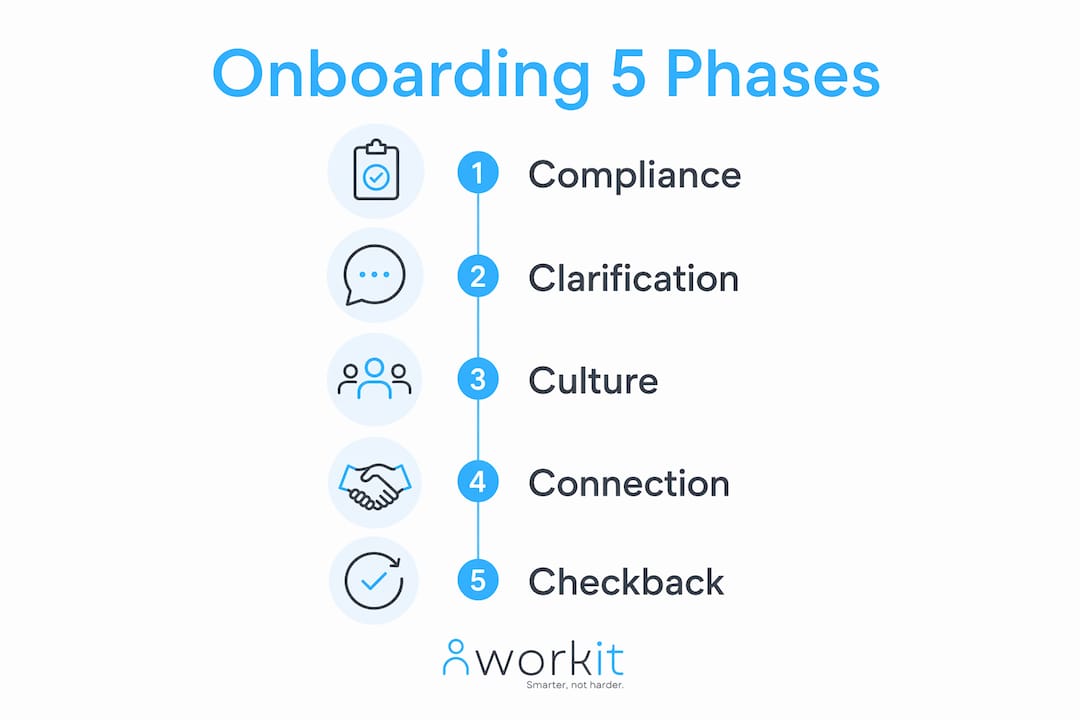
The 5 Cs framework gives onboarding a clear structure that moves beyond paperwork to genuine integration. Each stage has a defined owner and a concrete deliverable.
-
Compliance (HR, day one): Complete all legal and payroll requirements. This includes the Fair Work Information Statement, TFN declaration, superannuation choice form, signed contract, right-to-work verification, and WHS induction. Nothing else can proceed until this is done.
-
Clarification (hiring manager, week one): Set explicit role expectations, short-term goals, and success measures. The new hire should leave week one knowing exactly what they are responsible for and how their performance will be assessed.
-
Culture (whole team, weeks one to four): Introduce the new hire to how the organisation actually works, not just what the handbook says. This includes team rituals, communication norms, and unwritten expectations.
-
Connection (team buddy, ongoing): Build the social relationships that make people want to stay. A buddy programme, team lunches, and informal check-ins all contribute. Staged information delivery and checkbacks increase engagement and reduce early attrition.
-
Checkback (HR + hiring manager, 30/60/90 days): Run structured reviews at 30, 60, and 90 days to surface problems early, adjust goals, and confirm the new hire is on track.
For casual and part-time employees, compress the timeline but keep all five elements. For remote hires, replace in-person activities with video check-ins and digital buddy introductions, and be more deliberate about culture and connection since those do not happen organically.
Pro Tip: Send a preboarding welcome pack two to three days before the start date. Include the team org chart, a first-day agenda, and a short note from the hiring manager. It costs almost nothing and dramatically reduces first-day anxiety.

How to build a practical onboarding programme
A good programme starts with three planning decisions: who owns each phase, what technology will carry the workflow, and what success looks like at 30, 60, and 90 days. Get those three things agreed before the new hire accepts.
First-day agenda (sample)
- 9:00 AM: Welcome from hiring manager, workspace and equipment set-up
- 10:00 AM: HR compliance session (paperwork, Fair Work Information Statement, WHS induction)
- 11:30 AM: Team introductions and office or system tour
- 1:00 PM: Lunch with buddy or team
- 2:00 PM: Role overview and expectations conversation with hiring manager
- 3:30 PM: System access, logins, and tools orientation
- 4:30 PM: Q&A and close-out with hiring manager
30/60/90 learning plan
| Period | Learning goals | Success measure | Owner |
|---|---|---|---|
| 30 days | Understand role, team, and key systems | Can complete core tasks independently | Hiring manager |
| 60 days | Build key relationships, contribute to team projects | Positive peer feedback, tasks completed on time | Hiring manager + buddy |
| 90 days | Operate with full independence, identify improvement opportunities | Performance review passed, KPIs on track | Hiring manager + HR |
Pro Tip: Use a workflow tool (such as a task board in your HRIS) to assign and track each onboarding activity. When tasks are visible and assigned, completion rates rise and nothing gets forgotten.
Australian compliance checklist: what you must do
Australian employers have specific legal obligations during onboarding. Missing any of these is a compliance breach under the Fair Work Act.
- Fair Work Information Statement: Must be provided before or as soon as possible after the employee starts. Casual employees also receive the Casual Employment Information Statement; employees on fixed-term contracts receive the Fixed-Term Contract Information Statement.
- TFN declaration: Collect the employee’s Tax File Number declaration for the ATO. Without it, you must withhold tax at the top marginal rate.
- Superannuation choice form: Provide a Standard Choice Form so the employee can nominate their super fund. The ATO sets the rules and timelines.
- Signed employment contract: Both parties sign before or on day one. Update the contract if any terms were negotiated after the initial offer.
- Right-to-work verification: Confirm the employee has the legal right to work in Australia. For visa holders, check conditions and expiry dates. Background screening processes can help automate this step.
- Emergency contact details: Collect next-of-kin and emergency contact information on day one.
- WHS induction: Safe Work Australia sets the national framework; each state and territory has its own regulator. Complete a workplace health and safety induction before the employee begins their duties.
| Document / step | Timing | Responsible body |
|---|---|---|
| Fair Work Information Statement | Before or on day one | Fair Work Ombudsman |
| Casual / Fixed-Term Information Statement | Before or on day one | Fair Work Ombudsman |
| TFN declaration | Day one | Australian Taxation Office |
| Superannuation choice form | Day one | Australian Taxation Office |
| Signed employment contract | Before or on day one | Employer / HR |
| Right-to-work verification | Before day one | Employer / HR |
| WHS induction | Before duties commence | Safe Work Australia framework |
| Emergency contact form | Day one | Employer / HR |
The Fair Work Ombudsman’s starting employment guide and the business.gov.au onboarding checklist are the two most practical references for Australian employers. Keep copies of all signed documents in the employee’s personnel file.
How do you measure onboarding success?
Tracking the right metrics tells you whether your programme is working before problems become expensive. These five KPIs cover the full picture.
| KPI | What it measures | Suggested cadence | Data source |
|---|---|---|---|
| Time-to-productivity | Days until new hire meets baseline performance | At 30 and 90 days | Manager assessment |
| 90-day retention rate | Percentage of new hires still employed at 90 days | Quarterly | HRIS |
| Onboarding completion rate | Percentage of tasks completed on time | Weekly during onboarding | HRIS / task tracker |
| New hire engagement score | Pulse survey result for new starters | At 30 and 60 days | Pulse survey tool |
| Manager satisfaction score | Hiring manager rating of new hire readiness | At 90 days | Manager survey |
Structured onboarding programmes with staged learning and social integration consistently outperform single-day orientations on every one of these metrics. Tracking them also gives you the data to make the case for investing more in the programme.
A simple dashboard with these five fields, reviewed monthly by HR and quarterly by leadership, is enough for most Australian businesses. For HR metrics worth tracking beyond onboarding, Workit’s reporting tools give you a single view across the employee lifecycle.
Common onboarding mistakes and how to fix them
Most onboarding problems come from the same handful of errors. Here is what to stop doing and what to replace it with.
- Treating orientation as onboarding. A one-day induction does not build capability or connection. Replace it with a structured programme that runs for at least 90 days, with defined milestones at each stage.
- Leaving onboarding entirely to HR. HR owns compliance; the hiring manager owns role clarity; the team owns social connection. When HR carries the whole load, role expectations and cultural integration suffer.
- Overloading the first day. Presenting 40 slides of company history and policy on day one guarantees cognitive overload and low retention. Spread information across the first two weeks and prioritise what the new hire needs to function on day two.
- Skipping the 30/60/90 check-ins. Without structured reviews, problems fester until they become resignation letters. Schedule the 30, 60, and 90-day conversations before the new hire starts.
- No buddy or peer connection. New hires who have a workplace friend are more engaged and more likely to stay. Assign a buddy from the team, not just a manager, and give the buddy a simple brief.
Pro Tip: Split your onboarding content into three buckets: need-to-know on day one, need-to-know by end of week one, and good-to-know by day 30. Anything that does not fit those buckets can wait. This single change reduces first-week overwhelm significantly.
Onboarding checklist you can use right now
Copy this into your HRIS or task management tool and assign an owner to each item before the new hire’s start date.
| Task | Timing | Owner |
|---|---|---|
| Send offer letter and employment contract | Pre-start | HR |
| Collect signed contract | Pre-start | HR |
| Request IT access and equipment | Pre-start | IT / HR |
| Send welcome email with first-day logistics | 2–3 days before start | HR / hiring manager |
| Provide Fair Work Information Statement | Day one | HR |
| Collect TFN declaration and super choice form | Day one | HR |
| Complete right-to-work verification | Day one | HR |
| WHS induction | Day one | WHS officer / HR |
| Workspace and equipment set-up confirmed | Day one | IT |
| Team introductions completed | Day one | Hiring manager / buddy |
| Role expectations conversation | Day one | Hiring manager |
| System access and logins confirmed | Day one | IT |
| First 1:1 with hiring manager | Week one | Hiring manager |
| Role shadowing and initial tasks assigned | Week one | Hiring manager |
| Buddy check-in | Week one | Buddy |
| 30-day review scheduled | Week one | HR + hiring manager |
| 30-day performance and goals review | Day 30 | Hiring manager + HR |
| 60-day peer feedback collected | Day 60 | HR |
| 90-day formal review completed | Day 90 | Hiring manager + HR |
Key takeaways
Effective employee onboarding requires clear ownership across HR, hiring managers, and the team, structured in five stages from compliance through to ongoing checkbacks.
| Point | Details |
|---|---|
| Onboarding is not orientation | The process runs from offer acceptance to 90+ days, not just day one. |
| Five stages, three owners | HR owns compliance, hiring managers own clarification, and the team owns connection. |
| Australian compliance is non-negotiable | Fair Work Information Statement, TFN declaration, super choice, and WHS induction must all be completed on or before day one. |
| Measure five KPIs | Track time-to-productivity, 90-day retention, completion rate, engagement score, and manager satisfaction. |
| Workit supports the full process | Workit’s onboarding software automates compliance tasks, tracks completion, and gives Australian employers a single platform for the entire new-hire journey. |
The part most employers get wrong
Most onboarding conversations focus on process: the checklist, the forms, the 30/60/90 plan. Those things matter. But the single biggest predictor of whether a new hire stays past six months is not whether their paperwork was filed on time. It is whether they felt connected to their team and clear about what was expected of them by the end of week two.
That is a human problem, not a process problem. And it is almost always caused by the same structural failure: HR runs onboarding, and the hiring manager shows up for the first-day welcome and then disappears back into their calendar. The new hire gets compliant but not connected. They know the leave policy but not what their manager actually values. They have system access but no real sense of where they fit.
The 5 Cs framework works precisely because it forces that ownership split. Compliance belongs to HR. Clarification belongs to the hiring manager. Connection belongs to the team. When each group owns their piece, the new hire gets all three. When one group tries to own everything, at least one of those elements gets dropped, and it is almost always connection or clarification.
The practical fix is simpler than most employers expect: before the new hire starts, sit the hiring manager down and ask them two questions. What does success look like at 90 days? And who on the team will be this person’s buddy? If the hiring manager cannot answer both questions clearly, the onboarding programme is already at risk, regardless of how good the checklist is.
Workit makes onboarding straightforward for Australian teams
Replacing spreadsheets and email chains with a purpose-built platform is the fastest way to lift onboarding consistency across your organisation. Workit gives Australian employers a single place to manage the entire new-hire journey, from automated document collection and compliance tracking to 30/60/90 task workflows and real-time reporting.
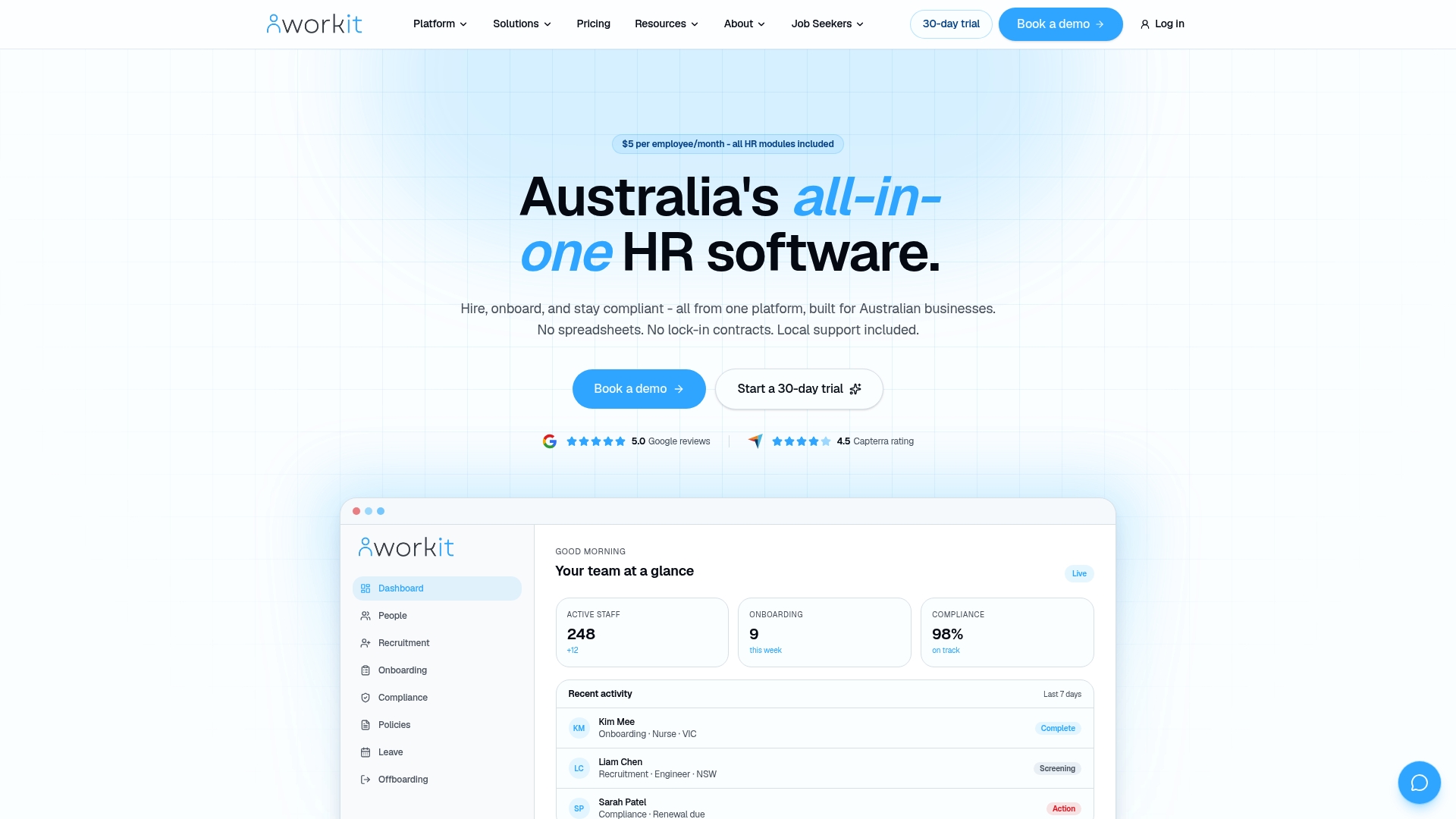
Every HR module is included with no hidden fees. That means onboarding templates, compliance checklists, reporting dashboards, and local support from a team that understands the Australian market, all in one platform. Whether you are onboarding five people a year or fifty, Workit scales without adding complexity. Book a demo to see how it works for your team.
Useful sources for Australian employers
These are the primary references for onboarding compliance and best practice in Australia.
- Fair Work Ombudsman: Information statements — the authoritative source for when and how to provide the Fair Work Information Statement, Casual Employment Information Statement, and Fixed-Term Contract Information Statement.
- Fair Work Ombudsman: Before starting employment — covers employee records, probation, unpaid trials, and rights before day one. Practical for both employers and new hires.
- business.gov.au: Onboard new employees — a concise government checklist covering employment conditions, induction, tax and super forms, and ongoing employer obligations.
- Business Queensland: Staff onboarding and inductions — practical six-step onboarding guide for Queensland employers, applicable across most Australian states.
- Workit: Employee onboarding software — product overview of Workit’s onboarding features, including compliance tracking, templates, and local support for Australian businesses.
- Workit: Standalone onboarding vs all-in-one HR platform — helps employers decide whether a dedicated onboarding tool or an integrated HRIS better suits their needs.
- AI automation for Australian businesses — explains how automation tools can handle document collection and compliance reminders during preboarding, freeing HR to focus on culture and connection.
FAQ
What does onboarding mean in a job?
Onboarding is the process an employer uses to integrate a new employee from offer acceptance through to full productivity. It covers compliance paperwork, role clarification, and social integration, and typically runs for 90 days or more.
What are the four steps in onboarding?
Most structured programmes follow four broad steps: preboarding (before day one), orientation and compliance (day one), role training and integration (weeks one to four), and ongoing development with 30/60/90 check-ins. The 5 Cs framework adds a fifth element, checkbacks, to formalise the review cycle.
What are the 5 Cs of onboarding?
The 5 Cs are Compliance, Clarification, Culture, Connection, and Checkback. Each maps to a phase and an owner: HR handles compliance, the hiring manager handles clarification, the team handles culture and connection, and HR plus the hiring manager run the checkback reviews at 30, 60, and 90 days.
How long should onboarding take?
Best practice for Australian employers is a minimum of 90 days, with structured milestones at 30 and 60 days. Longer, structured programmes consistently produce faster time-to-productivity and better retention than single-day orientations.
Does Workit handle Fair Work compliance during onboarding?
Yes. Workit’s onboarding platform includes built-in compliance checklists aligned to Australian requirements, automated document collection, and real-time tracking so nothing gets missed before or on day one.