

Modern awards Australia: HR compliance guide
TL;DR:
- Australian employment awards are legally enforceable and set minimum pay and employment conditions. Employers must correctly identify coverage based on actual duties, not job titles, and maintain thorough records to ensure compliance. Automated HR tools like Workit streamline classification and pay rules, reducing errors and supporting audit readiness.
Australia’s 121 modern awards are legally enforceable instruments, administered by the Fair Work Commission, that set minimum pay rates and employment conditions on top of the National Employment Standards. They are not optional, and a high salary does not remove the obligation to comply. Your first move as an HR manager: locate the award’s coverage clause (usually clause 4), audit the actual duties the role performs, then run the position through the Fair Work Ombudsman’s Pay and Conditions Tool (PACT) to confirm which award applies and what the minimum entitlements are.
Table of Contents
- Quick compliance checklist for HR teams
- Why awards are a risk-management tool, not a burden
- How Workit takes the manual work out of award compliance
- Authoritative sources and tools to bookmark
- Key takeaways
- FAQ
Quick compliance checklist for HR teams
Before your next pay run or new hire, work through these steps:
- Identify coverage. Check the award’s coverage clause against the employee’s actual duties, not their job title. The Fair Work Commission is clear: coverage is duties-based.
- Confirm classification. Match the role to the correct classification level in the award’s schedule. Misclassification is one of the most common compliance gaps the Fair Work Ombudsman identifies.
- Apply all entitlements. Base rates are only the start. Awards also govern penalty rates, overtime, allowances, rostering, span of hours, and minimum engagement periods for casuals.
- Keep records. Maintain time and roster records, and document your classification decisions, including the principal purpose test if more than one award could apply.
- Update rates annually. The Fair Work Commission Annual Wage Review typically takes effect from the first full pay period on or after 1 July. Configure your payroll system to apply the new rates on that date, every year.
- Enterprise agreements do not automatically replace awards. An agreement must pass the Better Off Overall Test (BOOT) to override award conditions. A high salary alone does not satisfy that test.
Why awards are a risk-management tool, not a burden
Proactive award management prevents underpayments and industrial disputes before they start. The Fair Work Ombudsman’s compliance findings consistently show the same failure points: wrong award applied, outdated job descriptions used for classification, penalty rates missed, and pay rates not updated after the July wage review. Each of these is avoidable.
The duties-based coverage rule catches many employers off guard. A “Marketing Coordinator” whose actual work involves significant graphic design could fall under a different award than the one HR assumed. Relying on a job title or a position description written three years ago is a genuine compliance risk.
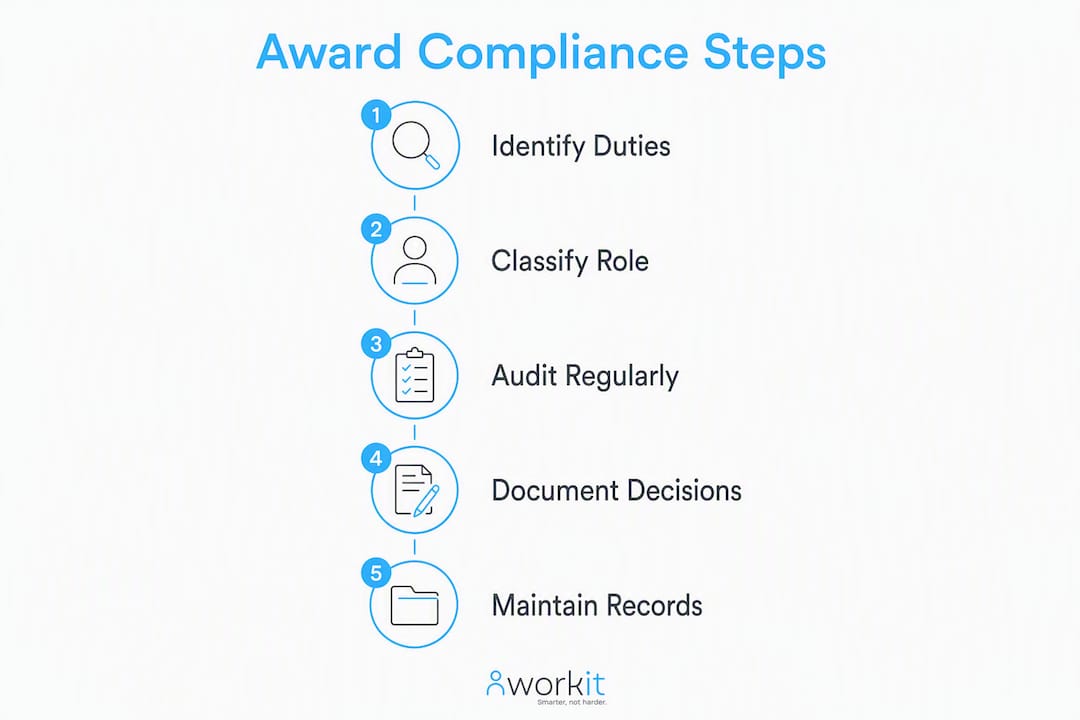
Pro Tip: After any role change, roster restructure, or organisational redesign, run a scheduled duties audit. Document what the employee actually does, map it to the relevant award classification, and date-stamp the record. Tie it to the payroll file. That audit trail is your first line of defence in an underpayment dispute.

When multiple awards appear to cover a business, apply the principal purpose test and record your reasoning. An undocumented decision is almost impossible to defend if the Fair Work Ombudsman comes knocking. Civil penalties for breaches of award and record-keeping obligations can be substantial, and employers should retain records for at least seven years.
How Workit takes the manual work out of award compliance
Keeping award obligations accurate across a growing workforce is where spreadsheets and manual processes break down fastest. Workit’s HR compliance software centralises role data, time records, and payroll rules in one place, reducing the manual errors that lead to underpayments.
Three steps HR teams can follow to integrate awards into Workit:
- Document duties at onboarding. Capture the actual duties performed at hire using Workit’s onboarding workflows, not just the job title.
- Map to the correct classification. Use Workit’s classification checkpoints to align each role to the right award level and keep that record current.
- Enable automated pay rules. Configure penalty rates, overtime, and allowances in the payroll rules engine, and set alerts for the annual July rate update.
Workit gives Australian businesses audit-ready Fair Work compliance without the hidden fees, available at an affordable monthly per-employee subscription. Book a demo to see how it works for your team.
Authoritative sources and tools to bookmark
Every HR team working with Australian employment awards should have these resources saved:
- About awards, Fair Work Ombudsman — the starting point for understanding what awards are and how they apply.
- List of awards and PACT, Fair Work Ombudsman — use PACT to identify the correct award and calculate minimum entitlements.
- Find an award, Fair Work Commission — search current award text and variation history.
- Which award applies, Fair Work Commission — guidance on coverage clauses and the BOOT.
- Workit HR compliance buyer guide — practical guidance on selecting HRIS features that prevent award errors.
| Figure | Detail |
|---|---|
| Total modern awards | 121 awards currently in effect across Australia |
| Annual rate update | Changes from the Fair Work Annual Wage Review take effect from the first full pay period on or after 1 July each year |
Key takeaways
Correct award identification depends on duties performed, not job titles, and must be reviewed every time a role or roster changes.
| Point | Details |
|---|---|
| 121 awards in effect | Australia has 121 modern awards, each covering specific industries or occupations. |
| Duties determine coverage | The Fair Work Commission assesses coverage by actual duties, not job title or position description. |
| Awards cover more than pay | Penalty rates, overtime, allowances, rostering, and casual engagement periods are all award obligations. |
| Annual July update | Configure payroll to apply new rates from the first full pay period on or after 1 July after each Annual Wage Review. |
| Workit automates the process | Workit centralises duties records, classification mapping, and pay rules to keep your team audit-ready year-round. |
FAQ
What is a modern award in Australia?
A modern award is a legally enforceable instrument administered by the Fair Work Commission that sets minimum pay rates and employment conditions for specific industries or occupations. It applies on top of the National Employment Standards, and there are currently 121 modern awards in effect.
How do you determine which award applies to an employee?
Check the award’s coverage clause (usually clause 4) and assess the employee’s actual duties against the classification schedules. Use the Fair Work Ombudsman’s PACT tool to confirm the correct award and calculate minimum entitlements.
Does a high salary mean an employee is not covered by an award?
No. A high salary alone does not remove award coverage. An enterprise agreement must pass the Better Off Overall Test (BOOT) to lawfully override award conditions, and failing that test exposes employers to retrospective pay liability.
What records do employers need to keep for award compliance?
Employers should retain time and roster records, payroll calculations, and documented classification decisions for at least seven years to support audits and respond to underpayment disputes.
Do award allowances affect superannuation calculations?
Some allowances form part of ordinary time earnings (OTE) for superannuation purposes, and some do not. HR teams should cross-check each allowance type against ATO guidance to apply the correct super treatment.