

Employment Hero alternatives for Australian HR leaders
For Australian businesses replacing Employment Hero, the clearest path forward is an Australian-first HRIS with native payroll links, STP Phase 2 readiness, and local support you can actually reach. G2’s alternatives listings and Capterra’s review data both confirm the same shortlist categories buyers compare most often: Australian-first HRIS platforms, mid-market HRIS suites, payroll-led platforms, shift and rostering tools, and enterprise HCM systems.
The right choice depends on your headcount, award complexity, and how much implementation support you need. Here is a quick shortlist to start your vendor outreach:
- Australian-first HRIS (e.g. Workit): all modules included, local support, Xero integration, a flat fee per employee per month
- Mid-market HRIS suites (e.g. HiBob, BambooHR): strong people analytics, global-ready, payroll via third-party integrations
- Payroll-led platforms (e.g. KeyPay, ADP): deep award interpretation, STP Phase 2 native, HRIS modules added on
- Shift and rostering specialists (e.g. Deputy): award-aware scheduling, time and attendance, payroll push integrations
- Enterprise HCM (e.g. ELMO): full suite for larger organisations, local AU data hosting, implementation-heavy
| Category | Best for | Payroll / AU readiness |
|---|---|---|
| Australian-first HRIS | SMEs to mid-market, AU compliance focus | Native Xero integration, STP Phase 2 |
| Mid-market HRIS suite | Growth-stage businesses, people analytics | Third-party payroll integrations |
| Payroll-led platform | Payroll-first buyers, complex awards | STP Phase 2 native, award engine |
| Shift and rostering | Hospitality, retail, shift-based teams | Award-aware timesheets, payroll push |
| Enterprise HCM | 200+ employees, complex org structures | AU data hosting, full payroll module |
Table of Contents
- Why do organisations replace Employment Hero?
- Which Employment Hero alternatives suit Australian buyers best?
- How do you choose the right alternative for your business?
- What does an HRIS replacement cost and how long does it take?
- Expert evaluation checklist for Australian HRIS due diligence
- Key takeaways
- The procurement mistake most Australian HR leaders make
- Workit: an Australian-built HR platform at $5 per employee
- Useful sources
- FAQ
Why do organisations replace Employment Hero?
The most common reasons Australian businesses move off Employment Hero centre on support speed, payroll reliability for complex awards, reporting limitations, and pricing inflexibility. These themes appear consistently across Capterra’s alternatives reviews and G2 user feedback.
-
Support response times. Buyers on smaller plans report waiting days for ticket resolution on payroll-critical issues. When a pay run is wrong, a 48-hour SLA is not acceptable. Test in a demo: ask for the average first-response time for payroll support tickets and request a sample SLA document.
-
Payroll reliability for complex awards. Australia’s Modern Award system is one of the most complex in the world. Buyers with hospitality, retail, or healthcare workforces report that edge cases in penalty rates and allowances require manual intervention. Test in a demo: run a sample pay scenario with a split-shift penalty and a casual loading.
-
Reporting limitations. HR leaders wanting headcount trend analysis, turnover cohort reports, or custom compliance exports find the standard reporting module thin. Test in a demo: ask to build a custom report combining leave liability, tenure, and department in under five minutes.
-
Pricing and contract rigidity. Annual contracts with limited flexibility frustrate businesses going through restructures or rapid growth. Per-employee pricing that bundles unused modules also draws criticism. Test in a demo: ask for a month-to-month option and confirm exactly which modules are included at each price tier.
-
Implementation support. Several reviews describe a self-serve implementation experience that left HR teams configuring complex award rules without expert guidance. Research into HRIS implementation failures consistently shows that unclear ownership between HR and IT is a leading cause of project failure.
Which Employment Hero alternatives suit Australian buyers best?
Australian buyers should prioritise modular HRIS platforms with payroll integration, STP Phase 2 readiness, and award handling rather than selecting based on feature volume or brand recognition. The shortlist below is structured around those priorities, not vendor marketing claims.
Comparison matrix
| Category | Core modules | AU payroll support | Pricing model | Implementation | Local support | Reporting | Integrations |
|---|---|---|---|---|---|---|---|
| Australian-first HRIS | HRIS, onboarding, compliance, performance, LMS, leave, recruitment | Xero integration, STP Phase 2 | Flat per-employee, all modules included | Fast, guided | AU-based team | Real-time, custom | Xero, payroll APIs |
| Mid-market HRIS suite | HRIS, performance, engagement, recruitment | Third-party payroll integrations | Per-employee, tiered by module | Moderate, partner-led | Regional or remote | Strong analytics | Wide marketplace |
| Payroll-led platform | Payroll, award engine, timesheets, basic HRIS | Native STP Phase 2, award-aware | Per-employee or per-payroll run | Moderate | AU-based | Payroll-focused | HRIS push integrations |
| Shift and rostering | Scheduling, time and attendance, leave | Award-aware timesheets, payroll push | Per-user, per-location | Fast | AU-based | Rostering and labour cost | Payroll, POS systems |
| Enterprise HCM | Full suite: HCM, payroll, talent, learning | AU payroll module, local data hosting | Per-employee, enterprise contract | Long, resource-heavy | AU enterprise team | Advanced, configurable | ERP, payroll, LMS |
Australian-first HRIS
This category covers platforms purpose-built for the Australian market, with native payroll integrations (typically Xero), STP Phase 2 compliance, and all HR modules included in a single subscription. Workit sits in this category: a flat fee per employee per month covers recruitment, onboarding, HRIS, compliance, performance, learning management, leave, incident reporting, policy management, and offboarding. Local support from an AU-based team means payroll questions get answered by people who know the Fair Work Act, not a global helpdesk.
- AU note: Xero integration and Fair Work compliance features are native, not bolted on
Pricing signals
- Australian-first HRIS: flat per-employee pricing (e.g. a flat fee per employee per month, all modules included) is the most transparent model
- Mid-market suites: per-employee pricing tiered by module; watch for add-on fees for onboarding, performance, or recruitment
- Payroll-led platforms: per-employee or per-payroll-run pricing; implementation fees vary
- Enterprise HCM: annual contracts, per-employee pricing, plus significant implementation and configuration fees
- Red flag: any vendor who will not confirm total cost of ownership (subscription plus implementation plus integrations) in writing before you sign
How do you choose the right alternative for your business?
Define your must-have requirements before you sit in a vendor demo. The single biggest selection mistake Australian buyers make is letting a polished demo substitute for a requirements-led evaluation. Payroll and award readiness plus local support are the two non-negotiable criteria for any AU business.
Decision checklist
- Fair Work compliance: can the platform generate Fair Work pay slips, issue Fair Work Information Statements, and export records in the format the Fair Work Ombudsman requires?
- Integrations: does it connect to your existing payroll tool (Xero, ADP, KeyPay), accounting system, and any industry-specific tools? Check the difference between HR management and payroll software before finalising your integration requirements.
Vendor demo questions
- Show me STP Phase 2 earnings category mapping for a casual employee with a split-shift penalty.
- Generate a Fair Work pay slip for a part-time employee on the Hospitality Industry General Award.
- Export an audit log of all pay rate changes in the last 90 days.
- Show me how a new employee completes onboarding without HR intervention.
- What is your average first-response time for a payroll support ticket?
Red flags
- Vague answers about STP Phase 2 or award interpretation
- No AU-based support team or support only via email ticket
- Implementation quoted as “self-serve” for a business with 50+ employees
- Pricing that changes significantly once you add the modules you actually need
- No reference customers in your industry or of your size in Australia
What does an HRIS replacement cost and how long does it take?
Most Australian HRIS replacement projects combine a per-employee monthly subscription with either a fixed implementation fee or a time-and-materials engagement. All-in-one flat per-employee pricing (where implementation is a known, capped cost) gives you the clearest total cost of ownership before you sign.
Typical implementation timeline
| Phase | Typical duration | Key activities |
|---|---|---|
| Discovery and scoping | 1–2 weeks | Requirements sign-off, data audit, integration mapping |
| Data clean and migration | 1–3 weeks | Employee data cleanse, historical record import |
| Configuration | 2–4 weeks | Award setup, workflows, forms, policy upload |
| Testing | 1–2 weeks | Parallel payroll run, user acceptance testing |
| Go-live | 1 week | Cutover, comms to employees, admin training |
| Optimisation | 4 weeks post go-live | Report tuning, workflow refinement, adoption tracking |
Total elapsed time for a business with mid-sized headcount typically runs several weeks to a few months from contract to go-live. Larger organisations with complex awards or multi-entity structures should allow more time for implementation.
Pro Tip: Run your first payroll in parallel on both the old and new system for at least one full pay cycle. It is the fastest way to catch award interpretation differences before they become a compliance issue.
Expert evaluation checklist for Australian HRIS due diligence
Verifying vendor capability before you sign means testing four things: certified payroll links, security posture, implementation resourcing, and local case studies. A vendor who cannot demonstrate all four in a structured evaluation is not ready for your business.
Compliance and payroll
- Confirm STP Phase 2 certification with the ATO (ask for the certification reference)
- Test your three most complex award scenarios live in the demo, not in a slide deck
- Verify Fair Work pay slip generation and record-keeping exports meet Ombudsman requirements
- Ask how the platform handles award updates when the Fair Work Commission varies a rate
- Check how the HRIS supports Fair Work compliance and audit readiness for your specific obligations
Security and privacy
- Request the vendor’s ISO 27001 certification or SOC 2 Type II report
- Confirm AU data residency and ask where backups are stored
- Ask how the vendor complies with the OAIC’s Notifiable Data Breaches scheme and request a copy of their incident response procedure
- Confirm the data deletion process at contract end
Implementation and support
- Ask for a named implementation consultant, not a shared queue
- Request a reference from an Australian customer of similar size and award complexity
- Confirm support hours, channels, and escalation paths for payroll-critical issues
- Implementation projects fail when ownership sits in a grey zone between HR and IT; confirm HR leads configuration and governance, not IT
Reporting and integrations
- Build a custom report live in the demo (headcount by department, leave liability, turnover rate)
- Confirm the payroll integration is bi-directional and test a data sync in the demo
- Ask for the full integration marketplace list and confirm your critical tools are supported
Data migration and governance
- Request a sample data migration template and confirm what historical data transfers
- Ask who owns data governance post go-live (vendor or buyer)
- Confirm the process for bulk data corrections if a migration error is found post go-live
A useful way to test payroll edge cases: ask the vendor to process a casual employee on the Retail Award who worked a public holiday split shift, then show you the STP Phase 2 earnings category breakdown. A vendor who handles it confidently in the demo will handle it in production.
Pro Tip: Assign a named HR project owner before you sign, not after. The buyer guide for choosing HR software in Australia recommends HR leads configuration and governance from day one, with IT as a support function, not the decision-maker.
Pro Tip: Post go-live, set a 90-day review with your implementation consultant to check adoption rates, payroll exception counts, and support ticket volume. These three metrics tell you whether the system is working or just running.
Key takeaways
For Australian businesses replacing Employment Hero, the right HR software alternative combines AU-native payroll links, transparent per-employee pricing, and local support that knows the Fair Work Act.
| Point | Details |
|---|---|
| Payroll readiness is non-negotiable | Test STP Phase 2 and your specific Modern Awards live in every vendor demo before shortlisting. |
| Define requirements before demos | List your must-have modules and compliance needs first; do not let a polished demo set your requirements for you. |
| Implementation ownership matters | HR must lead configuration and governance; unclear ownership between HR and IT is the leading cause of HRIS project failure. |
| Transparent pricing saves surprises | Flat per-employee pricing with all modules included gives you the clearest total cost of ownership from day one. |
| Workit as an AU-first option | Workit covers all HR modules at a flat fee per employee per month with Xero integration, STP Phase 2 readiness, and AU-based local support. |
The procurement mistake most Australian HR leaders make
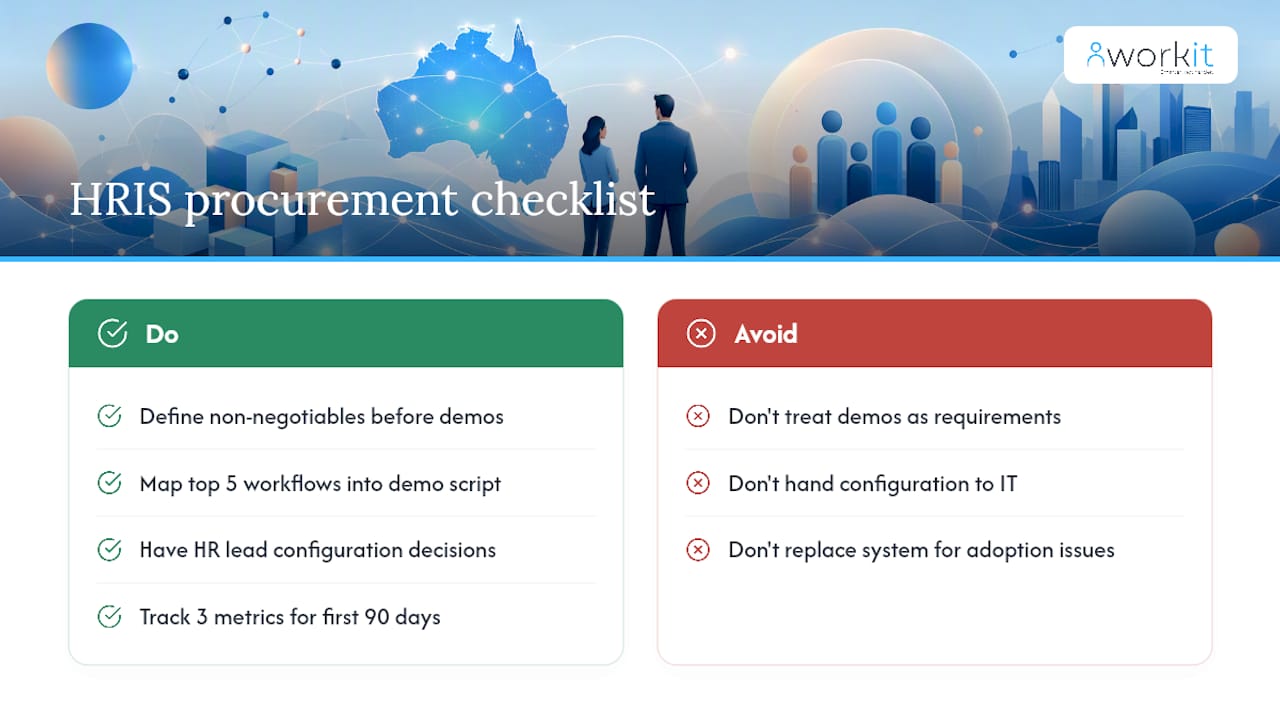
The most common mistake in an HRIS replacement project is treating the vendor demo as the requirements-gathering exercise. By the time you are in a demo, you should already know your non-negotiables: which awards you run, which integrations you cannot live without, and what your current system cannot do that is costing you time every fortnight.
Governance is the other gap. HR leaders who hand the project to IT because “it’s a software implementation” consistently report that the resulting system is configured for technical efficiency rather than day-to-day HR outcomes. The research is clear on this: HR must own configuration decisions, not just sign off on them at the end.
One practical fix: before you approach any vendor, spend two hours with your payroll officer and your most senior HR generalist mapping the five workflows that consume the most manual effort each month. Those five workflows become your demo script. Any vendor who cannot handle all five cleanly in a live session is not ready for your business, regardless of how good the slide deck looks.
Post go-live, track three metrics for the first 90 days: payroll exception rate (errors per pay run), employee self-service adoption (percentage of leave requests submitted without HR intervention), and support ticket volume. If any of those three are moving in the wrong direction at the 90-day mark, you have an adoption problem, not a software problem, and the fix is training and communication, not a new system.
Workit: an Australian-built HR platform at $5 per employee
Every alternative on this shortlist has genuine strengths. But if your priorities are transparent pricing, AU-native compliance, and a support team that picks up the phone knowing what the Hospitality Industry General Award looks like, Workit is worth a close look.
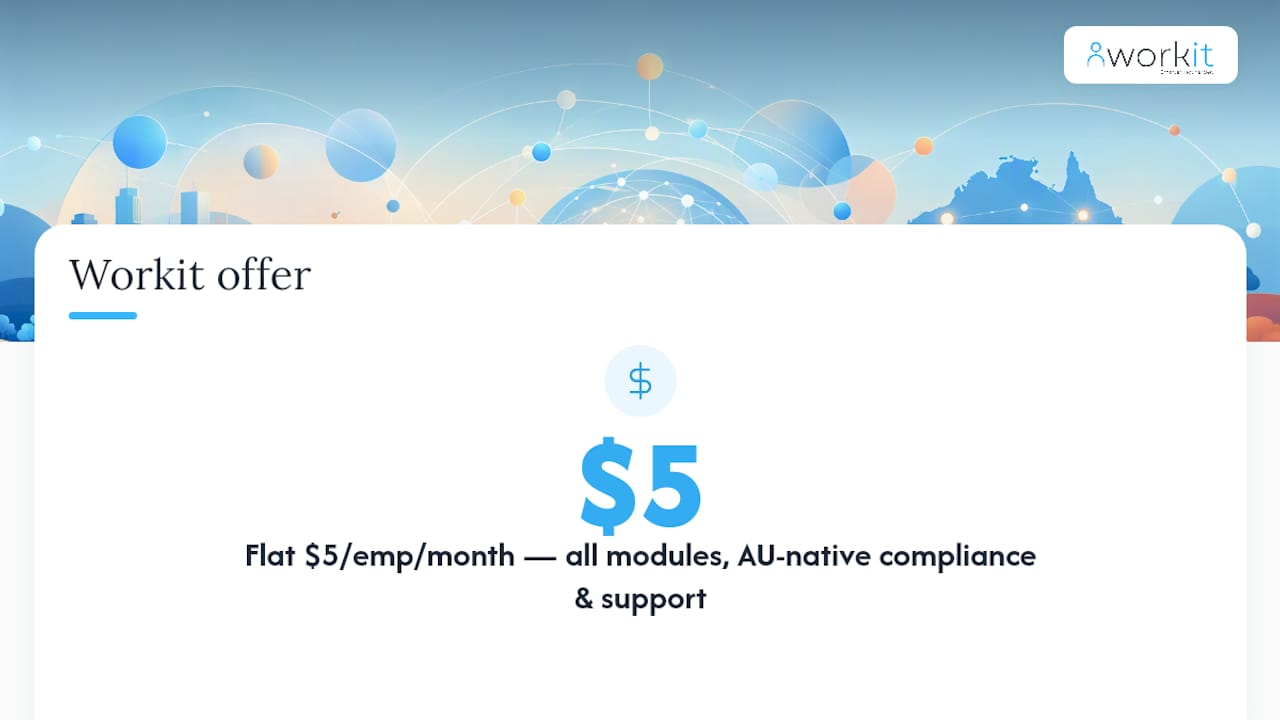
At a flat fee per employee per month, every module is included: recruitment and applicant tracking, onboarding, HRIS, compliance management, performance reviews, learning management, leave tracking, incident reporting, policy management, offboarding, employee self-service, and real-time reporting. No module gating, no surprise add-ons when you need the feature you actually came for.
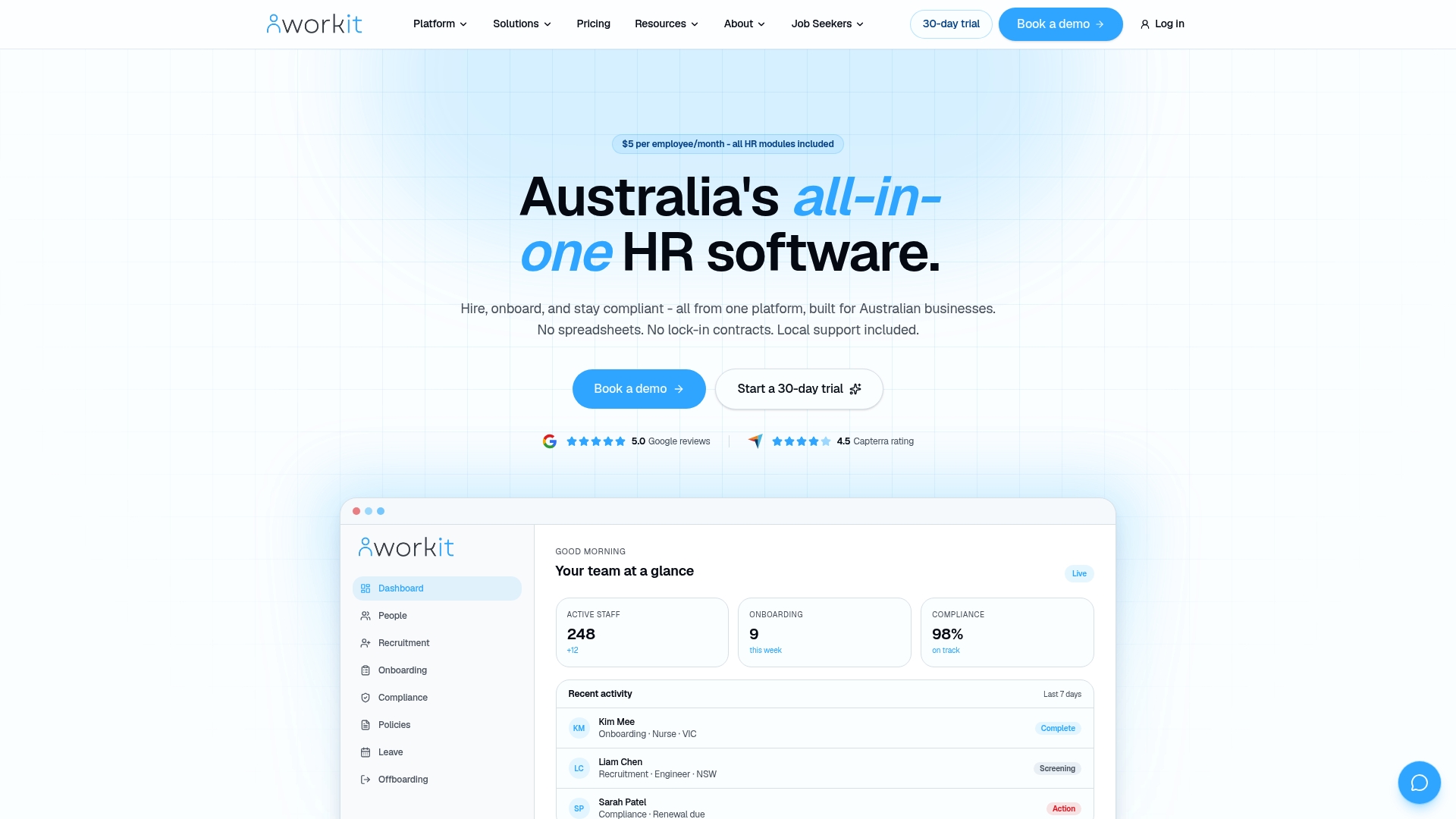
Xero integration is native, STP Phase 2 readiness is built in, and the support team is AU-based. For not-for-profits, education providers, and small businesses navigating complex award structures, Workit’s industry-specific solutions are worth reviewing alongside the core platform.
The clearest next step: book a demo on the Workit platform and bring your three most complex award scenarios. Run them live. That single session will tell you more than any feature comparison table.
Useful sources
The following sources informed this article and are worth bookmarking for your own procurement process:
- The pitfalls that derail HR system implementations (and how to avoid them) | Human Resources Director
- How to choose the best HR software and HR systems in Australia
- HRIS selection Australia: practical guide for growing businesses
- Record keeping and pay slips | Fair Work Ombudsman
- Notifiable data breaches | OAIC
- Top 10 Employment Hero Alternatives & Competitors in 2026
- Alternatives to Employment Hero
- How to choose the best HR software solution for growing teams
When you use any of these sources in your own evaluation, test the vendor’s claims against the Fair Work and OAIC standards directly. A vendor who cannot demonstrate compliance in a live session should not be on your shortlist.
FAQ
What is the best payroll software for Australian businesses?
The best payroll software depends on your award complexity. KeyPay and ADP have the deepest AU award engines for complex multi-award environments; Xero Payroll suits most SMEs. For an integrated HRIS and payroll solution, look for a platform with a native Xero or KeyPay integration and confirmed STP Phase 2 certification.
Are Swag and Employment Hero the same thing?
Swag is Employment Hero’s employee-facing app, not a separate product. It provides the self-service portal, benefits marketplace, and financial wellness features that sit within the Employment Hero platform.
What are the top HRIS systems for Australian businesses?
The most commonly compared categories are Australian-first HRIS platforms (such as Workit), mid-market suites (HiBob, BambooHR), payroll-led platforms (KeyPay, ADP), rostering specialists (Deputy), and enterprise HCM (ELMO). The right category depends on your headcount, award complexity, and whether payroll is your primary driver or one of several requirements.
How is Workit different from Employment Hero?
Workit is priced at a flat fee per employee per month with all modules included and no add-on fees, compared to Employment Hero’s tiered pricing where some modules are gated by plan. Workit’s support team is AU-based, and the platform is built specifically for the Australian compliance environment, including Xero integration and Fair Work compliance features as standard.
How long does it take to migrate from Employment Hero to a new HRIS?
For a business with 50–200 employees, a typical migration runs several weeks from contract to go-live, covering discovery, data migration, configuration, testing, and cutover. Complex award environments or multi-entity structures add time; larger organisations should budget more time accordingly.