

Audit checklist for Australian HR: Fair Work Information Statement
Every new employee, regardless of employment type, must receive a copy of the current Fair Work Information Statement before they start work, or as soon as practicable after. Casual employees also need the Casual Employment Information Statement at set milestones, and fixed term employees need the Fixed Term Contract Information Statement when they sign on. Always pull the current version from the Fair Work Ombudsman and keep dated proof of delivery. That proof is what protects you if a dispute ever lands on your desk.
TL;DR:
- Employers must provide the latest FWIS to all new employees before or immediately after starting, regardless of employment type or hours worked.
- Casual employees require the FWIS at onboarding and the separate CEIS at six months if there are 15 or more staff, or at 12 months if fewer employees.
- Delivery methods such as in-person handover, email, or intranet links are acceptable, but proof of receipt, like signed acknowledgments or timestamped emails, is essential.
- Failure to give the FWIS can lead to compliance breaches and penalties, especially if disputes over pay or employment rights arise later.
- Automating onboarding processes with HR systems ensures the statements are sent correctly, tracked, and compliant, reducing manual errors and audit risk.
Table of Contents
- What is the Fair Work Information Statement?
- Who needs the FWIS and when must you provide it?
- How do you provide the FWIS and prove you did it?
- CEIS and FTCIS: the extra statements and their reissue rules
- The legal basis and what non-compliance actually costs you
- A copy-paste onboarding checklist for FWIS compliance
- Turning FWIS delivery into an automated compliance step
- Where to download the current statements and legislation
- Why this is core compliance, not paperwork
- A simpler way to stay on top of FWIS and CEIS obligations
- Sources
- FAQ
What is the Fair Work Information Statement?
The Fair Work Information Statement (FWIS) is a plain-language summary of the National Employment Standards (NES), the 11 minimum entitlements every Australian employee is legally guaranteed. It’s not a contract, and it’s not a substitute for one. Think of it as an orientation document that points new starters toward the rules that govern their employment, without spelling out their personal pay rate or award classification.
The document covers a wide sweep of workplace basics: maximum weekly hours, requests for flexible working arrangements, parental leave and related entitlements, annual and personal leave, notice of termination, redundancy pay, and the right to request casual conversion. It also directs employees to where they can check their correct award or agreement, and how to contact the Fair Work Ombudsman or the Fair Work Commission if something looks off.
Here’s what the FWIS actually does and doesn’t do:
- It summarises NES entitlements in accessible language, not legal jargon.
- It directs employees to modern awards, enterprise agreements, and dispute resolution pathways.
- It does not set an employee’s actual pay, hours, or classification. That’s the job of the employment contract and the relevant award.
- It must go to every new employee, whether they’re full-time, part-time, casual, or on a fixed term contract.
That last point trips up more employers than you’d expect. Some businesses assume the FWIS is only for permanent staff, or that a verbal run-through of entitlements during induction is close enough. Neither assumption holds up. The obligation applies uniformly, and it’s a written statement, not a conversation.
Who needs the FWIS and when must you provide it?
Every employee you hire needs the FWIS, full stop. Full-time, part-time, casual, fixed term, it doesn’t matter how many hours they’re contracted for or how long the engagement is meant to last. The Fair Work Ombudsman is explicit that this applies to all new employees, without carve-outs for short-term or low-hours roles.
The timing test is straightforward on paper: give the FWIS before the employee starts work, or as soon as practicable after they start if that’s not possible. “As soon as practicable” isn’t a loophole for delay. It means the next business day, not the next payroll cycle. If you’re onboarding someone who starts on a Monday and you hand them the statement on the following Friday, you’re on shaky ground if that timing is ever questioned.
Where it gets more complex is casual employment. Casual employees need the FWIS at commencement, just like everyone else, but they also need the separate Casual Employment Information Statement (CEIS), and that one comes with a recurring schedule tied to your business size:
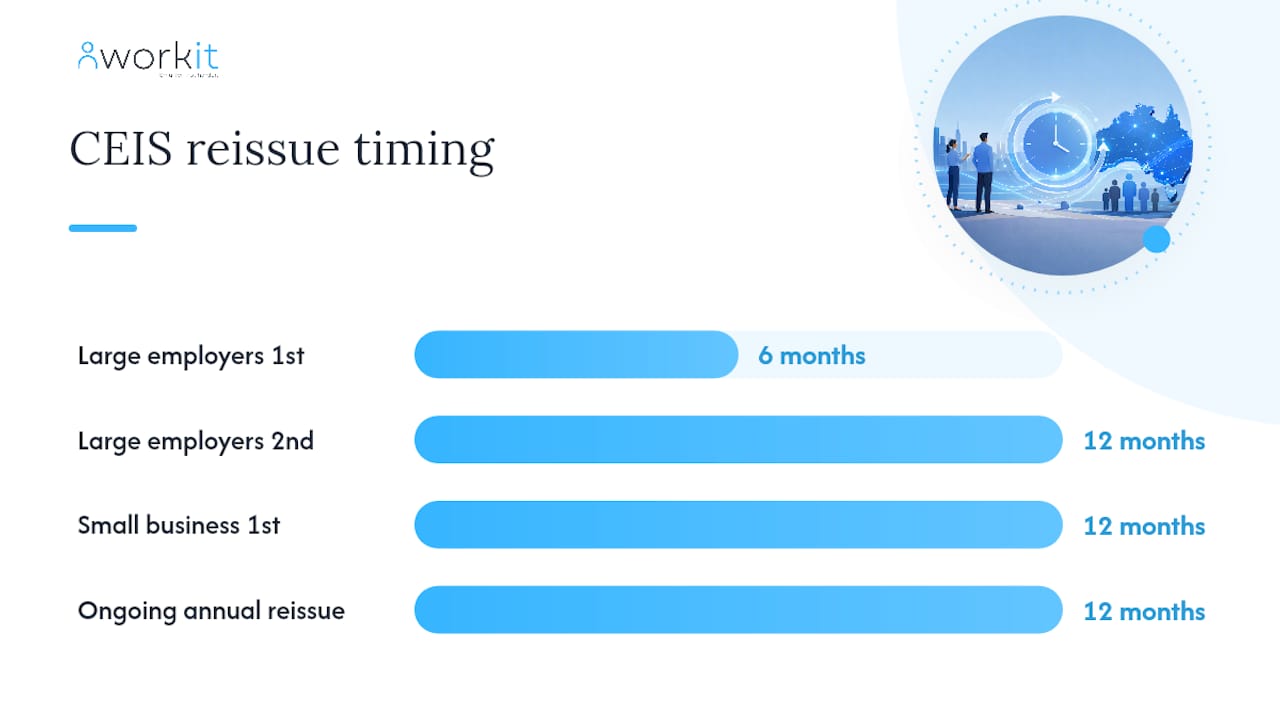
- Employers with 15 or more employees must reissue the CEIS at the 6-month and 12-month marks, then every 12 months thereafter, where casual conversion rights continue to apply.
- Employers with fewer than 15 employees only need to provide the CEIS at commencement and again at the 12-month mark.
- Small business status is assessed at the point the obligation arises, so a business that grows past 15 employees during a casual’s tenure may suddenly face a different reissue schedule for that same employee.
That last nuance matters more than it sounds. If you’ve been treating every casual the same way regardless of your headcount, it’s worth checking your current employee count against the CEIS requirements before you assume you’re compliant.
How do you provide the FWIS and prove you did it?
The Fair Work Act gives you flexibility on delivery method, but flexibility isn’t an excuse for skipping the paper trail. Acceptable methods include:
- Handing it over in person during induction, ideally with a signature or acknowledgement captured on the spot.
- Emailing the PDF directly to the employee’s nominated address, alongside their offer letter or contract.
- Sending a link to the Fair Work Ombudsman’s FWIS page, provided the employee can access and read it without hurdles.
- Posting it via mail for employees who don’t have reliable digital access.
- Publishing it on your intranet with a direct, easy-to-find link, as long as new starters are pointed there during onboarding.
- Faxing it, which is rarely used now but remains a technically valid method under the regulations.
Any of these satisfies the legal requirement. What actually protects you if a claim ever surfaces is evidence that delivery happened, on a specific date, in a specific form. A timestamped email with a read receipt, a signed acknowledgement form, or a delivery log inside your HR system are all far stronger than a verbal assurance from a manager who’s since left the business.
Pro Tip: Never rely on a PDF you saved to a shared drive last year. Download a fresh copy from the Fair Work Ombudsman for every new starter, because the document gets updated when legislation changes, and using a stale version undermines the whole point of proving compliance.
Practitioners increasingly recommend building FWIS delivery into your standard onboarding workflow rather than treating it as a one-off admin task. One HR law newsletter puts it plainly: embedding distribution into automated onboarding steps creates the audit trail employers need, and removes the reliance on someone remembering to attach a PDF manually. If your onboarding process still runs on manual email attachments, this is one of the easier gaps to close, and one of the more costly ones to leave open. A structured onboarding process that treats statutory documents as a mandatory checkpoint, not an afterthought, catches this automatically.
CEIS and FTCIS: the extra statements and their reissue rules
Casual and fixed term employees don’t just get the standard FWIS. They get an additional, purpose-built statement on top of it, and each comes with its own timing logic.
The Casual Employment Information Statement exists because casual employment carries entitlements and conversion pathways that the general FWIS doesn’t spell out in enough detail. Changes to casual employment definitions and conversion processes that took effect in August 2024 reinforced why this separate document matters: casual status now hinges on the real substance of the working relationship, not just the label on the contract, and employees need to understand how and when they can request conversion to permanent employment.
The reissue schedule follows the pattern already covered: 6 and 12 months for larger employers, 12 months only for small businesses, then annually where the casual continues working under conditions that keep conversion rights alive. The statutory text behind this sits in section 125B of the Fair Work Act, which sets out precisely when the obligation to give the CEIS arises.
The Fixed Term Contract Information Statement (FTCIS) works differently. It’s not tied to a recurring calendar. Instead, you issue it every time an employee enters a new fixed term contract, including renewals. If someone rolls from one 12-month contract into another, that’s a fresh trigger, not a continuation you can ignore.
Two things worth flagging for your own compliance calendar:
- Track each casual employee’s individual start date, not a single company-wide reissue date, because the 6 and 12-month clocks run separately for every person.
- Reassess your small business status periodically. If your headcount crosses 15 employees partway through a casual’s tenure, the reissue schedule for that employee may change from what you originally set up.
The legal basis and what non-compliance actually costs you
The obligation to prepare and give the FWIS sits in Division 12 of the Fair Work Act 2009, specifically sections 124 and 125, which require the Fair Work Ombudsman to publish the statement and require employers to give it to every new employee. Section 125B extends the same logic to the CEIS for casual employees, and the Fair Work Regulations fill in supporting detail around form and timing.
Failing to provide these statements is a breach of the NES, and that opens the door to civil penalty proceedings under the Fair Work Act. In practice, enforcement rarely starts with a surprise inspection over a missing FWIS alone. It surfaces when a dispute over pay, termination, or casual conversion is already underway, and the absence of a documented FWIS becomes one more point against the employer. Poor record-keeping is consistently flagged as the practical enforcement risk here, more so than the statement itself being withheld deliberately.
Where this gets genuinely complicated:
- Employees engaged through labour hire arrangements, where it’s unclear which entity carries the obligation.
- Long-serving casuals whose conversion rights have shifted under the 2024 changes and who may dispute their classification retrospectively.
- Businesses that have grown across the small-business threshold without updating their CEIS reissue schedule.
If any of these apply to your workforce, a workplace relations lawyer is worth the conversation before a dispute forces the issue.
A copy-paste onboarding checklist for FWIS compliance
Build this into your onboarding workflow once, and you stop relying on memory:
- Pre-start: confirm the employment type (permanent, casual, fixed term) and attach the current FWIS, plus the CEIS or FTCIS if applicable, to the offer or contract email.
- Day one: confirm the employee has opened or received the statement, and capture an acknowledgement, whether that’s a signed form, a ticked onboarding task, or a logged email receipt.
- Record the version: note the date you downloaded the FWIS PDF and store that copy alongside the employee’s file, not a generic shared-drive version used for everyone.
- Set anniversary reminders: for every casual employee, schedule the 6-month and 12-month (or just 12-month, for small businesses) CEIS reissue against their individual start date.
- Audit quarterly: spot-check a sample of new starter files each quarter to confirm the FWIS actually made it into the record, not just the onboarding checklist tick.
Pro Tip: Couple the FWIS with the employment contract in the same email or onboarding step. One combined record is far easier to produce during an audit than two separate documents sent days apart, and it matches what practitioner guides recommend for keeping onboarding evidence coherent.
This checklist works whether you’re running onboarding through a spreadsheet or a dedicated onboarding portal. The steps don’t change. What changes is how much manual chasing each one requires.
Turning FWIS delivery into an automated compliance step
Manual onboarding checklists work until you’re hiring at volume, and then they quietly start failing. The fix isn’t more diligence from your HR team. It’s removing the manual step altogether.
A well-built HR system attaches the current FWIS, and the CEIS or FTCIS where relevant, directly to the employment contract at the point of issue, so both documents go out together and land in the same record. That single step closes the gap where a contract gets sent but the statutory statement gets forgotten.
The bigger win is on the reissue side. Rather than someone manually tracking every casual employee’s 6-month and 12-month anniversaries across a spreadsheet, the system triggers reminders automatically against each start date, captures the employee’s acknowledgement when they open or accept the document, and lets you export a compliance report showing exactly who received what, and when. That exportable record is the practical difference between guessing you’re compliant and being able to prove it during a dispute or audit.

Where to download the current statements and legislation
Save these to your HR compliance folder now, not the week you need them:
- The Fair Work Information Statement PDF, refreshed periodically by the Fair Work Ombudsman.
- The Casual Employment Information Statement page, which also links the CEIS download and current milestone rules.
- The Fair Work Act 2009 text for the primary legislative wording behind these obligations.
The Fair Work Ombudsman also publishes the FWIS in multiple languages, useful if your workforce includes employees who read English as a second language.
Why this is core compliance, not paperwork
Treating the FWIS as a box-ticking afterthought is where most employers get caught out, not through deliberate non-compliance but through drift: a manual process that worked fine at 10 employees quietly breaks at 50. The fix isn’t a stricter policy memo. It’s removing the human memory requirement from the equation entirely.
Give the FWIS the same weight as the employment contract in your onboarding pack, and put clear ownership on who tracks casual reissue anniversaries. Once one person, or one system, owns that trigger, missed CEIS reissues become far rarer.
— Stephen
A simpler way to stay on top of FWIS and CEIS obligations
Chasing statement reissues across a spreadsheet works until your casual headcount grows, and then it becomes the exact kind of manual gap that turns into a compliance headache. There are HR systems designed to remove that gap for Australian employers, including modules for onboarding and compliance tracking, often available under straightforward pricing structures.
In these systems, the current FWIS and any required CEIS or FTCIS can attach automatically to onboarding flows, ensuring they go out alongside employment contracts rather than as separate steps. Acknowledgements can be captured and logged when employees open or accept documents, and reminders for casual reissues can trigger against individual start dates. Exportable reports help prove compliance without searching through old emails.
Workit’s onboarding software is built specifically for Australian employers navigating exactly these obligations, with local support from a team that understands the Fair Work framework you’re working within. If you’re ready to see how it handles your actual onboarding workflow, book a demo and bring your current process along to compare.
Sources
- Fair Work Information Statement - Fair Work Ombudsman
- Casual Employment Information Statement - Fair Work Ombudsman
- Legislation
- Fair Work Information Statement PDF - Fair Work Ombudsman
- HR Law newsletter: Fair Work Information Statement – key requirement for new employees
FAQ
What is the current Fair Work Information Statement (FWIS)?
The FWIS is the Fair Work Ombudsman’s official summary of NES entitlements, published as a downloadable PDF that employers must give to every new employee before or as soon as practicable after they start.
Is there a PDF version of the Fair Work Information Statement available?
Yes, the Fair Work Ombudsman publishes an official PDF that employers should download fresh for each new hire rather than reusing an older saved copy.
What are the changes to the Fair Work Information Statement in 2026?
The Fair Work Ombudsman periodically updates the FWIS PDF to reflect legislative changes, which is why practitioners recommend downloading the current version for each new employee rather than relying on a version saved from a previous year.
What are the key employer obligations around information statements?
Employers must give the FWIS to all new employees, provide the CEIS to casuals at commencement and required milestones, issue the FTCIS for new fixed term contracts, and keep dated records proving each statement was delivered. A system like Workit’s onboarding platform can automate the delivery and record-keeping side of these obligations.
Do casual employees need anything beyond the standard FWIS?
Yes, casual employees also need the Casual Employment Information Statement at commencement, and again at 6 and 12 months for larger employers or at 12 months for small businesses.