

NES entitlements explained for Australian employers
The National Employment Standards are the 11 minimum entitlements every national system employee is legally owed under the Fair Work Act 2009, and no award, agreement or contract can offer less. In practical terms, that means:
- Maximum ordinary weekly hours consistent with legal standards (plus reasonable extra hours)
- Four types of leave, plus community service and long service leave
- Ten public holidays with paid leave for those who’d otherwise work
- Notice of termination and, where eligible, redundancy pay
- Superannuation contributions and mandatory information statements
11 entitlements, one legal floor. Everything below expands on that list so you know exactly what applies, to whom, and what happens when it’s ignored.
Key Takeaways
Meeting NES obligations comes down to knowing all 11 entitlements, applying pro-rata rules correctly for part-time and casual staff, and keeping distribution records for every information statement.
| Point | Details |
|---|---|
| NES is the legal floor | No award, agreement or contract can lawfully provide less than the 11 NES entitlements. |
| Casuals get limited entitlements | Casuals miss paid annual and personal leave but keep unpaid carer’s leave and a conversion pathway after 12 months. |
| Pro-rata errors are the biggest trap | Part-time leave accrual must be calculated against actual ordinary hours, not a flat estimate. |
| FWIS and CEIS are mandatory | Every new starter and every casual employee must receive the correct information statement on time. |
| Workit automates the compliance grind | Workit logs document distribution and calculates leave accruals automatically, reducing manual payroll errors. |
This article is general information, not a substitute for advice from a qualified lawyer. Consult a qualified legal professional about your own circumstances before acting on anything here.
Table of Contents
- What are the National Employment Standards?
- What are the 11 NES entitlements?
- Do all employees get the same NES entitlements?
- How do awards and contracts interact with the NES?
- What must employers do to stay compliant?
- What happens if entitlements aren’t paid correctly?
- How does good HR process reduce NES risk?
- Why the NES should be your floor, not your target
- Get NES compliance sorted without the spreadsheet chaos
- Sources
- FAQ
What are the National Employment Standards?
The NES sit in Part 2-2 of the Fair Work Act 2009, spread across Divisions 3 to 12, covering everything from hours of work to redundancy pay. They’re not a target for employers to aim toward. They’re the legal floor, and any award, enterprise agreement or individual contract that tries to go lower simply has no effect in that respect.
The Fair Work Ombudsman treats the NES as non-negotiable minimums that underpin every award and agreement in the national system. Awards and agreements can add to them. They can never subtract.
A few things worth locking in early:
- The NES apply automatically. Nobody has to opt in.
- Contract clauses that undercut the NES are void, not just risky.
- legislation.gov.au carries the full legal text if you need to check a specific division.
What are the 11 NES entitlements?
Here’s the full list, grouped the way most HR teams and the Fair Work Ombudsman present it:
- Maximum weekly hours — 38 hours for full-time employees, plus reasonable additional hours depending on the role and industry.
- Requests for flexible working arrangements — certain employees (parents, carers, those over 55, people experiencing family violence) can formally request flexibility, and employers must respond in writing.
- Casual conversion — regular casuals employed for 12 months or more may be entitled to convert to permanent employment.
- Parental leave — up to 12 months unpaid leave for eligible employees, with a right to request a further 12 months, as detailed in the Fair Work Commission’s NES guidance.
- Annual leave — four weeks per year for full-time employees, pro-rata for part-time staff, accruing progressively through the year.
- Personal/carer’s leave, compassionate leave and family and domestic violence leave — 10 days paid personal/carer’s leave annually for full-time staff, two days compassionate leave per occasion, and 10 days paid family and domestic violence leave.
- Community service leave — unpaid leave for voluntary emergency work, with limited paid leave for jury duty.
- Long service leave — governed mostly by state and territory laws, but preserved as a standing entitlement under the NES.
- Public holidays — paid leave on gazetted public holidays for employees who would otherwise be rostered to work.
- Superannuation contributions — employers must make contributions to an eligible fund on the employee’s behalf.
- Notice of termination and redundancy pay — minimum notice periods scaled by length of service, and redundancy pay for eligible employees.
- Fair Work Information Statement and Casual Employment Information Statement — mandatory documents every new employee, and every casual employee, must receive.
That’s technically 12 items on some counts, because the last one covers two related documents, which is why you’ll see it grouped as “11 entitlements” with the FWIS/CEIS bundled as one.
Pro Tip: The most common employer trap isn’t ignorance of the list. It’s getting the pro-rata maths wrong for part-time staff, or assuming casuals accrue paid leave the same way permanents do. They don’t, and getting it wrong compounds fast across a whole team.
Do all employees get the same NES entitlements?
Not quite. Full-time, part-time and casual employees are covered by the NES, but what each group actually receives varies. Part-time employees get the same protections as full-timers, just calculated pro-rata against their ordinary hours.
Casual employees don’t accrue paid annual or personal/carer’s leave, but they still get unpaid carer’s leave, compassionate leave, paid family and domestic violence leave, and a pathway to convert to permanent employment after 12 months of regular and systematic work.
Picture a part-time bookkeeper on 20 hours a week. Their annual leave accrues at exactly half the full-time rate, not a flat number pulled from a template. Get the ordinary hours definition wrong in your payroll system, and that pro-rata figure is wrong every single pay cycle.
How do awards and contracts interact with the NES?
Awards, enterprise agreements and individual contracts can all sit above the NES. None of them can sit below it. Any clause offering less than the statutory minimum is legally void, according to The Law Handbook, even if both parties signed it willingly.
Where instruments genuinely add value is in the operational detail:
- Averaging ordinary hours over a roster cycle
- Cashing out certain leave entitlements under strict conditions
- Substituting one public holiday for another day
- Setting redundancy exceptions for specific award-covered industries
Pro Tip: Before drafting any contract clause that looks tighter than the modern award it sits under, check the award text first. “Standard practice” and “legally compliant” aren’t always the same thing.
What must employers do to stay compliant?
Meeting NES obligations isn’t complicated, but it does need consistency. Run through this at every hire:
- Provide the Fair Work Information Statement to every new starter, and the Casual Employment Information Statement to every casual.
- Track ordinary hours accurately from day one.
- Calculate pro-rata leave correctly for part-time staff.
- Pay superannuation contributions on time, every quarter.
- Maintain accurate payslips and employment records.
- Respond in writing to flexible working requests within the required timeframe.
- Flag and action casual conversion offers where the 12-month threshold is met.
If an internal audit turns up a gap, work through it in order: quantify the underpayment, arrange back pay where owed, fix the paperwork, then tell the affected employees what happened and how it’s being corrected.
Pro Tip: Manual FWIS/CEIS distribution is where most gaps start. An HR system that automates document delivery and logs the date it happened gives you an audit trail you’d otherwise have to reconstruct from memory.
What happens if entitlements aren’t paid correctly?
Start with the Fair Work Ombudsman for guidance and compliance enquiries. It’s the first port of call for both employees chasing unpaid entitlements and employers trying to get something right before it becomes a problem. The Fair Work Commission handles award interpretation and certain disputes, and legislation.gov.au carries the Act itself if you need to check the exact wording of a section.
Practically, gather your payslips, contract and any FWIS/CEIS records first. Try internal resolution before anything formal.
Keep dates, contract versions and information statement copies together from day one. Reconstructing that trail after a dispute starts is far harder than keeping it as you go.
How does good HR process reduce NES risk?
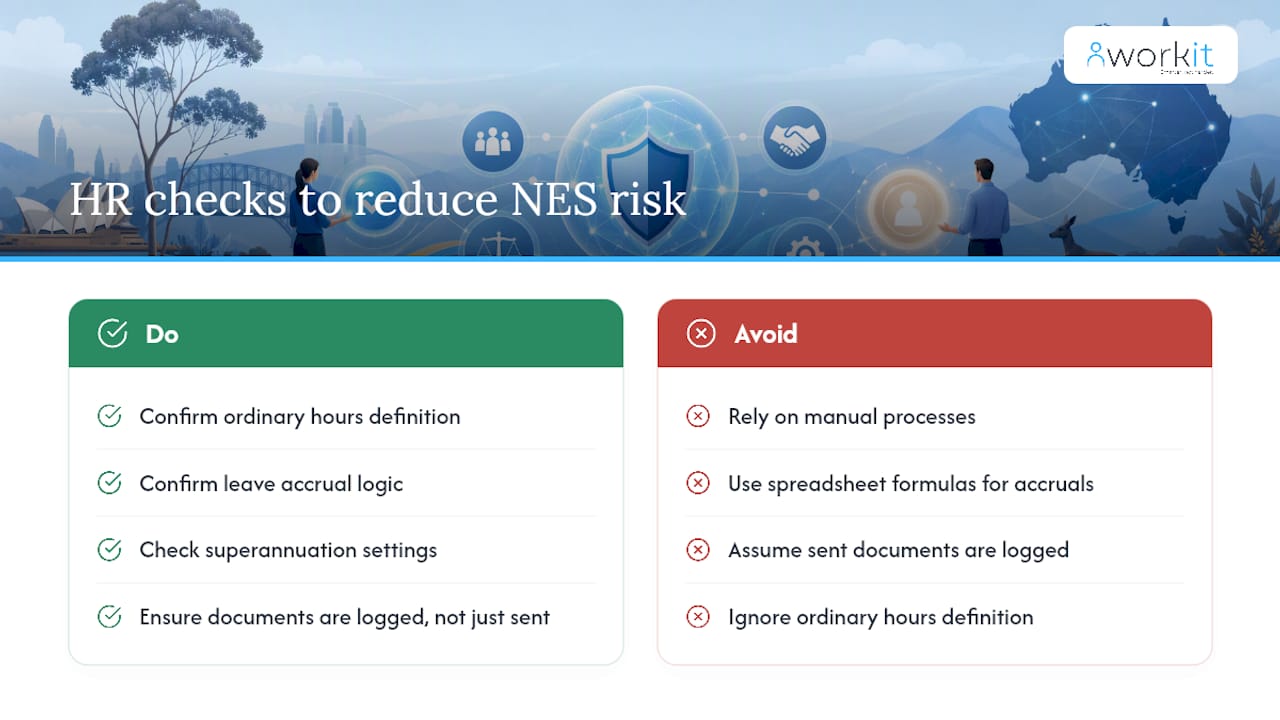
A single HR system removes most of the manual error that causes NES breaches. Automated FWIS and CEIS delivery means every new starter, casual or otherwise, gets the right document at the right time, with a timestamp to prove it. Leave accrual calculations run against real ordinary hours data instead of a spreadsheet formula someone wrote three years ago, and reporting stays audit-ready for payroll reviews or redundancy calculations.
Workit is one option built specifically for this: onboarding, compliance tracking and leave management sitting in one Australian-built platform.
Pro Tip: Whatever system you use, confirm four things before you trust it: the ordinary hours definition, the leave accrual logic, the superannuation settings, and whether document distribution is actually logged, not just sent.
Why the NES should be your floor, not your target
Treating the NES as a compliance checkbox misses the point. They’re the legal minimum, not a benchmark for good employment practice. Businesses that build policies a step above the floor, whether that’s slightly more generous leave or clearer flexible work processes, tend to see it reflected in retention and fewer disputes down the track.
Review your policies against the current award, any enterprise agreement, and the NES itself at least once a year. Entitlements and award rates shift; a policy written in 2022 might already be quietly non-compliant.
Get NES compliance sorted without the spreadsheet chaos
Manually tracking FWIS and CEIS distribution, leave accruals and pro-rata calculations across a growing team is where most NES breaches quietly start, not from bad intentions but from bad paperwork. Workit automates all three: every new starter gets the right information statement logged with a timestamp, leave accrues correctly against real ordinary hours, and compliance reporting sits ready for an audit instead of scattered across three spreadsheets and someone’s inbox.
At $5 per employee per month, every module is included, with local Australian support if something doesn’t look right. If you want to see how it handles onboarding and compliance for a team your size, book a demo and walk through it with your own numbers.
Sources
- National Employment Standards
- Leave - Fair Work Ombudsman
- National Employment Standards — Fair Work Commission (NES PDF)
- Legislation
- National Employment Standards — The Law Handbook
FAQ
What are the 11 NES entitlements?
They’re maximum weekly hours, flexible working requests, casual conversion, parental leave, annual leave, personal/carer’s and compassionate leave, community service leave, long service leave, public holidays, superannuation, notice and redundancy pay, and the Fair Work Information Statement.
What are the five types of leave employees are entitled to?
Annual leave, personal/carer’s leave, compassionate leave, family and domestic violence leave, and community service leave, with eligible employees also able to access up to 12 months unpaid parental leave.
What are the entitlements of part-time employees?
Part-time employees get the same NES protections as full-time staff, but paid leave accrues pro-rata against their ordinary hours rather than the full-time rate.
Are all employees covered by the NES?
Most employees in the national workplace relations system are covered, though casuals receive a narrower set of entitlements and some state public sector employees sit outside the system entirely.
How can employers track NES compliance easily?
A platform like Workit automates FWIS and CEIS distribution and leave accrual tracking, giving employers an audit trail without manual spreadsheet work.