

Open door policy: a practical guide for managers
TL;DR:
- An open door policy provides employees access to management for concerns without fear of retaliation, but many organizations lack effective implementation. Most policies fail because they shift responsibility onto employees, risking retaliation and creating productivity conflicts. Successful policies include clear scope, multiple channels, response timelines, confidentiality guidelines, and manager training to foster trust and meaningful communication.
An open door policy is defined as a formal organisational commitment that gives employees direct access to management to raise concerns, share ideas, or seek guidance without fear of retaliation. The concept sounds simple, but the gap between policy and practice is where most organisations lose ground. Only about 3 in 10 employees believe their opinions count at work. That figure tells you the policy alone is not enough. For managers and team leaders in Australian organisations, building a genuinely accessible communication culture requires structure, consistent behaviour, and the right HR systems to back it up.
What is an open door policy and why does it matter?
An open door policy is a workplace principle that removes formal barriers between employees and management, creating a standing invitation for direct communication. The term is widely used in HR frameworks, including those aligned with the Fair Work Act and Safe Work Australia guidelines on psychological safety. It covers everything from minor workplace concerns to ideas for improvement, and it sits at the foundation of any healthy employee feedback culture.

The policy matters because silence is expensive. When employees cannot raise concerns early, small problems become formal grievances, turnover rises, and trust erodes. Organisations with strong transparent communication practices consistently report higher engagement, lower absenteeism, and faster resolution of workplace issues. The open door principle is not just a feel-good gesture. It is a risk management tool.
Critically, an effective policy includes non-retaliation protections, clear guidelines on what can be raised informally, and defined escalation paths for serious matters. Without those safeguards, the door may be open in name only.
Why do traditional open door policies fail?
The primary failure of most open door policies is placing the entire burden of access on the employee. Access responsibility falls on employees, which causes hesitation and uneven communication across teams. Junior staff, employees from culturally diverse backgrounds, and those in lower-status roles are least likely to walk through that door, regardless of what the policy document says.
The data on retaliation is sobering. Approximately 1 in 5 employees who raise concerns informally experience some form of retaliation. That rate destroys trust quickly. Once word spreads that speaking up carries risk, the policy becomes symbolic rather than functional.
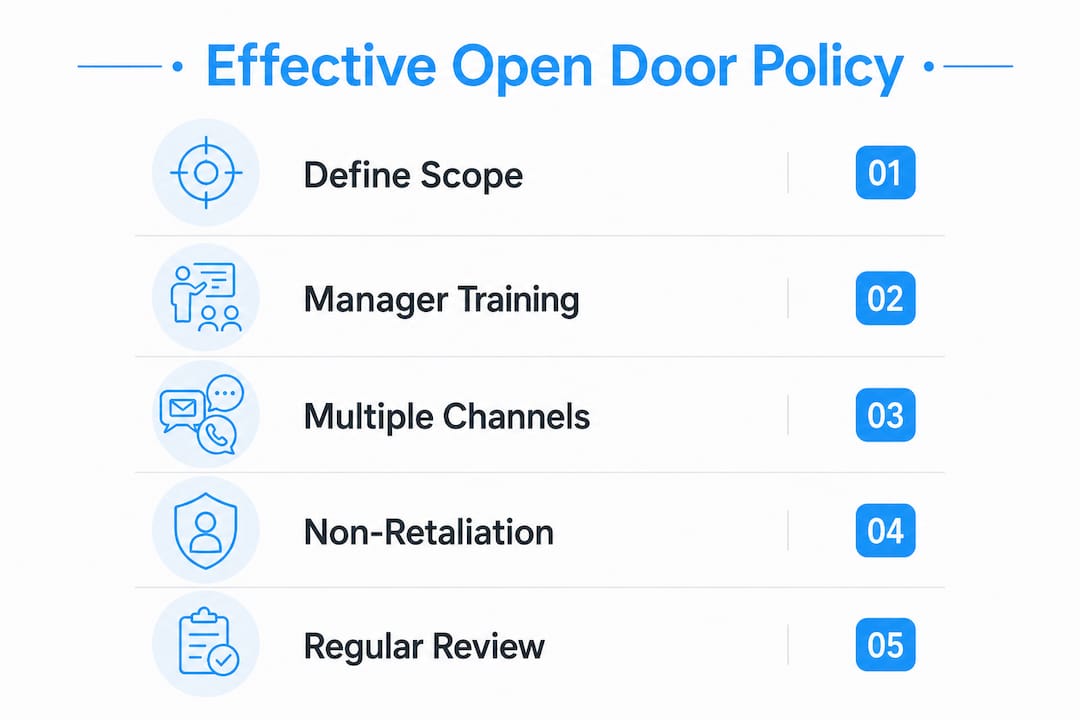
There is also a productivity cost that managers rarely account for. Constant interruptions cost a leader up to 23 minutes of refocus time per interruption. For a manager fielding five unplanned conversations a day, that is nearly two hours of lost deep work. The policy, as traditionally designed, creates a structural conflict between accessibility and effectiveness.
Common reasons traditional policies fall short include:
- No defined scope, so employees do not know what is appropriate to raise informally
- No follow-up process, leaving employees uncertain whether their concern was heard
- Manager behaviour that signals defensiveness or dismissal, even unintentionally
- No alternative channels for employees who are uncomfortable with face-to-face conversations
- Absence of psychological safety, meaning the policy exists but the culture does not support it
Leadership behaviour determines success more than policy language. A well-written document cannot compensate for a manager who reacts defensively or fails to follow up.
Key components of an effective open door policy
A well-designed policy in 2026 goes beyond a single paragraph in an employee handbook. It defines structure, sets expectations, and gives both managers and employees a clear framework to work within.
The core components every policy should include are:
- Clear scope and purpose. State explicitly what types of concerns, questions, and ideas the policy covers. Employees should not have to guess whether their issue qualifies.
- Multiple access channels. Face-to-face conversations are not the only option. Include email, anonymous digital feedback tools, and virtual meeting options for remote or hybrid teams.
- Defined response timelines. Commit to acknowledging concerns within a set period, such as 48 hours, and resolving or escalating within a defined window.
- Confidentiality guidelines. Specify what can be kept confidential and what must be escalated or documented. Ambiguity here destroys trust.
- Non-retaliation protections. Make the consequences of retaliation explicit and ensure managers understand their accountability.
- Escalation paths. Identify when an informal conversation must transition to a formal process, and who is responsible for that transition.
- Semi-annual policy reviews. Reviewing feedback data every six months, including resolution times and employee satisfaction metrics, keeps the policy relevant and effective.
Pro Tip: Schedule a 30-minute manager training session each time you update the policy. A policy refresh without a behaviour refresh achieves very little.
Training managers in active listening and non-defensive responses is not optional. Managerial mindset and behaviour create either trust or silence, and no policy document can substitute for that skill.
How to implement an open door policy that builds trust
Implementation is where most organisations stumble. The policy gets written, announced, and then forgotten. Building a communication culture that actually works requires deliberate, ongoing effort from every manager.
Start with plain language. Your policy document should be readable by a new employee on their first day. Avoid legal jargon, keep sentences short, and use examples to illustrate what kinds of conversations belong in an informal channel versus a formal grievance process. Embedding this into your employee onboarding process sets the right tone from day one.
Practical steps for sustained implementation include:
- Announce the policy with context. Explain why it exists, what it covers, and how it connects to the organisation’s values. A cold policy rollout without explanation signals compliance, not commitment.
- Offer multiple channels. Not every employee is comfortable with direct conversation. Anonymous feedback tools, suggestion systems, and team surveys give quieter voices a way in.
- Close the feedback loop. Without clear follow-up, open door policies become frustrating and symbolic. Tell employees what happened as a result of their input, even if the answer is “we considered it and here is why we did not act.”
- Use scheduled one-on-ones. Managing by walking around and scheduled check-ins improve accessibility without the productivity cost of constant unplanned interruptions.
- Track patterns, not just incidents. Longitudinal data reveals patterns of silence that surveys and intuition miss. If one team never raises concerns, that is a signal worth investigating.
Pro Tip: Review your open door policy metrics alongside your HR reporting data quarterly. Resolution times, repeat issues, and participation rates tell you whether the culture is working, not just the policy.
The manager’s visible behaviour matters more than any written commitment. If you respond to concerns with defensiveness, delay, or dismissal, employees will stop raising them. Consistency over time is what builds the psychological safety that makes the policy real.
What an open door policy does not cover
An open door policy is an early-stage communication tool. It is not a substitute for formal grievance procedures, whistleblower protections, or legal complaint mechanisms. Managers who treat it as a catch-all create risk for themselves and their organisations.
The table below clarifies the distinction between informal and formal channels:
| Situation | Appropriate channel |
|---|---|
| Employee has a concern about workload or team dynamics | Open door, informal conversation |
| Employee wants to share an idea for process improvement | Open door, suggestion system |
| Employee reports bullying or harassment | Formal grievance procedure |
| Employee raises a potential legal or compliance breach | Whistleblower or compliance channel |
| Employee disputes a performance review outcome | Formal HR process |
Open door policies complement formal grievance channels but never replace them. Sensitive matters involving harassment, discrimination, legal risk, or serious misconduct require documented formal processes with independent oversight. Routing these through an informal channel exposes the organisation to liability and the employee to harm.
Managers must also understand confidentiality limits. If an employee raises something that triggers a mandatory reporting obligation, such as a safety incident or suspected misconduct, the manager cannot promise confidentiality. Being upfront about those limits before a conversation begins protects everyone involved. Pairing your open door approach with a clear equal opportunity framework gives employees confidence that serious issues will be handled properly.
An open door policy alone cannot resolve systemic or cultural concerns. Separate anonymous and formal channels are necessary to address the full range of employee experience.
Key takeaways
An open door policy only works when it combines clear structure, consistent manager behaviour, and formal HR processes that handle what informal conversations cannot.
| Point | Details |
|---|---|
| Define scope clearly | Employees need to know what belongs in an informal conversation versus a formal process. |
| Behaviour drives outcomes | Active listening and non-defensive responses matter more than policy language. |
| Protect against retaliation | One in five employees face retaliation for informal concerns, so explicit protections are non-negotiable. |
| Use multiple channels | Anonymous and virtual options give employees who avoid face-to-face conversations a voice. |
| Review data regularly | Semi-annual reviews of resolution times and participation rates show whether the policy is working. |
Why most open door policies are a leadership test, not an HR exercise
I have worked with enough Australian organisations to know that an open door policy is almost always a mirror. It reflects the quality of leadership, not the quality of the document.
The organisations where these policies genuinely work share one trait: their leaders are visibly accountable. They follow up. They say “I heard you, here is what we did.” They do not react defensively when an employee raises something uncomfortable. That behaviour is rarer than it should be.
The uncomfortable truth is that many managers want the credit for having an open door without doing the work it requires. They announce the policy, put it in the handbook, and then wonder why no one uses it. The answer is almost always trust, and trust is built through repeated, consistent action over months and years.
My advice to managers implementing this for the first time: treat the policy as a commitment to your own behaviour, not a communication to your team. Write down how you will respond when someone raises a concern. Practise it. Then hold yourself to it publicly.
The organisations that get this right do not just have better communication. They have lower turnover, faster problem resolution, and teams that actually tell them when something is going wrong before it becomes a crisis. That is the real return on investment.
— Stephen
How Workit supports transparent communication in Australian teams
Building a genuine feedback culture requires more than good intentions. You need systems that track conversations, flag unresolved issues, and give managers visibility across the whole team.
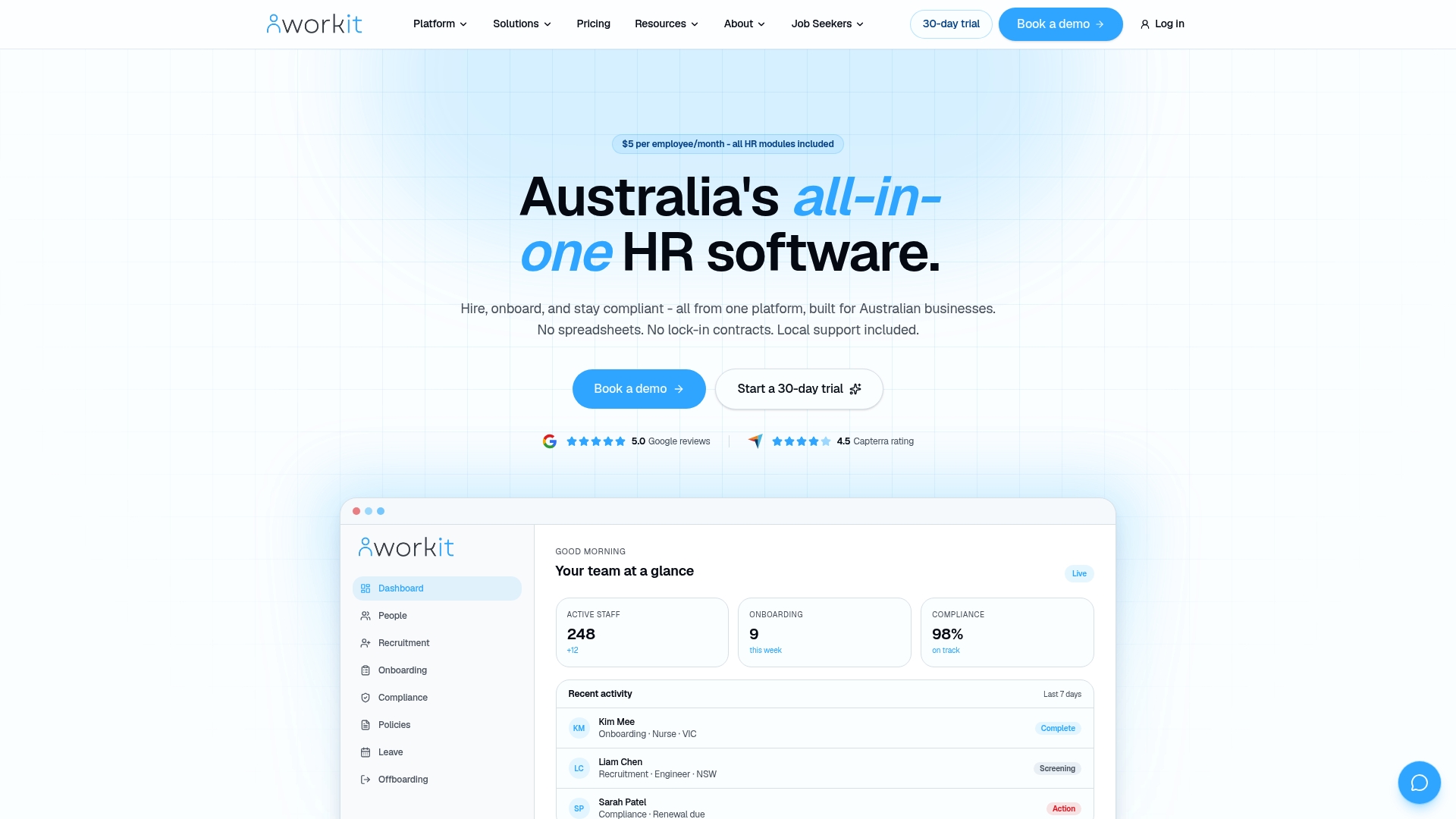
Workit is built for Australian businesses that want HR processes to actually work. The platform supports communication logs, anonymous feedback channels, and compliance management in one place, at $5 per employee per month with no hidden fees. Managers get the tools to balance accessibility with accountability, and HR teams get the reporting they need to spot patterns before they become problems. Book a demo to see how Workit can support your open door policy from day one.
FAQ
What does an open door policy mean in the workplace?
An open door policy is a formal commitment by management that employees can raise concerns, share ideas, or seek guidance at any time without fear of retaliation. It is an informal communication channel, not a substitute for formal grievance procedures.
Why do open door policies often fail?
Most policies fail because they place the burden of access on the employee rather than the system. Research shows only about 3 in 10 employees believe their opinions count at work, and approximately 1 in 5 who raise concerns informally experience retaliation.
How do you implement an open door policy effectively?
Start with plain language, define the scope clearly, offer multiple access channels including anonymous options, and commit to closing the feedback loop. Managers must also model the behaviour the policy requires, including active listening and consistent follow-up.
What issues should go through formal HR processes instead?
Harassment, discrimination, legal compliance breaches, and serious misconduct must go through formal grievance or whistleblower channels. An open door policy is designed for early-stage, informal concerns only.
How often should an open door policy be reviewed?
Semi-annual reviews of feedback data, including resolution times and employee satisfaction, are recommended to keep the policy effective and aligned with organisational changes.