

3–10 Short Pulse Survey Questions and Templates for Australian HR Teams
Use 3 to 10 short questions on a weekly, monthly, or quarterly cadence, depending on your team’s size and pace of change. Repeat one anchor rating question every cycle so you can track trends, and always include one open-text prompt to capture context. Keep the whole survey under two minutes to complete.
TL;DR:
- Running pulse surveys every cycle helps identify issues early, such as workload spikes or disengagement signs, before they escalate.
- Locking in one or two anchor questions and rotating secondary themes maintains trend clarity while preventing survey fatigue.
- Consistent response scales and limiting open-text questions ensure comparability over time and preserve response quality.
- Acting on feedback swiftly and visibly, especially on key trend indicators, sustains participation and builds trust in the process.
- Using existing HR platforms to administer pulses simplifies data collection, safeguards privacy, and ensures continuity in tracking over time.
Table of Contents
- Quick checklist: cadence, length, and who to ask
- Themed question banks: ready-to-use pulse questions
- Rotating pulse questions without wearing your team out
- How to turn pulse responses into action
- Privacy, anonymity, and legal considerations for pulse surveys
- Ready-to-use pulse templates by purpose
- What actually changes once you start pulsing regularly
- Run pulses inside the HR system you already use
- Sources
- FAQ
Quick checklist: cadence, length, and who to ask
Before you write a single question, settle four operational decisions. Get these wrong and even brilliant questions will fail to produce useful data.
Weekly pulses work best for teams navigating a specific change (a restructure, a new manager, a system rollout) and should stay to 3 to 5 questions. Monthly pulses suit most organisations running ongoing engagement tracking, and can stretch to 5 to 7 questions without hurting completion rates. Quarterly pulses give you room for 7 to 10 questions, closer to a mini engagement survey, and work well when you want more depth without committing to a full annual review. Pulse surveys are most effective when they stay brief, at 3 to 10 questions, and are frequent, from weekly to quarterly.
- Weekly: 3–5 questions, best for active change periods or new team formation.
- Monthly: 5–7 questions, the default cadence for ongoing engagement tracking.
- Quarterly: 7–10 questions, useful when you want broader coverage without survey fatigue.
- Whole organisation vs team-level: run org-wide pulses for culture and leadership sentiment; run team-level pulses for workload and manager support, since local issues get buried in aggregate data.
- Anonymity quick check: confirm who can see raw, individual responses before you send anything, not after someone asks.
If you’re choosing between platforms to run this on an ongoing basis, it’s worth checking how each tool handles response confidentiality and reporting before you commit. A buyer guide for HR software can help you compare that alongside other features you’ll need day to day.
Themed question banks: ready-to-use pulse questions
Good pulse questions come from a small number of themes, asked consistently, rather than a long list of one-off ideas. Organising pulse questions by theme, engagement, workload, manager support, recognition, belonging, and development, with one open-text prompt attached, gives each pulse a clear focus. Here’s a working bank you can adapt.
1. Engagement and outcome anchors
These are your repeat-every-cycle questions, the ones that let you build a trend line over months. Keep the wording identical each time you send them.
- “I would recommend this organisation as a great place to work.” (Scale: 1–5)
- “I feel motivated to do my best work here.” (Scale: 1–5)
2. Manager and leadership prompts
Manager relationship questions consistently surface issues before they show up in exit interviews. Rotate these in every second or third cycle rather than every time.
- “My manager gives me useful feedback on my work.”
- “I feel comfortable raising concerns with my manager.”
- “Leadership communicates clearly about what’s changing and why.”
3. Workload and wellbeing items
Workload questions catch burnout risk early, often weeks before absenteeism or turnover data would flag it.
- “My workload is manageable most weeks.”
- “I have enough time to do quality work, not just finish tasks.”
- “I feel able to switch off outside work hours.”
4. Recognition and reward questions
Recognition gaps are cheap to fix and easy to miss without direct asking.
- “I feel recognised for the work I do.”
- “My contributions are noticed by people beyond my immediate team.”
5. Connection, belonging, and culture questions
Belonging measures something distinct from general satisfaction, and it’s worth tracking on its own line. Research on workplace belonging links it to measurable engagement gains, which is reason enough to keep it as a standing theme rather than an occasional add-on.
- “I feel like I belong on this team.”
- “People here respect different perspectives and ways of working.”
- “I have at least one person at work I can rely on.”
6. Development and growth questions
These matter most for retention conversations, particularly with employees under two years’ tenure.
- “I have opportunities to grow my skills here.”
- “I understand what career progression could look like for me.”
7. Short open-ended prompts
One open-text question is enough. Asking for two or three tends to tank completion rates without adding proportional insight. Pairing a numeric score with a short open-text field consistently yields useful context without adding much respondent burden.
- “What’s one thing that would make your work life better this month?”
- “Is there anything on your mind you’d like leadership to know?”
You’ll find longer question lists elsewhere online, some running to 30 or 40 items, and they’re a reasonable source of phrasing ideas. But most guides at that length are built as reference banks, not as pulses you’d actually send, since a real pulse survey stays short and picks two or three themes per cycle, not all of them at once.
Rotating pulse questions without wearing your team out
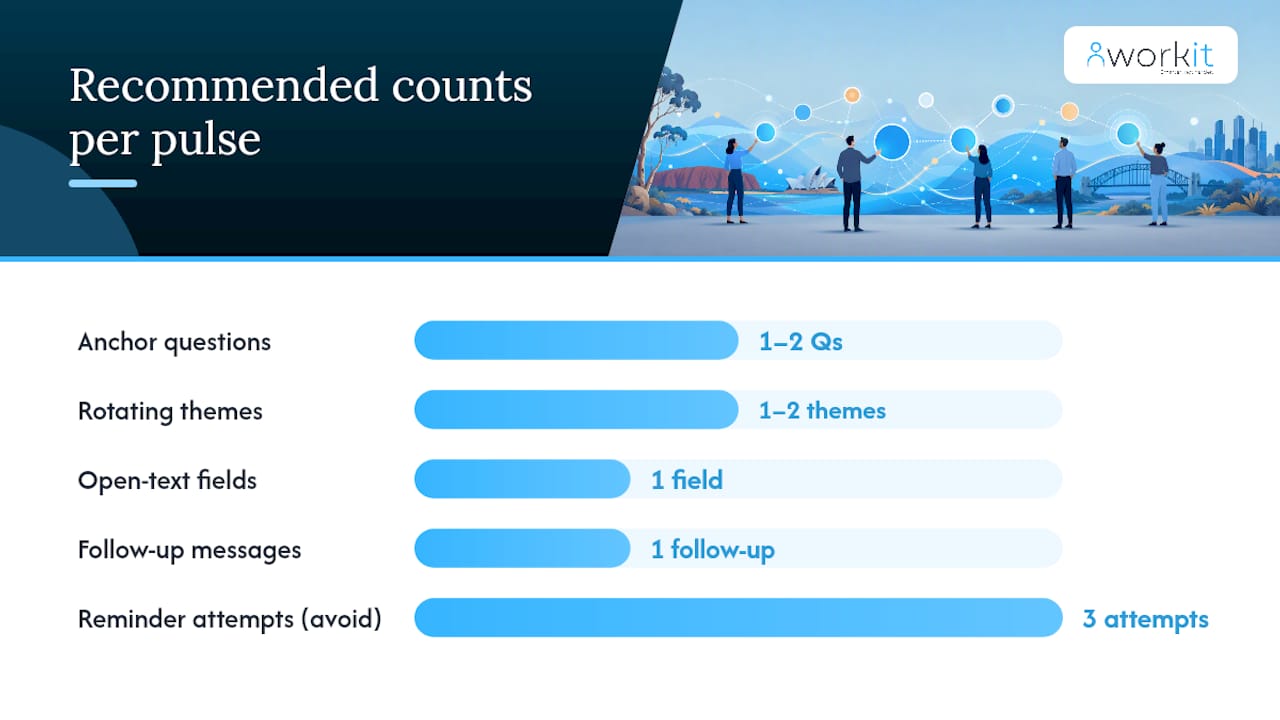
Survey fatigue kills response rates faster than almost anything else, and it’s avoidable with a bit of structure. The strongest pulse programmes repeat one or two anchor questions every cycle and rotate secondary themes underneath them, which keeps the survey fresh while still producing a usable trend line.
- Lock in 1 to 2 anchor questions that never change, so you always have a comparable baseline.
- Rotate 1 to 2 secondary themes each cycle (manager support one month, recognition the next).
- Use the same rating scale every time. Switching between a 5-point and a 10-point scale mid-year makes trend comparisons meaningless.
- Cap the survey at one open-text field per cycle.
- Send pulses at a consistent time, ideally mid-week and mid-morning, and follow up once, not three times.
- If response rates drop below 50% for two cycles running, that’s your signal to shorten the cadence or the question count, not to send more reminders.
Pro Tip: If you’re not sure whether to add a new theme or drop an old one, look at your open-text responses first. If nobody’s mentioning a topic unprompted, it probably doesn’t need its own dedicated question yet.
Scale consistency sounds like a small thing until you try to build a 12-month trend chart and realise half your data points aren’t comparable. Pick one scale format at the start and don’t touch it.
How to turn pulse responses into action
Collecting data is the easy part. Acting on it, visibly, is what actually moves engagement.
Start by tracking your anchor question over time and setting an internal baseline, since a single score means far less than a trend. A rating of 3.8 out of 5 tells you almost nothing on its own, but a drop from 4.1 to 3.6 over two cycles tells you exactly where to look. Anchor questions exist precisely so teams can watch trends develop rather than react to one noisy data point.
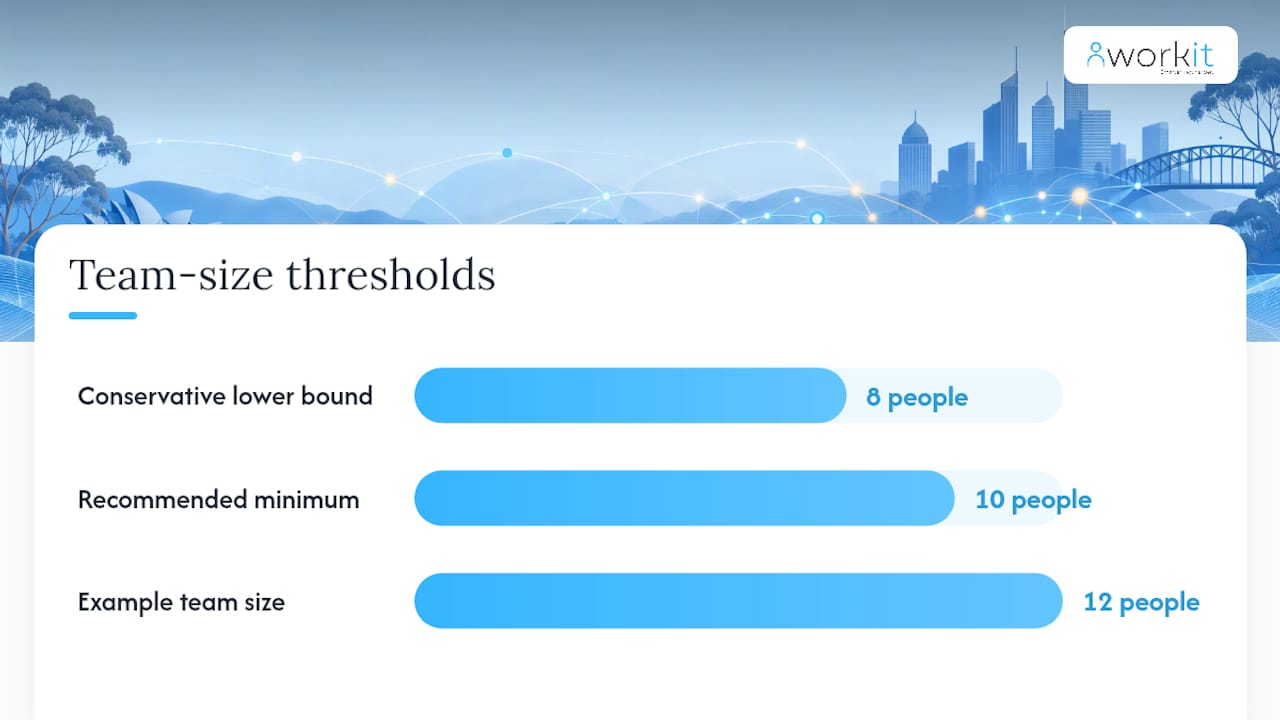
- Segment by team or tenure only when the group is large enough to protect anonymity, generally 8 to 10 respondents minimum.
- Read open-text responses alongside score shifts. Numbers tell you what changed; comments tell you why.
- Prioritise two or three fixes per cycle, assign a named owner, and set a deadline. Long action lists rarely get finished.
- Track a small dashboard: response rate, anchor question trend, and one leading indicator per active theme (workload, recognition, and so on).
- Share what changed back to the team within a few weeks. Visible follow-up is consistently what drives participation in future pulses, more than the survey design itself.
Managers who act on feedback and communicate about it tend to see participation climb over subsequent cycles. Practical guidance on handling difficult follow-up conversations with staff can help managers translate a pulse result into a real conversation rather than a silent shrug.
Privacy, anonymity, and legal considerations for pulse surveys
Be explicit about whether responses are anonymous or simply confidential, and say clearly who can see raw, individual-level data versus aggregated reports. These are different promises, and conflating them erodes trust fast.
For teams smaller than 8 to 10 people, skip granular demographic breakdowns (age, tenure, specific role) entirely. A single “female, under 30, in finance” filter on a 12-person team can identify someone instantly, even with no name attached. Operating in Australia, feedback handling should align with the Australian Privacy Principles, particularly around what’s collected and who can access it.
- State plainly in the survey intro who sees individual responses versus aggregated results.
- Document your data-handling process when using a third-party survey tool, including where data is stored and who has admin access.
- Avoid demographic filters on teams under 10 people.
- Reinforce anonymity by removing IP tracking or timestamp identifiers where the platform allows it.
Practical best practice includes documenting who sees the data and communicating that clearly before the survey goes out, not after someone asks.
Ready-to-use pulse templates by purpose
Three templates cover most situations HR teams face. Copy the structure, adjust the wording to your context.
1. Weekly mood check (3 questions)
- “How are you feeling about work this week?” (1–5 scale)
- “My workload this week felt manageable.” (1–5 scale)
- “Anything you want to flag?” (open text)
2. Monthly engagement pulse (6 questions)
- “I would recommend this organisation as a place to work.” (anchor, 1–5)
- “I feel motivated to do my best work here.” (anchor, 1–5)
- “My manager gives me useful feedback.” (1–5)
- “I feel recognised for my contributions.” (1–5)
- “I feel like I belong on this team.” (1–5)
- “What’s one thing that would improve your work experience this month?” (open text)
3. Post-change pulse (4 questions)
- “I understand why this change happened.” (1–5)
- “I feel prepared for what’s changing.” (1–5)
- “Leadership communicated this clearly.” (1–5)
- “What’s still unclear or concerning to you?” (open text)
- Stick to one scale type across all templates, either 1–5 or 1–10, never both.
- Phrase open-text prompts as invitations, not interrogations. “Anything you want to flag?” gets more honest answers than “Explain your rating.”
What actually changes once you start pulsing regularly
Most organisations underestimate how quickly small, repeated questions surface issues that annual surveys miss entirely, workload spikes tied to a specific project, a manager who’s dropped off on feedback, a team quietly disengaging months before anyone notices in performance data. The pattern that separates programmes that work from ones that fizzle isn’t question design. It’s what happens after the results come in.
Teams that see managers actually respond to pulse feedback keep participating. Teams that watch three cycles go by with no visible change stop bothering, and response rates tell that story faster than any exit interview does.
— Stephen
Run pulses inside the HR system you already use
Running pulse surveys through a separate tool means exporting data, cross-checking it against headcount records, and hoping nobody loses track of who’s opted out of what. Workit keeps pulse results inside the same platform where you already manage onboarding, compliance, and leave, so a workload trend from your pulse can sit next to the roster data that explains it.
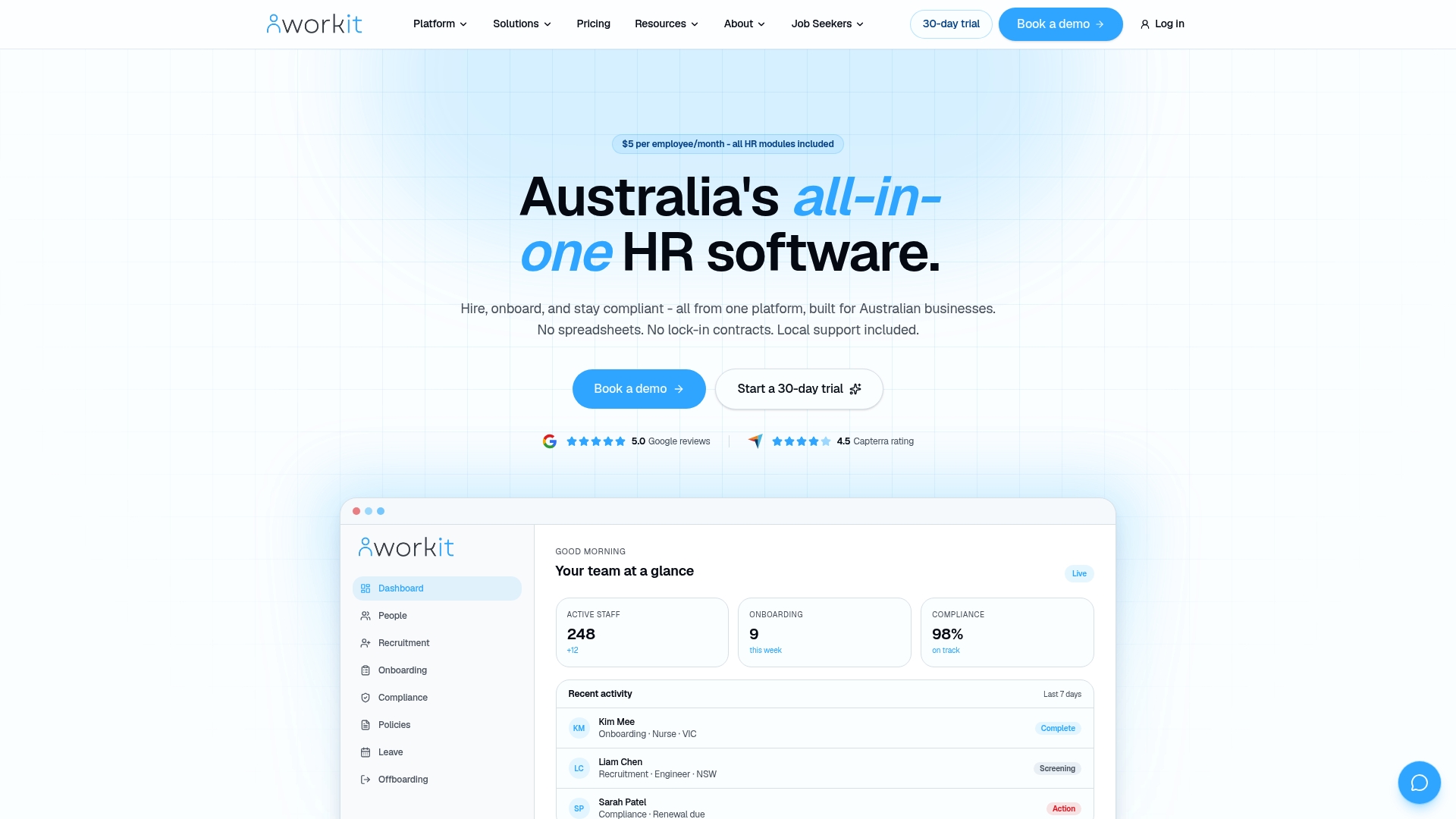
Every module, including reporting and employee self-service, comes under a single flat rate per employee per month, with no separate charge for adding survey or reporting features later. That matters when you’re trying to build a 12-month pulse trend and don’t want a pricing change to interrupt the data. A local support team can also help you set up anonymity settings and data access controls correctly the first time, rather than after a privacy question comes up mid-cycle.
If you’re ready to see how pulse data fits alongside your existing HR records, book a demo and walk through it with the team.
Sources
- Pulse Surveys: Questions, Use Cases + Free Templates
- Pulse Survey: The Complete Guide to Real-Time Feedback - Polling.com
- 37 Enlightening Employee Pulse Survey Questions To Ask
FAQ
What are 5 good pulse survey questions to start with?
A strong starting set covers engagement, manager support, workload, recognition, and belonging: for example, “I would recommend this organisation as a place to work,” “My manager gives me useful feedback,” “My workload is manageable most weeks,” “I feel recognised for my contributions,” and “I feel like I belong on this team.”
What is a good pulse survey score?
There’s no universal benchmark score, since results depend heavily on your scale and baseline. What matters more is the trend: a stable or rising anchor score cycle over cycle signals health, while a sustained drop over two or more cycles signals a problem worth investigating.
Are employee pulse surveys really anonymous?
Anonymity depends entirely on how the survey is set up. Genuinely anonymous surveys strip identifying data and avoid granular demographic filters, while confidential surveys still let a limited group see individual responses, so it’s worth confirming which applies before you answer.
What is a pulse survey?
A pulse survey is a short, recurring questionnaire, typically 3 to 10 questions, sent weekly, monthly, or quarterly to capture real-time employee sentiment, in contrast to a longer annual engagement survey.