

Succession planning: a practical guide for leaders
TL;DR:
- Succession planning involves proactively developing internal candidates for key leadership roles to ensure business continuity. Regular review, knowledge capture, and integrating employee development plans improve long-term readiness and engagement. Focusing on critical roles and combining internal and external talent sources helps organizations manage leadership transitions effectively.
Succession planning is defined as the proactive process of identifying and developing people to fill key leadership roles before those roles become vacant. Nearly one in three CEOs exit their role with little notice, which means organisations without a plan face real disruption. The average CEO tenure runs about eight years, covering roughly two major strategic cycles. That window is shorter than most leaders expect, and it passes quickly when you are focused on running the business.
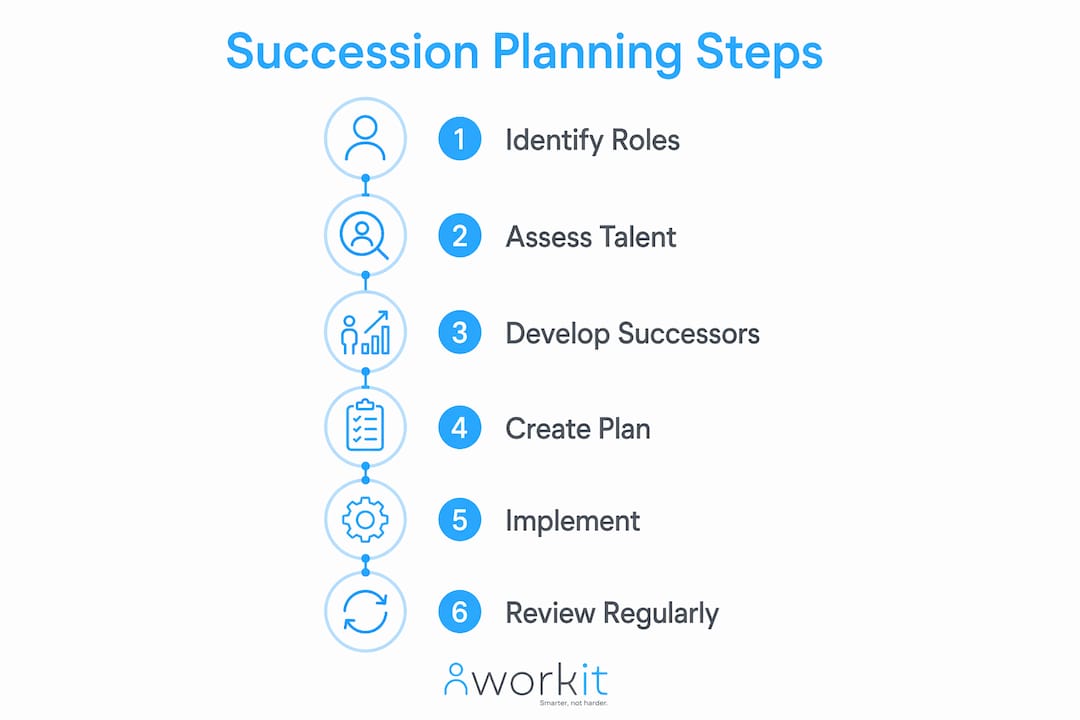
What are the key steps in effective succession planning?
Succession planning is not the same as replacement planning. Replacement planning asks “who covers this role if someone leaves tomorrow?” Succession planning asks “who are we developing right now so the business never misses a beat?” The distinction matters because one is reactive and the other builds lasting capability.

The process follows six clear stages. Each stage builds on the last, and skipping any one of them creates gaps that surface at the worst possible time.
| Step | Action | Purpose |
|---|---|---|
| 1. Identify critical roles | Map roles whose vacancy would disrupt operations | Focus resources where risk is highest |
| 2. Assess bench strength | Rate candidates as ready now, ready in 1–2 years, or long-term | Understand your current pipeline |
| 3. Develop successors | Use stretch assignments, mentoring, and targeted training | Build capability before it is needed |
| 4. Document knowledge | Capture processes, relationships, and institutional knowledge | Prevent knowledge loss during transitions |
| 5. Communicate the plan | Share relevant parts with leaders and HR | Align expectations and accountability |
| 6. Review regularly | Revisit the plan quarterly or after major changes | Keep the plan accurate and current |
The most common mistake organisations make is treating step six as optional. A plan that sits untouched for two years is not a succession strategy. It is a document. Continuous leadership assessments keep the pipeline accurate and aligned with where the business is heading.
Bench strength assessment deserves particular attention. Rate each potential successor against three categories: ready now, ready within one to two years, and a longer-term prospect. This gives you an honest picture of your current pipeline and tells you exactly where development investment needs to go. Without this rating, organisations tend to overestimate how prepared their people actually are.
How to integrate employee development plans into succession planning
An employee development plan (EDP), sometimes called an individual development plan (IDP), is a written agreement between a manager and an employee that outlines the skills to build, the experiences to pursue, and the timeline for doing so. EDPs are the engine of any succession strategy. Without them, employee growth stays opportunistic and reactive rather than deliberate.
The most effective development plans follow the 70-20-10 rule. Effective development plans apply this framework as follows: 70% of learning comes from on-the-job experience, 20% from coaching and feedback, and 10% from formal training or courses. That ratio matters because most organisations get it backwards. They load development plans with courses and workshops, then wonder why successors are not ready when the moment arrives.
Creating a practical EDP does not require a lengthy process. A well-prepared development plan can be completed in a single 60-minute meeting between a manager and an employee. The key is preparation beforehand: the manager reviews performance data, and the employee reflects on their career goals.
Build your EDP process around these steps:
- Hold a career conversation. Ask the employee where they want to be in three to five years. Align that ambition with roles the organisation needs to fill.
- Identify the skill gaps. Compare current capabilities against the requirements of the target role.
- Assign development activities. Apply the 70-20-10 split: prioritise projects and stretch assignments first, then coaching, then formal learning.
- Set milestones. Agree on what “ready” looks like and when you will check progress.
- Review quarterly. A plan reviewed four times a year stays relevant. A plan reviewed annually becomes stale.
Pro Tip: Avoid the common trap of filling a development plan with training courses alone. A course teaches concepts. A stretch assignment builds the judgement and confidence a future leader actually needs.
Employees with clear development plans are 3.5 times more engaged than those without one. Engagement and retention are direct outputs of a well-run succession strategy, not separate HR initiatives.
What are the common challenges in succession planning?
Most succession plans fail for predictable reasons. Knowing the failure modes in advance lets you design around them.
- Knowledge stays in people’s heads. When a key leader leaves without documented processes, relationships, or institutional knowledge, the successor starts from scratch. Knowledge capture is not a nice-to-have. It is the single biggest factor in whether a transition succeeds or fails.
- Plans become static documents. A succession plan written once and filed away reflects the business as it was, not as it is. Business priorities shift, people leave, and new talent emerges. The plan must shift with them.
- The board stays disengaged. Succession planning at the executive level requires board involvement. When the board treats it as an HR task rather than a governance responsibility, the process loses authority and resources.
- The scope stays too narrow. Succession planning must extend beyond the C-suite to build a steady leadership pipeline at every level. A business that only plans for the CEO role will face a crisis when a regional manager or a technical lead departs unexpectedly.
- Diversity gets overlooked. Succession lists that draw from the same pool of candidates year after year produce leadership teams that lack the range of perspective needed to navigate complex markets. Inclusive succession planning drives diverse leadership development and produces better business outcomes.
Pro Tip: Maintain two separate lists: one for emergency coverage (who steps in tomorrow if someone leaves today) and one for long-term development (who we are building for the future). Mixing the two creates confusion and leaves you exposed on both fronts.
Identifying whether an emergency candidate exists for each critical role is the most important first check in any succession audit. If the answer is no for a key position, that is your highest-priority risk.
How to implement and maintain a flexible succession plan
The biggest barrier to starting a succession plan is the belief that it needs to cover every role in the organisation. It does not. Start with the three to five roles whose loss would cause the greatest disruption. That focus keeps the process manageable and delivers immediate risk reduction.
Once you have identified those roles, build flexibility into the plan from the start. Business strategy changes. People change. A succession plan that cannot adapt becomes a liability rather than an asset. Build in a formal review trigger: any significant organisational change, a key departure, or a shift in business direction should prompt a plan update, not just the annual calendar review.
Use visual tools to make the plan accessible. A succession matrix, sometimes called a nine-box grid, plots employees against their current performance and future potential. It gives leadership and HR a shared language for talent conversations and removes the subjectivity that often derails those discussions. Pair the matrix with a simple one-page succession chart for each critical role, showing the current incumbent, the ready-now successor, and the longer-term candidate.
The table below compares two common approaches to succession planning implementation:
| Approach | Strengths | Limitations |
|---|---|---|
| Centralised HR-led process | Consistent methodology, clear ownership | Can feel disconnected from line managers |
| Embedded leadership-led process | Higher engagement, closer to day-to-day reality | Inconsistent quality without HR governance |
The most effective organisations combine both. HR sets the framework and the tools. Line managers own the conversations and the development activities. That combination produces plans that are both rigorous and grounded in reality.
Link your succession process to onboarding and talent management from the start. When a successor steps into a new role, a structured onboarding process reduces the time it takes them to become effective. Succession and onboarding are two parts of the same leadership continuity system.
External talent sourcing also has a role. When internal pipelines cannot fill a gap in the required timeframe, bringing in external candidates is the right call. The goal of succession planning is business continuity, not internal promotion for its own sake. A healthy plan acknowledges both internal development and external recruitment as valid tools.
Pro Tip: Treat talent acquisition and succession planning as connected processes. The skills you recruit for today shape the pipeline you will draw from in three years.
Key takeaways
Effective succession planning is a continuous process of identifying, developing, and documenting talent across every level of the organisation, not a one-time event reserved for the C-suite.
| Point | Details |
|---|---|
| Start with critical roles | Focus on the 3–5 positions whose vacancy would cause the most disruption. |
| Separate emergency and long-term plans | Maintain distinct lists for immediate coverage and future development. |
| Apply the 70-20-10 rule | Prioritise on-the-job experience over formal training in every development plan. |
| Review plans regularly | Quarterly reviews keep succession plans accurate and aligned with business changes. |
| Extend beyond the C-suite | A strong pipeline at every level protects the business from unexpected departures. |
Why succession planning is the risk management conversation most boards avoid
I have worked with leadership teams across a range of industries, and the pattern is consistent. Boards that treat succession planning as a governance priority build organisations that absorb leadership change without crisis. Boards that treat it as an HR administrative task discover its importance at exactly the wrong moment.
The single biggest lesson I have taken from watching succession plans succeed and fail is this: knowledge capture matters more than candidate selection. You can have the right person ready to step into a role, but if the outgoing leader has not documented their key relationships, their decision-making frameworks, or the institutional context behind major commitments, the successor starts at a disadvantage that takes years to overcome.
The second lesson is that agility beats perfection. A succession plan that is reviewed and updated regularly, even if it is imperfect, outperforms a beautifully designed plan that sits untouched. The organisations that handle leadership transitions best are the ones that have made succession a standing agenda item, not a project that gets dusted off when someone announces they are leaving.
Data-driven HR tools are changing what is possible here. When performance management data, development plan progress, and role requirements all live in one system, talent reviews become faster and more objective. That shift from gut feel to evidence is where the real gains are in 2026.
— Stephen
How Workit supports your succession and talent strategy
Building a succession strategy requires more than a spreadsheet and good intentions. You need a system that tracks development plans, monitors progress, and connects your talent data to your broader HR processes.
Workit is built for Australian businesses that want all of that in one place, at $5 per employee per month with no hidden fees. The platform supports employee development plan tracking, performance reviews, and onboarding workflows, giving HR teams and leadership a single source of truth for talent decisions. When a key role becomes vacant, you will know exactly who is ready, what development they have completed, and what the transition plan looks like. Book a demo at Workit’s HR software page to see how it works for your organisation.
FAQ
What is succession planning?
Succession planning is the process of identifying and developing internal candidates to fill key roles before those positions become vacant. It differs from replacement planning by focusing on long-term development rather than short-term coverage.
How often should a succession plan be reviewed?
Succession plans should be reviewed at least quarterly and updated after any significant organisational change, key departure, or shift in business strategy.
Which roles should succession planning cover first?
Start with the three to five roles whose loss would cause the greatest operational disruption. Once those are covered, extend the process to other critical positions across the organisation.
What is the 70-20-10 rule in succession planning?
The 70-20-10 rule allocates development activity as 70% on-the-job experience, 20% coaching and feedback, and 10% formal training. This ratio produces more capable successors than course-heavy development plans.
How does succession planning improve employee retention?
Employees with clear development plans are 3.5 times more engaged than those without one. A visible path to growth gives people a reason to stay and invest in the organisation’s future.