

Long service leave Australia: what employers must know
Yes, Australia has long service leave, and it’s a statutory entitlement, but there’s no single federal law that governs it. Instead, each state and territory runs its own Act, so the rules you follow depend on where your employee works, not just where your business is registered.
The headline figure most Australians know is 8.6667 weeks after 10 years of continuous service with one employer. That’s the benchmark used across most jurisdictions, but it’s not universal. Victoria and the ACT let employees access leave after less than the usual qualifying period, commonly from seven years. South Australia and the Northern Territory offer a bigger slice, around 13 weeks after a decade.
Here’s what shapes your entitlement:
- Which state or territory Act applies to your employment
- How many years of continuous service you’ve clocked up
- Whether an award, enterprise agreement, or portable scheme changes the standard rules
For the authoritative detail, the Fair Work Ombudsman points employees and employers to their relevant state regulator, and NSW Industrial Relations has just refreshed its own guidance to reflect real payroll scenarios.
- Fair Work Ombudsman: national entry point and regulator directory
- NSW Industrial Relations: updated guidance effective 1 March 2026
- Business Queensland: entitlement formula and pro‑rata detail
Pro Tip: Don’t assume your head office state sets the rule for every employee. Long service leave follows the employee’s place of work, so a national team can mean five different sets of obligations running at once.
Key Takeaways
Long service leave in Australia is governed by state and territory law, not a single federal Act, so the correct entitlement depends entirely on where each employee’s role is based.
| Point | Details |
|---|---|
| No single national law | Long service leave rules come from state and territory Acts, so check the relevant regulator for each employee’s location. |
| Headline entitlement varies | Most jurisdictions use 8.6667 weeks after 10 years; Victoria and the ACT allow access from year 7. |
| Pro‑rata depends on the reason | Redundancy, illness, and death commonly trigger early payout; resignation rules differ by state. |
| Ordinary pay excludes overtime | Variable earnings require averaging, commonly over 12 months or 5 years, depending on the jurisdiction. |
| Portable schemes cover mobile industries | Construction, cleaning, security, and community services workers may carry service between employers. |
| Automate multi‑state tracking | Workit’s leave module applies location‑aware accruals and averaging so compliance doesn’t rely on manual spreadsheets. |
Table of Contents
- Long service leave entitlements Australia: state and territory summary
- Who qualifies for long service leave and how is continuous service worked out?
- How to calculate long service leave: formula and worked examples
- Pro‑rata long service leave: when does it apply after resignation or termination?
- How is long service leave paid, and what happens with variable earnings?
- What breaks continuity of service for long service leave?
- Portable long service leave: which industries carry entitlements between employers?
- Do the NES, awards, or enterprise agreements change your long service leave rights?
- How do you request long service leave or lodge a complaint?
- Employer compliance checklist for long service leave across states
- Why accurate long service leave tracking matters more than most businesses realise
- How Workit keeps long service leave compliance simple
- Sources
- FAQ
Long service leave entitlements Australia: state and territory summary
If you employ people in more than one state, this is the section to bookmark. Every jurisdiction agrees on the broad concept of long service leave, but the qualifying period, the number of weeks, and the pro‑rata triggers all shift depending on where your employee clocks in.
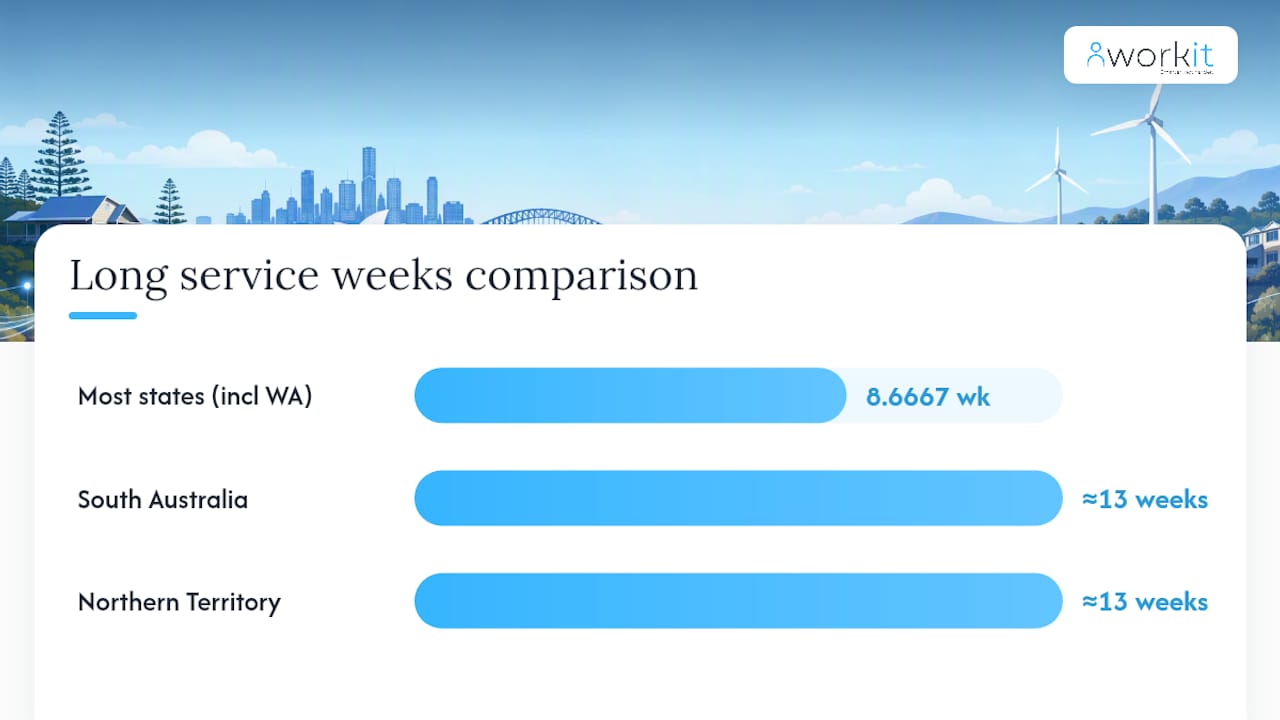
The table below sets out the standard position in each jurisdiction. Treat it as a starting point, not the final word. Awards, enterprise agreements, and portable schemes can all change the numbers for a specific employee.
A few nuances worth knowing before you take any figure at face value:
- Victoria and the ACT both let employees bank pro‑rata leave from year 7, well ahead of the 10 year mark that applies almost everywhere else.
- South Australia and the Northern Territory calculate a larger quantum. Their statutory entitlement sits closer to 13 weeks after 10 years, not the more common 8.6667.
- Western Australia keeps the standard 8.6667 week formula, but pro‑rata rules have their own quirks worth checking against the Act directly.
- Construction, cleaning, community services, and security workers in several states fall under portable schemes rather than the standard employer‑based Act. Coverage differs by jurisdiction, so check the relevant portable authority, not just the general state Act.
The jurisdiction gap that catches employers out most often is the qualifying period itself, a complexity well explained in Understanding Work Rights in Australia for International Students - Fewa Consultancy. A Victorian employee can lawfully ask for pro‑rata long service leave at year 7, while a Queensland employee doing the same job wouldn’t have that right until year 7 only under specified termination reasons, and full entitlement waits until year 10.
Pro Tip: If your team spans states, don’t manage long service leave from a single spreadsheet tab. Build a location tag against each employee record so accrual calculations automatically follow the right Act.
Portable schemes deserve a special mention here because they flip the usual logic. Instead of resetting when someone changes employer, service in a covered industry accumulates across multiple employers, provided the new employer is registered with the scheme. Victoria’s Portable Long Service Authority runs one of the better documented versions of this model, and similar authorities operate in Queensland (QLeave), NSW (Long Service Corporation) and other states for specific industries.
Who qualifies for long service leave and how is continuous service worked out?
Eligibility comes down to two questions: has the employment relationship been continuous, and has it lasted long enough under the relevant state Act? Both sound simple until you factor in casual work, parental leave, and employees who’ve moved between states with the same employer.
Continuous service generally means an unbroken employment relationship with the one employer, even if the type of work or hours changed along the way. Most state Acts count the following toward continuity:
- Periods of paid leave, including annual leave and sick leave
- Absences covered by workers’ compensation (WorkCover) up to a defined limit
- Public holidays and rostered days off within an otherwise continuous engagement
- Short periods of unpaid leave that the relevant Act specifically preserves
What typically breaks continuity is a genuine termination of employment followed by a fresh start with no contractual link back to the earlier period, though even that has exceptions. Some Acts protect continuity where an employee resigns and is re‑employed within a short window, often 12 weeks, depending on the jurisdiction.
Casual and regular‑and‑systematic employees are not automatically excluded. If a casual has worked regular and predictable shifts over a long period, several state Acts treat that work as counting toward long service leave, the same principle the Fair Work Act uses for other entitlements. Part‑time employees accrue on a pro‑rata basis reflecting their average hours, which matters enormously when someone has moved between full‑time and part‑time roles during their tenure.
Where an employee’s role is genuinely based in one state but they occasionally perform duties elsewhere, courts have looked at where the work was contractually located, not just where tasks happened to occur, when deciding which state’s Act applies and whether continuity survived a transfer.
That question of geography matters more than most employers realise. The Business Queensland guidance on continuous service references judicial consideration of service performed partly outside the state, underscoring that the contract’s terms, not simply the employee’s physical location on a given day, often decide which Act governs.
Pro Tip: Document the location basis of every role in the employment contract, not just the mailing address on file. If a dispute ever arises over which state’s Act applies, that clause is often the first thing a regulator or tribunal asks for.
How to calculate long service leave: formula and worked examples
Most jurisdictions use a version of the same formula, expressed clearly in the Business Queensland guidance:
Total ordinary hours worked ÷ 52 ÷ 10 × 8.6667 = weeks of long service leave
Breaking that down:
- Add up ordinary hours worked across the full period of continuous service (excluding overtime).
- Divide by 52 to convert total hours into an average weekly hours figure.
- Divide that by 10 to reflect the 10 year qualifying period.
- Multiply by 8.6667, the standard entitlement figure most states use at the 10 year mark.
Three quick examples show how this plays out in practice:
Full‑time employee, 38 hours a week for 10 years: roughly 8.6667 weeks of leave, paid at their ordinary full‑time rate.
Part‑time employee, averaging 20 hours a week for 10 years: the same 8.6667 week formula applies, but the value of each week reflects their lower ordinary hours, so the payout is proportionally smaller in dollar terms.
Casual employee working regular and systematic shifts averaging 25 hours a week across a decade: many state Acts will count this service, calculating the entitlement using an average of hours worked over a defined period, often the last few years, to smooth out fluctuations.
For payroll teams converting weeks into rostering terms, a standard 38 hour week breaks down like this:
Getting this formula wrong is one of the most common payroll errors Workit sees flagged during compliance reviews, particularly where fluctuating hours or bonuses complicate the “ordinary pay” calculation.

Pro‑rata long service leave: when does it apply after resignation or termination?
Pro‑rata payment is where long service leave law gets genuinely confusing, because the trigger for early payout differs by state and by the reason employment ended.
In broad terms, most jurisdictions allow a pro‑rata payout once an employee has completed somewhere between 5 and 7 years of continuous service, provided the termination happens for a qualifying reason. Common triggers include:
- Redundancy or retrenchment
- Resignation due to illness, incapacity, or domestic or other pressing necessity
- Death of the employee, with the entitlement paid to their estate
- In some states, straightforward resignation after a longer minimum period (often 7 years)
Queensland specifies the qualifying reasons fairly narrowly, while NSW and Victoria tend to be more generous about which resignation circumstances trigger a payout. Always check the applicable Act rather than assuming the rule from one state carries across the border.
Here’s a worked example. An employee with 12 years of continuous service resigns for personal reasons in a jurisdiction using the standard formula. Their entitlement calculation:
- Total ordinary hours over 12 years ÷ 52 ÷ 10 × 8.6667
- This produces a larger figure than the 10 year benchmark, because additional years accrue leave beyond the initial entitlement
- The employer pays out the full accrued balance at termination, calculated at the employee’s ordinary rate
Disputes at termination usually trace back to the same handful of issues: missing employment records from early in the tenure, inconsistent methods for averaging pay, and confusion over whether a resignation reason actually meets the pro‑rata threshold in that state.
Pro Tip: Keep every payslip and contract variation for the life of the employment relationship. Long service leave calculations can span a decade or more, and a gap in records is the single biggest reason employers get the payout wrong.
How is long service leave paid, and what happens with variable earnings?
Long service leave is generally paid at the employee’s ordinary rate of pay, which excludes overtime and most penalty rates. That sounds straightforward for a salaried employee on a fixed wage, but it gets more complicated the moment someone’s earnings fluctuate week to week.
According to Victoria’s guidance on calculating long service leave, where ordinary pay varies, employers typically need to average earnings over a defined period, commonly the last 12 months or, in some states, the last 5 years, to arrive at a fair weekly rate.
Some awards and enterprise agreements go further, requiring certain allowances or loadings to be included in the calculation even though the base Act might exclude them. That’s worth checking before you run any payout, because getting this wrong on a long‑serving employee can mean a meaningful underpayment.
- Base salary and ordinary hourly rate: always included
- Overtime: generally excluded
- Shift and penalty loadings: usually excluded, unless the award says otherwise
- Regular commissions or piece rates: often included via an averaging method
- One‑off bonuses: treatment varies significantly by jurisdiction and award
The averaging window matters more than most payroll teams expect. An employee whose income spiked in the final 12 months before requesting leave could see a very different payout depending on whether the employer uses a 12 month or 5 year average.
Pro Tip: Automate the averaging calculation rather than doing it manually in a spreadsheet. A leave management platform integrated with payroll can apply the correct averaging window per state automatically, cutting the risk of a manual formula error on a high‑value payout.
What breaks continuity of service for long service leave?
Continuity is the quiet dealbreaker in most long service leave disputes. An employee might genuinely believe they’ve hit the qualifying period, only to discover a gap in their record that resets the clock, or an employer might inadvertently break continuity through a well‑meaning but poorly documented restructure.
Absences that typically preserve continuity include paid leave of any kind, WorkCover absences up to the limits set by the relevant Act, and unpaid parental leave, which most jurisdictions now explicitly protect. Re‑employment within a short window, commonly 12 weeks, after a genuine resignation can also preserve continuity in several states, though the exact period and conditions vary.
Absences that can break continuity include extended unpaid leave outside statutory protections, industrial action beyond what the Act allows, and, most commonly, a genuine termination with no contractual bridge back to the earlier employment.
Employers create accidental problems more often than employees do. A common scenario: a business restructures, technically terminates and rehires staff under a new entity, and assumes the slate is wiped clean on long service leave. Several state Acts treat this as a “transfer of business” and preserve continuity regardless of the entity change, provided the work and the employee are substantially the same.
Courts have consistently looked past the corporate mechanics of a restructure to the substance of the employment relationship, asking whether the employee’s role and continuity of service survived in fact, not just whether a new contract was signed.
The Business Queensland material on continuous service also references judicial consideration of service performed partly in another state, reinforcing that where the work was contractually based matters more than where a shift happened to occur on any given day.
Portable long service leave: which industries carry entitlements between employers?
Portable schemes exist precisely because certain industries have historically high job mobility, workers moving between employers every year or two, which would otherwise leave them with almost no long service leave under a standard employer‑based Act.
Industries commonly covered by portable schemes include:
- Building and construction
- Contract cleaning
- Community services
- Security
- Coal mining, in some states
Coverage and the specific authority administering the scheme vary by jurisdiction, so a construction worker in Victoria deals with a different authority than one in Queensland. Victoria’s Portable Long Service Authority explains how service credits accumulate across registered employers within a covered industry, and similar bodies, including QLeave in Queensland and MyLeave for the construction industry in Western Australia, operate the same basic model.
Employers in a portable scheme carry specific obligations: registering with the relevant authority and paying periodic levies based on hours worked or wages paid. Skipping registration in a covered industry is a compliance gap that can surface later as a worker claim.
For employees, the practical steps are straightforward:
- Confirm your industry is covered by a portable scheme in your state
- Register with the authority if your employer hasn’t already done so on your behalf
- Keep payslips as evidence of hours worked with each registered employer
- Submit a claim once you’ve reached the scheme’s qualifying threshold
Pro Tip: If you’re hiring in construction, cleaning, or security, check portable scheme registration before you check the standard state Act. Missing a levy payment is a far more common compliance gap than getting the standard formula wrong.
Do the NES, awards, or enterprise agreements change your long service leave rights?
The National Employment Standards preserve long service leave as a workplace right, but the NES doesn’t create its own national entitlement. Instead, it points back to whichever state or territory law, or pre‑modern award, applied to the employee before the NES came into effect.
This creates a layered system that trips up plenty of HR teams:
- State and territory Acts set the default entitlement for most employees
- Pre‑modern awards, which predate the modern award system, can preserve different and sometimes more generous long service leave terms for specific occupations
- Enterprise agreements can override the state Act if they provide a benefit that’s at least as good overall, though they rarely reduce the statutory minimum
The practical takeaway for employers is a simple checklist item:
- Identify whether any pre‑modern award applies to a role, particularly in older, established industries
- Check whether an enterprise agreement contains specific long service leave clauses
- Compare those terms against the default state Act and apply whichever is more generous to the employee
Getting this wrong usually means underpaying an employee who was actually entitled to better terms under an overlooked award. It’s worth a periodic audit rather than a one‑off check at onboarding.
How do you request long service leave or lodge a complaint?
Requesting long service leave generally starts with a written request to your employer, giving reasonable notice of your preferred dates. Most Acts don’t mandate a specific notice period, but 3 months is a common courtesy standard, longer for extended leave blocks.
For employers, the response should confirm dates in writing, propose alternative timing only where there’s a genuine operational reason, and never simply ignore or indefinitely defer a valid request.
If a dispute arises over eligibility, calculation, or a refused payout, here’s the practical sequence:
- Raise the issue directly with your employer or payroll team first, in writing
- Gather your evidence: employment dates, payslips, any relevant award or enterprise agreement, and correspondence about the leave request
- Contact the relevant state regulator, such as the Long Service Corporation in NSW, QLeave in Queensland, or SafeWork SA, if the matter isn’t resolved internally
- Lodge a formal complaint with that regulator, including your supporting documentation
- Keep every relevant document, even years after the fact. Long service leave disputes often surface long after the events they concern.
- Don’t assume silence from an employer means a request has been refused. Follow up in writing before escalating.
Pro Tip: Most regulators resolve straightforward long service leave disputes faster when the employee provides a complete paper trail upfront. A single missing payslip can add weeks to a claim.
Employer compliance checklist for long service leave across states
Running long service leave well across multiple states comes down to a handful of disciplined habits, not complex legal expertise. Here’s what actually prevents the most common mistakes:
- Map each employee to the correct jurisdiction based on where their role is genuinely located, not just their manager’s office address.
- Confirm the qualifying period and standard weeks for that jurisdiction, remembering Victoria and the ACT differ from the 10 year norm.
- Apply the right accrual and averaging method, particularly for employees with variable pay, commissions, or irregular hours.
- Document continuity carefully, including any restructures, re‑hires, or transfers of business that could affect the calculation.
- Check applicable awards and enterprise agreements for terms more generous than the default state Act.
- Verify portable scheme obligations if you employ people in construction, cleaning, security, or community services.
The NSW Industrial Relations guidance updated for 2026 specifically addresses fluctuating hours and bonus treatment, a useful benchmark even for employers based in other states, since it shows the level of detail regulators now expect employers to get right.
Pro Tip: Schedule a long service leave liability audit annually, not just when an employee approaches their 10 year mark. Catching a miscalculation early is far cheaper than unwinding it after a payout dispute.
Sample evidence worth retaining for any regulator audit includes signed employment contracts, a full payslip history, documented leave approvals, and any correspondence about role transfers or restructures. An HRIS with location‑aware leave accruals can hold all of this in one record rather than scattered across separate systems, which matters enormously if a regulator ever asks for evidence going back a decade.
Why accurate long service leave tracking matters more than most businesses realise
The businesses that get burned on long service leave are rarely trying to cut corners. They’re usually running a manual spreadsheet that made sense with 15 employees and quietly became unmanageable at 150, especially once staff started working across more than one state.
Back pay claims on long service leave tend to be large precisely because the entitlement accrues over 7 to 10 years or more. A calculation error on ordinary pay, or a missed averaging period, doesn’t just cost a few dollars. It compounds across a decade of service and shows up as a five figure liability the moment someone finally takes leave or leaves the business.
Beyond the financial risk, there’s a retention cost too. Long serving employees notice when their entitlements are handled carelessly, and it undermines exactly the loyalty that long service leave was designed to reward in the first place. Getting this right isn’t just a compliance exercise. It’s part of how a business signals that it takes its longest serving people seriously.
How Workit keeps long service leave compliance simple
Workit handles the part of long service leave that trips up most Australian businesses: applying the right rules automatically for every employee, no matter which state or territory they work in.
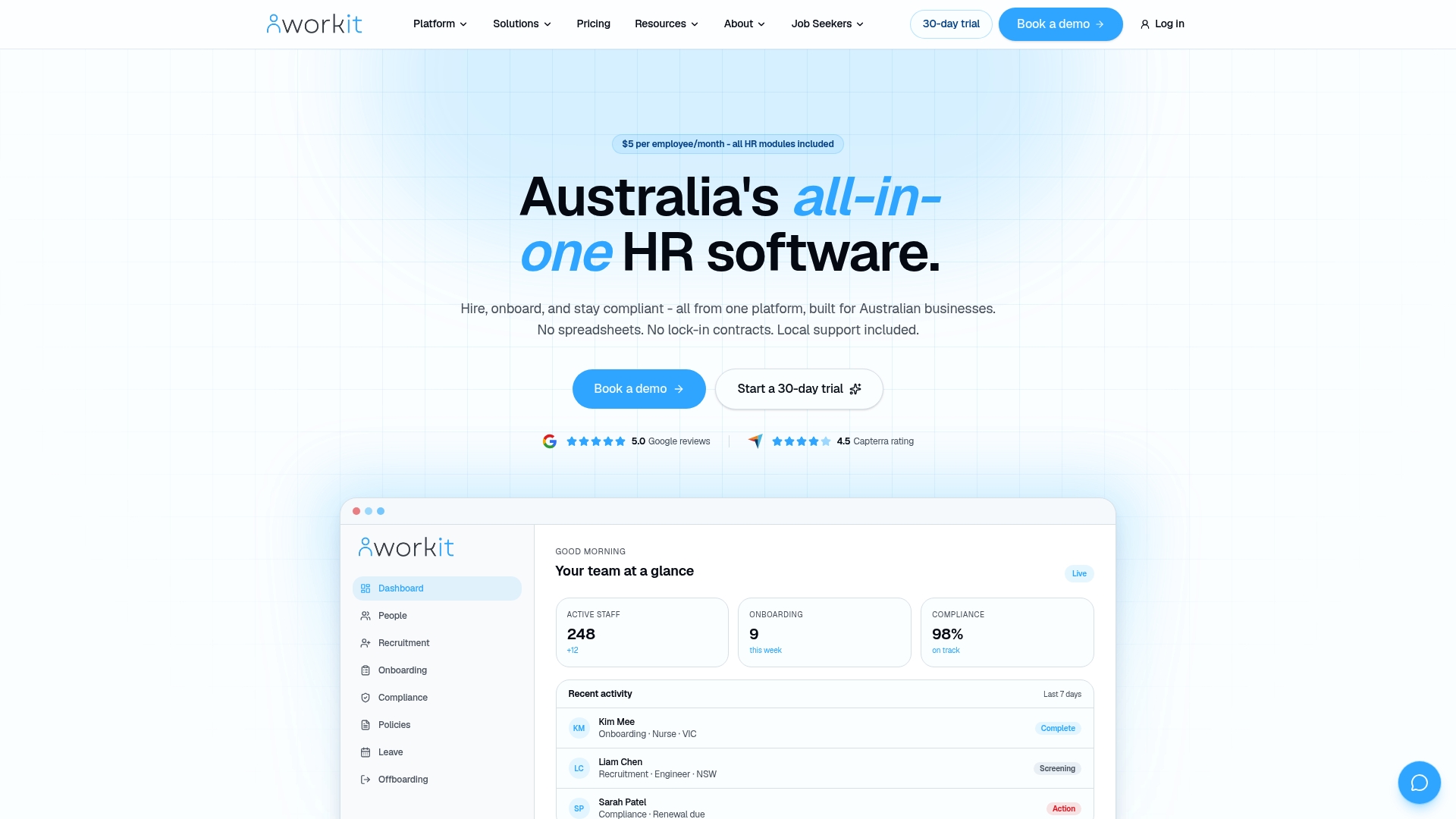
Instead of a shared spreadsheet with state exceptions bolted on as afterthoughts, Workit’s leave tracking module applies location‑aware accrual logic per employee, so a Victorian team member and a Queensland team member are calculated correctly without anyone manually adjusting a formula. Payroll averaging for variable earnings runs against the same HRIS record used for onboarding and compliance, giving you one source of truth instead of three disconnected systems.
For businesses managing teams across multiple states, this means fewer underpayment risks, faster and more accurate claims processing, and a clear audit trail if a regulator ever asks for evidence. Every module, including leave, compliance, and reporting, comes included in Workit’s transparent $5 per employee per month pricing, with real Australian support behind it.
Ready to see it in action? Book a demo and walk through how Workit applies your state’s long service leave rules automatically.
Sources
Check these regulator pages directly for the specifics of your jurisdiction, since award and enterprise agreement terms can differ from the standard Act:
- Long service leave
- Long Service Leave guidance (NSW Industrial Relations)
- What is portable long service leave (Victoria PLSA)
Always cross‑check any applicable award or enterprise agreement, since it can provide more generous terms than the state Act alone.
This article is general information, not a substitute for advice from a qualified lawyer. Consult a qualified legal professional about your own circumstances before acting on anything here.
FAQ
How long do you get for long service leave in Australia?
Most jurisdictions provide 8.6667 weeks after 10 years of continuous service, though Victoria and the ACT allow access from 7 years, and South Australia and the Northern Territory offer around 13 weeks.
Do you get pro‑rata long service leave after 7 years if you resign?
In several states, including Victoria and the ACT, resignation after 7 years can trigger a pro‑rata payout, but other states, including Queensland, limit pro‑rata resignation payouts to specific qualifying reasons.
How much long service leave do you get after 10 years of service?
The standard entitlement in most states is 8.6667 weeks, calculated using the formula of total ordinary hours divided by 52, divided by 10, then multiplied by 8.6667.
How many weeks is 7 years’ pro‑rata long service leave?
Victoria and the ACT both let employees access pro‑rata leave from year 7, with the exact figure and eligibility depending on the state’s Act and the reason for leaving.
Does long service leave work the same for casual employees?
Casual employees working regular and systematic hours can still qualify in most states, with entitlements calculated using an average of hours worked over a defined period rather than a fixed weekly rate.
Can a business automate long service leave calculations across states?
Yes. An HRIS with location‑aware leave logic can apply the correct state formula, qualifying period, and averaging method per employee automatically, reducing the manual errors common in spreadsheet‑based tracking.