

BambooHR alternatives for Australian HR teams: 2026 guide
For most Australian businesses, the best BambooHR alternative is a locally built, all-in-one HRIS with native STP Phase 2 and superannuation support — and Workit is the recommended starting point for most local teams. BambooHR is a capable platform, but it was built for the US market. Australian employers running multi-award environments, state-specific long service leave, and ATO-mandated STP Phase 2 reporting need a system where those requirements are core features, not bolt-ons.
Here is a quick shortlist of the three categories worth evaluating:
- Local all-in-one HRIS (e.g. Workit): best for Australian businesses of any size that want a single vendor covering HRIS, onboarding, compliance, and payroll integration without custom configuration. Ratings on Capterra and G2 consistently show that local compliance gaps are the top reason Australian buyers switch away from BambooHR.
- Global mid-market HRIS (e.g. HiBob, Employment Hero): best for mid-sized employee businesses that want modern people-experience features and can manage a separate payroll connector.
- Enterprise HCM suites (e.g. Workday, ADP): best for organisations above 500 employees with dedicated HR and IT teams to manage implementation and ongoing configuration.
Implementation risk is a real decision factor. Switching HRIS mid-year, particularly around payroll cut-overs, carries compliance exposure. Choose a vendor with a documented migration process and local support available during business hours.
Pro Tip: Before you shortlist any vendor, confirm they can demonstrate STP Phase 2 reporting and superannuation handling in a live environment — not just on a slide deck. This single test eliminates a large portion of global platforms from contention immediately.
Table of Contents
- How do the main BambooHR alternatives compare for Australian buyers?
- Which BambooHR alternative is right for your situation?
- How do you choose the right BambooHR alternative for your organisation?
- What does pricing and migration actually cost in Australia?
- Why Workit is the recommended BambooHR alternative for most Australian teams
- What is the final recommendation for Australian HR teams?
- Key takeaways
- The honest view on HRIS selection in Australia
- Ready to see Workit in action?
- Useful sources and further reading
- FAQ
How do the main BambooHR alternatives compare for Australian buyers?
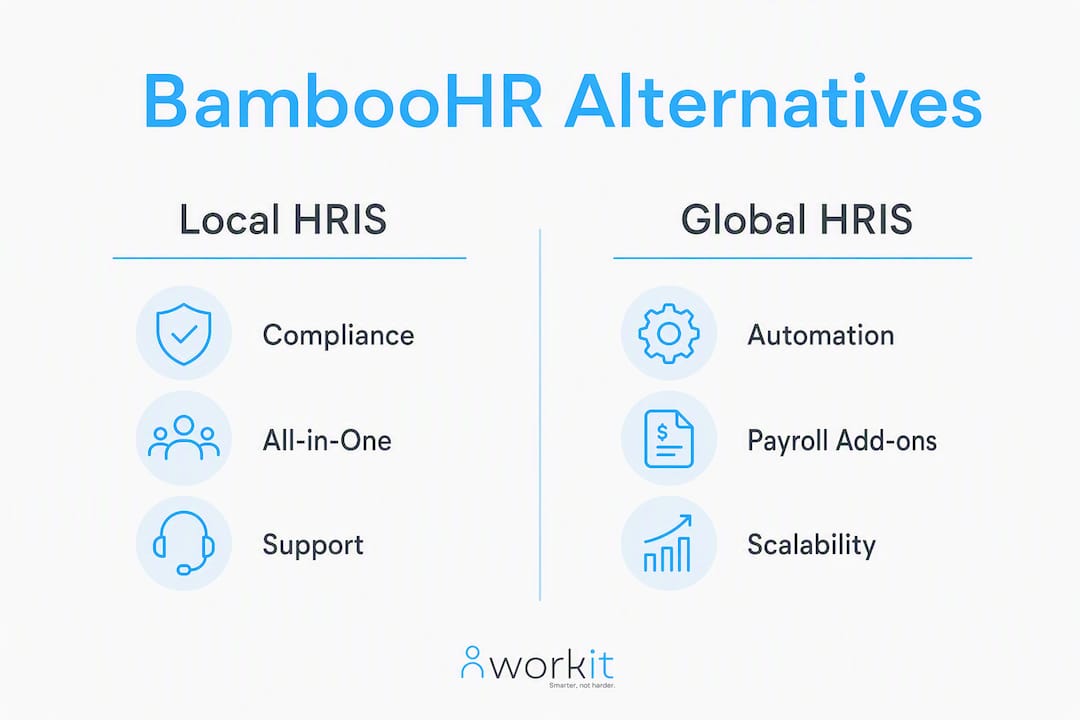
The table below maps five vendor categories across the dimensions that matter most to Australian HR and payroll teams. Use it to identify which category fits your organisation before booking demos.
| Dimension | Local all-in-one HRIS | Global mid-market HRIS | Payroll-first platforms | Enterprise HCM suites | Specialist point solutions |
|---|---|---|---|---|---|
| Best for | SMBs to mid-market (20–500 staff) | Scale-ups (50–500 staff) | Payroll-heavy SMBs | Enterprise (500+ staff) | Specific gaps (ATS, engagement) |
| Pricing model | Per employee/month, all modules included | Per employee/month, modular add-ons | Per employee/month + payroll fees | Custom enterprise contract | Per user/month or flat fee |
| STP Phase 2 & super | Native, built-in | Often via third-party connector | Native payroll engine | Requires local payroll bolt-on | Rarely included |
| Core features | Onboarding, ATS, performance, leave, reporting, compliance | Onboarding, people analytics, performance, leave | Payroll, leave, basic HRIS | Full HCM suite, workforce planning | Single module depth |
| Integrations | Xero, MYOB, KeyPay (two-way sync) | Xero, MYOB via connectors | Xero, MYOB native | SAP, Oracle, custom API | Varies widely |
| Local support | Australian team, local hours | Regional support, variable SLAs | Australian team for payroll | Partner-led, often offshore | Vendor-dependent |
| Scalability | 20–500+ employees | 50–500 employees | 10–300 employees | 500+ employees | Unlimited, but narrow |
| Deployment time | 2–8 weeks | 4–8 weeks | 2–6 weeks | 3+ months | 1–4 weeks |
| Trial/demo | Free demo, 30-day trial available | Demo on request | Free trial common | Structured POC process | Free trial common |
Key pricing and integration notes:
- Local all-in-one platforms typically start at $5 per employee per month with all modules included, making total cost of ownership predictable.
- Global mid-market platforms often start at a similar per-seat rate but charge separately for payroll connectors, advanced analytics, or additional modules.
- Xero and MYOB are the dominant payroll and accounting integrations for Australian SMBs; KeyPay (now Employment Hero Payroll) is widely used for award interpretation.
- Two-way payroll sync — where HRIS and payroll each remain the source of truth for their respective data — is the standard to demand, not a premium feature.
Which BambooHR alternative is right for your situation?
Workit — recommended for most Australian teams
Workit is an all-in-one HRIS built specifically for Australian businesses. Every module — recruitment, onboarding, compliance, performance, leave, learning, incident reporting, policy management, and offboarding — is included at a flat $5 per employee per month. There are no module tiers, no hidden fees, and no separate payroll engine to licence.

Core features: Applicant tracking, digital onboarding, employee self-service, compliance tracking, performance reviews, leave management, custom forms and approvals, policy distribution, real-time reporting, and Xero integration.
Pros:
- All modules included at one transparent price
- Built for Australian compliance from day one (STP Phase 2, superannuation, Fair Work)
- Local support team available during Australian business hours
- Fast deployment: most SMBs go live within 2–8 weeks
Cons:
- Newer to market than some global platforms, so the case study library is still growing
- Enterprise-scale workforce planning tools are less deep than dedicated HCM suites
Australian compliance note: Workit’s payroll integration with Xero supports two-way sync, so leave balances and employee data stay consistent across both systems without manual re-keying.
Ideal for: Australian businesses from 20 to 500+ employees that want one vendor, one price, and a support team that understands local employment law.
Local all-in-one HRIS (other Australian vendors)
Several Australian-built platforms compete in this space, including Employment Hero. These platforms treat Australian tax, superannuation, and award rules as core features rather than customisations, which reduces integration fragility compared to global alternatives.
Pros:
- Strong native payroll and compliance handling
- Award interpretation built in or tightly integrated
- Local implementation partners available
Cons:
- Pricing can become complex as modules are added
- Some platforms bundle payroll separately, which changes the total cost picture
Australian compliance note: Local providers treat Australian tax and superannuation as core features, not customisations. Confirm whether award interpretation is native or relies on a third-party engine before signing.
Ideal for: Businesses with complex award structures or multi-state operations that need proven local compliance depth.
Global mid-market HRIS (HiBob / bob)
HiBob is a modern people platform with strong engagement, performance, and analytics features. It is popular with scale-ups and technology companies that prioritise employee experience. For Australian payroll, it typically requires a connector to a local payroll engine.
Pros:
- Modern, intuitive interface with strong people analytics
- Good performance and engagement tooling
- Active product development roadmap
Cons:
- Australian payroll requires a third-party connector, adding cost and integration risk
- STP Phase 2 and super handling depend on the connected payroll system, not HiBob itself
- Support hours may not align with Australian business hours
Australian compliance note: Global mid-market platforms excel at automation but can require bolt-on payroll for Australia, introducing sync dependencies that break during vendor updates.
Ideal for: Tech-forward scale-ups (50–300 staff) that already have a payroll system and want to improve the people experience layer.

Payroll-first platforms (ADP Australia, Zoho People)
Payroll-first platforms lead with payroll as the primary engine and layer HR modules on top. ADP has a long-standing Australian presence with native STP and super support. Zoho People is a cost-effective option for smaller teams, though its Australian payroll compliance relies on integration with Zoho Payroll or a third-party system.
Pros:
- Strong payroll accuracy and compliance for ADP
- Zoho People offers a low entry price point for budget-conscious teams
- Established vendor relationships with Australian accountants and bookkeepers
Cons:
- HR experience features (onboarding, performance, engagement) are often secondary to payroll
- Zoho’s award interpretation for complex Australian awards requires additional configuration
- ADP’s pricing is not publicly listed and tends to suit larger organisations
Australian compliance note: ADP’s Australian platform supports STP Phase 2 natively. Zoho People’s compliance depth depends on which payroll system it connects to.
Ideal for: Businesses where payroll accuracy is the primary concern and HR experience features are a secondary priority.
Enterprise HCM suites (Workday)
Workday is a full human capital management suite used by large Australian organisations. It covers workforce planning, talent management, payroll, and advanced analytics at a depth that smaller platforms cannot match. The trade-off is significant: implementation typically takes months, requires dedicated project teams, and carries a price tag that suits organisations with 500 or more employees.
Pros:
- Deep capability across the full employee lifecycle
- Strong analytics and workforce planning
- Established in large Australian enterprises and government
Cons:
- Implementation timelines of several months are common
- Requires dedicated HR, IT, and finance resources to manage
- Cost is prohibitive for most SMBs and mid-market organisations
Australian compliance note: Workday supports Australian payroll through its own payroll module, but configuration for complex awards and enterprise agreements requires specialist implementation partners.
Ideal for: Organisations above 500 employees with the budget and internal resources to run a full HCM implementation.
Specialist point solutions
Tools like standalone ATS platforms, engagement survey tools, or performance management apps solve one problem well. They are useful when you already have a solid HRIS and need to plug a specific gap. Free options such as Zoho People’s free tier, OrangeHRM, and Bitrix24 exist for very small teams, though free tools often lack native Australian payroll and award interpretation.
Pros:
- Low cost or free entry point
- Deep functionality in one specific area
- Fast to deploy
Cons:
- Integration work multiplies as you add more point solutions
- No single source of truth for employee data
- Compliance gaps are common, particularly around STP and super
Ideal for: Teams with a specific, well-defined gap and an existing HRIS that covers everything else.
Pro Tip: During any demo, ask the vendor to walk through a long service leave calculation for an employee who has worked across two Australian states. This scenario exposes gaps in award and compliance handling faster than any standard demo script.
How do you choose the right BambooHR alternative for your organisation?
The single best screening question is this: does the vendor provide native STP Phase 2 and superannuation handling, or does it depend on a third-party connector? Systems that allow employees to input their TFN and super choices directly into a payroll-linked portal reduce manual re-keying and compliance errors significantly. If the answer is “we integrate with a payroll system,” ask exactly which system, how the sync works, and what happens when the payroll vendor updates their API.
Vendor evaluation checklist
- Leave management: — Does it handle all leave types under the Fair Work Act, including state-specific long service leave variations?
- Security: Does the vendor align with the ASD Essential Eight cybersecurity framework? Where is data hosted?
Questions to ask on vendor demos
- Show me STP Phase 2 reporting in a live environment, not a sandbox.
- How does your system handle long service leave for an employee who has worked across Victoria and Queensland?
- What happens to our data if we cancel our subscription?
- Who do we call at 4 PM on a Thursday when payroll has an error?
- Can you show me a two-way sync between your HRIS and Xero, including a leave balance update?
- What is your average implementation timeline for a business our size?
- How do you handle award interpretation for [your specific award]?
- What does your data migration process look like, and who owns it?
- How do you handle system updates that affect payroll integrations?
- What does your onboarding process include, and is there a dedicated implementation contact?
Red flags to watch for
- Vendor cannot demonstrate state-specific long service leave in a live environment.
- Payroll compliance depends on an unsupported or end-of-life bolt-on.
- Pricing is opaque or changes significantly once implementation and connectors are added.
- Support is offshore only, with no Australian-hours SLA for payroll issues.
- Demo flows are polished but the vendor resists testing your specific use cases.
Pro Tip: Run a technical pilot with your most complex employee group before signing any contract. If your organisation has employees under multiple awards or across multiple states, that group is your test case. A vendor that performs well in a standard demo but struggles with your real data is telling you something important.
What does pricing and migration actually cost in Australia?
Cost components to budget for
Licence fees are only one part of the total cost. Australian buyers should budget across these categories:
- Licence/subscription: Per employee per month, typically covering all or some modules depending on the vendor.
- Implementation and setup: Ranges from included (some local vendors) to tens of thousands of dollars for enterprise deployments.
- Payroll connector fees: Third-party connectors between HRIS and payroll engines carry their own licence costs and ongoing maintenance.
- Data cleansing and migration: Cleaning historical employee data before migration is often underestimated. Budget time and internal resource, not just vendor fees.
- Training: End-user training for HR teams, managers, and employees. Some vendors include this; others charge separately.
- Ongoing support and maintenance: Annual support contracts, system updates, and configuration changes as your business grows.
Typical deployment timelines and cost ranges
| Business size | Discovery & scoping | Pilot & configuration | Data migration | Go-live & training | Typical total timeline |
|---|---|---|---|---|---|
| SMB | Discovery and setup through go-live generally takes several weeks | ||||
| Mid-market | Discovery and setup through go-live generally takes a few months | ||||
| Enterprise | Discovery and setup through go-live generally takes multiple months |
Data migration checklist
Before you migrate, confirm you have exported and validated:
- Employee master data (names, addresses, employment types, start dates)
- TFN declarations and superannuation fund details
- Leave balances (annual, personal, long service, and any accrued entitlements)
- Historical payslips and payroll records (minimum seven years for ATO compliance)
- Position and organisational structure data
- Performance review history
- Onboarding and compliance document records
- System owner and admin contacts for both old and new platforms
- Payroll reconciliation report from the final pay run in the old system
- Cutover plan with rollback criteria if the go-live encounters a critical issue
The payroll integration cutover is the highest-risk moment in any migration. Run a parallel payroll for at least one pay cycle before decommissioning the old system.
Why Workit is the recommended BambooHR alternative for most Australian teams
Workit was built from the ground up for Australian businesses. That distinction matters in practice: STP Phase 2 reporting, superannuation handling, Fair Work compliance, and award-aware leave management are not configuration options — they are standard features available to every customer from day one.
Flat low per employee monthly pricing — all modules included. No per-module fees, no hidden costs, no surprises when you add a new HR function. Optional paid implementation services are available for teams that want a managed go-live.
Three scenarios where Workit is the preferred choice:
- Small business, one vendor: A business with 30–80 employees that wants recruitment, onboarding, compliance, leave, and performance in one place without managing multiple vendor relationships or integrations.
- Multi-state employer with award complexity: An employer with staff across several states, under multiple awards, who needs leave balances and compliance tracking to stay accurate without manual reconciliation.
- Not-for-profit with a constrained budget: A not-for-profit organisation that needs a full-featured HRIS at a predictable, per-head cost with no module surprises.
Workit integrates with Xero for two-way payroll sync, so leave approvals, employee changes, and payroll data stay aligned across both systems. The local support team operates during Australian business hours, which means you get a real person when payroll has an issue, not a ticket queue.
For a successful demo, bring:
- A sample of your most complex employee records (multi-award, multi-state if applicable)
- Your current leave balance data
- A list of your existing integrations (payroll, accounting, identity provider)
- Key stakeholders from payroll and finance, not just HR
Workit’s HRIS module overview covers the full feature set if you want to review modules before booking time with the team.
What is the final recommendation for Australian HR teams?
For most Australian organisations, Workit is the right starting point. It covers the full HRIS lifecycle at a transparent price, with local compliance built in and a support team that operates in your time zone.
When to consider a different category:
- If you are above 500 employees with complex workforce planning needs, evaluate enterprise HCM suites with a dedicated implementation partner.
- If your primary pain point is payroll accuracy and your HR needs are minimal, a payroll-first platform may be a better fit.
- If you already have a solid HRIS and need to plug one specific gap, a specialist point solution is faster and cheaper than switching platforms.
Next steps
- Run a pilot with your complex use case. Before signing anything, test the vendor with your most complex award or leave scenario. A 30-day trial with real data tells you more than any demo.
- Book a demo and include payroll and finance stakeholders. HR should not evaluate HRIS alone. Payroll accuracy and finance reporting are shared concerns, and those teams will surface questions HR might miss.
- Test two-way payroll sync during the pilot. Make a leave change in the HRIS, confirm it flows to payroll, and make a payroll change to confirm it flows back. If the sync breaks in a controlled test, it will break in production.
Book a Workit demo and bring your data pack. The team will walk you through payroll sync, compliance reporting, and onboarding in a session built around your actual business.
Key takeaways
For most Australian businesses, the right BambooHR alternative is a locally built, all-in-one HRIS with native STP Phase 2 and superannuation support — and Workit delivers exactly that at $5 per employee per month with all modules included.
| Point | Details |
|---|---|
| Prioritise native STP and super support | Confirm STP Phase 2 and superannuation handling are built in, not reliant on a third-party connector. |
| Demand two-way payroll sync | One-way data pushes cause drift between payroll and HR records; two-way sync keeps both systems accurate. |
| Match vendor category to company size | Local all-in-one platforms suit 20–500 staff; enterprise HCM suites are typically overkill below 500 employees. |
| Budget beyond the licence fee | Implementation, payroll connectors, data migration, and training add to total cost of ownership. |
| Workit for most Australian teams | Workit covers the full HRIS lifecycle at $5 per employee per month with local support and Xero integration. |
The honest view on HRIS selection in Australia
Most Australian HR teams spend too long evaluating software features and not long enough testing real-world compliance scenarios. A platform with a polished onboarding flow and a beautiful dashboard is not worth much if it cannot handle long service leave across two states or produce an STP Phase 2 report without manual intervention.
The other mistake is framing the selection purely as an HR decision. HRIS procurement works best when it is framed around operational friction — payroll errors, offer-to-hire delays, compliance gaps — because that framing secures budget and gives you clear success metrics. When HR, payroll, and finance evaluate together, the right platform becomes obvious faster.
Global platforms are not inherently worse than local ones. But for Australian businesses under 500 employees, the integration overhead of connecting a global HRIS to a local payroll engine, and then maintaining that connection through vendor updates, is a real and ongoing cost. Local platforms that treat Australian compliance as a core feature, not a customisation, remove that overhead entirely.
Workit was built for exactly this market: Australian businesses that want one platform, one price, and a support team that picks up the phone.
Ready to see Workit in action?
Australian HR teams switching from BambooHR or evaluating their first dedicated HRIS have a clear path forward. Workit gives you every module — recruitment, onboarding, compliance, leave, performance, and reporting — at $5 per employee per month, with no hidden fees and no module upgrades to negotiate.
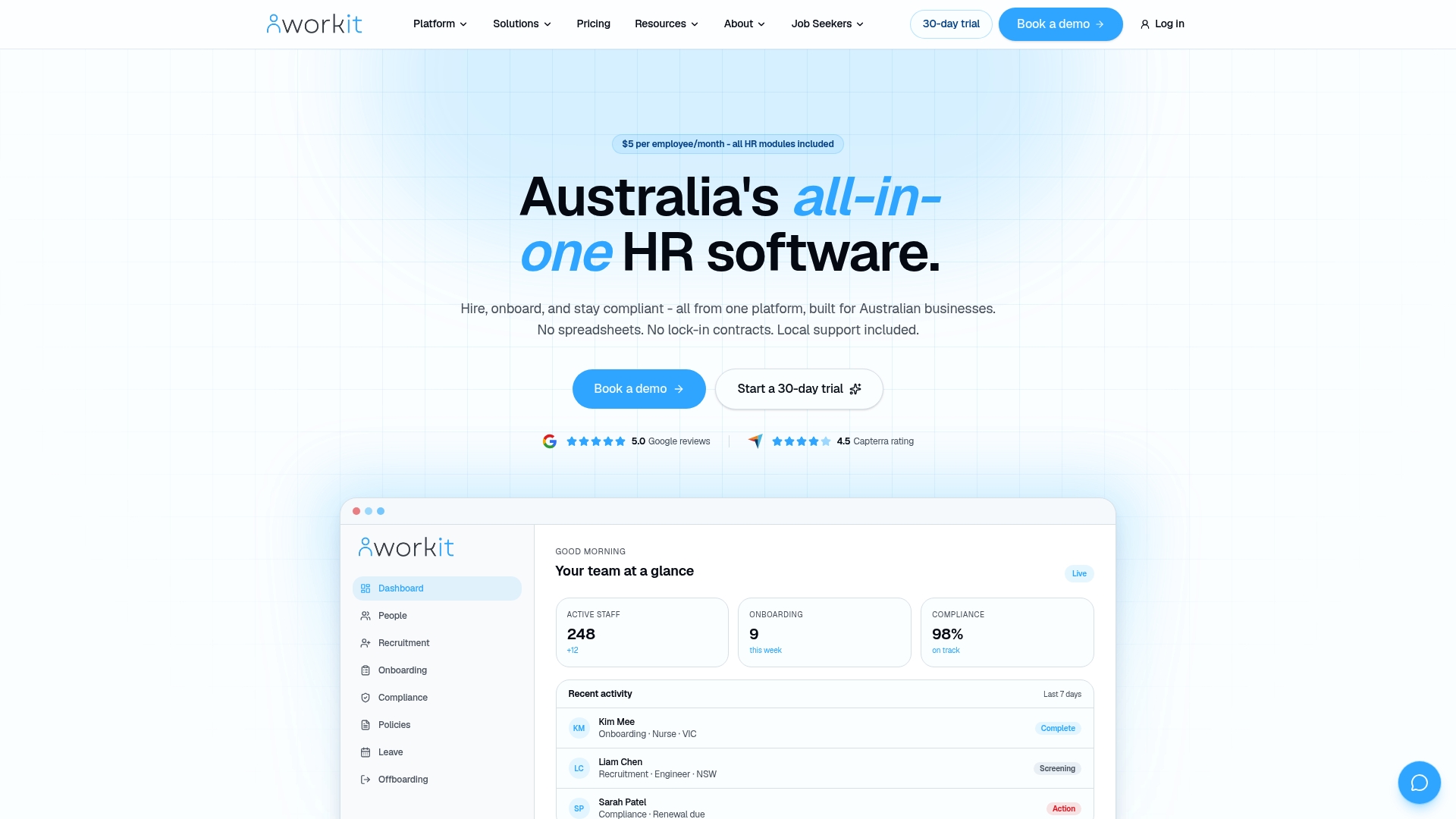
The demo is short, practical, and built around your business. Bring a sample of your employee data, your current payroll setup, and a list of the compliance scenarios that keep you up at night. The Workit team will show you STP Phase 2 reporting, Xero payroll sync, and the onboarding flow in a single session.
Payroll and finance stakeholders are welcome — in fact, bring them. The questions they ask during a demo are the ones that matter most when you are deciding whether to switch.
Book your Workit demo and see why Australian businesses are choosing a platform built for this market.
Useful sources and further reading
These are the authoritative sources used to build the recommendations in this guide. Each one is worth reading if you want to go deeper on a specific topic.
- ATO — STP Phase 2 employer reporting guidelines: The primary source for STP Phase 2 obligations. Read this before evaluating any vendor’s compliance claims.
- Gartner — BambooHR alternatives and competitors: Peer reviews and alternative recommendations from verified enterprise buyers.
- G2 — BambooHR reviews: User reviews covering feature gaps, support quality, and integration experiences.
- Capterra — BambooHR reviews: Verified buyer reviews with ratings across ease of use, features, and value for money.
- People Playbook — HRIS selection Australia: Sizing guidance for growing Australian businesses choosing between mid-market and enterprise platforms.
- Workit — How to choose HR software in Australia: A practical buyer guide covering vendor evaluation, compliance requirements, and implementation expectations for Australian organisations.
FAQ
Who are BambooHR’s main competitors in Australia?
BambooHR’s main competitors in Australia include locally built all-in-one platforms like Workit, global mid-market HRIS tools like HiBob and Employment Hero, payroll-first platforms like ADP Australia, and enterprise HCM suites like Workday. For most Australian businesses, a locally built platform with native STP Phase 2 and superannuation support is the stronger choice.
Is BambooHR suitable for Australian payroll compliance?
BambooHR was built for the US market and does not natively support STP Phase 2 or Australian superannuation handling. Australian employers using BambooHR typically need a separate payroll system, which introduces integration complexity and compliance risk.
What are the top HRIS systems for Australian businesses?
The strongest options for Australian businesses are local all-in-one platforms (such as Workit) for SMBs and mid-market teams, payroll-first platforms for payroll-heavy operations, and enterprise HCM suites for organisations above 500 employees. The right choice depends on company size, award complexity, and whether you need native payroll compliance or can manage a connector.
Is there a free HR software option for small Australian businesses?
Free options such as Zoho People’s free tier, OrangeHRM, and Bitrix24 exist for very small teams, but they typically lack native Australian payroll compliance and award interpretation. For most Australian businesses, the compliance risk of a free tool outweighs the cost saving, particularly once STP Phase 2 obligations apply.
How long does it take to migrate from BambooHR to a new HRIS?
For an SMB with 20–500 employees, a migration typically takes 2–8 weeks from scoping to go-live. The highest-risk moment is the payroll cutover; running a parallel payroll for at least one cycle before decommissioning the old system is strongly recommended.