

Local HR support in Australia: what SMEs need to get right
The fastest way for an Australian SME to get compliant, reliable HR support is a blended model: a fractional HR adviser working alongside Australia-aware HR software that centralises your records. This combination fits how small businesses actually operate.
- Compliance: It meets Fair Work record-keeping obligations without a full-time hire.
- Local knowledge: You get support from people who understand Australian awards, the National Employment Standards (NES), and how Fair Work actually audits businesses.
- Next step: Run a short compliance audit this week, then book a fractional HR consult or a software demo.
Key Takeaways
A blended model of fractional HR advice plus Australia-aware HR software gives Australian SMEs the fastest path to compliant, well-documented HR without full-time overhead.
| Point | Details |
|---|---|
| Blend fractional HR with software | Combine a fractional adviser for judgement calls with software for daily record-keeping and compliance tracking. |
| Watch for operational and regulatory triggers | Payroll errors, repeat escalations, and missing seven-year records signal it’s time to act. |
| Vet providers on Fair Work knowledge | Choose advisers and vendors who can demonstrate award expertise, audit trails, and local support, not generic templates. |
| Simplify processes before migrating | Document payroll, contracts, and leave workflows before moving them into any new system. |
| Workit offers a flat-rate local option | Workit provides all HR modules, including Xero integration and compliance tracking, for $5 per employee per month with Australian support. |
Table of Contents
- What local HR support actually looks like in Australia
- When should a small business get HR help?
- How do you choose the right local HR support?
- What do local HR support and software typically cost?
- Getting local HR support up and running
- Which employment laws actually shape your HR support?
- How does local HR support manage work health and safety compliance?
- How can local HR support improve engagement and retention?
- What role does local HR support play in dispute resolution?
- Why does cultural awareness matter in Australian HR?
- How does local HR support affect payroll and superannuation compliance?
- Get local HR support that’s built for Australian businesses
- Sources
- FAQ
What local HR support actually looks like in Australia
Local HR support isn’t a single thing. It comes in four practical shapes, and most growing businesses end up using a mix of them.
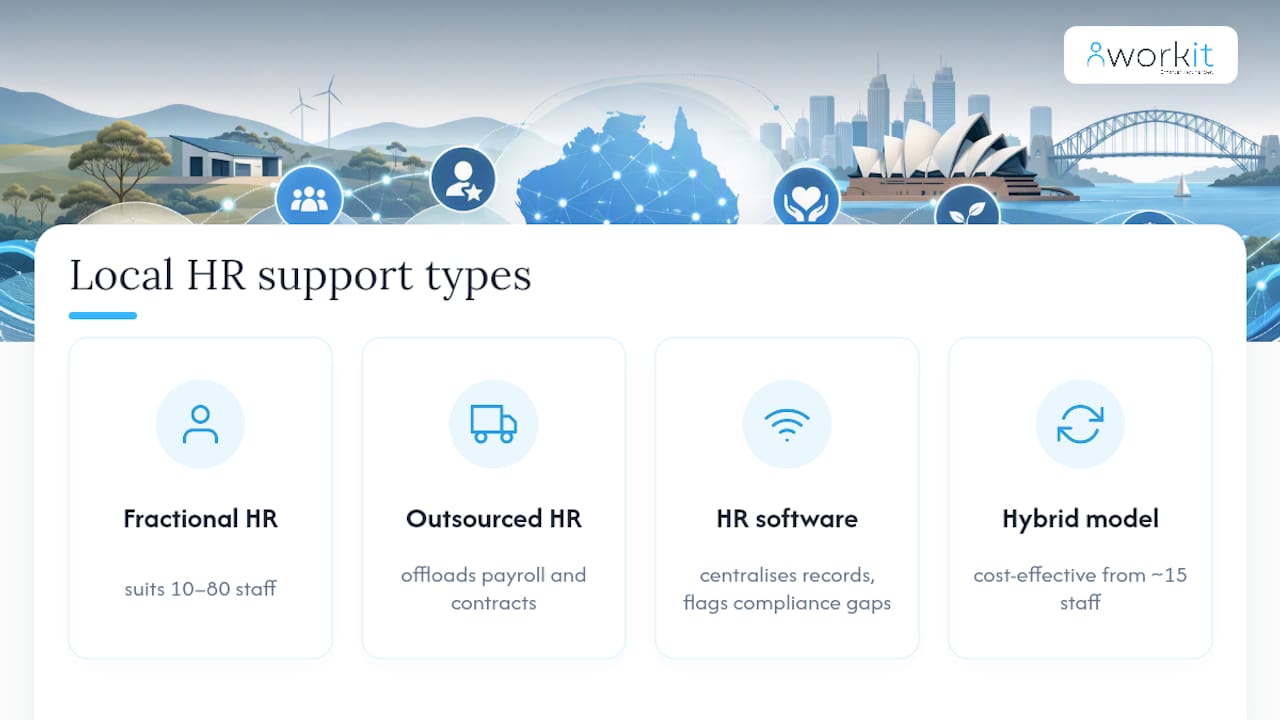
Fractional HR means hiring an experienced HR professional for a set number of days a month rather than a full-time salary. It suits businesses with 10 to 80 staff that need senior judgement on terminations, restructures, or award interpretation but not five days a week of it. Fractional support can cost around one-fifth of a full-time HR manager’s annual salary in typical arrangements.
Outsourced HR hands off transactional work: payroll processing, contract drafting, policy updates. You keep decision-making in-house but offload the admin grind. Outsourcing HR also gives SMEs access to specialist expertise they couldn’t otherwise afford.
HR software centralises employee records, generates compliant pay slips, tracks onboarding, and flags compliance gaps automatically. It doesn’t replace human judgement on tricky cases, but it stops basic record-keeping failures.
Hybrid models combine software for the daily grind with fractional or outsourced expertise for the judgement calls. This tends to be the most cost-effective setup once you pass about 15 employees.
Pro Tip: Don’t buy software and a fractional adviser separately without checking they talk to each other. Ask any adviser which platforms they already work in before you sign anything.
When should a small business get HR help?
Most Australian businesses wait too long. Here’s how to know when reactive HR has become a liability.
- Operational signs. Payroll errors keep recurring, the same manager keeps escalating the same type of conflict, or headcount has crossed 15 to 20 people and nobody owns HR as a defined role.
- Regulatory signs. You can’t produce seven years of pay records on request, an award review is coming up that you don’t fully understand, or you’ve had a Fair Work enquiry or an employee dispute land on your desk.
- The cost rule of thumb. If the time your leadership spends untangling HR problems each month exceeds what a fractional adviser or software subscription would cost, you’re already paying for HR support. You’re just paying for it badly, in owner hours and legal risk.
Businesses that shift to proactive, documented HR processes before a crisis hits tend to avoid the expensive version of this problem entirely.
How do you choose the right local HR support?
Picking an adviser, outsourced team, or software vendor comes down to a handful of concrete checks. Skip these and you risk paying for something that looks professional but doesn’t hold up under an audit.
What to look for:
- Demonstrated knowledge of the Fair Work Act and relevant modern awards, not generic HR theory
- Built-in record-keeping features that match the seven-year retention requirement
- Payroll integration, particularly with Xero, so data doesn’t need re-entering
- Documented response times and genuinely local support, not an overseas call centre reading from a script
- Clear audit trails for onboarding, performance, and termination documentation
Questions to ask before signing anything:
- Can you show me an example of how you’ve handled an unfair dismissal risk or underpayment issue?
- What’s your implementation timeline, and who owns data migration?
- How is pricing structured, and what happens if our headcount changes mid-contract?
- Where is our data stored, and who can access it?
- Can I speak to an existing client in a similar industry?
Red flags: vendors pushing US-style HR templates that ignore Australian awards, pricing that’s vague until you’re deep into a sales call, and no clear way to export or audit your own records. If a provider can’t explain how they’d handle a genuine Fair Work complaint, that’s your answer.
What do local HR support and software typically cost?
Cost shapes differ depending on which model you choose, and none of them are one-size-fits-all.
- Fractional HR is usually priced as a day rate or a monthly retainer, scaled to the days you need each month.
- Outsourced HR packages often bundle a set number of transactional tasks (contracts, policy updates, payroll support) into a flat monthly fee.
- HR software subscriptions are typically priced per employee per month. Workit, for example, runs a flat $5 per employee per month across every module, with no separate fee for compliance tracking, onboarding, or reporting.
In practice: a quick fix, like fixing pay slip generation or backfilling missing records, can often be sorted within a week or two. Full system implementation, including migrating historical records and retraining managers, more commonly takes four to eight weeks depending on headcount and how messy your existing data is.
Getting local HR support up and running
Before you migrate anything, simplify your processes. Vendors and advisers consistently flag the same mistake: businesses digitise a broken workflow instead of fixing it first, then wonder why the software feels clunky.
Before you migrate:
- Document your current payroll, contract, and leave approval processes, even roughly
- Identify which records are missing, outdated, or stored inconsistently across spreadsheets and email
- Decide who owns each HR process once the new system is live
During implementation:
- Migrate essential records first: contracts, pay history, and leave balances
- Turn on audit trails immediately, particularly for anything touching disciplinary action or termination
- Use onboarding templates rather than building new starter paperwork from scratch every time
Local support matters here more than most buyers expect. When your Xero integration throws an error at 4pm on a Friday before pay run, a support team that understands Australian payroll and answers in your time zone is worth more than a feature list.
Pro Tip: Never rely on AI-generated templates or offshore boilerplate for termination or disciplinary documentation without a human, Australian-aware review. Getting this wrong is one of the most expensive mistakes an SME can make.
Which employment laws actually shape your HR support?
Two pieces of legislation do most of the heavy lifting in Australian workplaces, and any local HR support you engage needs to be fluent in both.
The Fair Work Act 2009 sets the floor: minimum wages, the National Employment Standards, unfair dismissal protections, and the awards system that governs pay rates and conditions across most industries. It applies to private sector businesses of all sizes. Being small doesn’t exempt you from record-keeping or NES obligations, a misconception that catches out a lot of first-time employers.
Layered on top are federal and state anti-discrimination laws, covering protected attributes like age, sex, race, disability, and pregnancy across recruitment, promotion, and termination decisions. Getting this wrong in a job ad or a performance review can trigger a complaint regardless of business size.
Good local HR support translates these obligations into daily practice: award interpretation when you’re unsure which classification applies, NES-compliant leave calculations, and policies that don’t inadvertently discriminate. Fair Work’s own best practice guidance is a genuinely useful starting point, with free templates, calculators, and training modules built specifically for small employers.
The practical risk isn’t usually deliberate non-compliance. It’s businesses genuinely not knowing an obligation exists until an employee raises it, or Fair Work does.
How does local HR support manage work health and safety compliance?
Work health and safety sits under a separate legal framework from the Fair Work Act, but it’s just as central to what local HR support should cover. Each state and territory runs its own Work Health and Safety Act, all built on a largely harmonised model, which places a duty on employers to eliminate or minimise risks to workers so far as is reasonably practicable.
For small businesses, this plays out in three practical areas. First, incident reporting: documenting workplace injuries or near misses properly, not just informally noting them. Second, policy management: having current safety policies that staff have actually acknowledged, not a document buried in a folder from three years ago. Third, training records: proof that inductions and safety briefings happened, which matters enormously if an incident is ever investigated.

Local HR support earns its keep here by keeping these records current and accessible, rather than scattered across email threads and paper forms. A manager who can pull up an employee’s safety induction record in thirty seconds during a WorkSafe enquiry is in a very different position from one digging through filing cabinets.
This is also where software genuinely outperforms manual systems. Incident reporting modules, policy acknowledgement tracking, and automated reminders for expiring certifications reduce the chance that a safety gap sits unnoticed until it becomes a serious problem. It’s not glamorous work, but it’s the kind of thing that only matters until the day it really matters.
How can local HR support improve engagement and retention?
Retention problems rarely announce themselves. They show up as a slow drift of good people leaving for reasons nobody quite articulated in their exit interview.
Local HR support tackles this through a few concrete levers rather than vague culture initiatives. Structured onboarding is the first: employees who go through a genuinely organised first 90 days, with clear expectations and check-ins, settle in faster and stay longer than those handed a login and left to figure things out.
Regular, documented performance conversations matter more than annual reviews alone. Quarterly check-ins that actually get recorded give managers something to reference and employees a sense that feedback isn’t arbitrary. Leave and workload visibility also plays a bigger role than most owners assume. When a manager can see at a glance who’s been working unusually long hours or hasn’t taken leave in months, they can intervene before burnout drives someone out the door.
Local advisers add something software can’t: they understand what’s realistic for an Australian small business budget and can suggest engagement moves that don’t require a corporate wellness program. Sometimes it’s as simple as formalising flexible work arrangements that were previously ad hoc and inconsistently applied across the team, which itself can create resentment if handled unevenly.
What role does local HR support play in dispute resolution?
Workplace disputes rarely resolve themselves, and how they’re handled in the first 48 hours often determines whether they stay small or escalate into a Fair Work complaint.
Local HR support brings two things a business owner handling a grievance solo usually lacks: procedural distance and a documented process to follow, as expert advisers from Citation Group - Smarter Workplace Solutions often provide. An external fractional adviser can run an investigation without the emotional weight of being someone’s direct manager, which tends to produce a fairer outcome and a more defensible paper trail if the matter is ever challenged.
Practically, this means having a written grievance procedure before you need one, not drafting one mid-dispute. It means documenting every conversation, decision, and piece of evidence as you go, rather than reconstructing a timeline from memory weeks later. And it means knowing when a matter needs to go beyond an internal conversation, whether that’s mediation, a formal investigation, or involvement from the Fair Work Commission.
Businesses that skip this structure often make the underlying problem worse. An undocumented verbal warning, a termination decided in anger without proper process, or a grievance left to fester because nobody wanted an awkward conversation. These are the situations that turn into unfair dismissal claims, and they’re almost entirely preventable with a clear process and someone experienced enough to run it properly.
Why does cultural awareness matter in Australian HR?
Australia’s workforce is genuinely diverse, and HR practices that ignore this create friction that shows up in retention, engagement, and sometimes legal risk.
Culturally aware HR support means recruitment and onboarding processes that don’t inadvertently favour one background over another, policies that account for religious observance and cultural leave needs, and communication that doesn’t assume everyone reads workplace instructions the same way. It also means being genuinely accessible: Fair Work itself runs a Translating and Interpreting Service for workers who need information in a language other than English, a reminder that language barriers are a real, practical HR issue, not an edge case.
For small businesses, this often comes down to small, deliberate choices. Job ads written without unnecessary jargon or culturally loaded phrasing. Policies translated or explained clearly to staff who need it. Performance conversations that account for different communication styles rather than penalising people for not matching one cultural norm.
The payoff isn’t just ethical, it’s practical. Businesses that get this right tend to see broader talent pools, lower turnover among migrant and multicultural staff, and fewer discrimination complaints. Local HR support that understands the Australian context, rather than importing generic diversity frameworks from elsewhere, tends to build policies that actually fit the workforce in front of them.
How does local HR support affect payroll and superannuation compliance?
Payroll and superannuation errors are among the most common, and most expensive, compliance failures small businesses face. Underpayment claims and missed super guarantee contributions can trigger back-payments, penalties, and reputational damage well beyond the original error.
Local HR support reduces this risk in a few specific ways. Correct award interpretation ensures employees are classified and paid correctly from day one, rather than discovering a systemic underpayment years later. Automated compliance tracking flags when a pay run doesn’t match expected entitlements, catching errors before they compound across dozens of pay cycles.
Superannuation guarantee compliance is a particular pressure point, since rates and thresholds shift periodically and manual payroll systems are notoriously bad at catching changes in time. HR software with payroll integration, such as a direct Xero connection, closes this gap by keeping employee records and pay calculations in sync automatically rather than relying on someone remembering to update a spreadsheet formula.
There is a legal requirement for employers to retain pay slip and employment records, including superannuation records, for a significant period. A Fair Work fact sheet confirms this obligation covers hours worked, leave balances, and pay details, which means the businesses best placed to survive an audit are the ones who never had to scramble for records in the first place.
Author perspective: why small, early investments in HR pay off
Most small business owners treat HR as overhead until it becomes a fire. That’s backwards. A modest fractional HR engagement in the first quarter, paired with decent software, tends to surface two or three quiet compliance gaps that would have cost far more to fix after the fact. The businesses that get this right early spend less time firefighting and more time actually running the business.
— Stephen
Get local HR support that’s built for Australian businesses
Workit is the Australia-native alternative to piecing together spreadsheets, generic overseas software, and ad hoc advice. Every module, from onboarding and compliance tracking to leave management and Xero integration, comes included in one flat $5 per employee per month, with no hidden module fees and support from a local team that actually understands Fair Work obligations.
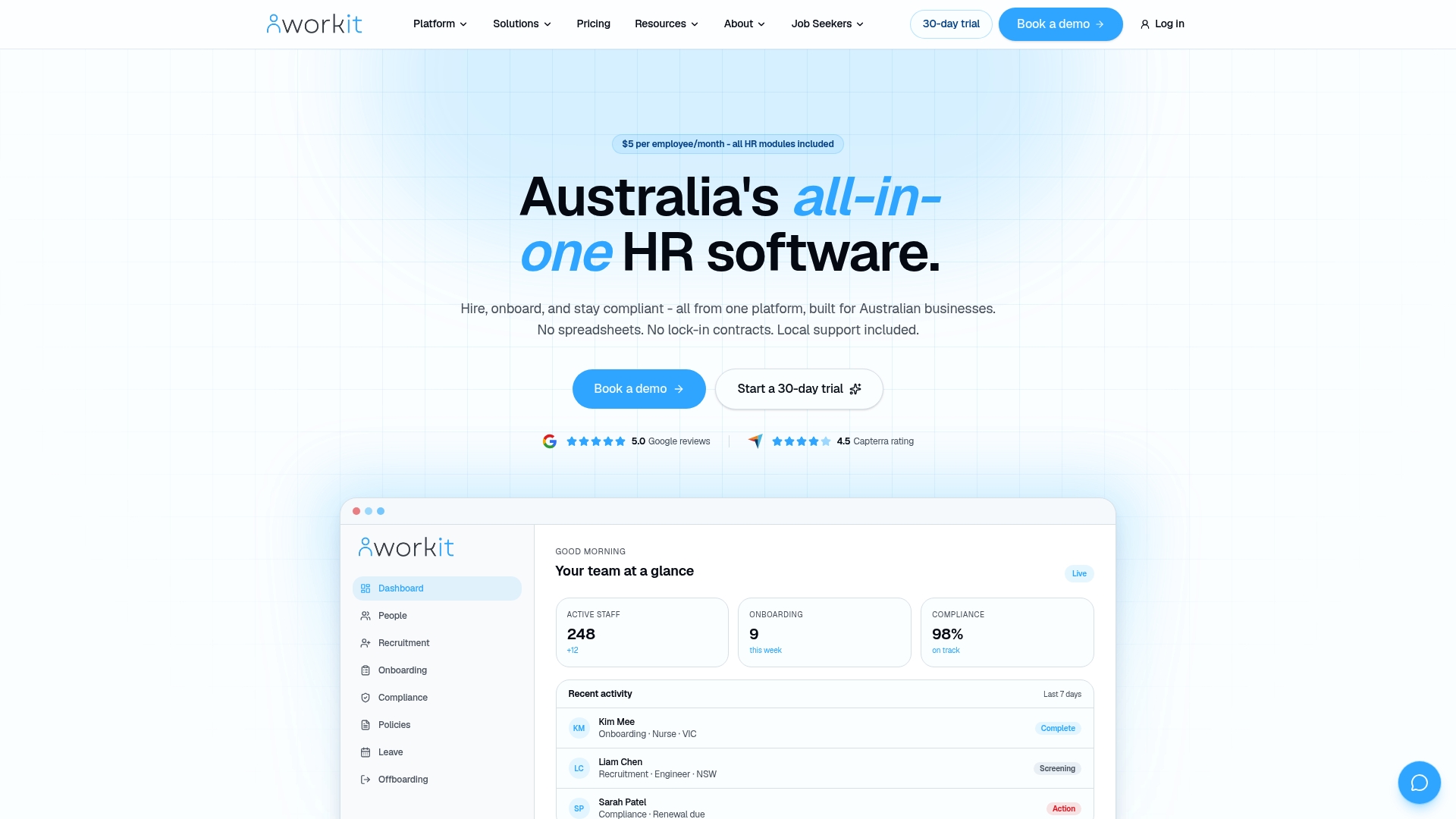
If you’re ready to move from reactive to proactive HR, start with a 30-day pilot on the platform and pair it with a fractional adviser for your first quarter to handle the judgement calls software can’t. It’s a practical way to get compliance tracking and local support in place without a long procurement process. You can book a demo to see how the modules fit your current setup, or explore the buyer guide to choosing HR software if you want to compare feature needs first. Either way, the next step is a conversation, not a contract.
Sources
For compliance detail, start with Fair Work’s record-keeping and pay slips fact sheet and its small business best practice guide. For implementation planning, Workit’s HR system implementation guide and workplace policies guide cover the practical steps in more depth.
- Small business, big HR gains: Why one day a week can transform your people function – HR Excellence Partners
FAQ
What is local HR support in Australia?
It refers to fractional HR advisers, outsourced HR services, and Australia-built HR software that help small businesses meet Fair Work obligations and manage staff without a full-time HR department.
How much does fractional HR cost in Australia?
Fractional HR is typically priced as a day rate or monthly retainer and can cost around one-fifth of a full-time HR manager’s salary, depending on the days of support needed.
How long does it take to implement HR software?
Quick fixes like pay slip corrections can be sorted in a week or two, while full implementation with record migration and manager training typically takes four to eight weeks.
Do small businesses have to keep employment records?
Yes. Under the Fair Work Act, employers must retain employment records for at least seven years and issue pay slips within one working day of payment, regardless of business size.
Does Workit include compliance tracking and Xero integration?
Yes. Workit includes compliance tracking, onboarding, and Xero integration in every plan at a flat $5 per employee per month, with no separate fees for individual modules.