

Personal leave in Australia: what employees and employers need to know
Full-time and part-time permanent employees in Australia are entitled to at least 10 days of paid personal/carer’s leave per year under the National Employment Standards (NES), as set out in section 96 of the Fair Work Act 2009. Casual employees do not receive paid personal leave, but they do have access to two days of unpaid carer’s leave per occasion. The Fair Work Ombudsman confirms this entitlement accrues progressively from day one and carries over year to year if unused.
Personal leave covers three core situations:
- Personal illness or injury — when you are too unwell or injured to work
- Caring for an immediate family or household member — when someone you live with or are close to needs care due to illness, injury, or an unexpected emergency
- Unexpected emergencies — affecting an immediate family or household member
The term “personal leave” is the umbrella name used in the Fair Work Act. In everyday workplaces, you will hear it called sick leave or carer’s leave depending on the reason for the absence. Both draw from the same 10-day balance.
Key takeaways
Australian permanent employees are entitled to at least 10 days of paid personal/carer’s leave per year under the NES, accruing progressively from day one and carrying over if unused, with payment at base rate only and no statutory payout on termination.
| Point | Details |
|---|---|
| Minimum entitlement | Full-time employees get 10 days (76 hours) paid personal leave per year; part-timers receive a pro-rata equivalent. |
| Progressive accrual | Leave accrues from day one at 1/26 of ordinary annual hours, not in a lump sum at the year anniversary. |
| Track in hours | Hours-based tracking in your HRIS prevents under- or over-deductions when rosters change or shift workers take leave. |
| Pay at base rate only | Personal leave is paid at the employee’s base rate for ordinary hours; overtime, penalty rates, and allowances are excluded. |
| No payout on termination | Accrued personal leave is not paid out when employment ends unless an award or contract specifically provides for it. |
| Workit for compliance | Workit automates hours-based accrual, Xero payroll integration, and audit reporting to keep leave management NES-compliant. |
Table of Contents
- Who is eligible for personal leave in Australia?
- When can you take personal leave?
- How personal leave accrues and how to calculate it for shift workers
- What notice and evidence can employers reasonably ask for?
- How personal leave is paid, and how it interacts with public holidays and termination
- Compassionate leave and family and domestic violence leave: how they differ
- Employer compliance checklist: common payroll and HR pitfalls
- Where to get help and how to resolve a leave dispute
- Workit makes leave compliance straightforward for Australian employers
- Sources
- FAQ
Who is eligible for personal leave in Australia?
Eligibility turns on your employment type, and the rules differ meaningfully between permanent and casual employees.
Full-time employees receive the full 10-day entitlement per year. A standard 38-hour week translates to 76 hours of paid personal leave annually.
Part-time employees receive the entitlement on a pro-rata basis, calculated against their ordinary hours. A part-timer working 20 hours per week accrues leave at the same fractional rate as a full-timer, just applied to fewer hours. The result is proportionally fair: fewer hours worked means fewer hours accrued, but the rate is identical.
Casual employees sit outside the paid personal leave system entirely. They cannot access the 10-day paid entitlement. What they do have is the right to two days of unpaid carer’s leave per occasion when a family or household member needs care due to illness, injury, or an unexpected emergency.
One nuance worth knowing: awards, enterprise agreements, and individual contracts can improve on the NES minimum, but they cannot go below it. An employer offering 15 days of personal leave under an enterprise agreement is perfectly lawful. An employer trying to offer eight days is not. Always check the applicable modern award or enterprise agreement first, because some industries carry more generous entitlements than the NES baseline.
When can you take personal leave?
Section 97 of the Fair Work Act sets out the permitted reasons, and they are deliberately broad. You can take paid personal leave when:
- You are not fit for work because of a personal illness or injury (including mental health conditions)
- A member of your immediate family or household needs care or support due to illness, injury, or an unexpected emergency
- An unexpected emergency affects an immediate family or household member
Practical scenarios that clearly qualify include your own flu or surgery recovery, a child’s sudden illness requiring you to stay home, a parent’s medical appointment where you are the carer, or a household emergency that leaves a dependent without care. Pregnancy-related illness also qualifies as a personal illness.
There is no statutory minimum or maximum for a single period of leave. You can take one hour or three weeks, provided you have the accrued balance to cover it. Employees sometimes assume they can only take leave in full-day blocks. That is not correct. Leave can be taken in any increment, including part-days, as long as the employer’s payroll system can handle it.
Compassionate leave is separate. When an immediate family or household member dies or suffers a life-threatening illness or injury, employees are entitled to two days of compassionate leave per occasion. This does not come out of the personal leave balance. It sits alongside it as a distinct NES entitlement.
How personal leave accrues and how to calculate it for shift workers
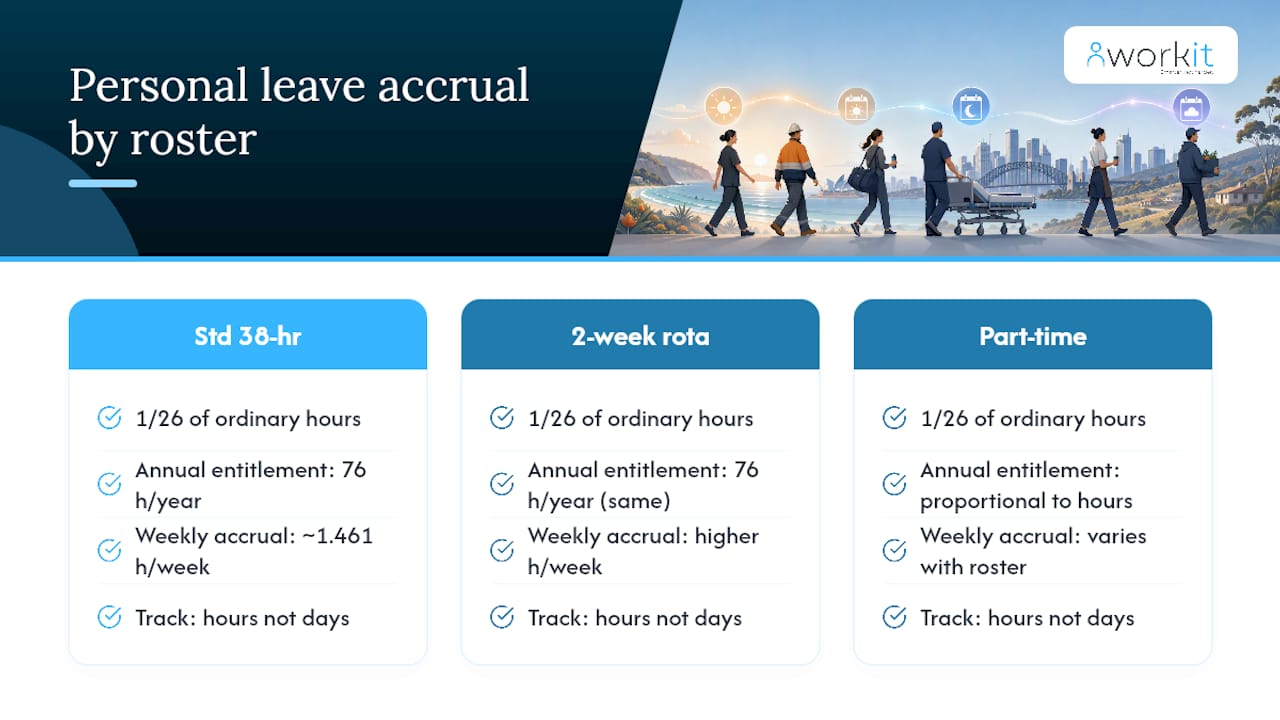
Leave accrues progressively from the first day of employment, not in a lump sum at the start of each year. The formula under the Fair Work Act is 1/26 of an employee’s ordinary hours worked in a year. For a standard 38-hour full-time week, that produces 76 hours of personal leave annually, or approximately 1.461 hours per completed week.
Accrual continues while an employee is on paid leave (annual leave, long service leave, paid personal leave) but pauses during unpaid leave periods. HR systems need to be configured to handle this automatically, otherwise year-end reconciliations become a manual headache.
The table below shows how the formula plays out across common roster types.
The two-week rotating shift example is worth pausing on. The annual entitlement in hours is the same as a standard full-timer because the total ordinary hours across the year are the same. The difference is the accrual rate per week, which is higher to match the compressed roster.
Pro Tip: Track leave in hours, not days, in your HR and payroll system. When a shift worker’s roster changes, a “day” of leave means something different from one fortnight to the next. Hours-based tracking removes the ambiguity and prevents both under-deductions and over-deductions when rosters vary. The Fair Work library’s guidance on leave calculation makes this point explicitly.
What notice and evidence can employers reasonably ask for?
Employees must notify their employer as soon as reasonably practicable when taking personal leave, and they must advise how long the absence is expected to last. “As soon as reasonably practicable” is not defined by a fixed time, but calling in before your shift starts is the standard expectation in most workplaces.
On evidence, the Fair Work Ombudsman’s fact sheet applies a “reasonable person” standard: documentation must be sufficient to convince a reasonable person that the employee genuinely needed the leave. A medical certificate from a GP is the most common form, but it is not the only acceptable one.
Acceptable evidence can include:
- A medical certificate or specialist’s letter
- A statutory declaration signed before a JP or authorised witness
- A pharmacy receipt or prescription for medication
- Visible injury that the employer can observe directly
- A hospital discharge summary
The key point for employers is that the standard is flexible, not prescriptive. Demanding a medical certificate for a single day’s absence every time, regardless of context, can create unnecessary friction and may not reflect what a reasonable person would actually require. Publishing a clear, written evidence policy removes ambiguity for both sides.
For employees who cannot get a certificate immediately (say, a weekend illness where the GP is unavailable), a statutory declaration is a practical alternative. Employers should communicate this option rather than leaving staff to assume a certificate is mandatory.
How personal leave is paid, and how it interacts with public holidays and termination
Paid personal leave is paid at the employee’s base rate for the ordinary hours they would have worked during the absence. Overtime, penalty rates, allowances, and bonuses are all excluded from the calculation. If an employee normally earns $30 per hour base rate but picks up penalty rates on weekends, the personal leave payment uses the $30 base rate only.
A few interactions trip up payroll teams regularly:
- Public holidays during personal leave: When a public holiday falls on a day an employee would normally work, and they are already on personal leave, they are not counted as being on personal leave for that day. They receive the public holiday entitlement instead. The personal leave balance is not deducted for that day.
- Workers’ compensation: When an employee is on workers’ compensation, they are generally not on personal leave at the same time. Some employers allow employees to top up workers’ compensation payments using personal leave to reach their full base pay, but this depends on the applicable award, enterprise agreement, or contract. Get advice specific to your situation before applying this.
- Termination: There is no statutory requirement to pay out accrued personal leave on termination. Unlike annual leave, unused personal leave does not convert to a termination payment unless an award, enterprise agreement, or individual contract specifically provides for it.
The practical payroll check: before processing any personal leave payment, confirm you are using the base rate only, check whether a public holiday falls within the period, and verify the employee’s ordinary hours for that period rather than assuming a standard week.
Compassionate leave and family and domestic violence leave: how they differ
These two entitlements are often confused with personal leave, but they are distinct NES categories with their own rules.
Compassionate leave gives permanent employees two days per occasion when an immediate family or household member dies, contracts a life-threatening illness, or sustains a life-threatening injury. Casual employees also receive this entitlement, though it is unpaid for casuals. Critically, compassionate leave does not reduce the personal leave balance. It is a separate entitlement.
Family and domestic violence (FDV) leave is a newer NES entitlement. Eligible employees receive 10 days of paid FDV leave in a 12-month period to deal with the impacts of family and domestic violence. This includes making safety arrangements, attending legal proceedings, or accessing support services. Like compassionate leave, FDV leave is separate from personal leave and does not draw down the personal leave balance.
A quick comparison:
- Personal/carer’s leave: 10 days paid per year, accrues progressively, carries over, covers own illness or caring for family/household members
- Compassionate leave: 2 days per occasion, no accrual, does not carry over, covers bereavement and life-threatening events
- FDV leave: 10 days paid per 12-month period, does not accrue in the same way as personal leave, covers family and domestic violence impacts
Casuals receive unpaid carer’s leave (2 days per occasion) and unpaid compassionate leave, but they do access paid FDV leave under the NES.
Employer compliance checklist: common payroll and HR pitfalls
Most Fair Work compliance issues around personal leave come down to a handful of recurring errors. Here is a practical checklist for HR managers.
- Confirm your contracts and awards sit at or above the NES. Check that employment contracts and applicable modern awards do not inadvertently set personal leave below 10 days. Awards can improve entitlements but cannot reduce them.
- Switch to hours-based leave tracking. Recording leave in days for shift workers or variable-roster employees is one of the most common NES defects the Fair Work Commission identifies. Hours-based tracking in your HRIS removes the ambiguity.
- Configure progressive accrual from day one. Accrual must start from the first day of employment, not the anniversary date. Anniversary-based accrual is a compliance risk and can result in back-pay liability.
- Set accrual to pause during unpaid leave. Accrual continues during paid leave periods but stops during unpaid leave. Your payroll system should handle this automatically based on leave status, not manual intervention.
- Exclude overtime and penalty rates from leave payments. Configure payroll to calculate personal leave at base rate only. A misconfigured rate that includes penalties will either overpay or underpay, both of which create audit exposure.
- Handle public holidays correctly during leave periods. When a public holiday falls within a personal leave period, the employee should be paid the public holiday entitlement for that day, not have their personal leave balance deducted.
- Publish a clear evidence policy. Document what evidence you require, when you require it, and what alternatives are acceptable. Inconsistent evidence requests across managers create both legal risk and staff relations issues.
- Audit recent leave payments. Pull a sample of personal leave payments from the past 12 months and verify the rate used, the hours deducted, and whether any public holidays were handled correctly.
Pro Tip: Integrating your leave management with payroll removes most of these risks at the system level, as highlighted by the Payroll Export & Timesheets for Equipment Dealers feature from MDMS, which automates leave hours export to payroll. Workit’s leave management module tracks balances in hours, configures progressive accrual automatically, and syncs with Xero so leave payments use the correct base rate. Connecting your HRIS and payroll is one of the most effective ways to choose payroll software that integrates with your HRIS and eliminate manual reconciliation.
For a broader audit of your HR compliance posture, Workit’s guide on how to conduct an HR compliance health check walks through the full process step by step.
Where to get help and how to resolve a leave dispute
When a disagreement about personal leave arises, the escalation path is straightforward.
- Start internally. Raise the issue directly with your manager or HR team. Most disputes resolve at this stage when both parties understand the NES entitlement clearly.
- Check the applicable instrument. Review the modern award, enterprise agreement, or employment contract. The entitlement may be higher than the NES minimum, which changes the calculation.
- Lodge a formal grievance. If internal discussion does not resolve it, use your workplace’s formal grievance procedure. Document everything in writing from this point.
- Contact the Fair Work Ombudsman. The Ombudsman provides free advice and can investigate underpayment or adverse action claims. You can contact them at fairwork.gov.au or on 13 13 94.
- Apply to the Fair Work Commission. If the dispute remains unresolved, the Fair Work Commission can conciliate or arbitrate. This is the formal legal avenue for unresolved disputes.
On recordkeeping: employees should keep copies of any medical certificates, written leave requests, and employer responses. Employers should retain timesheets, leave records, and evidence documentation for at least seven years. Good records are the single most effective defence in any dispute, on either side.
If your situation involves a potential adverse action claim (being dismissed or disadvantaged for taking personal leave), seek legal advice promptly. The Fair Work Act includes specific protections against adverse action for exercising a workplace right, and time limits apply to general protections applications.
What HR managers see most often
The most common issue is not employers acting in bad faith. It is payroll systems configured years ago that nobody has audited since. Leave recorded in days for a workforce that now includes shift workers, accrual that only triggers on anniversary dates, and leave payments that include penalty rates because the rate was set up incorrectly at implementation. These are process failures, not deliberate underpayment, but the Fair Work Ombudsman treats the outcome the same way.
The small process change that fixes most of this is moving to an automated HRIS that tracks leave in hours and connects directly to payroll. When the system handles accrual, rate calculations, and public holiday interactions automatically, the margin for human error shrinks considerably. Disputes drop because the records are clean and the calculations are consistent.
Workit makes leave compliance straightforward for Australian employers
Keeping personal leave compliant under the NES is genuinely manageable when your systems do the heavy lifting. Workit’s HR compliance software tracks leave balances in hours from day one, applies progressive accrual automatically, and pauses accrual during unpaid leave without manual intervention. The Xero integration means leave payments flow through to payroll at the correct base rate, with overtime and penalty rates excluded by default.
For HR managers who have inherited a payroll setup they are not confident in, Workit’s audit reporting gives you a clear picture of current balances, recent payments, and any configuration gaps, without needing to pull spreadsheets together manually. At $5 per employee per month with all modules included, it is a practical option for businesses of any size. Book a demo at Workit to see the leave module in action.
Sources
- Sick and carer’s leave - Fair Work Ombudsman
- FAIR WORK ACT 2009 - SECT 96 Entitlement to paid personal/carer’s leave
- National Employment Standards | Fair Work Commission
This article is general information, not a substitute for advice from a qualified lawyer. Consult a qualified legal professional about your own circumstances before acting on anything here.
FAQ
What reasons can I use personal leave for?
You can take paid personal leave when you are unwell or injured, when an immediate family or household member needs care due to illness or injury, or when an unexpected emergency affects a family or household member. Mental health conditions qualify as a personal illness under the Fair Work Act.
Does personal leave get paid out when I leave a job?
No. Unlike annual leave, accrued personal leave is not paid out on termination under the NES. The only exception is if your modern award, enterprise agreement, or individual employment contract specifically provides for a payout, which is uncommon.
What is the difference between annual leave and personal leave?
Annual leave is for rest and recreation and is paid out on termination; personal leave covers illness, injury, and caring responsibilities and is not paid out when employment ends. Both accrue progressively, but they are separate balances under the NES.
Can my employer ask for a medical certificate every time I take personal leave?
Employers can request reasonable evidence, but the standard is what would satisfy a reasonable person, not a mandatory certificate every time. A statutory declaration, pharmacy receipt, or other supporting documentation can also satisfy the evidence requirement depending on the circumstances.
How does Workit help employers manage personal leave compliance?
Workit tracks leave balances in hours, applies progressive accrual from day one, and integrates with Xero to process leave payments at the correct base rate. Its audit reporting helps HR teams identify configuration gaps before they become back-pay liabilities.