

Probation period Australia: what employers and employees must know
A probation period in Australia is a contractual trial at the start of employment. It does not remove statutory entitlements or workplace protections. From day one, employees keep their National Employment Standards (NES) rights, superannuation contributions, and protections against adverse action, regardless of what the contract says about probation. According to the Fair Work Ombudsman, probation is commonly set between three and six months, but the Fair Work Act itself does not define the term.
Three things every employer and employee should know immediately:
- Check your contract and applicable modern award. The contract sets the probation length; the award or enterprise agreement sets the floor for pay, notice, and conditions.
- Understand the minimum employment period (MEP). The MEP, not the contractual probation period, determines when an unfair dismissal application becomes available.
- Document every review. Scheduled check-ins with written notes are the single most effective way to protect both parties if the employment ends during probation.
Key takeaways
Probation in Australia is a contractual trial period that operates within the Fair Work Act’s full protections, not outside them; every employer and employee should understand the MEP threshold and document every review from week one.
Table of Contents
- What does a probation period in Australia actually mean?
- How long does probation usually run, and how does the MEP differ?
- Which entitlements still apply during probation?
- How does ending employment during probation work?
- Best practice for employers: setting up and managing probation
- What employees should do to protect their position during probation
- How to extend probation, and how to handle a failed outcome
- What to include in a probation clause in the employment contract
- How Workit helps employers manage probation from day one
- Does probation affect superannuation and other statutory benefits?
- Do probation rules differ across Australian states or industries?
- Can employees request flexible working arrangements during probation?
- How probation applies to casual versus permanent employees
- The documentation habit that changes everything
- Workit makes probation management straightforward for Australian businesses
- Sources
- FAQ
What does a probation period in Australia actually mean?
Probation is a contractual assessment window, not a separate category of employment under Australian law. The Fair Work Act 2009 does not use the word “probation” at all. What it does set are minimum standards that apply to every employee from the first day of work, whether or not they are on probation.
Employers use probation to assess whether a new hire meets the role’s requirements before the employment relationship becomes more entrenched. That is a legitimate purpose. The mistake many employers make is treating probation as a legal shield that reduces their obligations. It does not. Modern awards and enterprise agreements continue to apply in full. If your award specifies a minimum notice period, that minimum applies during probation. If your agreement provides for a particular redundancy entitlement, that entitlement does not disappear because the employee is still in their first three months.
The Fair Work Ombudsman’s probation guidance is clear: probation is a common and lawful practice, but it operates within, not outside, the existing legal framework. Employers who treat probation as a free pass to ignore award conditions or NES entitlements expose themselves to underpayment claims and general protections complaints.
How long does probation usually run, and how does the MEP differ?
Most Australian employers set probation for a period typically lasting several months. Senior or specialist roles occasionally carry longer periods, though anything beyond six months is uncommon and worth reviewing carefully against the MEP thresholds below.
The minimum employment period is a statutory concept under the Fair Work Act, and it is entirely separate from whatever probation length appears in the employment contract. The Fair Work Commission explains it this way: the MEP is the threshold an employee must cross before they can lodge an unfair dismissal application. It is not something an employer can extend by writing a longer probation clause into the contract.
Under the Fair Work Act, the minimum employment period before an employee may access unfair dismissal remedies is six months for larger employers and twelve months for small businesses. The contractual probation period does not alter this statutory threshold. Plan your reviews accordingly, and do not assume a longer probation clause buys you more time under the Fair Work Act’s unfair dismissal provisions.
Key figure: Employees of businesses with many staff can apply for unfair dismissal after meeting the statutory minimum employment period, regardless of any probation clause.
Which entitlements still apply during probation?
Every permanent employee retains their full NES entitlements from the first day of work. Probation changes nothing about that. The entitlements that apply immediately include:
- Minimum pay rates set by the applicable modern award or enterprise agreement (or the national minimum wage if no award applies).
- Superannuation contributions at the legislated rate, payable from the first eligible pay period.
- Maximum weekly hours (38 ordinary hours plus reasonable additional hours).
- Annual leave accrual at four weeks per year of service for full-time permanent employees, accruing progressively.
- Personal/carer’s leave accrual at 10 days per year for full-time permanent employees.
- Parental leave entitlements where the employee meets the relevant service threshold (generally 12 months, so this rarely arises during a standard probation, but the right exists).
- Protection from adverse action and unlawful discrimination from day one, with no qualifying period.
Casual employees do not accrue annual or personal leave but receive a casual loading as compensation in lieu of leave entitlements; this applies regardless of probation status.
Pro Tip: Before finalising any employment contract, check the applicable modern award on the Fair Work Ombudsman’s Pay and Conditions Tool. Award notice periods and conditions can override contract terms that are less favourable to the employee.
How does ending employment during probation work?
Ending employment during probation is lawful, but it must follow the correct process. The NES sets minimum notice periods based on length of service. For employees with less than one year of service, the minimum notice period is typically set at one week, subject to applicable awards and contracts. The employment contract or applicable award may require more notice than the NES minimum; whichever is greater applies.

Employers can pay in lieu of notice rather than requiring the employee to work out the notice period. Final pay must include all accrued but untaken annual leave, any outstanding wages, and any other entitlements owed under the award or contract. Superannuation contributions must be paid on all ordinary time earnings up to the date of termination.
The critical risk during probation is not unfair dismissal. Before the MEP is reached, an employee generally cannot bring an unfair dismissal claim. What they can do, from day one, is bring a general protections (adverse action) claim if they believe the dismissal was motivated by a protected attribute or activity, such as exercising a workplace right, making a complaint, or a protected characteristic like pregnancy or union membership. These claims carry no qualifying period and can be costly.
A lawful termination during probation should include written notice stating the last day of employment, confirmation of final pay entitlements, and a clear, documented reason for the decision. Keep the termination letter factual and brief. Avoid language that could be read as discriminatory or retaliatory.
Best practice for employers: setting up and managing probation
A well-run probation process protects the employer, supports the employee, and produces a clear record if the employment ends. The Victorian Chamber of Commerce and Industry notes that employers who delay documentation until the final week of probation often lack the contemporaneous evidence needed to justify termination decisions. The fix is straightforward: schedule reviews from the start and write notes at each one.
Here is a practical framework:
-
Embed probation terms in the employment contract before the start date. Specify the length, review dates, notice period during probation, and the extension process. Check award coverage using the modern awards guide before finalising the contract.
-
Conduct a structured week-one induction. Cover role expectations, KPIs, reporting lines, and the review schedule. Confirm the employee has received and read the relevant policies.
-
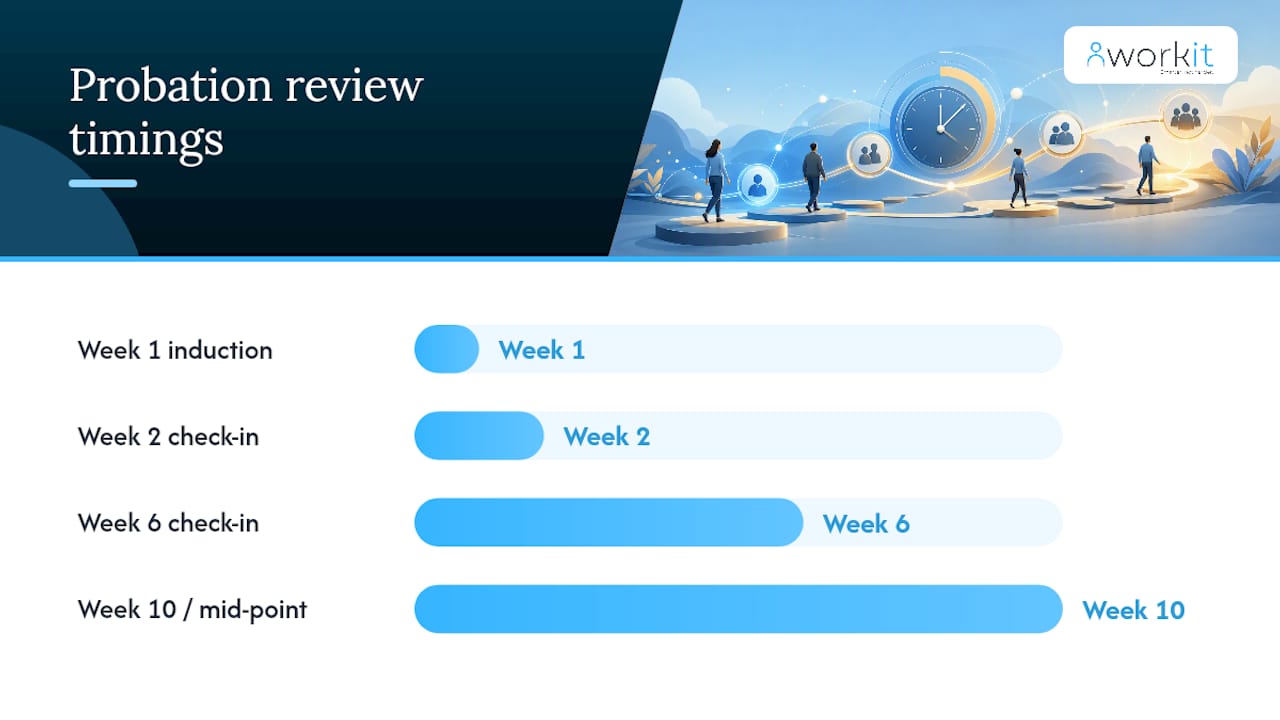
Schedule check-ins at weeks 2, 6, and 10 (or equivalent milestones for a three-month probation). Each meeting should cover performance against KPIs, any training provided, concerns from either side, and agreed actions with deadlines.
-
Write notes at every check-in. Record the date, who attended, what was discussed, any agreed actions, and the employee’s response. Both parties should sign or acknowledge the notes.
-
Conduct a formal mid-probation review at the halfway point. This is the right time to address any emerging performance issues, not the final week.
-
Complete a formal end-of-probation review at least one week before the probation period ends. Decide: confirm employment, extend by agreement, or end employment with proper notice.
-
Store all documentation centrally. Notes, signed review forms, training records, and any performance improvement plans should be accessible and timestamped.
The table below shows what to record at each review stage:
| Review stage | What to document |
|---|---|
| Week 1 induction | Role expectations, KPIs, policies received, induction checklist signed |
| Week 2 check-in | Early observations, any concerns, agreed support or training |
| Week 6 check-in | Progress against KPIs, training completed, any issues raised and actions agreed |
| Week 10 / mid-point | Formal performance summary, written feedback, improvement goals if needed |
| End of probation | Final assessment, outcome decision, signed confirmation or termination notice |
A structured onboarding process that feeds directly into the probation review schedule makes this significantly easier to manage consistently across your workforce.
What employees should do to protect their position during probation
Probation is a two-way assessment. You are evaluating the role just as much as the employer is evaluating you. Knowing your rights and keeping your own records puts you in a much stronger position if anything goes wrong.
- Read your contract carefully before you start. Confirm the probation length, notice period, and review schedule. If anything is unclear, ask in writing before your first day.
- Confirm your KPIs in writing at the start. If the employer has not provided written performance expectations, request them at your week-one induction.
- Request feedback at every check-in. Do not wait for the formal review. If you have concerns about your performance or the role, raise them early.
- Keep your own dated notes. After every meeting or significant conversation about your performance, write a brief summary and save it somewhere outside the employer’s systems.
- Know your NES entitlements. You are entitled to minimum pay, leave accrual (if permanent), and superannuation from day one. If you believe any of these are not being met, contact the Fair Work Ombudsman directly.
If you choose to resign during probation, you are still required to give the notice specified in your contract or award, whichever is greater. Your final pay must include all accrued annual leave and any outstanding wages. You are not entitled to a shorter notice period simply because you are still in probation.
Pro Tip: If you receive a performance improvement plan or any written warning during probation, keep a copy. Dated records of what was said, what was agreed, and what support was offered are your strongest protection if a dispute arises later.
For independent advice, the Fair Work Ombudsman’s helpline (13 13 94) is free and available to all employees. Union members can contact their union delegate. If you believe you have been dismissed for a discriminatory reason or in retaliation for exercising a workplace right, seek legal advice promptly as time limits apply to general protections claims.
How to extend probation, and how to handle a failed outcome
Extending a probation period is lawful when it is reasonable and properly documented. According to Scalesuite’s probation guidance, typical extensions run for one to three months and must be agreed in writing with clear improvement goals attached. An extension that is indefinite, repeated without genuine cause, or designed to delay the MEP threshold is likely to be challenged.
When an extension is appropriate:
- The employee has shown genuine effort but needs more time to meet a specific, measurable KPI.
- An unexpected absence (illness, family emergency) has interrupted the assessment period.
- A significant change in the role’s requirements has made the original assessment period less meaningful.
What the extension must include:
- Written agreement signed by both parties before the original probation period ends.
- A clear statement of the specific improvement goals and the timeline for achieving them.
- Scheduled review dates within the extension period.
- Confirmation of the notice period that applies during the extension.
Sample extension letter bullet points:
- State the original probation end date and the reason for the extension.
- Specify the new end date (no more than three months from the original end date as a general guide).
- List the specific performance goals the employee must meet, with measurable targets.
- Confirm the review date within the extension period.
- Note that all other terms and conditions of employment remain unchanged.
If probation is not being passed:
- Document the specific performance issues with examples and dates.
- Confirm that the employee was given clear feedback and a genuine opportunity to improve.
- Hold a final meeting before the decision is made; give the employee the opportunity to respond.
- Issue written notice of termination, including the last day of employment and final pay details.
- Arrange return of company property and revoke system access on the last day.
Sample termination letter bullet points:
- State that the probation period has been completed and the decision not to confirm employment.
- Give the reason in factual, non-discriminatory terms (e.g. “performance has not met the requirements of the role as discussed in reviews on [dates]”).
- Confirm the notice period and last day of employment.
- Detail final pay entitlements: accrued annual leave, outstanding wages, superannuation.
- Request return of company property and confirm any post-employment obligations (e.g. confidentiality).
What to include in a probation clause in the employment contract
A well-drafted probation clause removes ambiguity for both parties. Sprintlaw’s guidance on probation under the Fair Work Act confirms that the clause should be clear about length, review process, and notice requirements, and that awards and enterprise agreements still apply and can override contract terms that are less favourable to the employee.
Sample probation clause (adapt to your circumstances):
Must-have checklist for every probation clause:
- Probation length (specific dates or duration).
- Named manager responsible for reviews.
- Review dates or milestones.
- Notice period during probation (must meet or exceed the NES and award minimum).
- Extension process (written agreement, maximum extension length).
- Reference to applicable award or enterprise agreement.
- Statement that statutory rights are not affected.
Avoid “at-will” or “without reason” termination language. It does not override the NES, award conditions, or general protections provisions under Australian law, and it creates a false impression that can lead to disputes.
How Workit helps employers manage probation from day one
Managing probation well means having the right documents, the right reminders, and a clear audit trail. Workit’s onboarding software gives Australian employers a single platform to handle every step of the probation workflow without spreadsheets or manual follow-up.
Key features relevant to probation management:
- Contract templates with built-in probation clauses, ready to customise and send for e-signature before the employee’s first day.
- Automated check-in scheduling that triggers review reminders at the milestones you set (week 2, week 6, week 10, or any custom schedule).
- Centralised documentation so every review note, signed form, and performance record is stored in one place and timestamped.
- Performance review forms that can be completed by the manager and employee, with acknowledgement tracking.
- Award-check reminders to flag when a modern award condition may affect notice or pay during probation.
- Offboarding workflows for when employment ends, covering final pay checklists and property return.
A typical Workit probation workflow: create the employment contract with the probation clause in Workit, trigger the onboarding checklist on day one, receive automated reminders for each check-in, log notes directly in the platform, and generate an extension or termination letter from a template when the outcome is decided. Every step is documented and auditable.
Pro Tip: Use Workit’s performance review module to set KPIs at the start of probation and track progress against them at each check-in. Having a dated, signed record of agreed goals is your strongest protection if a general protections claim is made later.
Does probation affect superannuation and other statutory benefits?
Superannuation contributions are not affected by probation status. Employers are required to pay the legislated superannuation guarantee rate on all ordinary time earnings from the first eligible pay period, regardless of whether the employee is in a probationary period. There is no waiting period for super.
Other statutory benefits work the same way. Workers’ compensation coverage applies from the first day of employment in every Australian state and territory. If an employee is injured at work during probation, they have the same rights to make a claim as any other employee. Payroll tax obligations for the employer also apply from the first payroll run, with no probation exemption.
For employers managing superannuation compliance across a growing workforce, AI-assisted superannuation research tools are increasingly used by HR and finance teams to stay current with legislative changes, particularly for businesses with complex fund arrangements.
One area where probation can have an indirect effect is salary packaging or benefits that the employer has structured as discretionary (for example, a performance bonus tied to confirmed employment). If the contract specifies that a particular benefit only commences after probation is confirmed, that is generally enforceable, provided the benefit is not an NES entitlement or award condition. Always check the award before treating any benefit as discretionary.
Do probation rules differ across Australian states or industries?
The core framework for probation in Australia is federal. The Fair Work Act and NES apply to the vast majority of private sector employees across all states and territories. State-based industrial relations systems apply only to a small group of employers, primarily state public sector employees in Western Australia and some other state government entities.
Within the federal system, the differences that matter are not geographic but industry-specific, driven by modern awards. The award that covers your industry sets the floor for pay, notice, and conditions during probation. A retail employee covered by the General Retail Industry Award has different minimum notice requirements than a professional covered by the Professional Employees Award. The probation clause in the contract must meet or exceed whichever award applies.
Some industries with higher regulatory requirements, such as finance, aged care, and childcare, may impose additional pre-employment checks or licensing conditions that affect how probation is structured. A financial services firm, for example, may require ASIC-related background checks to be completed before or during probation. These are industry-specific compliance requirements layered on top of the standard probation framework, not replacements for it.
State-based differences in workers’ compensation schemes, long service leave entitlements, and payroll tax thresholds can also affect the total cost of employment during probation, even though the probation rules themselves are federal.
Can employees request flexible working arrangements during probation?
The right to request flexible working arrangements under the NES applies to employees who have completed 12 months of continuous service with the employer. That threshold means most employees on a standard three-to-six-month probation period do not yet have the statutory right to request flexibility under the NES.
That said, employers are not prohibited from agreeing to flexible arrangements during probation. Many do, particularly for roles where remote or hybrid work is standard practice. If a flexible arrangement is agreed during probation, it should be documented in writing to avoid ambiguity about what was agreed and when.
Employees with a disability, a carer responsibility, or another protected attribute may have additional rights under anti-discrimination law that apply regardless of their length of service. If an employee raises a need for a reasonable adjustment during probation, the employer should treat it as a workplace adjustment request under the applicable state or federal anti-discrimination framework, not simply as a flexible work request. Refusing a reasonable adjustment without genuine consideration can give rise to a discrimination complaint, which carries no qualifying period.
How probation applies to casual versus permanent employees
Probation is most commonly used for permanent employees, both full-time and part-time. For casual employees, the concept works differently in practice.
A casual employee does not have guaranteed ongoing hours, so the “trial” element of probation is somewhat built into the casual arrangement itself. Employers can simply not offer further shifts if a casual employee is not meeting expectations, without the same notice and documentation obligations that apply to permanent employees. However, adverse action protections still apply to casuals from day one. Dismissing a casual employee (by ceasing to offer shifts) in retaliation for exercising a workplace right, making a complaint, or a protected attribute is still unlawful.
Casual employees who have worked regular and systematic hours for 12 months now have access to the casual conversion pathway under the NES, which gives them the right to request conversion to permanent employment. This is a separate process from probation, but it is worth noting that a casual employee who converts to permanent employment does not then go through a new probation period unless the contract explicitly provides for one.
For permanent employees, the probation period is the formal assessment window. Once it ends (or once the MEP is reached, whichever comes first), the employee’s position becomes more protected. Planning the end-of-probation review well before the MEP milestone is one of the most practical steps an employer can take to manage risk.
The documentation habit that changes everything
The single most common mistake employers make during probation is treating it as a passive waiting period rather than an active management process. By the time a performance issue becomes undeniable, the probation period is often nearly over, and the employer has no contemporaneous documentation to support a termination decision.
The fix is not complicated. Schedule the check-ins before the employee starts. Write brief notes at every meeting. Share those notes with the employee and ask them to acknowledge receipt. That habit, applied consistently from week two, produces a clear, dated record of what was discussed, what was agreed, and what support was offered. If the employment ends and a general protections claim follows, that record is the difference between a defensible position and an expensive settlement.
The Victorian Chamber’s best-practice guidance makes the same point: early, scheduled check-ins and contemporaneous notes are the most effective risk-reduction tool available during probation. Not a longer probation clause. Not a more detailed contract. Notes, written at the time, signed by both parties.
Workit makes probation management straightforward for Australian businesses
Probation management done properly takes time, consistency, and the right tools. Workit gives Australian HR teams and business owners everything they need in one platform, at $5 per employee per month with no hidden fees and no module lock-outs.
With Workit, you can set up a probation workflow before the employee’s first day, automate check-in reminders, log review notes, and generate compliant letters from templates, all without touching a spreadsheet. The platform integrates with Xero for payroll, so final pay calculations and super obligations are handled in the same system.
- Onboarding and contract templates with built-in probation clauses, ready for e-signature.
- Automated review scheduling so no check-in is missed and every milestone is documented.
- Centralised HR records with timestamped notes and signed acknowledgements for every review.
Book a demo to see how Workit handles the full probation workflow, from contract to confirmation or offboarding.
Sources
- Probation - Fair Work Ombudsman
- Probation Periods Under the Fair Work Act | Sprintlaw Australia
- Probation at work: Best-practice approaches | Victorian Chamber of Commerce and Industry
- What is the minimum employment period? — Fair Work Commission
- Probation Periods in Australia 2026: Legal Rules, Notice Periods, and What Employers Get Wrong
FAQ
Can I be fired during my probation period?
Yes. An employer can end employment during probation with proper notice or payment in lieu. Before the minimum employment period is reached (6 months for larger employers, 12 months for small businesses), an employee generally cannot bring an unfair dismissal claim, but adverse action and discrimination protections apply from day one.
Can I resign during my probation period?
Yes. Resigning during probation is straightforward, but you must give the notice period specified in your contract or applicable award, whichever is greater. Your final pay must include all accrued annual leave and any outstanding wages.
Is a probation period always six months in Australia?
No. Six months is common but not mandatory. Employers set their own probation length in the employment contract; three months is also widely used. The six-month figure is significant because it is the MEP threshold for unfair dismissal eligibility at larger employers, but the contractual probation period and the MEP are separate things.
Can probation be extended?
Yes, but only by written agreement with the employee and only when the extension is tied to specific, measurable improvement goals. Extensions typically run for one to three months. An indefinite or repeated extension without genuine cause is likely to be challenged.
What happens to my superannuation during probation?
Superannuation contributions are payable from your first eligible pay period, with no waiting period for probation. The legislated superannuation guarantee rate applies to all ordinary time earnings from day one, regardless of your probation status.